Thursday, June 27, 2013

Changing NewSpeak

A few days ago AVI pointed to an article about Europe and noted that the way people thought even 50 years ago isn't the same as the way we think today, even when the words are the same.

Words are slippery things. I think Confucius was right: you have to get the names of things right if you propose to accomplish anything important. "Freedom from want" is security, which is in tension with liberty, but the phrase has the word "freedom" in there, so it must be about liberty, right? Sort of, in some situations. But not in general.

Artists like to think they set the direction of the culture; that they can change the world. This kind of hubris is irritating, all the more so since it is often true, and still more so when the changes they invoke are for the worse. Barzun's From Dawn to Decadence description of the last century (1890's to 1990's) included familiar and (to me) unfamiliar names who aimed to overthrow Western culture and replace it with solipsism or nihilism. And, as Francis Schaeffer also described, they did. He attributed the initial change to philosophers and Barzun does not, but aside from that the progress of the ideas from the ambitions of a few artists to filling pop culture looks the same in both.

In the process a lot of words changed meaning. The denotation of "respectability" is still mostly there, but the connotation is now one of hypocrisy. We still have the fact: we respect some people because they live out good character and others because they do the fashionably respectable (usually "green") sorts of things--no change there. But we wouldn't call them respectable, because that's rather insulting.

We had one word "respectability" doing duty for several meanings: "worthy of respect" and "appearing worthy of respect". A little concentrated focus on the latter colors the meaning of the first. Combine this with claims that "authenticity" matters more than rules of behavior (Does exercising self control make you a hypocrite?) and efforts to improve yourself start to sound unhealthy.

Picking out imprecise language is an easy game: politics relies on it, so does seduction, and other forms of advertising. It turns up in church too: I hate the loose description of an emotional high as a "spiritual experience", and similar shortcuts.

When the fuzzy terms are magical ("rights", "love", "democracy", "fairness") slight of hand makes it impossible to withhold support or enthusiasm. The "Arab Spring" was democratic, so it had to be good and you were bad if you expressed doubts.

Of course trying to translate your real meaning into the current vocabulary is fraught with problems. You're apt to find that the way the terms of the debate are framed leaves no room for any novelty, and your attempt at precision gets plugged into irrelevant categories. Ruggieri and Ricci had a hard time trying to translate Christian concepts into Chinese, because the philosophical and theological language didn't fit.

Jesus used parables that both illustrated his points and helped define his terms, as in the story of the good Samaritan. It isn't that hard to similarly illustrate and define precise language, but it has to be imbedded in something people will listen to. I wonder if there's a handy set of short illustrations that show the distinctions in the magic words. They probably take too long to use in any debate--I see instantaneous reaction to any questioning of magic words.

Wednesday, June 19, 2013

Clarification

I should not post late at night.

A few things might make the 4-quark post a little clearer.

Quantum mechanics assumes that an object can be described by a linear combination of states, where a state can be such things as:

  • an electron and a positron orbiting each other with a specific angular momentum
  • an up quark and an anti-up quark orbiting each other with that specific angular momentum
  • a neutrino and an anti-neutrino orbiting each other with that specific angular momentum
  • an electron and a positron and a photon, with the photon going between the two
  • a top quark and an anti-top quark orbiting each other with that specific angular momentum
  • a neutron and an anti-neutron orbiting each other ditto
  • other combinations that have the same quantum numbers (charge, angular momentum, etc)

The experienced reader will have noticed that the masses of these combinations seem a little disproportionate: the top quark is perhaps a hundred billion times heavier than a neutrino. Can it be in the same mix? Yes: but its contribution will be correspondingly tiny. Or if you want to try to interpret that statement, you might say something like: "It only exists a little bit there, or it only exists for a tiny amount of time."

Interpretations are controversial, and these are no exception. But one way to understand it goes like this. Particles that only exist for a small amount of time have (thanks to the Uncertainty Principle) some fuzziness in their energy. For a big fuzziness in energy/mass (being "off the mass shell"(*)) the particle can only exist for a proportionately tiny amount of time. (δE δT > h).

If a particle is unstable, it typically winds up in a final state based on one of those component states. If possible. One way to think of a positive pion (mass 140 MeV/c^2) is as a combination of a proton (mass 938 MeV/c^2) and an anti-neutron (mass 940 MeV/c^2). That is handy for describing some of its interactions, but you'll notice the mass numbers don't add up--it is the proverbial gallon of frogs in a pint jar--so it never decays into a proton and neutron. It doesn't decay into a positron and electron neutrino either, but instead into a positive muon and muon neutrino, but that's a topic for another day.


(*) The term "mass shell" comes from the description of the possible particle momenta in momentum 4-space (Px,Py,Pz,Energy). For a particle of known mass, the possible momenta are restricted to a 3-dimensional "cone" or shell in the 4-space. If there's fuzziness in the mass because of the Uncertainty Principle, the momentum can be away from that cone/shell: "off the mass shell."

Tuesday, June 18, 2013

4 quarks?

The description over at SciTech Daily of the new particle is pretty good. Go read it. The upshot is that it looks like there's a particle that is made of 4 quarks instead of 2 or 3. It isn't stable, of course, and its most striking decay mode (the one they detected) is to a charged pion and a J/psi particle. To reconstruct the mother particle mass you need the momenta of the daughters, and their identities. A J/psi decaying to two muons or two electrons is pretty easy to identify. The pion--well, it might be a kaon or a proton. So if they do the same as other groups do they tried all the different possibilities, and it turns out (in this case) that the pion hypothesis gives a clean mass peak and the others are washed out. The mass peak shown in the article is pretty tight, so there's not much wiggle room for a third undetected daughter particle.

In fact since the events occur at a known energy (they used a tuned e+e- collider) they can also look at the "Dalitz plot" which shows the mass-squared combinations of two pions and a J/psi. That's a handy way to look for structure, and they find it.

So what would 4 quarks (actually 2 quarks and 2 anti-quarks) look like? That's hard to say for sure. From the speed with which the pion and J/psi separate we know it isn't from a loosely bound system with the pion sort of orbiting the c/c-bar pair (charm and anti-charm).

As the article above says, low energy is harder to understand than high energy. That might seem odd, but imagine wooden blocks covered in velcro. At low speeds they may stick together in ways that are hard to describe, but at high speeds they bounce off each other, and at very high speeds they shatter in ways that are easily described.

The thing is too far off the mass shell to include a b-quark, since the lightest known b-meson is much heavier than the available energy. I have to run a few numbers, but this looks interesting. People have been looking for 4-quark states for quite a while.

Sunday, June 16, 2013

Risks and rewards

We call it foolish when a man undertakes a project where the risks outweigh the rewards. Sometimes we don't value the rewards he is striving for; such as when a boy takes a dare to climb the quarry wall. He is looking for peer approval and to prove that he can do it; but I don't look for affirmation from teenagers and I suspect that I can't climb anymore (and hope I never have to try).

Russian roulette is a fool's game: there's no reward at all and the risk is utter loss. Regular roulette more nearly balances risk and reward (but the house gets the edge). The risks of driving to work every day we call negligible (weather permitting) compared to the rewards of the work.

Let's look a bit closer at one aspect of that last case. There are two types of driving risk: those where someone or something else fails, and those where we break the rules ourselves, such as by being inattentive. The consequences of breaking the rules--trying to change lanes without checking all the mirrors or looking to see what's wrong with the radio instead of watching to road--are spectacular, and seem disproportionate to the apparently minor reward of arriving at work.

But without the potentially deadly speed of cars you likely wouldn't have the job at all. The speed and power of our transportation grid lets us employ and feed far more people than we could otherwise--you might not be alive at all without cars. We forget the real reward: you get to live. The risk is that you may suffer or die in an accident; the reward is commensurate with the risk.

There are major risks to breaking the 10 Commandments. Even neglecting eternity, murder is likely to get you dead too, and coveting tends to poison your enjoyment of what you have. God, being love, designed a system that will be better than fair. What are the rewards for following the rules that the stand against the punishments for breaking the rules? What happens when we recast these not in terms of the consequences, but (as with "honor your father and mother") in terms of the benefits?

Stealing destroys the time and effort of someone else. Every thing we have represents the time God gave us that we traded to get the thing. Giving, which I suppose we may take as the opposite of stealing, trades part of our lives to benefit someone else. It sounds like something you don't want to take lightly. If I'm going to trade a day of my all-too-short life to benefit someone else, I want that to be a serious benefit and not some cluttering knick-knack.

In 1Cor11:23-30 Paul wrote that eating the bread or drinking the cup of the Lord in an unworthy manner had terrible consequences. Since a loving God instituted the observance, we should expect that participating has benefits at least commensurate with the consequences. That means it isn't a purely symbolic observance, though we don't see visible effects. I'll let theologians describe how it works, if they can.

Sex participates in the creation of human beings, and that alone is a grand adventure. Raising them adds even more responsibility and glory. The rewards of obeying the rules here are also dramatic.

Paul urged the Thessalonians to try to live quiet lives. We make that sound dull, but it should be rich.

Saturday, June 15, 2013

Use Cases


The library remodeling seems nearly done. (The sidewalk is almost open again.)

It looks like they plan to mount the sign at ground level. Visibility isn't such a huge issue, since the hills and sharp bends mean that you can't even see the building from more than about a block away.

But have they thought about how people will use the sign?

At night homeless guys who were kicked out of the shelter will sleep behind the letters, and trash will accumulate under them.

In the day children will climb on them and jump from one to the next. They don't look sturdy enough for the purpose.

Thursday, June 13, 2013

Squeezing harder makes it bigger

That sounds like trying to squash political dissent, but it is how some materials tested at Argonne behave. The article is here. They squeezed (at 9,000 - 18,000 times atmospheric pressure) zinc cyanide in the presence of various fluids (e.g. water and methanol), and some combinations doubled the original material volume. Somehow the force rearranged the bonds to force fluid into the lattice, and in some cases the new lattice structure stayed the same size even after the pressure was removed. Compare with wet crepe paper, which gets a lot smaller when squeezed.

In one case (isopropanol was the fluid) the product was amorphous rather than crystalline, and shining X-rays on it caused it to shrink somewhat. This has to make X-ray crystallographic analysis complicated.

Although ScitechDaily suggests that this might have application in health care, zinc cyanide is not ideal, being poisonous and explosively reactive. But maybe there are some other substances that will do this too.

The 2-fold pressure-induced percentage volume expansion is 50–100 times larger than that previously observed in zeolites due to superhydration or cation migration (100% cf. 0.8–2.5% volume expansion).(35) While the increase in volume may seem surprisingly large, the resulting new phases contain guest-filled pores, such that the overall system volume (solid sample and fluid medium) is reduced. This eliminates inefficiencies in space filling associated with the interpenetrated structure (Zn(CN)2-I).

So it makes sense, but it isn't ordinary.

Clarity

If you get rid of the fat in a brain, you can see through it. Literally. Go watch the video.


No, it can't be done with living tissue...

Saturday, June 08, 2013

Another breastfeeding benefit?

Study shows breastfeeding improves brain development in infants.

The prevailing consensus from large-scale epidemiological studies is that children who were breastfed perform, on average, higher on tests of IQ and cognitive functioning than do children who were exclusively formula-fed, even when factors such as birth-weight, gestation duration, and maternal education and socioeconomic status (SES) are accounted for.

...

The primary hypothesized substrate for these developmental advantages is the rich compliment of long-chain fatty acids found in breast milk, specifically docosahexaenoic (DHA) and arachidonic (AA) acids. Together, DHA and AA comprise approximately 20% of the fatty acid content of the brain and are involved in early neurodevelopment by promoting healthy neuronal growth, repair, and myelination.

... and from the abstract

Positive relationships between white matter microstructure and breastfeeding duration are also exhibited in several brain regions, that are anatomically consistent with observed improvements in cognitive and behavioral performance measures.

They had 3 groups: exclusively breastfed, exclusively formula, and some of both. There are a few minor oddities with the exclusively formula group: a tighter distribution of gestation times (rms of 12 rather than 34 or 40--is this enriched in c-sections?),slightly lower birth weight with a bigger rms, and what has to be a typo on the Mullen visual reception score (rms of 1 rather than 10-12). But nothing really jumps out at me.

They looked at the infants while they slept in a quiet MRI. I didn't know such a thing existed.

The raw curves for the amount of white matter vs age for the different groups look quite similar. The plot of difference vs mean is clear enough, but the individual variation is huge. It looks like a real effect.

The "receptive language" score differences (Receptive language: breastfed=41.1 ± 3.3, formula-fed=34.5 ± 5.6, p-value that these are the same distribution=0.0019) look rather different (most of the rest are not so dramatic, but overall breast-fed score higher).

I wonder about that "receptive language" difference. Do nursing mothers sing more to their babies?

I also wonder if the nutrition is the entire story. Being in such close contact with the mother for long periods should have some effect too. It might be interesting to look at whether there are brain changes (well before and after) when someone gets married and starts to spend more time touching someone else: Most of us don't do a lot of touching outside the immediate family. POSSLQ's probably muddy the possible change. Longitudinal study is the ticket here.

Color detection

Einstein got his Nobel for explaining the photoelectric effect (not for relativity). The photoelectric effect was a little bit of a puzzle. Put a cesium electrode in a vaccuum, and shine light on it. You get a small current flow to a nearby electrode. If you make the light more intense, proportionately more current flows. If you put a slightly negative relative voltage on the nearby electrode, you get a little less current, but it still flows until you reach a critical voltage. So far so good: electrons are getting knocked off with some maximum energy.

If you change the frequency of the light but keep the intensity the same, the current stays the same too--until the frequency drops too low, and then you don't get any current anymore. And if you check that voltage difference that stops the current, that rises and falls linearly with frequency. V ∝ (f-f_crit).

Einstein explained it: light comes in units, in which the energy is proportional to the frequency, and electrons are bound to atoms with well-defined energies. If the light particle has less energy than that binding energy, the electron stays put. If more, it kicks the electron loose, and gives it a little extra energy, up to as much as the whole leftover energy (usually less, though).

So if you don't know the photon energy you can figure it out from how much energy electrons get kicked out with. (provided the photon energy isn't too low)

It is kind of hard to see this effect in air, because the electrons collide with air molecules and lose energy. It would be even harder to see it in a solid, unless the solid layers were ultra-thin: say 50 nanometers or so. The more energetic electrons (from higher-frequency light: e.g. blue) travel farther through the thin layers than those from lower-frequency light (e.g. red). In the same way as with the traditional experiment, you can add a negative voltage to the deeper layers: the more energetic electrons will still get through but the lower energy (from red light) won't. Varying the voltage lets you determine what the energy was.

So you can have solid-state frequency detection in a tiny (they estimate 100 nanometer square pixels are possible) device. If you use several readout layers you could get "instantaneous" estimates, which would be good for multi-frequency fiber devices.

The CPU of the machine you read this on uses layers that can be as thin as 0.5nm, so this looks doable. This falls in the category of "I should have thought of that," but I wasn't paying attention to how thin micro devices were getting.

Wednesday, June 05, 2013

Wasting time learning

You can start with his collection of "How not to do it" posts. Watch how to dispose of 10 tons of sodium. Or
Diazomethane’s a very useful reagent, but it has to be treated the right way. You can’t buy it – no one will ship the stuff – so you have to make it fresh. (There are several such reagents). For many years there have been chemicals in the catalogs whose only real use has been to generate diazomethane when needed. Generally this involves treating some nasty N-nitroso compound with base in ether, then distilling over the ether solution of the reagent, which is a distinctive bright yellow.

There’s where some of the trickiness comes in. That diazo group is looking for an excuse to revert back to nitrogen gas, which process comes with an inevitable no-substitutions side order of kaboom. The chemist’s job is to not give it that excuse.

Monday, June 03, 2013

Philosophy class

I've wondered what our civil discourse would be like if high schoolers were given a little course in philosophy. Would people still use words like democracy and diversity as incantations or argument-stoppers, never asking whether they have anything to do with the topic at hand?

I wish we had something like the French have: the requirement of philosophy for a degree. OK, this is the "Bac Litteraire" which I gather is like high school plus a couple of years of college, so it isn't quite comparable to a high-school course. But suppose a largish fraction of the voting population was at least exposed to the notion that it helps to understand what you are talking about. Would it make a difference in our culture or our politics--or perhaps even the advertisements?

Three things come to mind.

I know several people who tell me C.S. Lewis was hard to understand. When I was young I thought that with patience you could teach just about anybody anything, but I'm not so sanguine these days.

Maybe the AP courses would be thorough, but if the required psychology and sociology courses are any guide the result would probably be jargon heavy and biased.

The French have had this since Napoleon, and they seem to chase the banners of "god words" just as eagerly as Americans.

Saturday, June 01, 2013

Gut feelings

It is a bit over-the-top to refer to "The second brain in our stomachs" as the BBC article titles the "network of neurons that line your stomach and your gut". I suppose you could call the network a "dedicated I/O processor" since it is ultimately responsible for deciding what to digest and what to hurl. Different parts of the network watch for different things.

It wouldn't do to have just one or two neurons monitoring "stretch", you need them all over the place and their output needs to be coordinated to give a final value of "I'm empty", "I'm a little full", "I'm very full", or "I've got an odd lump of something in here."

In addition, different parts of the gut produce different hormones. That sort of communication might as well be done locally, and the results sent to the brain; so in that sense there is some local "intelligence" in the network.

And we've been learning that intestinal flora either directly secrete hormones that effect us or that stimulate the gut to secrete them (I'm not sure if they have been able to distinguish the two possibilities), and at UCLA researchers say that consuming probiotics changed brain activity. It isn't clear what the significance of that was.

During the resting brain scan, the women consuming probiotics showed greater connectivity between a key brainstem region known as the periaqueductal grey and cognition-associated areas of the prefrontal cortex. The women who ate no product at all, on the other hand, showed greater connectivity of the periaqueductal grey to emotion- and sensation-related regions, while the group consuming the non-probiotic dairy product showed results in between.

Unfortunately I don't have access to the GastroJournal report, so I can't get a sense of how good their results were. There were only 12 women in each group, and reading brain scans without knowing what you are looking for sounds like a fruitful source of false positives. So I'm dubious, but willing to be convinced: We're full of surprises. But even if there are changes, it would still have to be proven that they are due to the bacteria.

Thursday, May 30, 2013

Dreamy slogan

On the Square sits "Dream Bank" whose slogan, posted word by word over its windows on East Washington, is "Your dream is the most valuable thing you'll ever own."

I've been trying to decipher that.

  • "When you finally reach your dream, we'll hold the mortgage and you won't really own it."
  • "Reality will harsh your mellow."
  • "You're broke, and you'll stay that way."
  • "All is illusion: desire leads to suffering."
  • "Come join the Matrix!"
  • "We had to hire the owner's nephew, and he imagines himself as an ad man."

Mishearing

A banging screen door garbled the request and as a result I thought I heard my Better Half ask Youngest Daughter to make an ice cream salad.

That opened culinary vistas that I didn't want to shutter with mundane accuracy.

Before I google let me guess: A melon baller (maybe we should get one?) would make reasonably-sized scoops of ice cream. Add sliced strawberries and blueberries, and maybe slivers of apple or pear, garnish with some shredded mint and use a drizzle of chocolate sauce for a dressing? Or maybe salted peanuts and skip the mint?

Yep, other people thought of it already. I don't think I'd like this cream cheese type. But this strawberry version looks interesting and everybody likes this.

Sunday, May 26, 2013

Machen

Perhaps I haven't read enough of Machen's work, but the BBC magazine article about him doesn't seem to quite match my take.
It's true that many of Machen's stories are about unwise explorations of a world beyond the one that's revealed to the senses. But like Walter de La Mare, it wasn't so much the supernatural as the mysterious qualities inherent in what we think of as our everyday environment that fascinated Machen. He had a life-long interest in esoteric traditions,

...

Machen's fictions aren't intended to persuade the reader that events of the kind he describes could actually happen. He thought of the world as a kind of text in invisible writing, a cipher pointing to another order of things - but you needn't accept anything of this occult philosophy to find his stories more than just entertaining. What they deal with is the nature of human perception.

Instead I read Hill of Dreams as the story of a young man's journey into self-deception and madness. It began with a vision of a magic beyond the world through the ruins of a Roman fort, but in clinging to his dream and his contemptuous reaction to the world of yahoos, he contracts within himself and loses all sense of proportion in a solipsistic haze. Not quite what you'd hope for from a vision of realities beyond the world. The key section stuck with me for years:

Here, he thought, he had discovered one of the secrets of true magic; this was the key to the symbolic transmutations of the Eastern tales. The adept could, in truth, change those who were obnoxious to him into harmless and unimportant shapes, not as in the letter of the old stories, by transforming the enemy, but by transforming himself. The magician puts men below him by going up higher, as one looks down on a mountain city from a loftier crag.

In other words, defeat your enemies and destroy their evil by imagining yourself as more glorious and above it all. I wish that attitude was only found in literature.

Saturday, May 25, 2013

Brains


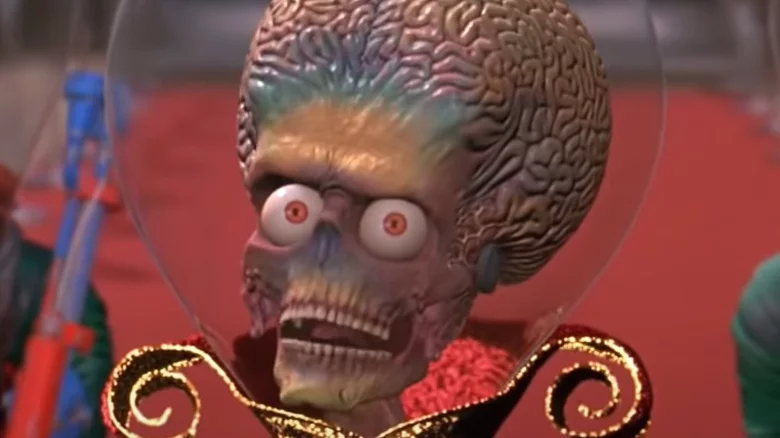
The shortcut for depicting superior aliens is to give them a giant head. Giant head means giant brains; giant brains means giant intelligence; giant intelligence means superior.

Never mind that there are many uninspected assumptions in that chain. Think about that last link. We know that high intelligence tends to correlate with more successes, higher income, better health, lower crime rates, and so on. That's all good, but you don't necessarily get those kinds of benefits unless you have a civilization around you that gives you enough leisure to develop some of that skill. "Whoever watches the wind will not plant; whoever looks at the clouds will not reap." You're better off if you plant intelligently, but if you don't yet know what you should be looking for the price for spending time observing may be higher than you and your family can afford. There's an upfront cost to making use of intelligence.

The greatest benefits don't appear until you can take the time to specialize a little, and there is enough of a framework of reliable rules to be rewarded for it. Or in other words, a little civilization. The more, the better, I presume, but some minimum is essential.

But lots of people live without that minimum. For them the best program is to mature quickly and work hard, and not be too trusting of outsiders. And history is crammed to overflowing with tribes who liked to prey on their neighbors; having a berserker temper might be useful in helping the neighbors deal with their tormenters. In a civilized society that kind of temper would lead to crime, but elsewhere it might help you fend off the Vikings.

Superiority seems to be relative to the situation. And if the question is not simply what's best for you, but what's best for your family, things look a little muddier. We ask the intelligent among us to spend so much time in school without marrying that their families have to be smaller--there are only a few years to spend. And for a lot of us the reply to the question is "What family?" Unless you have the rest of the world for your family and serve them somehow (I'm thinking of nuns in a hospital, or explorers out finding new islands), it seems as though creation trails off with you--not a sign of obvious superiority. Something should pass on to the future.

Civilization is obviously superior to chaos. But it doesn't immediately follow that the people who do best in some instance of civilization are therefore superior to the others: think monarchy. I don't know that we have a clear instance of a meritocracy: the machinery we have might have been designed around a slightly different set of values and resulted in a different set of "meriting ones". For example, we value entertainment very highly, and reward some entertainers better than surgeons. We don't value farming as much: too hard; though we do value adventure camping which is even harder. Similarly with attitudes: fidelity and honor don't get as much notice as in other eras, so someone who is loyal but not clever is honored/rewarded only on the basis of the revenue his cleverness produces.

As a Christian I believe that intelligence is a gift that brings obligation and does not make one man superior to another. A civilization needs to have honorable room for those who aren't as sharp. But even from a purely secular system of values a civilization that does not provide a space for them will find them making a space for themselves. And I suspect that it will be less resiliant as well. (Our society feels brittle. I haven't traced out why it seems so, but too many things rely on "And tomorrow will be like today, or even far better," with no obvious fallbacks.)

Big Bang Testing

Inexperienced programmers will sometimes code up the component parts of a big program and then bundle them together for the testing. If you don't know much about programming, that link is very clear about why it is a bad idea. Changing programs late in development is extremely complicated and expensive.

Now imagine someone trying to "big bang test" a new program when they haven't clearly outlined what the specifications are. (Danger, flee!)

If you don't clearly know what each part of the system is supposed to do, and haven't made sure (by testing it first!) that it will in fact do the proper job, you are begging for failure, and the bigger the project the more spectacular the disaster that will follow. Your best bet is to be very much elsewhere when everything hits the fan.

Instead of "programmer" read "legislator," instead of "program" read "suite of laws," and instead of "big bang testing" read "we have to pass it to find out what's in it."

I like AVI's rule that "When you hear the word "comprehensive," zip in the phrase "cocaine-based" instead." Step after step wins more races than a giant leap. The problem is that when it all fails the politicians are nicely retired elsewhere, and we are the ones flat on our backs.

A few flakes of Brann

Years ago H Allen Smith included a bit of William Brann's (1855-1898) work in a humor anthology. He wrote a journal called The Iconoclast and did his best to live up to its name. The first article in the linked compilation sympathetically revisits the story of Potiphar's wife--he thinks her unfairly maligned.

From the linked bio: "Mainly because of Brann's jaundiced view of the Negro race (altogether too forthrightly expressed by the Iconoclast), he is considered far too politically incorrect for contemporary Americans to gracefully handle. Thus, in spite of the richness of his wit and wisdom on a vast array of other subjects, he is considered by many best forgotten."

Which is a pity, because he had a lively sense of language and much wider interests; you can pick and choose. Had he met Condoleezza Rice he might have had the iconoclastic urge to resist the attitudes of his time.

A quick sampling to show his wordsmithing skill:

St. Paul SAYS: "Though I speak with the tongues of men and angels and have not charity, I am become as sounding brass or a tinkling cymbal. And tho' I have the gift of prophecy, and understand all mysteries and all knowledge; and though I have all faith, so that I could remove mountains, and have not charity, I am nothing."

So it appears that chin-music without charity is not calculated to pay very large dividends in the interesting ultimate; that a man may be full of faith, and pregnant with prophecy, and chock-a-block with knowledge and redolent of religious mystery,—that he may leak sanctification in the musical accents of an angel and still be "nothing"—a pitiful hole in the atmosphere, a chimera circulating in a vacuum and foolishly imagining itself a man.

But what is charity? You people who have prayers and Bible readings before breakfast, while your hearts vibrate between holiness and hash—between Christ and the cook— should know; but it's dollars to doughnuts you don't. You probably imagine that when you present your out-of-fashion finery to your poor relations, then wait for a vote of thanks or a resolution of respect; that when you permit a tramp to fill a long-felt want with the cold victuals in your cupboard, which even your pug dog disdains, that the Recording Angel wipes the tears of joy from his eyes with his wing- feathers and gives you a page, while all Heaven gets gay because of your excessive goodness. That's because your religious education has been sadly neglected. If you would read the Bible—and the ICONOCLAST—with more care you couldn't make such mistakes. St. Paul says (and, as the country preacher remarked, I fully agree with him):

"And though I bestow all my goods to feed the poor, and though I give my body to be burned, and have not charity, it profiteth me nothing."

Or take these:

"I came very near being a Baptist... but reneged when an attempt was made to baptize me in cracked ice on a winter's day."

or

"When Rome began to mock her gods, she found the barbarians thundering at her gates. When France insulted her priesthood and crowned a courtesan as Goddess of Reason in Notre Dame, Paris was a maelstrom and the nation a chaos in which Murder raged and Discord shrieked..."

"Character no longer counts for aught unless reinforced by a bank account... Men are sent to Congress whom God intended for the gallows, while those he ticketed for the penitentiary sprout inanities in fashionable pulpits. The merchant who pays his debts in full when he might settle for ten cents on the dollar is considered deficient in common sense... Why is this? It is because the old religious spirit is dormant if not dead; it is because when people consider themselves but as the beasts that perish, they can make no spiritual progress, but imitate their supposed ancestors..."

or

"No man can be either a patriot or a consistent Christian on an empty stomach—he's merely a savage animal, a dangerous beast."

"The concentration of wealth in the hands of the few and the impoverishment of the common people... has ever been the herald of moral decay and of national death... Shall the average American Citizen be a Slave or a Sovereign?"

and this set

"We're governed entirely too much—Officialism is becoming a veritable Old Man of the Sea on the neck of Labor's Sinbad. About every fifth man you meet is a public servant of some sort, and you cannot get married or buried, purchase a drink or own a dog except with a by-your-leave to the all-pervading law of the land... and if the police don't cut you down in time to put you in jail the preachers will send you to hell. ...We have so many laws and so much legal machinery that when you throw a man into the judicial hopper not even an astrologer can tell whether he'll come out a horse-thief or only a homicide..."

"I admit that I haven't much respect for the law—there's so much of it that when I come to spread my respect over the entire lot it's about as thin as one of Sam Jones's sermons...

"We are bowing down before various pie-hunting political gods and electing men to Congress who couldn't tell the Federal Constitution from Calvin's Confession of Faith...

"Our patriotism has been supplanted by partisanship, and now all are for a party and none are for the state. On July 4 we shout for the old flag and all the rest of the year we clamor for an appropriation..."

(I purloin selections freely from the bio page.)

Friday, May 24, 2013

Near extinction

The Scottish wildcat is near extinction, with estimates from 300 to 35 left.

Their kittens look very much like the cute little kittens we play with, but I gather these will attempt to take your face off given half a chance. The people who lived in close proximity to wildcats did not acquire the same love for the creatures that people at a safe distance feel for such rare animals.

People have been trying to exterminate them for over a thousand years, without much success, but now they finally seem seem to be going under.

The secret weapon? Undiscriminating sex.

They look like housecats, and it turns out they successfully breed with housecats, and as a result there are plenty of hybrids but not so many pureblood wildcats. One group of researchers was proposing to capture wildcats and isolate them in a breeding colony, but a) he's going to find it hard to keep volunteers intact and b) the population would have to be forever captive unless he can figure a way to explain to the wildcats that they should only have sex with other wildcats.

Thursday, May 23, 2013

Plasmas are hard

A passerby saw a man frantically looking for his lost keys under a lamp post and asked him if he could help. After a fruitless few minutes he asked for the man to point out where he lost them and was told that he actually lost them in the bushes - but he was looking for the keys under the lamp because the light there was brighter.

That's not really fair to researchers--they have to start in the light and work their way outward. But it does feel frustrating sometimes. It works like this:

Even the simplest models of physical systems are often intractably hard to solve. One of the standard tools in the physicist's box is to consider the system at some kind of equilibrium or simple early state and then do a formal expansion of the true (but unknown) solution as the initial state plus some linear variation plus a second order variation plus etc--and then argue that the variation is small and solve the linear equation. (If you can't argue that, then you try to find some remapping of the problem that will make it small, and if you can't do that -- so much for this tool.) The procedure doesn't seem quite fair, but it works very well a lot of the time.

When you're dealing with mostly homogenous things (empty space with a few balls in it, water, etc) with a few simple boundary conditions, you can often exactly solve the equations describing the system. Even when the boundary conditions get too hairy, you can usually manage excellent approximations with simple computer programs, and have a general notion of what the solution will look like before you start.

The equations describing simple plasmas start to get very hairy, because energy moves through the system both as kinetic energy (motion of the particles) and electromagnetic field energy--and each influences the other. It isn't easy to linearize these in real-life kinds of problems. (Classroom exercises have all sorts of simplifying assumptions to keep the problems simple enough for students to solve.)

That means that not only is there not a "formal" exact solution, but that computer solutions are going to be very sensitive to the initial conditions and round-off, and be apt to give misleading answers. (Chaos, anyone?) Worst of all, you typically don't have a good general notion of what the solution should look like.

All this is preface to explain why it has taken so long to get explanations of things we've known about for years, such as why solar flares change so fast or how they manage to accelerate electrons to such high energies.

The problem this group tried to solve is why "flux pinning" sometimes fails.

Have you ever tried to open a breaker on a high-current line? If not, have you noticed that they tend to have very long handles? It is almost as though the current wants to keep flowing, and is willing to jump long arcs to do it. That effect is related to "flux pinning". If you have a magnetic field inside a conducting medium (like a plasma), if the field starts to change that will (by Maxwell's equations) create an electric field, which then moves the charged particles in the plasma, and the resulting current creates a magnetic field that tends to sustain the existing magnetic field. So if there's a magnetic field (e.g. the Sun's) in the middle of a chunk of plasma (e.g. something ejected in a solar flare), it should stay with it as the chunk of plasma moves. That's "pinning".

Except that sometimes it very spectacularly doesn't stay pinned, but jumps over and reconnects with other magnetic fields and releases large amounts of energy.

This team modeled a way that could work when there is a certain kind of turbulence. Without turbulence of some kind, the fields stay pinned.

I have to think about this paper a while, and would have to do quite a bit of literature review (and refresh my memory--I haven't studied plasmas since a class back in '81) to make sure what they're doing covers the bases. But it is encouraging to see progress.

This is the sort of problem that could not have been solved without computers. It is too complex for pencil and paper.

But of course small scale effects, though they are critical and sometimes dramatic, aren't the whole story. Another group studied how "shear waves" smooth out the small variations to leave behind large collective effects.

Unfortunately it is hard to stick probes in the Sun to measure these shear waves. For that matter, it isn't easy to put probes in a rotating globe of molten sodium either, but they're trying, and maybe the results can shed some light on the Sun. So to speak.

There are lots of collective electromagnetic/plasma phenomena that we don't quite understand yet. Describe, yes. But why do they take the form they do?