Showing posts with label Biology. Show all posts

Tuesday, November 18, 2025

Orientation and surgery

Typically if someone touches me I can touch the same spot in the same way without looking.

But when the OT was showing me how to manipulate neck skin to try to mobilize scar tissue and get lymph moving, I found that I had to touch her fingers to find the spot. Something about some nerves gone, and some nerves not running in precisely the same locations, left me a bit offset.

Not serious or life-changing, just an oddity nobody mentioned.

Friday, August 02, 2024

Artemis project

Smarter Every Day's Dustin talked to the American Astronautical Society. I found it very interesting. He brings up some aspects of the Artemis project that I'd not heard about before. Yikes! I hadn't paid a lot of attention to their plans. The points he brings up sound crazy.

He recommends What Made Apollo a Success?; NASA document SP 287. I haven't read much of it yet.


The rabbit hole that led me to that was this video he made about progress in learning how the flagellum motor works. It's pretty spectacular--a motor made out of proteins.

Sunday, January 14, 2024

Isotopic differences

It's no secret that deuterium instead of H1 isn't good for proteins, but apparently a certain percentage of it is not just tolerated but expected, with not-always benign consequences if it isn't there. Not what I would have expected...

A major deuterium-depleted water (DDW) phenomenon is the depressed growth of cancer cells, which is currently being exploited in a clinical trial. Previously, while studying the antiproliferation effect of DDW in human lung adenocarcinoma cells, we determined that DDW induces mitochondrial redox imbalance that leads to oxidative stress. In general, deuterium concentration between 80 ppm and 300 ppm (the natural value being ∼150 ppm) is found to be a cell growth regulator.

So what happens if you purify media (they call it Depleted) of the heavier isotopes of carbon and oxygen and nitrogen?

Well, e-coli grow faster, some proteins become more active, and other technical variations appear.

An M9 minimum media based on 13C-depleted glucose and 15N-depleted salt dissolved in D,18O-depleted water (Depleted media) was formulated. E. coli bacteria grow faster in Depleted media compared with isotopically natural media (Normal media). In addition, four different enzymes recombinantly produced in Depleted media showed faster kinetics compared with the enzymes produced in Normal media.

Found via SciTechDaily

Monday, January 16, 2023

Brain and fluid intelligence

Cipolotti et al took an interesting approach to looking for locations in the brain on which fluid intelligence relies. Instead of trying a phrenological approach or looking for relatively larger regions in the brain (or relatively more connected), they looked at what happened with brain lesions. They aren't the first, but other studies were smaller. "Patients with non-frontal lesions were indistinguishable from controls and showed no modulation by laterality." But right frontal damage did show an effect: "prominently highlighting a right frontal network involving middle and inferior frontal gyrus, pre- and post-central gyri, with a weak contribution from right superior parietal lobule".

The study had 165 control and 227 injured patients. I'm not familiar with some of the jargon, but assuming the analysis is OK, a couple of things do appear. No brain damage is good for you (surprise), but right frontal is worse. The Raven's Advanced Progressive Matrix score dropped by about a standard deviation--about 25%.

I'd have to dig awhile to figure out what confounding factors there might be (lethality of lesions in other locations?--but the non-frontal part suggests that may not be a big effect), and I have some higher priority projects.

Tuesday, December 27, 2022

These didn't demand a lot of comment

The video Chernobyl mentioned "beta tan", which I'd heard of years ago--beta particles (electrons and positrons) don't penetrate far at nuclear energies, so they give something like a sunburn. Naturally, the first thing that google serves up is a cough remedy.

Supply chain issues get magnified in poorer countries: "the company disclosed that the arrival of jet fuel in Liberia will be delayed as a result of the shortage on the global market." ... "The vessel should have arrived on December 14, 2022. We are now being informed that the vessel will not be in Liberia until January 13, 2023."

Customs change. Used to be that beggars got a Christmas gift from the President. (One year they banded together to buy a goat in thanks, and the donation was reduced!) Now: "Zogos took to the streets after being denied their routine Christmas packages from Finda Bondo, the Chief of Protocol to President George Weah." With cutlasses. Bystanders handled two of them.

Do not get arrested in third world countries

The Baptist War ... Also known as the Christmas Rebellion, it was an eleven-day rebellion that started on Christmas Day 1831 in Jamaica. The harsh repression of it became so notorious that it helped fuel the banning of slavery in England.

I've been looking off and on at radiation tolerance studies: there's a new report about bank voles "Chernobyl fibroblasts had higher total antioxidant capacity than the control cells and were less sensitive to DNA damage induced lethality, both of which processes may explain their increased resistance against radiation."

Saturday, April 23, 2022

Scleral Rings

Some years ago I puzzled over the eyebones of Dunkelosteus. I didn't do quite enough research Mea culpa. The layout of the skull and bones mislead me into thinking that the bones were above the eye. But no, other examples clearly showed they weren't--I'd forgotten about the skin and muscles over the bone.

In fact, far from being unusual, they're quite common. All birds have them, for instance, and all reptiles except snakes and crocodiles. They're just not so big and obvious. Different species have different numbers of bones, and the number can even vary from left to right eye.

Notice where the lens is in relation to these bits of bone in bird's eyes. The one at the bottom, labeled "tubular", is from an owl. (Hummingbird scleral rings are almost tissue-paper thin.)

I got these images from Why are bones in vertebrate eyes?.

Why? Night-active creatures seem to have larger and more conical ones, day-active ones have smaller holes. Yet they have irises also to control the amount of light, so I don't quite see the benefit.

Some say this helps keep vision sharp, possibly by holding the eyeball more stiffly in place. If you live and die by your vision as birds do, I can imagine that reducing jitter might be important. Though in the human eye a little jitter (saccades) seems to help give individual rods/cones time to recover by spreading the signal around a bit. Or something--there's disagreement. Birds have saccades too.

There are other plates in some eyes too--near the lids (if present).

From this reference: "The function of the ocular skeleton is not well understood but is believed to be as follows. The scleral cartilage cup provides structural support to the delicate retina. The scleral ossicles either assist in visual accommodation by preventing the eyeball shape from distorting as the cornea changes shape to focus light onto the retina or it also provides structural support."

They wouldn't have them if they weren't useful. Mammals don't have them (except for the platypus, which has cartilege ones), so they aren't essential. But how do they help?

Tuesday, April 19, 2022

Not good news for the mammoth cloners

A "junk DNA" study suggests that one of the functions has to do with identifying DNA belonging to "me"--this species--to keep it from being discarded ("chromosomes scatter and start to leak out of the cell’s nucleus.") That seems like a possible defense against viruses.

I complained before that the host egg cell wouldn't have perfectly matching RNA and that that probably would cause failures to express the DNA correctly. If this study is correct, cross-species cloning faces an additional problem.

I don't quite see how the claim about germline cells (at least as the article purports to explain it) makes sense. Perhaps they mean that for meiosis, one of the daughter cells is sacrificed to give the other the full complement of the required sequences needed to keep it "young". If that happened every time, I don't see how the germline cells would reproduce. You'd get a fixed number and a division would produce another and a not-quite, keeping the count of good ones the same. The article didn't have a link to the paper.

Sunday, March 27, 2022

Plastic in the blood?

he headline seemed nuts: Scientists find microplastics in blood for first time. The image associated with the article shows mm-size bits--which is even crazier. Never mind the picture--how do you get bits of plastic into the blood? My intuition says this is hard--otherwise we'd have all sorts of stuff getting into the blood.

The actual report is at Science Direct. It starts out talking about particle sizes, which explains why the summarizer at phys.org thought of larger bits. But read on.

When you get down to the Methods section, it looks a little different. They describe careful methods to avoid contamination, how they tried to denature and digest the proteins, and then filter the resulting blood samples on a 25nm glass fiber filter (mesh size 700nm).

The next steps had to do with baking the result and testing for chemicals baked out.

The compounds that are desorbed in the first run (‘shot’) are molecules that are volatilized between 100 and 300 °C and can include unpolymerized monomers, additives and other sorbed chemicals. Polymerized target analytes such as polystyrene, EPS, ABS, PP, PE, PMMA are physically unable to volatilize in the ‘first shot’ because the maximum temperature of 300 °C is too low (therefore they are retained for the second shot).

Why the distinction? Because you could have chemicals from your body's trying to digest plastic in your blood, or from inhaling gases from soft plastics, and so on. These are presumably not good, though whether they are actively bad isn't quite proven.

They find chemicals at the right point in the procedure to have been driven off of small particles, but they don't know the size, or if these are new combinations of polymer chemicals and something else. They don't actually see the particles.

And...

The human placenta has been shown to be permeable to 50, 80 and 240 nm polystyrene beads (Wick et al. 2010) and likely also to microsized polypropylene (Ragusa et al. 2021). In a study of acute lung exposure to nanopolystyrene spheres (20 nm) in rats, the translocation of plastic particles to placental and fetal tissues was demonstrated (Fournier et al. 2020). Bioaccumulation of small polystyrene micro-particles in the liver, kidney and gut was observed after oral administration in mice in vivo

And they mention drug delivery in nano-sized plastic particles--and reference something odd in which chronic exposure to "polymeric nanoparticles" in the blood results in clearing the particles out more quickly.

How does this stuff get in? "Mucosal contact"--skin is pretty protective. Really fine stuff (<.1micrometers) can be inhaled. Plus "PE in toothpaste, PET in lip gloss, dental polymers": "even tattoo ink residues."

My intuition was wrong. Partly. The bits have to be very small.

Sunday, February 27, 2022

Underground sounds

Small things underground make noises. You can tell different species of grub apart from the different sounds they make. And it isn't just ants and springtails that use sound.
All the tubes were filled with soil, but some were exposed to the vibrations of flowing water (running through a tube on the outside of the pipe). Gagliano, ..., reported that the pea plants favoured growing roots toward the sound of water, even though the water itself was not accessible to the plants and no moisture could seep into the tubes.
Henson knew.

Saturday, October 16, 2021

Sunscreen degradation and improvement

The headline read Scientists Warn: Sunscreen That Includes Zinc Oxide Loses Effectiveness and Becomes Toxic After 2 Hours I've learned to be suspicious of headlines, but this isn't entirely wrong.

The researchers made up their own sunscreens from the usual sorts of chemicals and exposed them to standardized fake sunlight. Some of the chemicals in sunscreen protect you by disintegrating themselves (and thus becoming ineffective), but "We were surprised to find that all five of the commercially relevant small-molecule UV-filter mixtures were mostly photostable."

But it seems that zinc oxide changes things.

The plot on the left is for ZnO micro-particles, and the one on the right for ZnO nano-particles. The blue curves are before and the orange curves are after UV exposure. The drop in absorbance at longer wavelengths (the UV-A region) is pretty dramatic. Interestingly, there's a rise in absorbance for nano-particle ZnO mixtures--so the mix gets better at blocking UV-B.

They also dosed embryonic zebrafish with the various before and after mixtures. It looks to me as though sunscreen isn't good for zebrafish, old sunscreen is worse, and defects really start to kick in with ZnO sunscreen and get really bad for old ZnO sunscreen--especially the nano-particle version. Of course the doses are huge.

They say zebrafish have "significant gene homology to humans", but I'll bet the 5-day turn-around for "more rapid screening" was the decisive reason for the choice. And everybody uses them (probably because of the quick growth).

Friday, September 24, 2021

Lies, Damned lies,..

"Junk DNA" has a purpose, something most of us probably guessed was true from first principles, though we couldn't predict what it would be. The link tells of some progress they're making on figuring out what its roles are.

But one sentence jumped out at me:

“If you look at the chimpanzee genome and the human genome, the protein coding regions are, like, 98 percent, 99 percent identical,” she says. “But the junk DNA part is very, very different.”

You've heard that 98% stat over and over again, haven't you? But unless you dig into the details, you never learn that said "98%" covers only 1.5% of the DNA. I'd never dug into it before myself. I need to be more suspicious--I figured it was just a matter of complexity. Nope, hubris: "If we don't understand it, it doesn't matter."

Thursday, May 06, 2021

The Secret of Our Success by Joseph Henrich

He makes several claims:
  1. Our knowledge, and to some degree even our intelligence, is strongly social
  2. Our social intelligence/culture co-evolves with our bodies

His favorite examples of social intelligence are the young children vs chimps in problem solving. When both are young enough, the chimps are faster at figuring out simple problems, but even at that age the children completely outclass the chimps in learning from others. (Once language is involved, no creature comes even close to human performance.) Another is the explorers starving--or being slowly poisoned--in the midst of plenty of food they just don't know how to prepare. South American preparation of cassava is intricate; African methods are somewhat simpler--and chronic cassava poisoning is a problem in some places. The primitive toolkit of the Eskimos would take someone with plenty of time on his hands years to develop--and a castaway typically has no leisure for figuring out a good material for binding together a fish spear.

Humans predigest our food, so we don't need as large a large intestine as other creatures--and it isn't as large. We have a vast amount of cultural knowledge for our clan members to pick up, and it turns out that humans take far longer to mature than similar creatures.

He noticed that some South Pacific tribes have taboos that have subtle safety effects. Women are forbidden certain fish, which it turns out often carry parasites that can harm unborn children.

Here I wonder if he's cherry-picking the data. Dr Harley's Native African Medicine with Special Reference to its Practice in the Mano Tribe of Liberia summarized the local treatments as being roughtly 1/3 effective, 1/3 neutral, and 1/3 harmful. Is there a systematic analysis of the taboos Henrich mentions?

He tries to explain how culture can literally evolve. Hang around near high status people to pick up either status or knowledge, depending on how they got their status. Over time, status from knowledge grows knowledge and reproductive success.

He admits--insists on--the fact that this sort of knowledge/culture growth is delicate, and information can be lost (forever as far as your tribe is concerned) in a famine or plague or dead end approach). He gives a New Guinea example--a tribe forgot how to fish. And forgot lots of other things too.

Hmm. It seems so delicate, and takes so long, that one comes away with the impression that this kind of cultural/physical evolution isn't possible. There should have been more signicant culture earlier or much more rapid physical changes recently. Or a combination gift.

Sunday, February 14, 2021

Argh-onomics

Why grunt when lifting weights--or lifting yourself out of a too-deep chair? It's natural, and seems to have something to do with stabilizing your core muscles--including your diaphragm (hence the noise)--for the heavy lifting or hard hitting you are doing.

So now I have a good excuse for making so much noise when I have to get out of bed in the morning.

Sunday, August 30, 2020

Clever cells

When the body is damaged, the injured cells release "I'm in trouble" chemicals. Other cells (e.g. white blood cells) come to help out.

How can they figure out which way to go? After all, the chemicals are going to diffuse all over the place. True, a blood vessel is a simple one-dimensional region, but do you go left or right to get to the hammered thumb?

The model this group was testing is pretty simple and clever: the seeking cells destroy the trouble chemicals near them. After that the region with a higher density of those chemicals will diffuse into the newly cleaned regions by the seeker cell first. The seeker cell detects the alarm chemicals on (e.g.) its left side first--so that's the direction the seeker cell should move. That's a pretty clever way to estimate a density gradient, and it has the added benefit of getting rid of the old alarm chemicals so the body isn't in constant alert mode.

They have videos of ameobas and cancer cells threading mazes to find "chemoattractants".

It isn't infallible, of course--brownian motion might randomly bring attractants to the low density side first. You can see that in the videos. But most of the time it works, and it seems like a simple process to implement. It'd be more robust than a simple "try to measure concentration on both sides" scheme, since very high densities of chemoattractants would overwhelm a seeker cell's finite number of built-in receptors.

Wednesday, April 29, 2020

His Master's Voice

AVI thought that dogs would pay more attention to recorded voices as the reproduction quality improved.


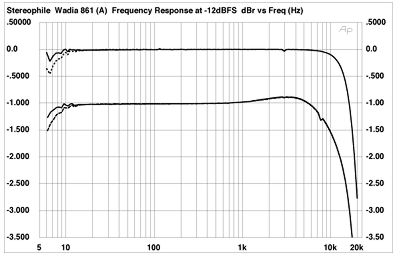
I wasn't so sure. Look at the above frequency response thresholds. Dogs can hear higher frequencies than we, but miss out on the lower. When a dog hears your voice, it hears supersonic details we don't, and misses the lower register. It doesn't hear what you hear.

Below find the response curve for a "Wadia 861, Filter A, CD." The response curve is nice and flat--until it falls off. It keeps up with the low register, which the dogs don't notice anyway, but it misses out on the high end, which we don't care enough about to instrument. (Why bother? Dogs don't buy electronics.)


The bulk of the energy spectrum for human speech is below 1000Hz, but there's still about a percent or so above human hearing range. Does 1% matter? I guess that dogs wouldn't have that kind of sensitivity unless it made a difference--maybe in finding mice. I wonder if anybody has tested dog response to human voices with signal response flat out to 30-40 kHz.

Tuesday, February 04, 2020

Waste products

When bacteria decompose sugars they leave some toxins behind--ethyl alcohol being the most famous.

Bacteria are developing to devour plastics. What do they leave behind?

For the PET family, Ideonella sakaiensis is here. Some details are here. The answer seems to be that different colonies of bacteria can eat most stuff all the way down to CO2 and water, but some intermediate compounds are terephthalic acid and ethylene glycol. At least the former isn't very toxic, and since it is solid at room temperatures won't migrate far.

Maybe plastic mines aren't such a wild idea, though purification seems like it would be hard. I don't think I want to be downstream of the ethylene glycol though.

Monday, January 28, 2019

The Old Ones. Or not.

The Scientific American has an article about long-lived microbes inside the Earth. Tuning the metabolism down to nearly nothing, a surprising quantity of living things can survive where you wouldn't expect there to be enough food. Nothing big, mind you--just microbes.

One bit that surprised me was about Lipman

Back in the late 1920s, a scientist named Charles Lipman, a professor at the University of California, Berkeley, began to suspect there were bacteria in rocks. Not fossil bacteria. Alive bacteria.

When placed in solutions of coal dust and sterile water, in two to three weeks he began to see what looked like bacteria.

...

Intriguingly, he found that a rehydration period of at least a few days in liquid was essential for revivification. If the crushed coal was wetted but immediately placed on food-infused gelatin-like agar in a Petri dish, nothing grew.

...

In fact, he found that heating the sample for hours at 160°C never managed to kill the bacteria inside the coal. If anything, it only seemed to encourage them. The longer they were baked – up to an incredible 50 hours – the better they seemed to grow when the coal was subsequently crushed (If his results were genuine, they may not be altogether surprising given both the conditions that create coal and the effects of heat shock proteins).

That's a pretty dramatic result, and I'd expect lots of people would check it out. But a quick googling doesn't show that anybody has reproduced his results. On the contrary:

S.K. Roy, 1937 Popular Astronomy 45:499.

Charles Lipman claimed to have found living bacteria in stony meteorites. Roy doubts this, pointing out Lipman had also "found" living bacteria in ancient terrestrial rocks and coal, but that other scientists had failed to verify this. Roy also tried to obtain living cultures from meteorites, but failed.

Did the experiments that "failed to verify this" ever get published? If not, why not? Popular Astronomy vol45 doesn't seem to be available online. I will have to see if the Astronomy library has a copy. Maybe it will have references.

The failure to reproduce ought to be as famous as the claim.

Wednesday, January 03, 2018

Cancer in animals

It says here that 1 in 2 in the UK will get some form of cancer during their lifetime, and from the graph it looks like almost all of that is post-60 years old.

It says here that 1 in 2 dogs over 10 years old will have cancer of some kind (varies wildly by breed--smaller have much lower rates).

I'm trying to figure out how to compare those numbers. Two factors that come to mind are 1) senescence of the system as a whole and 2) the number of cell divisions that have taken place (more means more random accumulated errors). The replication rate varies a lot in humans depending on what kind of cell you're talking about--and since the faster replicating ones aren't necessarily the ones that have the most frequent cancers, I suspect that's not the biggest factor. I didn't find anything about cell division rates in dogs that I could use to compare with humans, but it probably doesn't matter anyway.

So maybe 10 dog years are like 60 human years, and the system isn't able to smack down failures as well? (On average--I know young ones can get cancer too.) Does the cancer rate with age normalized to the lifetime follow the same sort of trend with various breeds, or with other animals? Does anybody know?

Tuesday, January 10, 2017

Appendix

I've never been confident in the claim that the appendix is a useless vestigial organ. Everything else is doing something, sometimes many somethings at once. Why waste energy growing something useless? Maybe it is a bacteria reservoir?
They discovered that the appendix has evolved independently in several mammal lineages, over 30 separate times, and almost never disappears from a lineage once it has appeared. This suggests that the appendix likely serves an adaptive purpose.