You might need extra-thin roll-outs, with maybe a little something to reinforce it.
Showing posts with label Ideas. Show all posts
Showing posts with label Ideas. Show all posts
Sunday, January 02, 2022
For the kids
They twist up balloon animals for kids at festivals and fairs. Could one take fruit roll-ups and make ori-gummis?

Sunday, March 15, 2020
Remote participation
Playing baseball without fan noise would be weird. They could do it, of course--they practice all the time--but the fans give the game more "energy" and put something more than just game stats at stake.
Suppose MLB created an app that let you watch the game if you liked (this already exists, of course), but with the option of signaling your approval/disapproval in real time.
This would have to be with "buttons"--no way could the network or the servers handle the bandwidth from live-streaming 10,000 fan voices. But when the boo/yay/hit!/miss! tallies arrived at the server, it could drive the appropriate volumes of fan noise into large speakers around the stadium.
The players would get fan feedback and encouragement in real time, the fans would get to feel like they're doing something--and hear the noise that results, and MLB could rake in a little extra money for the app as well.
The user interface is absolutely critical. It would have to be extremely easy to use, maybe let you hear your cry (maybe record your voice and play it back to you?) in the mix, and have enough "resistance" to make it feel like you are actually doing something more than punching a button. By resistance I mean that you have to do something harder than touching a screen: but it has to be something natural. Maybe pushing a button and yelling?
Tuesday, March 03, 2020
Movie focus
I was absorbed in my reading on the bus. I felt it turn, and turn, and when I looked away from the kindle I realized I'd lost track of where we were. It wasn't significant--my exit wasn't for another 15 minutes--but it was a sharp reminder that I'm not always attentive. The sketch of a man eyeing an attractive woman walking by and running into a phone pole he didn't notice is funny because it's all too true.
What comes to mind is one of those scenes in the New Zealand movies where there's vast scenery and a troop of nine walking along the ridge. My eyes flick back and forth between the scenery and the actors, and when I concentrate on one the other fades.
Suppose you were making a "first person"/stream-of-consciousness movie, seeing what the protagonist sees and hearing what he hears. You could force the viewpoint with camera focus, and maybe with post-processing tricks to literally fade other things in view. I've seen something like this done when the hero has been drugged or slugged and is slowly gaining consciousness, but that's only for a scene. I wonder if you can do it longer. Finding a balance between single-minded focus and flicking the attention this way and that would be quite a trick.
In clumsy hands this would be unwatchable. Without a good story-line reason for doing it, it would be pretentious. With skill and story-telling reason--it might still be a poor choice.
Somebody is bound to have tried this--probably many somebodies. And I'd bet most of the results aren't any good: in art "90% of everything is junk". Has this approach to forcing the viewer's attention ever worked?
Wednesday, August 28, 2019
A Modest Proposal
I saw that Stanford was making physics inclusive and creating an additional physics course that is about experiences and not physics. And it isn't, apparently, a mentoring program.
You can probably gather from an earlier post that I think of this sort of thing misses the point.
But I want to be positive for a change.
I have a modest proposal.
Most of the claims about racism and toxic environments are blissfully innocent of any data. It would not be expensive to accumulate some.
Every incoming student's records are already associated with their 1) age and 2) college board scores. Ask 3 questions during onboarding, that also go in their record:
- Sex: male, female, "whatever"
- Ethnicity: (include "prefer not to answer")
- First and second choices for major ("undecided" is OK)
Five years later, look up the all those students' records and determine
- Did the student graduate?
- If so, with what major?
Any such study has to preserve anonymity, so the only things included in the database for research are the 7 items.
A lot of students change majors, a number drop out, some get sick or even die. But even so, for a state university you'll start to get good statistics with the first or second cohort. In 10 years you might even have enough statistics about minority groups and about uncommon majors to begin to learn something useful, but even after 6 years (the second cohort) you'd have enough to start saying useful things about men and women in college.
After you learn the patterns ("18-year olds who want to do chemistry but have combined SAT less than 1150 generally don't complete the degree, but 35+ year olds do") you could, for the first time, actually use statistics to say whether some department is less friendly to women than others, or than the same department in another university. Right now we have subjective anecdotes. Sometimes those are revealing, and sometimes they are less than fully accurate.
Easy, cheap, high statistics--what's not to like? I know the diversity industry might fear it, but they aren't the only players in town.
Monday, July 22, 2019
Tradition Markers
We've stopped at a couple of "Historical Markers" on our trip so far. One was about the naming of Madeline Island (named after the new name of Chief White Crane's daughter).
Very few such markers (in this part of the country, anyway) involve Indian history. We consider history as tied to dates and places. Non-literate societies don't usually record times precisely, so if something happened before the white man started writing things down, it isn't quite as "solid" a history. But all sorts of things happened; why not memorialize them?
I wonder how many tribes would jump at the opportunity to have "Tradition Markers" put up, that record what happened nearby at some non-entirely firm date, and what it meant. There's plenty of precedent--the date of Jesus' birth isn't known precisely, nor its exact location, but there are plenty of markers of tradition.
I'm not quite sure where the line would be drawn--I suspect that there might be some objection to describing the Devils Tower as bear scratchings desecrated by builders and climbers.
And different tribes might have radically different interpretations of the same event--who gets to write the text?
I'd be interested in "Tradition Markers," and stop to have a look. Would you?
Thursday, June 07, 2018
Bright idea
Those who manage computer servers know that you can tell the machine to blink a light for a particular disk or sometimes for a particular controller, so that when you yank the defective item you get the correct one.
I was helping with some cable tracing yesterday.
You are familiar with those LED cable lights that turn from color to color to color.
They'd be an extra-cost item, but imagine a network cable that was twinned with such an LED strand, so that you could tell the server to turn the light on and find out where the cable went.
If that doesn't seem obviously wonderful, look at this and remember that the cable run started out nice and neat, but over the years replacements make it look just a little different.
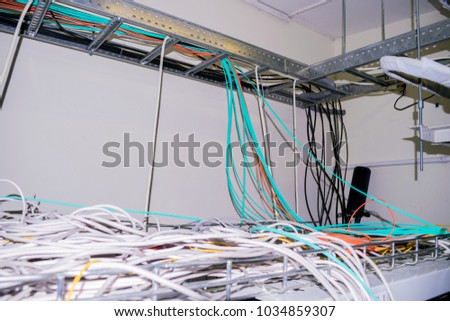
Of course, by the time you realized that you really needed such an item, it would be too late to install it. There's probably a theorem to prove that whichever cable you really need to trace is going to spend at least part of its length at the bottom of the pile. I can count the exceptions on my thumbs.
Sunday, June 25, 2017
Stowing wheelchairs
I was talking this morning with a man who’d sustained a temporary injury that meant that although he could walk a little, and drive, he had to use a wheelchair most of the time. He’d fallen. He fell again while trying to store his wheelchair, and in consequence had to rely on other people to help him drive around.
Perhaps that’s actually a good thing, but I wondered if there were ways to make it possible for someone semi-wheelchair bound to drive by themselves.
If he uses a collapsible wheelchair, it might be.
The most obvious approach is to have a four-door sedan in which the front door is hinged, as usual, on the front, and the rear door hinged on the rear. Wheel up, open both doors, sit in the driver’s seat, fold the wheelchair and shove it into the back seat area, then close the doors and drive away. Reverse the procedure to get out.
The problem with that is that remounting a car door would take fairly massive and expensive modifications—probably of order of the cost of a used wheelchair van. (Which aren’t cheap.)
Another possibility is a roof-mounted mechanism using a swing-out arm. It would probably have to be motorized, but that could be arranged.
- Wheel up to car, open door, and have swing-out arm open out
- Sit in car and fold up wheelchair
- Lower and attach the upper attachment cables to the wheelchair.
- Raise the wheelchair to mid-station, and lower and attach the lower attachment cables to it
- Raise the wheelchair the rest of the way
- Have the mechanism turn the wheelchair sideways
- Rotate the swing-arm back over the car
Reverse this to get out of the car.
This doesn’t sound like a very cheap prospect either, and mounting it solidly to the roof of a car sounds difficult—though easier than trying to change the frame. It doesn’t sound like something you would rent for a few months.
Or you could strap a walker to the back of the wheelchair, and unlimber that when you need to store the wheelchair. You might need a hooked rod as well to help you get the wheelchair in and out, of course. A lot cheaper...
Thursday, August 27, 2015
Livelier baseball
My Better Half is the baseball fan.
I think the game would be much livelier and more interesting if so many innings weren't pitchers' duels.
Suppose for the first 6 innings the opposing team got to pick which player would be the pitcher. (Nobody could be required to pitch more than 2 innings if they and their coach disagreed.)
Each position player would have to be more of a utility player, since he'd never know from inning to inning where he'd be. Except for the late inning closers, of course--that's still enough of a tradition that we should probably keep it.
This opens more opportunities for strategy: who do you pick as pitcher, and how do you defend against losing (e.g.) your best catcher to the pitcher role for an inning?
And there'd almost certainly be more hits, more infield and outfield play--a livelier game. What's not to like?
She doesn't like the idea.
Friday, August 21, 2015
Thunderstorms
We still don't know quite a few things about thunderstorms, such as why one sometimes gets the red sprites shown in the linked picture. You can fly planes in and around them and the instruments tell us quite a bit, but they're so big our probes only catch a little of it.
I wonder if it is possible and useful to instrument a valley with chirping polarized radio transmitters and have receivers on planes or balloons measuring the Faraday rotation of the polarization axis. It isn't the same as a point measurement, since it integrates the magnetic effect along the whole path length (miles), but as the storm moves through the valley you'd get different sections through the storm, and maybe be able to tell if there were regions of exceptionally strong magnetic field.
If the Sun can have an effect on lightning rates, it might be nice to test models of how it works.
Sunday, July 26, 2015
Kitchen paint?
I was talking with a professor from India about cooking, and he told me that in cold climates (e.g. Wisconsin) where one couldn't always cook outdoors they found it advisable to cook in a garage or other outbuilding, because the oils and spices that smell so good at first tend to adhere to the walls and become rancid over time. I know that some apartment hallways tend to smell pretty rank, and the apartments can be even worse inside.
San Francisco is experimenting with pee-proof paints that are hydrophobic enough to bounce urine (and other water-based fluids) back from the surface. I wonder what sort of surface you would need to keep oily droplets from sticking. Tile is easy enough to clean (but not the grout!) but oil still sticks. We don't tile ceilings (and they're hard to reach to clean), and cabinets and handles get begrimed and so probably a source of odor as well. We try to keep things clean enough in our house to forestall that, so I can't be sure about the source of the odor, but the surfaces seem the most likely candidate.
If the surface was oil repellant, it would be easier to keep clean--and maybe not wind up as rancid. If oil droplets wouldn't stick to the ceiling they'd drift down. It's easier to clean the counter and the floor than the cabinets and the ceiling...
Of course the devil is in the details. Would water droplets adhere better or worse to the new surface? How do you put on a second coat of paint later?
UPDATE: Oh, and is it food safe?
Sunday, July 19, 2015
Harmonizing languages
One of the songs in church this morning had a phrase about peoples and languages in harmony. Thinking of Gilbert and Sullivan's trios with different songs harmonizing, I wondered how difficult it would be to write a work (e.g. a quintet) of different languages singing at the same time. Somebody has probably done something like this before with two languages, though I don't have the breadth of experience to guess who. I'm curious how this could be made beautiful(*) with more than two or three. Anybody know?
(*) I don't find Aaron Copeland's blendings all that beautiful. Maybe that's my loss.
(*) I don't find Aaron Copeland's blendings all that beautiful. Maybe that's my loss.
Saturday, July 04, 2015
Litter on the park trails
My Better Half and I hiked part of Devil's Lake and Parfrey's Glen as a belated 35'th anniversary celebration. Part of the path by the lake is asphalt and wheelchair accessible, but after a very short distance there's no chance of getting a wheelchair through.
I wondered if it would make sense to rent a litter so that friends of a wheelchair-bound person could bring them along. You'd need a team of 3, more likely 4, as a minimum, and some way to retrieve people if a carrier sprains something along the way.
Wikipedia says these are used for tourists in the Huangshan Mountains, so there's some precedent--though there the pros carry people. Liability issues would preclude that here.
Some of those steps are pretty steep.
Sunday, May 31, 2015
Sing for your supper
Focus group testing (my wife and two of my daughters) suggests that this might be better as a weekend special theme and not a permanent theme.
Inspired by hearing of colonial-era taverns (an era when everyone was supposed to be able to sing for himself if he wanted music), I wondered how features of that could be brought over into modern dining.
Consider a restaurant with basic pub food. Its target is singles less than about 30-35; definitely not families.
Patrons pay for food and drink before getting it--to make it convenient prices should round to even dollars after taxes.
The central idea is to sing together with "strangers".
- The patrons fill up tables for 6--a seventh seat to be squeezed in if a couple arrives. No new tables are used until the earlier ones are full. You would likely be seated with at least one stranger. At staff discretion, large parties might be split up between tables to mix them up.
- There is no canned music of any kind, and both players and recordings are forbidden. Patrons are expected to sing. If you sing for 2 minutes for your table, a dollar is knocked off the price of your entree--$2 if all 6 join in. Repeated songs don't count.
- Staff can veto a song (no Horst Wessel or other vile stuff please--looking for good fun).
- Patrons can play piano as long as at least 3 people sing along, or if the staff agree.
- Table singing competitions are encouraged, and prizes awarded. Outstanding performance is decided by acclaim or by staff pick. Prizes could be a bowl of house specialty snack, bubble mix and wands--whatever the market might like.
There are a few details that would need to be worked out. Enforcing rules about songs might get hard, but without something in place the restaurant might get a name as a place where, for example, women aren't comfortable.
The menu should be short or it would be too taxing for the staff to sing it out...
Monday, March 30, 2015
Instead of a comb-over
Perhaps a "California lawn" approach to hair loss could be popular. Henna tattoo some curls in that empty patch!
Thursday, March 05, 2015
What odors do we have?
I keep reading stories of dogs being trained to try to sniff out different cancers. That’s pretty dramatic. (Though the fact that I keep hearing stories about how they're trying suggests that it isn't reliable yet.)
What gases do humans emit? Yes, I know about H2O and CO2 and methane, I want to know what else is in the mix.
Suppose you made a bare room with nothing but a metal chair in it; sealed so that you control what gas goes in and you control where the gas goes afterwards. Douse the place with 30% peroxide, bake the whole thing for a few hours--make sure anything that could outgas already has. Use an airlock to get in and out.
The gas that goes in is as pure a mix of O2 and N2 as you can manage. Chill the gas down until nearly liquefied to fractionate all impurities, and then warm up what’s left so you don’t freeze the volunteers; adding a little pure H2O so they don’t dry out. Gas flowing out of the room is also chilled to nearly the boiling point, except that you try to capture all the stuff that condenses out.
Put a man in there for a few hours. What will turn up in the pool of condensate? Whatever it is (aside from the obvious), there won’t be much and so studying it will be tricky.
Cleaning up after a volunteer wouldn’t be trivial--we shed skin, which will presumably continue to outgas long after we’ve left the area. (Who knows what the mites will do.) That’s why I suggested making the chamber a bake-able facility.
I could tell pretty easily on Monday when Richard had made himself a garlic pizza on Saturday. If I use a volume of air 2mx2mx2m, and the garlic smell chemical was 1ppm, then there’s about .03% of a mole of the stuff. If the molecular weight is O(100g/mole), and the density of the liquid is about 1g/cm^3, then I expect about .03cc of the goo to condense on the chilling system. That’s going to be hard to scrape together, but I don’t think it would be impossible.
Things that show up at the ppb level or smaller (still sometimes detectable by dogs, I’m told) are obviously going to require heroic collection measures. (I'm thinking of a cyclonic gas flow inside a super-chilled pipe--have to worry about lubricant contamination too.)
Do people outgas differently when sick or when well? Does a woman have a different chemical mix at different points in her period? Is a baby’s scent the same as an adults?
What comes out through the breath, what through the skin? And how much of it depends on the bacteria on the skin?
Sunday, July 13, 2014
Font question
Everybody knows that spending hours in front of a computer screen gives you eyestrain, enough that although sitting down to a printed paper is a welcome relief, my eyes still tend to glaze over at the columns of text. Equations catch the eye well enough, but the actual definition of ω is buried somewhere in that uniform sea of letters.
I remember the Liberian Star (circa 1964) and its mixed fonts without fondness (I think they used one set of letter bins for headlines and another set for text body, regardless of size): I prefer the simplicity of having a single font on the page. It does make the page easier to read.
However. Suppose one allowed a tiny amount of "hair" in the font--the length of the serif, its exact angle, that sort of thing. Not so much that it wouldn't be obviously the same letter from the same font, but enough that the eye could catch the difference. There might be 5 very close versions of the letter t, which the display engine uses alternately in the body of the text.
Would that make the sea of letters less uniform, and easier to navigate?
Creating a new font for this sort of thing would be pretty easy (creating a good one is quite a bit harder!); the hairy part is the display engine that picks which version of k to use. A unicode test page wouldn't be too hard for a pro to whip up, but it would probably take a pro to evaluate it quickly--otherwise you'd need a lot of pages and a lot of amateur eyeballs. I don't know what to look for: I only tend to notice that I get tired reading something, and not notice the fonts or lighting.
UPDATE: See Grey-Text for another description of the problem.
Saturday, October 19, 2013
Pre funeral last blessing
A man in our Saturday Bible study spoke of a friend who decided to have his funeral before his death, so he could attend. This was taken as a bit odd. Did he want to attend to hear all the nice things about himself, or to let people say their thanks now before it was too late? I pointed out that there was precedent for something a little bit like that in Isaac's and Jacob's final blessings. It seems as though they assembled family together for a final meeting, and didn't necessarily die right afterwards.
I hesitate to recommend the revival of the custom, because I've known a few people who'd use the occasion for a final nasty jab. We don't have the infrastructure of expectations to curb abuses.
Nevertheless I like the idea of having a get-together for a final blessing. It could be a hard to muster the energy to say much, but that's one reason we have microphones. And it could take a long time, with plenty of rests, to talk to everyone. And there could be expectations that everybody get comparable amounts of face time, which isn't remotely reasonable but... And I can imagine expectations that everybody use insincere happy talk. And things get amusing if the dying person recovers to live a few more years (my late mother-in-law was very close to death several times in the years before she died).
Still, if the opportunity is there, it seems a shame not to try.
On a related note, I hope you read David Warren's column about his mother's death.
Sunday, July 21, 2013
Ring tones
Ring tones are a wonderful invention. I use Morning (Peer Gynt) for calls from my better half, a bit of Carmen for my opera-fan Youngest Daughter, and so on. I need something appropriately ominous for calls from work. I wish it were possible to lump telemarketers together and assign 4'33".
I also wish it were straightforward to let some numbers assign a priority. When I'm driving it isn't easy to answer the phone (I tried a bluetooth headset but the battery didn't last long). Do I pull over to answer this, or can it wait? Suppose you had a system in which you dial the number and then #*#, and now the caller ID includes a "priority call" flag. If I opted in, so that my phone will accept priority calls from your number, now "The Hall of the Mountain King" is punctuated with whoops when you send a priority call.
Sunday, December 11, 2011
Another one bites the dust
Oh well, so much for that idea.
Resizing a ring to be larger isn’t too hard—you’re basically stretching it, tapping it down over a long iron cone. Resizing it smaller is harder—they cut out a chunk and solder it back together. Why not squeeze it? Wild idea: use a hot mold with a hole for the ring; the cold ring snugly fit in the hole; the mold cools and squeezes the ring. Bingo, smaller ring. Except…
Unless the shape of the mold matched the shape of the outside of the ring, you’d tend to flatten it, which is probably not what you want. And it turns out that the squeezing is really rather small: you’d need about 10 differently sized molds to reduce a 20mm ring by 0.5mm.
So: this is doable with latch-able molds, provided you have a small furnace and that all the rings you deal with are the same shape; but it’s labor-intensive and you’d need a lot of molds.
Yes, I finally lost some of the weight. Why do you ask?
Subscribe to:
Posts (Atom)