I tend to get a bit rebellious when books are forbidden, and this one is treated like Mein Kampf in the circles I work in.
(I don’t need to read that; he spelled out in blood what he meant.) And in light of the recent attack at Middlebury this seems timely.
Their Chapter 22 (A Place for All) overlaps a bit with things I’ve been worrying about, and most of their suggestions seem reasonable—though their idea that government aid for children be cut is a deserved non-starter.
Start at the beginning. (I skipped the appendices, btw.) They say society is becoming more stratified and the castes are becoming more and more isolated from each other, mediated only by pop culture which is dominated by one of the castes. This seems clear and true enough.
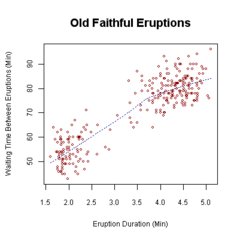
Then they go on to give an exposition of which social issues are and which are not highly correlated with IQ. Here I want to tear my hair. They show beautiful curves displaying how IQ correlates better with income or crime than does parental socio-economic status or education. But there are no error bars or scatter plots (like this) and I have no way of evaluating the comparisons—especially since sometimes the tails on each side have smaller statistics and are less well measured.
But let’s stipulate that the results are largely accurate (for the time being—I have 2 other books to read that are intended to refute this book).
They take a little time to worry about "dysgenics"—that with IQ (or "g", hereafter g/IQ) being strongly hereditary, when the smarter have fewer children, the overall average intelligence will drop, and the rate of really brilliant folk will drop even more. I’d think this one of the controversial sections. I think their model of society is a bit simplistic—the machine we built relies invisibly on qualities other than technological expertise—courage in battle, for example. And it relies on virtue, which I've never found to be correlated with intelligence one way or another. And I’ve often read the complaint that the engineers with the brainpower work for companies run by the guys who majored in beer and blondes--and networking.
Then H&M go into differences in g/IQ between populations. I notice that many people are unable to distinguish between statements about populations and about individuals. H&M do, and try to emphasize that point. They try.
They claim that the average measured g/IQ of Americans of African ancestry is substantially (1 standard deviation) lower than that of those of European ancestry, which in turn is lower than the average for Japanese and Han Chinese. If IQ is the measure of human worth, this is a really big deal—but I don’t believe that and H&M claim not to believe it either. Let me repeat that: human worth and dignity have nothing to do with intelligence or education or family background.
The proper first question about such a difference is not “Is this insulting” or “Will this lead to evil” but “Is this true?”
H&M cite plenty of statistics, and if I do a back of the envelope calculation using statistics from my field, I get similar numbers (restricting my sample to Americans—there was a brilliant Nigerian in our group for a while).
If this is correct, it destroys the iron rice bowl of the “disparate impact” industry. They’ve fought tooth and nail against the idea, as have a generation or 3 of education fadsters.
But it isn’t enough to have the right enemies.
H&M go on to review what has been tried, and what the results have been. Poor nutrition or early disease can stunt the brain, and great progress has already been made in dealing with these—though they think, and common sense suggests, that we hit diminishing returns long ago in this country. (Except possibly for pre-natal nutrition.) Head Start, as implemented, is worthless. (I examined Head Start’s report back in 2013 and came to the same conclusion--by grade 3 there was no effect.)
One thing that helped seriously at-risk children was adoption at birth—but this was not tested for less at-risk children, and as a policy this falls under the category of Like Hell You Will.
Some education seems to have an effect, but H&M didn’t say whether these studies were successfully replicated.
Me talking: One thing that nagged at me was the description of backwoods whites in Kingdom of Cotton. This was a seriously pathological society—feckless, uneducated, and to all appearances dull-witted. A century and a half later things didn’t look nearly so bad in that population, though drugs and lack of jobs have apparently started to make a mess of them since then.
Me talking: How g/IQ gets expressed is going to be a function of good luck (disease and environment, for example) and discipline. And if the very notion of being paper-tested is alien, you may do less well than you would with some practice (e.g. the moderate but limited increase in SAT scores with practice). And perhaps education needs to be differently structured for those at the left side, or those with chaotic families.
Me talking: Other inborn skills aren’t easy to paper-test for: musical, athletic, being able to sense what another person is feeling (as opposed to Asperger’s), and so on. Some of these matter a lot.
At any rate, they go on to worry about an increasingly stratified future in which a cognitive elite try to put the rest “on reservations”, so to speak. The Last Psychiatrist opined that prescription drugs were effectively if not intentionally used to zone out many of the underclass. Be that as it may, a “reservation” society won’t work—the inhabitants will burn it down and whatever else they can reach.
The final chapter has policy suggestions.
Chuck disparate impact but keep other parts of affirmative action; chuck civil union benefits (if you won’t commit why should we?); re-evaluate education structure; decentralize regulation so that more is decided locally—and more simply, so interactions aren't too complicated for the slower (Have you read the 1040 instructions?); simplify what you can in law and regulation; and don’t offer benefits for extra children.
The last point won’t fly, and shouldn't.
Decentralization of authority starkly opposes the principles of 1 ½ of our 2 political parties. The affirmative action industry wants to grow, not shrink, and claims that traditional morality is good are met with howls of hatred.
I can see why it raises a stir.
BTW, one of the things that complicates the field is the Flynn effect--that g/IQ scores have been rising since tests were introduced. That makes calibration difficult. Are they rising because education actually improves raw intelligence, or because people are just getting used to tests and therefore getting better at it (e.g. like practice for the SAT)?
Now for a rebuttal.
The Bell Curve Wars edited by Fraser, is a collection of essays arguing with the Bell Curve. I list the authors below.
- Steven Gould: His description of "factor analysis" seems interesting, but his claim that the spike in g vanishes and turns into spikes in other "intelligences" if you rotate the parameter space, and that therefore the spike isn’t important, sounds backwards. He gripes about the lack of scatter plots.
- Howard Garder: Often disingenuous—or maybe he didn’t read thoroughly.
- Richard Nisbett: Cites lots of studies challenging the black white g/IQ gap. Hurray for Nisbett! He actually addresses some of their research!
- Rosen and Lane: Ad hominem from the get-go. Rubbish.
- Ramos: Addresses a few points
- Sowell: Addresses issues of testing among white groups, questions its reliability
- Jones: Ad hominem from the get-go and –oh look, slavery! Rubbish
- Gates: Ad hominem, but mercifully short.
- Andrew Hacker: Claims that tests are biased and points out the ranges in white g/IQ by ethnicity, and then indulges in mind-reading.
- Wolfe: Questions the claim that America is developing a cognitive elite class.
- Judis: Attacks H&M dysgenic claims
- Kaus: Argues about the genetic vs environment, but is also disingenuous—if racial differences are prenatal, changing that would require massive and intrusive intervention.
- Glozer: Asserts that H&M shortchange environmental effects, challenges their “utopia.”
- Peretz: Why don’t we all get along.
- Wiesaltier: Ad hominem, seems almost proud of his ignorance.
- Pearson: Blacks have had it bad, and H&M will discourage them.
- Lind: “Right wing” political history—recognizes role of religion in supporting human equality, but thinks it “ironic.”
- Kennedy: Bell Curve is bad; people who read it are bad.
- Patterson: H&M put in references to material which challenges their direction, and draw the reader’s attention to it—therefore the work has “self-contradictions.” His genetic argument doesn’t sound correct—he implies that intelligence is selected-for and then offers an example where propensity for violence is. If both can be, then his formula is wrong.
A few essays do deserve some followup. I’ll not spend the time myself—there are others who address this sort of detail, and I don't intend to spend what few years I have left trying to become an expert in this field. I think I'll skip the third book.
In any event, one of the thrusts of the book is barely dealt with. How to close the gap may be disputed, but the existence of the gap seems not to be. Given that gap, and given that we’re all in this together, what can we do to make sure there is a dignified role for everyone right now?
Maybe some combination of education and encouragement and pre-natal nutrition and whatever may raise the average black achievement—but if that only helps those who are children now, it doesn’t tell us how to structure things for today's adults. And Hacker points out that gaps exist among white ethnicities too—it isn’t a strictly racial divide.