Wednesday, June 05, 2024

Pray to Live

by Henri J.M. Nouwen Thomas Merton: Contemplative Critic

It's a short book. The first half is Nouwen's description of his life and ideas, and the second half is quotations from Merton's work that illustrate the description.

Merton could be contradictory--saying one thing one time and the apparent opposite another.

His personal journey looking for solitude left him with a more expansive idea of how to achieve it, and the conviction that solitude made him more part of the community.

He flirted with notions from Zen, noting commonalities in practice of meditation, but was alive to the radical difference between that and Christianity.

He held a "we're all sinners" approach. The quotations from My Argument with the Gestapo are less than compelling literature. I hate to say it, but Merton sounded holier-than-thou. He grew sorry for some of his earlier attitudes, perhaps this was among them.

His writing on the early civil rights movement dug in hard into the importance of white repentance and being taught and transformed by the prophetic vision of the oppressed blacks. Some of it sounds very weird over 60 years later. The intervening years haven't been kind to the nice binary he worked from.

Merton wanted to be a hermit; he sought a union with God he thought was only possible in solitude. His attitude towards solitude changed with time, but he always seemed to have the conviction that the contemplative life was superior.

I'm not sure that's quite accurate. It seems to prefer "dis-incarnation", looking behind everything in creation to find God in "pure" form. But although some contemplation seems important to keep us from getting distracted by the superficial, it isn't obvious that it is a good ultimate goal. If we were to empty ourselves of all acts and thoughts and try to apprend God in as unmediated a way as possible, we would still be as limited by our own nature as if we were singing hymns in the choir.

I've tried to puzzle through aspects of incarnation, although not to my complete satisfaction, and my tentative opinion is that God knew what He was doing when He gave us bodies and announced that it wasn't good for man to be alone. Not all the time, anyway--Jesus went off away from His friends to pray alone, so some alone time is important.

Staff protecting violent students

At La Follette high school in Madison in 2022, two staffers (elsewhere alleged to be "student advocates", though one claims to have been personal secretary to the principal) interfered with the arrest of a 16-year-old found with a stolen Glock at school (modified to shoot BBs??? I think the reporter didn't do his research.), claiming to be his guardians and berating the arresting officers.

As will not surprise the reader, the then-16 is now 18, and thus his name is publishable after getting caught again with a gun at school (Kyshawn Bankston). Whether the two interfering staffers are still employed by the MMSD two years later isn't clear from the story (I think at least one isn't), but this time "at least one of the MMSD security assistants became erratic and upset at MPD for arresting the 18-year-old with a gun in their school... he said ... 'We're supposed to protect kids here. This is the second time you've done this to Bankston.'"

I don't know the people involved, but I've heard a few possible explanations for the staff behavior. They are so focussed on advocating for and protecting the students from the consequences of their behavior that they lose sight of the big picture. They are all in on the ideology/religion that holds that criminals are really victims of society/police. They automatically close ranks whenever anyone of their tribe is threatened. They are associated with the same gangs.

None of the options speaks well of MMSD's hiring and supervision practices.

Tuesday, June 04, 2024

Roman exposure

The Romans, perhaps ashamed of their past, abhorred human sacrifice. According to this, burying unchaste Vestals and drowning hermaphrodite children wasn't human sacrifice—and it probably wasn't. The one was punishment for a criminal offense, a danger to the city, and the second was probably also a public safety measure (it looks human but isn't?).

But they exposed unwanted children. I was curious how the death rate from that compared with that of the explicit child sacrifice among the despised Carthaginians. Short answer: no numbers.

Rabbit hole: Exposure killed a lot of kids, but some survived and what became of them was complicated. How the child was exposed mattered--some were put where they would be quickly found, and some even had identifying trinkets--and some Roman plays involved reconnection with the original parents. But contemporary writers assumed that many would die.

The finder wasn't supposed to make a slave of a free-born baby, but in practice babies were often raised as slaves or prostitutes.

The second link is about the legal status of the children, under Roman, Jewish, and Christian rules. I'd forgotten the bit about "slaves abandoned because they were sick automatically became Roman citizens"--Claudius had some good ideas.

As you probably guessed, with the rise of Christianity, Christians rescued the exposed children they could find, and after it became lawful to have churches, those became places to leave the babies.

Monday, June 03, 2024

Minor amusement

During a boring interlude, I wondered what sequences of continuous functions you might get with $f(x)$, $f(f(x))$, $f(f(f(x)))$, etc, and when would the sequence converge? Restrict ourselves to $x \in [0,1]$, and require that the function also stay in that range. Figuring out the convergence is not a tough problem: if the sequence converges to some $f^{\infty}(x)$, there's only one function that works.

The sequence might not converge at all: For $f(x) = 1-x$ the result jumps back and forth between two graphs. I don't see why you couldn't generate longer chains of repeating graphs.

Or it might converge, but not to something continuous. If $f(x) = x^2$, the graphs get flatter and flatter, and $f^{\infty}(x)$ would be $0$ for $x \neq 1$ and $1$ for $x = 1$

If you parameterize the function and play games with the parameters, I'd bet you get chaotic behavior in there somewhere.

I used pari/gp to create the base images and gimp to create the animations. I know, all the cool kids use python.

FWIW, I noticed that the high school math classes used the same graphics calculators over the time all our kids were in school (12 year age range), and marveled that there'd been no improvements over that time. Well, there have been, and the ubiquitous cell phones can easily download an app that will do their algebra factoring etc for them. The math classes don't dare use anything more recent, or the kids would use their shortcuts and not get the hang of algebra themselves.

Tuesday, May 28, 2024

Despair and purpose

The hymn had the line "threatens the soul with infinite loss." When do we see that infinite loss?

Despair testifies to that loss. Nobody cares if a leaf blows. If the stakes in our lives were as trivial as that, mere chance or determinist, why would we care? If there were no purpose, if nothing mattered, winning and losing would be so much dust, of no more account that yesterday's breakfast.

But despair says that the significance of success or failure in life is greater than the life itself. Some despair that there is any purpose in life, their pain testifying to how important a purpose would be.

Despair doesn't see the whole picture, of course, and so it expedites the very infinite loss that it dreads.

Monday, May 27, 2024

Kilauea caldera collapse

A time-lapse from the USGS:

For Memorial Day

see this post on poetry and the aftermath of the Civil War. (Ambrose Bierce would have had crisp words for some Madisonians.)
While Bierce, as a veteran, urges the nation to honor all of the American dead, North and South, Melville the civilian promotes a larger reconciliation between the former antagonists, with the goal of preserving the Union.

Sunday, May 26, 2024

Teaching algebra ideas in elementary school

Back in the 90's I offered to help at the local elementary school, and somebody took me up on it. They assigned me a half dozen 3rd grade TAG students and gave me a package called Hands-On Equations, in which students use marker and number manipulatives to get a feel for how to manipulate equations.

The theme of the system is a balance scale, and the balancing rules are made easy to visualize. Once you're set up, both sides of the scale always have to balance. You can add numbers to both sides, split into groups to show division, and get a feel for what it means to have a name for an unknown. The video shows a newer version, in which the cubes have actual numbers. I like the older approach better: if you want to represent 12, you count out 12 cubes onto the workpad. It makes numbers easier to visualize, and to separate into groups (divide), or to combine groups (multiply). Since you don't have to do the translations (a 10 cube is the same as a 5 and a 5), the lesson is simpler to visualize.

The kids learned the material quickly enough, and the last lesson had a sneaky problem or so that would trip up kids who were guessing their answers. I thought it was a clever approach. There was one more day than lessons, so I ended by giving them a little explanation of clock math and triangle math, not as parts of a field of study, but as examples of mathy things that didn't work like the usual counting numbers.

Advice to analysts

"What I Learned in 40 Years of Doing Intelligence Analysis for US Foreign Policymakers" by Martin Petersen: From September 2010.
During one of the most challenging times in my analytical career, I worked for the finest analyst I ever knew. In the middle of the Tiananmen Crisis in 1989—when everyone’s hair was on fire—I found him late one afternoon going through a stack of musty old reports. I asked him what he was doing. He said, “I am looking for things that did not make sense then, but do now.” He found some, and it profoundly affected our line of analysis.

The article ends with this:

The colleague who teaches the Kent School’s Art of Review Seminar with me tells a story about Abraham Lincoln, who in one of the darkest hours of the Civil War attended a Sunday service in that little church that still stands across from the White House. On his way back, he was asked by a fellow parishioner what he thought of the young reverend. Lincoln replied that he had a strong voice and clear message, but that he failed to do one thing; he failed to ask us to do something great.

It's a pity the agency deteriorated so badly. We could use some intelligence.

Thursday, May 23, 2024

Kill switch

"ASML and TSMC Can Disable Chip Machines If China Invades Taiwan" "Firms can remotely shut off advanced EUV chip-making machines"

Oh joy. I assume that mainland Chinese industrial espionage made those firms a target years ago, if only to be able to duplicate the work themselves sometime. I think I'm safe in further assuming that they were largely successful. If so, what are the odds that the mainland Chinese now have the ability to shut off those machines themselves?

Wednesday, May 22, 2024

Oopsies

Putting your processing "in the cloud" has some nice scalability features. For example, the student registration program needs only a few CPUs most of the year, but for a few weeks it's nice to have a few hundred instances running, without having to have those systems idle the rest of the year.(*)

Putting your data "in the cloud" has nice redundancy: it can be in several different datacenters. If an earthquake takes out one, there's another datacenter that has it too, or maybe a third. Yes, you pay a bit more than managing your data yourself, but the tools are there to access your data from anywhere.

Until it isn't there. It seems Google deleted the account of an Australian pension fund, and all of its records went poof. No backups--pointers to backups went poof along with the account.(**)

an inadvertent misconfiguration during provisioning of UniSuper’s Private Cloud services ultimately resulted in the deletion of UniSuper’s Private Cloud subscription. This is an isolated, ‘one-of-a-kind occurrence’ that has never before occurred with any of Google Cloud’s clients globally. This should not have happened. Google Cloud has identified the events that led to this disruption and taken measures to ensure this does not happen again.

Until it does. Luckily, at $135 billion, "UniSuper (is) a big enough company that, if something goes wrong, it gets the Google Cloud CEO on the phone instead of customer service."

Fortunately a wise planner at UniSuper spent the extra money to have a backup cloud service from an independent vendor, but for a couple of weeks they weren't able to send out pension checks. (I hope that wise planner wasn't fired for spending too much money.)


(*) You pay extra for speed. If you want your calculations done sometime this year, the CPU time is cheap. If you need to crunch a lot of numbers for results in time for the conference next week, expect to pay more.

(**) That is a security feature. If you could get access to data that used to belong to somebody else's account, you could do nasty things with that information. So, no account means no access. A new account will almost certainly not be exactly the same--I wouldn't design it like that, anyhow.

Saturday, May 18, 2024

Transporting heavy blocks of stone

Rivers meander sometimes, and the Nile valley is wider than the Nile, which seems to be a bit to the east in its valley. Archaeologists have wondered how the stones for the pyramids got to where they are now, and hypothesized that the Nile used to run more to the west--closer to the pyramids--than now. Bringing them downriver by boat makes excellent sense, but why drag them miles across the land to the west side of the valley?

Nature has a report from a group that combines "radar satellite imagery, in conjunction with geophysical data and deep soil coring," to "identify segments of a major extinct Nile branch" which ran at the western edge of the valley, where the pyramids were built.

The dating seems to be consistent with the era in which the pyramids were built. It's not a gigantic surprise, but it's nice to see it verified.

Thursday, May 16, 2024

The Farmer's Journey

I heard a talk on applying "the hero's journey" to memoir writing, as a framework for telling the story. I can see that for some life stories, or adventures, but there are other callings. The contortions to make my life story fit the hero's journey would stand out among side show grotesques.

My story's more like "the farmer's journey," where what is required of the hero is perseverance and faithfulness and working with what he's been given. Not that I'm an exemplar of those virtues; I've often been more of a "Look! A squirrel!" sort. But that seems more like the theme of my life. This incident or that can be shoehorned into the HJ model--I gather most stories can. But seriously...

The "farmer's" decisions are significant, the task takes effort, there's strain and pain sometimes--but they are spread out over years. I don't say one calling is better than the other (that's God's call about His callings), though one makes a livelier story than the other. Frodo would have starved to death long before Mordo without faithful farmers.

Monday, May 13, 2024

Inkling Variety Hour

I found the their Podbean site from their Youtube channel. The former is updated, the latter not. Interesting, but time consuming.

A cure brings its own issues

A link from AVI's page points to the Orthosphere, where today you find a post on Lewis Carroll and formality in worship. I admit that when I read the Sylvie and Bruno books I paid little attention to the prefaces, and Carroll's complaints. Have a look for yourself. A necessary correction to irreverent informality brought the risk of superficial formality. "a liturgy that requires the congregation to kneel in prayer is a liturgy that will teach many in the congregation—especially the children—how to pretend they are praying."

In the books referenced, Carroll tried what I take to have been a novel blend of the surreal and natural, in which fairyland intermittently overlaps our world. I recommend the books, with the caveat that I found Bruno's lisping accent gratingly precious. Sylvie and Bruno and Sylvie and Bruno Concluded

But take my literary recommendations with a grain of salt; I also like Pippa Passes

Savings

Somehow, at the end of the day, I can't find any of the time all those timesaving shortcuts accumulated, much less find any accrued interest from it in the time bank.

Sunday, May 12, 2024

Rand sacrifice

I ran across one of those Ayn Rand memes on sacrifice the other day, and remembered how I'd reacted when I first read about it fifty years ago. Contra Rand, a sacrifice isn't giving up a greater value for a lesser, but exactly the opposite: giving up a lesser value for a greater. A mother giving her child the last bread in the house isn't doing it because she values the child less but more. You sacrifice the party night to study for your electrodynamics exam because you value passing the course more.

The conflict comes when you value the lesser good more than the greater one--you don't love having good lungs better than you love cigars, or you don't love God in your neighbor more than your entertainments. The glory of the sacrifice comes from the glory of the higher good involved.

In her view, enlightened self-interest will always pick the greater value--but who enlightens that self? Someone who explains that good lungs are a great lifetime value, and that the world is wider and deeper than the simply physical universe--someone who does the sort of thing she complains about. Unless you are born and grow with perfect wisdom and enlightenment, you need someone to teach you. And WRT her strawman, I don't know anybody who says you should love a stranger more than your family--except politicians and Marxist theorists.(*)

She had a pretty fair understanding of what the socialist state involved, and what sort of people were attracted to it (she'd observed for herself) but I don't put any trust in her diagnoses and her prescriptions.


(*) Elisha asked a widow to feed him first in honor of God, but then he backed it up with a miracle. We might be in a better place if we applied the rule about what to do with false prophets...

One aspect of being human

"He was made man:" Not separable, but both truly God and truly man. He was subject to our natural limitations--only two arms, only two eyes that don't see when it's dark ... and subject to the Dunbar number limitation.

"But I tell you the truth, it is to your advantage that I go away; for if I do not go away, the Helper will not come to you; but if I go, I will send Him to you." The Spirit living with us is not subject to the time and space and "number of friends" limits that a man is. The Spirit of God is not less present than Jesus was, just differently present.

Tuesday, May 07, 2024

Complicated job?

The other Sunday a gentleman stepped over to the corner where I was running the sound and slides, and noted with a little awe that the system was complicated. The sound board looks daunting, and the cabling behind the scenes certainly is, but I let him in on the secret. The experts set it up the day before; I just tweak the thing. (In a pinch I can add microphones, but the infrastructure is given.) And the slides and video and slip-stream video--likewise. (In a pinch I can make some changes, but they upgraded the software and a lot of the stuff I used to know, I don't.)

No great skills are required for the job. The only gift needed is the spiritual gift of showing up. And paying attention.

Sunday, May 05, 2024

Neutrality forbidden

The political economy of Solon’s law against neutrality in civil wars, evaluated in game theory.

I posted about Solon's counterintuitive law that punished people who refused to take sides in a civil strife. The paper linked at the top begins with a little history of arguments about Solon's law--quite a number of people living 2600 years after the event are certain that a report written only 200 years later must be mistaken. Would a wise lawgiver put in a clause that might cause his laws to be overthrown?

The authors apply some game theory to the Athenian situation (whose population was legally divided into classes by wealth), assuming that revolts would be driven by rent-seeking high-status leaders. They find that the rule requiring everybody to join the melee tends to suppress the inclination of the wealthy to try to corner the whole pie.

It isn't obvious, and I suspect the origin of Solon's law might have been more emotional, driven by exasperation, instead of decided by calculation.

It might be instructive to game this out in modern America. We have had fringe revolutionists for a very long time, with such luminaries as Charles Manson, Bill Ayers, and the current pro-Hamas occupiers. The sociopolitical system we have works for most of the people. In a conflict with no neutrality, the revolutionists would be terribly outnumbered by the people with something to lose. The only way for the revolutionists to survive would be to battle from underground, robbing banks to get funding (as many of them did), and hope for the "best" (aka chaos they could exploit). It seems Solon's rule wouldn't change much.

OTOH, powerful and better-connected people who want more power and more complient plebs (you can think of a few on the opposite side from you, and an opponent think of a few on your side, and both of you be right) are able, now perhaps even more easily than in Solon's time, to persuade masses that their cause is existential. Without neutrality, they'd have to persuade more than a plurality. Would that reduce the risk of civil war?

No. The powerful aren't any wiser than you or I, and self-deception is just as popular a pastime with them as with us. And once a war gets rolling (or even just the pre-war posturing heats up), especially if it involves populations larger and more diverse than a mere city-state like Athens, there's no predicting the direction.

It doesn't look like a silver bullet to me. It might help with the fringe revolutionaries, but they're arguably cultists, and game theory considerations don't enter when you're talking about ultimate values.

UPDATE: Of course, forbidding neutrality is stunningly arrogant. Looking at warring factions, a legitimate option is "A plague o' both your houses!"

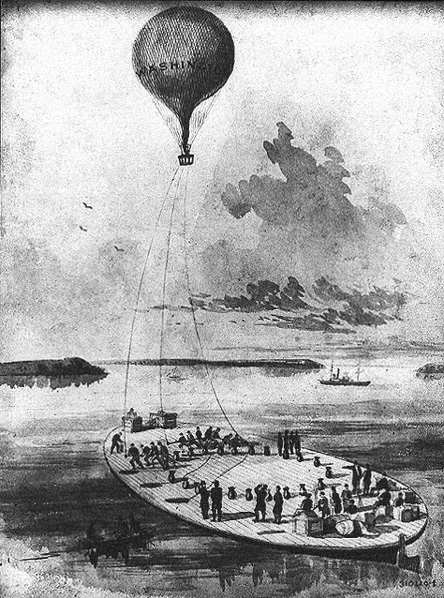
Aircraft carrier

I'd not heard before today that the first aircraft carrier served in our Civil War. It was a modified steam tug.

The picture above is of a different, just slightly later, machine.

The balloon service was important in reconnaisance during the war. Which hill did the other guy put his cannon behind? Are your shots getting close?

Not that the brass used the balloon intelligence well...

Friday, May 03, 2024

TRC or War and Economic Crimes

The Liberian president has, by executive order, established a War and Economic Crimes Court. Plenty of people got away with murder, and plenty of other crimes, during the civil war.

I had thoughts about this 14 years ago, and I haven't heard anything to change my mind. The buried weapons may not be so accessible any longer, but they're easy to come by, especially if you make common cause with one of the regional terrorist groups. It wouldn't be wise, but politic calculations aren't famous for wisdom.

I think this is dangerous.

Thursday, May 02, 2024

Exceeding authority

In Fremantle's diary he describes a prisoner handover:
When I arrived I found that General Hardee was in company with General Polk and Bishop Elliott of Georgia, and also with Mr Vallandigham. The latter (called the Apostle of Liberty) is a good-looking man, apparently not much over forty, and had been turned out of the North three days before. Rosecrans had wished to hand him over to Bragg by flag of truce; but as the latter declined to receive him in that manner, he was, as General Hardee expressed it, "dumped down" in the neutral ground between the lines, and left there. He then received hospitality from the Confederates in the capacity of a destitute stranger. They do not in any way receive him officially, and it does not suit the policy of either party to be identified with one another.

Odd. I hadn't remembered Vallandigham at all, though I must have seen the name before. During the Civil War he was a leader of the Copperheads (sympathizers with the rebels): "Vallandingham wrote that he knew his public opinions and sentiments aided the Confederate war effort, raised public skepticism against the Lincoln administration, raised sympathy for the Confederate soldiers, and encouraged Northerners to violate the wartime laws of the Union."

He complained that the federal government was usurping power, which was true enough, as demonstrated when he was arrested and given a military trial (Lincoln had been allowed to suspend habeas corpus). Lincoln had him "sent through the enemy lines to the Confederacy", where he said "I am a citizen of Ohio, and of the United States. I am here within your lines by force, and against my will. I therefore surrender myself to you as a prisoner of war."

His biography is fascinating--including how he died. He was brave--he had that going for him. Also an anti-abolitionist, even pro-slavery. You could almost overlook the abuse of power used against him.

"Vallandigham's deportation to the Confederacy prompted Edward Everett Hale to write "The Man Without a Country."" (The story has a good scene or two, but it is painfully unrealistic, and the inspiration seems strained.)

Monday, April 29, 2024

Temple Passovers

A book cited Josephus The Wars of the Jews telling us that during the reign of Nero a Jewish population estimate was made based on the number of Passover lambs sacrificed. That was counted to be 256,500 (some rounding likely). (And for the census, the resulting estimate was 2.7 million.)

The sacrifices were supposed to only be done from the ninth hour until the eleventh (3pm to 5pm, very roughly). That's a pretty tight window; almost 36 every second, almost 2200 every minute!

From this source I picked up a description of the temple passover (different from Moses' and from the current one) that seems consistent:

The paschal lamb was slaughtered in three groups… when the first group entered and the Temple court was filled, the gates of the Temple were closed. A tekiah, teruah, and again a tekiah were then blown on the shofar. The priests stood in rows, and in their hands were basins of silver and basins of gold. … An Israelite slaughtered his offering and the priests caught the blood. The priest passed the basin to his fellow priest, and he to his fellow, each receiving a full basin and giving back an empty one. The priest nearest to the altar tossed the blood against the base of the altar. While this ritual was performed the Levites sang the Hallel [Talmud Pesachim 64a].

I don't know how old the lambs were, but a 50 pound lamb would have something over a quart of blood (6% of body weight), and assuming that only about half of that is taken, and half of that is actually thrown on the altar, that's about 64 cubic meters of blood to drain (and wash!) away. From this site: "Beneath the floor of the Azarah courtyard, near the southwestern corner of the Altar, was a cave. Access to the cave was by means of a 2-foot square hole that was covered by a marble slab. In the floor of the cave was a natural system of drains that led the blood of the sacrificial Altar out into the Kidron Valley below the Temple Mount."

In two hours--call it three because drains can be slow--that's a lot of drainage. I'd heard it said that the result, including the necessary rinsing, would have made blood and water flow visibly, which John noticed in Jesus--a connection I wouldn't have thought of.

If the people stood 300 abreast, with the "bucket brigade" (I'm sorry, that's what it sounds like), that leaves only a few seconds for them to slaughter the lamb and move out of the way for the next people. I think you'd need several rows of people all at work at once. I guess it could work, with good traffic management and thousands of priests.

I remember when a delayed Delta flight disgorged into the Paris airport. It looked like complete chaos at the desks, but somehow we all got processed quite quickly. They got used to this sort of thing, and knew how to manage it.

Still, wow.

Sunday, April 28, 2024

Cotton Kingdom 2

A few years ago I read Olmstead's Cotton Kingdom, but found only volume 1. Project Gutenberg has remedied that problem.

Much of the book consists of his travel experiences, going on horseback through Texas and Louisiana and Mississippi and Alabama. Rarely was he able to stay in a hotel, and had to rely on the hospitality of strangers (for a consideration). One of the slaveowners stood out from the rest: his slaves had a great deal of freedom, education, and his admiration.

The great cotton planters were not so wealthy as appeared, and thanks to perverse incentives were frequently ruining the value of their land and their slaves in a fixation on cotton sales.

The latter part of the book is his analysis, economic and sociological, of the claims for the wisdom and beneficence of slavery that were current in his day.

A few snippets:

"Visited sixty families, numbering two hundred and twenty-one souls over ten years of age; only twenty-three could read, and seventeen write. Forty-one families destitute of the Bible. Average of their going to church, once in seven years. Several, between thirty and forty-five years old, had heard but one or two sermons in their lives. Some grown-up youths had never heard a sermon or prayer, until my visit, and did not know of such a being as the Saviour; and boys and girls, from ten to fifteen years old, did not know who made them. All of one family rushed away when I knelt to pray, to a neighbour’s, begging them to tell what I meant by it. Other families fell on their faces, instead of kneeling."

.

"I was told by a gentleman in Washington, not long ago, that he was travelling in a county not a hundred miles from this place, and overtook one of our citizens on horseback, with, perhaps, a bag of hay for a saddle, without stirrups, and the leading line for a bridle, and he said: 'Stranger, whose house is that?' 'It is mine,' was the reply. They came to another. 'Whose house is that?' 'Mine, too, stranger.' To a third: 'And whose house is that?' 'That's mine, too, stranger; but don’t suppose that I'm so darned poor as to own all the land about here.'"

.

"Were there no Free States, the white people of the South would to-day be slaves."

.

"There is one other characteristic of the Southerner, which is far more decided than the difference of climate merely would warrant, and which is to be attributed not only to the absence of the ordinary restraints and means of discipline of more compact communities in his education, but unquestionably also to the readiness and safety with which, by reason of slavery, certain passions and impulses may be indulged. Every white Southerner is a person of importance; must be treated with deference. Every wish of the Southerner is imperative; every belief undoubted; every hate, vengeful; every love, fiery. Hence, for instance, the scandalous fiend-like street fights of the South. If a young man feels offended with another, he does not incline to a ring and a fair stand-up set-to, like a young Englishman; he will not attempt to overcome his opponent by logic; he will not be content to vituperate, or to cast ridicule upon him; he is impelled straightway to strike him down with the readiest deadly weapon at hand, with as little ceremony and pretence of fair combat as the loose organization of the people against violence will allow. He seems crazy for blood. Intensity of personal pride—pride in anything a man has, or which connects itself with him, is more commonly evident. Hence, intense local pride and prejudice; hence intense partisanship; hence rashness and over-confidence; hence visionary ambition; hence assurance in debate; hence assurance in society. As self-appreciation is equally with deference a part of what we call good breeding, and as the expression of deference is much more easily reduced to a matter of manners and forms, in the commonplace intercourse of society, than self-appreciation, this characteristic quality of the Southerner needs to be borne in mind in considering the port and manners he commonly has, and judging from them of the effects of slavery."

.

There really was something which, with some sort of propriety, could be termed a gentry in Carolina and Virginia in their colony days; yet of the names which are now thought to have belonged to it, as descended of brave, loyal, and adventurous cavaliers, some I once saw in London upon an old freight-list of a ship outward bound for Virginia, with the addition of tinker and tailor, poacher and pickpocket, all to be sold for life, or a term of years, to the highest bidder when they should arrive. A large majority of the fathers of Virginia were unquestionably of this class.

Sunday, April 21, 2024

Blogging as essay format

"For in Calormen, story-telling (whether the stories are true or made up) is a thing you're taught, just as English boys and girls are taught essay-writing. The difference is that people want to hear the stories, whereas I never heard of anyone who wanted to read the essays." The Horse and His Boy, C.S. Lewis

I wonder what he'd have thought of blogging. He wrote a pretty fair number of essays himself, many still eagerly read.

Saturday, April 20, 2024

Magic servants

If you didn't have electricity, or natural gas/oil, or gasoline, how many servants would you need to maintain your current lifestyle? (Setting aside things like e.g. air travel) There are lots of things that we don't have to do ourselves because our magic servants do it for us.
Cooking?Somebody needs to chop the firewood, and maybe cook for the others
Hot bath?Chop wood, heat water and bring the water to you
Washing clothes?Part time washer, maybe more to wash for the others. Hot water needed too
Driving?Somebody to maintain the carriage, take care of the horses, clean up
Internet?Somebody to run to the library to ask your questions
Warm in winter?More wood chopping, and you might a lot of it if your house is big. Also extra cleaning because of smoke residues
Cool in summer?Need a big house for tall rooms, big windows, which implies extra cleaning from critters and pollen getting in
Phone calls?Messengers
Water the lawn?Fetch lots of water from the well

At first it looks manageable--you don't need a full-time wood chopper in summer--but washing and cleaning time adds up, and since you're providing lodging for them you need more servant time to take care of the others. Maybe you and your neighbors could board horses in a single neighborhood facility and split the costs, but your current lifestyle presumes the convenience of instant use of a vehicle.

I'm guessing at least 3.

Tuesday, April 16, 2024

Parallel?

A cousin spent some time digging around her family trees. The oldest record she found was a court record from England several centuries back. An (probably, records aren't always reliable) ancestor of hers had blocked off a public road and was charging tolls.

I just paid the second of the Houston toll bills. We've been using I-Pass, but Texas doesn't recognize that, and Houston has at least two independent toll systems.

Monday, April 15, 2024

Self sealing fuel tanks

I'd read about them in WWII history. Here's a history.
One of the chief difficulties encountered in cooling gasoline by dropping dry ice into it lay in the fact that as the dry ice extracted the heat from the gasoline, gaseous carbon dioxide was liberated and in the process caused heavy boiling of the gasoline. While we could reach the desired temperatures very quickly by using adequate amounts of dry ice, we were limited to the amount which would not cause all of our gasoline to bubble away and be lost. ... This same effervescing of the carbon dioxide from the cold gasoline caused us no end of trouble in keeping filling connection caps on the tanks during gun-firing tests.

Yes, they had to test the self-sealing in cold as well as hot; rubber gets brittle in the cold.

The British shot down so many German airplanes over England that it is reputed that they were in a position to supply the Turkish Government with spare parts for the airplanes which the latter had procured earlier from the Germans.

Sunday, April 14, 2024

Teaching mathematics

"Every working mathematician knows that if one does not control oneself (best of all by examples), then after some ten pages half of all the signs in formulae will be wrong and twos will find their way from denominators into numerators."

archive.org version

(The Cours de M Hermite so highly praised here seems not to be in English.)

Prince Caspian

While checking a pacing question, I read a bit of Prince Caspian last night(*). It was never my favorite--the kids didn't have much to do except issue an improbably accepted challenge, and the long flashback was offputting the first time I read it. This writer explains more precisely. It's better than the movie, which is a low bar. I get the attempt to illustrate "You need not fight in this battle; take your position, stand and watch the salvation of the LORD in your behalf" sort of ideas, but it doesn't make for a very interesting story.

At any rate, the answer to my pacing question is that I have a bit of revising to do.

(*) Bronchitis makes composition, or much of any creative work, hard.

Saturday, April 13, 2024

When fighting starts

Buffet said that when the tide goes out you discover who was swimming naked.

I've not learned much in the past few years to encourage great faith in our upper level defense establishment. I'm not a prophet--I don't know how wild this is going to get--but I suspect that if things get bad we're going to learn some unhappy things about our military. (Including the "even if you have overwhelming force stashed somewhere, it takes a long time to position it" law that lots of us civilians forget about.)

We've some nice hardware, but Ukraine should have warned us that a war runs through supply really fast. The Houthis were running through some of our ships' defense material pretty fast--can we resupply quickly?

I wonder if we'll learn the right lessons. Screw-ups and heirs-of-screw-ups are generally good at plausible excuses, if nothng else.

I wonder if Arthur Clarke's short story Superiority is required reading in military colleges.

Tuesday, April 09, 2024

Totality

I missed last totality--my wife had had knee surgery and couldn't travel comfortably. We showed the partial off to people around us last time, in 2017. It seemed odd to me that in downtown Madison, there were adults walking about who had no idea what was going on that day, and who were astonished and pleased to be able to see it through a pair of those goggles.

My wife's experience was different. She was working with an ESL student, going over some exercises and helping keep the lady's daughters entertained by looking at the eclipse from time to time. Other kids came by. "Kids under 11 thought looking through the glasses was cool. Girls over 11 thought looking through the glasses was cool. Boys over 11 looked at their Big Bug to make sure looking would be cool, and when he demurred, they went on their way. 15 minutes later one of the boys showed up alone and begged to look, and 10 minutes after that a second one came."

This year I was the sick one--nasty persistent cough. However, I noticed that it was worse when I lay down and better sitting or standing, so we headed for Taylorville Sunday afternoon (and got there rather late). We got up at 5 to leave at 7 for the revised destination of a state park south of us, realized it was not quite in the centerline (and some of it was closed to boot!), and went back to our original target of Olney. Traffic proved quite light. In town one Baptist church advertised an "Eclipse party" but we stuck with our idea of trying a natural area so we could hear the wildlife, so we went to the wildlife refuge at the east edge of town. So, over the course of the day, did a number of other Wisconsin-ites, and Champaign-ites, and Decatur-ites. I'd picked Olney as a big enough town and roughly equidistant from metropolitan areas, and it seemed to work out fine.

There was a bit of a line for the restroom, but not terrible, and plenty of room to spread out--though latecomers had to park on the road. As occultation began we carried our chairs into the woods to a clearing where Merlin had ID'd a dozen birds, and we'd seen a few silent ones (e.g. a heron) as well.

The light changed, and my wife got pictures of buds and sunning turtles and trees in different lightings. When it got too dark the flash went off for her picture and the turtles scampered into the lake.

It's funny how much we count on some things just being there: it feels like a more profound loss than just light as the "wolf eats the last bits of the sun". What would we do without it? The shadows on the clouds moved in. (There was a light haze above us.)

A friend said he felt a little breeze as totality began; we didn't. He said the birds went silent. Most did, but the tufted titmouse didn't miss a beat. It makes a huge noise for such a little bird. (We used the Merlin recording feature to hear the birds before and during totality to be sure.)

And we got to see the Sun with her hair down, and a couple of little pink pyramids of light just above the Moon's surface. I was awed and fascinated enough that I forgot to take pictures--it would have seemed like a distraction.

Afterwards we hung around town for another hour, and then went to the town park to see if we could see the famous white squirrels of Olney (my wife knew about them; I didn't). We spotted a few draped on branches high above the recent infestation of dogs and urchins in the park.

The traffic back home was mostly not terrible (except in a few places), but not good either, and we didn't get to bed until 1:30. The cough is worse, unfortunately, so I think I'll post this and go back to bed again.

And yes, somewhere across the lake it had sounded like someone was firing a shotgun to scare away the wolf eating the sun. I guess they succeeded.

A not-so-good example

I've heard the wheelbarrow story for ages. You know the one: a tightrope is stretched across Niagara Falls, and a daredevil walks over and back with a pole. Then he does it without a pole. Then he does it pushing a wheelbarrow. Then he does it balancing the wheelbarrow on his head. Then he does it pushing the wheelbarrow full of a couple hundred pounds of bricks. The crowd cheers each time. He asks the crowd, "Do you believe I could push a man across the falls in this wheelbarrow?" "Yes," is the answer. He addresses the nearest man who said yes: "Get in the wheelbarrow."

The lesson drawn is about faith, and the difference between thinking something and being willing to follow through.

OK, ok, but look at it a different way. What's the benefit? The daredevil gets acclaim when he pushed the bricks across the falls--"What a wonderful man to be able to do that!"--but nobody cares about the bricks. If you get in, the daredevil gets the glory, and you get the "He's a very trusting soul" reaction. And the downside is that every now and then you get a wind gust, and a very intimate view of the falls.

Saturday, April 06, 2024

Looking backward

I cleaned up a shelf of accumulated documents yesterday, and among the items I found a 50-year old notebook of mine, with essays on this and that, a talk I was going to give, the beginnings of a few stories, and some math problems that amused me at the time.

We've a grandkid almost as old as I was when I wrote that.

I was struck by a few things--how much better my handwriting was then, and how pompous some of my phrasing was. I'd write on those topics much better now--and did, sometimes several times. I was young enough to know everything, I guess. The story fragments weren't memorable, and I know how organizations work much better now. And the math problems were going at them the wrong way.

It feels strange; would I have liked the old me if we met now? I didn't care for his work; trashed it.

Thursday, April 04, 2024

Liberation

The World War 2 Museum in New Orleans was worth visiting. Yes, it took more than a day to cover. If it had told the viewpoints of more countries it would probably have taken weeks.

I gather that they have a large collection of personal stories--many of which are integrated into the displays. We didn't see all of the displayed ones. I should contact them and see if there's internet access to their archives.

In one auditorium they ran video distillations of interviews with concentration camp liberators and inmates. Horror and anger and disbelief on one side, and joy, numbness, and disbelief on the other. One stuck with me:

An American told a hungry Jewish prisoner that he was free to leave the camp now, and that he'd be happy to take him to get some food. The man thanked him, and in the interview told us the rest of his story, as he explained it to his liberator. (My quotation will not be perfect.)

Here I was a slave. Not a Jewish slave; a slave. If they gave me non-kosher food, I had to eat it or die. If they said work, I had to work or die. If they said work on Shabbat, I had to work on Shabbat or die. But you have come, and now I am a free man. It is Shabbat, and a free man does not have to travel on Shabbat. I will stay here one more day.

Saturday, March 30, 2024

'as I have loved you"

"This is My commandment, that you love one another, just as I have loved you."

We look at this in retrospect, knowing how Jesus showed His love next. No doubt He meant them and us to look at it that way thereafter, and that's the most important aspect to meditate on. But... how would they have herd it then?

How had He loved them so far?

He condescended. That's not available to us, since we're equals. Last time I checked, I wasn't God. But I can try to give up some of my pride.

He was patient. He reproved, but didn't give up on the disciples. We can try to do this, too, though within the church sometimes we have to exercise some discipline.

He protected them. We usually don't have that requirement or option.

He taught them. Teachers among us do so, but most of us are not in that kind of position vis a vis each other. I've taken the approach that everyone has something to contribute sometime or other in Bible study, and most everybody does eventually, but it's easy to spot the teachers.

He shared with them--apparently others provided most of the time.

He encouraged them ("You will see greater things than this", "I will make you fishers of men"). We don't read of many examples, but they act as though He was encouraging them, along with the recorded rebukes. We can do that.

He offered fellowship to Judas one last time, and the advice not to dwell on what he was about to do and deepen the sin. We can, when it isn't damaging the church.

He called them from many jobs, not just religious ones, and called them friends. I think we can handle this one too.

Looking at the list, I think Jesus was referring to love shown in unrecorded incidents; the kind of environment of little things that makes such a big thing.

And then there's Good Friday, which overtops them all.

Thursday, March 28, 2024

Naming my designs

I was seven when National Geographic printed an article on the X-15. That seemed the coolest thing ever, and I promptly got pencil and paper and made a drawing of my own rocket airplane. With the naive confidence so cute in little boys (and so horrible in politicians and generals) I figured that the only thing it needed now was a name in order to be a complete design. The "X" series was in use already, so I picked "V" and explained to my father that this was a picture of a "V-1." I didn't quite follow all his earnest explanation, but I gathered that the name had already been used, likewise the "V-2", and that it would be much better if I didn't try to use anything in that series of names.

I mulled this over for a moment. "Y" just sounded weird, and "Z" too final. I asked if "W-2" would work as the name for my rocket plane.

My father was working as an accountant at the time. I don't remember if he laughed.

Monday, March 25, 2024

Lex DEI

The penny finally dropped. I'd wondered why DEI seemed to be such a cult, overriding any human or observational law and even laws of logic. (In my defense, I never took Latin.)

Friday, March 22, 2024

Muddy speakers

I have heard muddy PA announcements too often. Sometimes it has been a lousy speaker, but often these days it is the room response doing strange things with the frequency mix. High frequencies may get absorbed, low ones echo, and the distortion makes it hard to distinguish words. The room response varies from place to place, and on how many people are in the room, which complicates matters, but for the moment just consider the average.

Suppose you could measure the room response, and use a "smart" speaker that included a correction for that. You send a digital signal, a chipset uses a programmable correction template and produces an output that would sound OK for that room. People will measure your room response for you. Invert that distribution (with cutoffs) and download it into a smart speaker, and you should get clearer messages. The only thing missing is the smart speaker technology--doable, but is it doable cheaply, and is it durable/robust over time and voltage spikes?

Thursday, March 21, 2024

Code of the Street

by Elijah Anderson (1999) This is ghetto Philadelphia from 25-30 years ago. Does it still apply? Probably, the situations and attitudes are self-reinforcing. Is it worse now? The trends were bad when he wrote it, and the politics of race turned pretty bad in the intervening years.

The labels the people in the area used were "decent" and "street," with meanings you can guess easily enough. The "street" boys and young men (growing old can be a challenge) live and die by respect and lack of it. Always being ready to violently defend your status puts a strain on everyone, including the "decent" kids who have to live in the mess--and who have to "look the part" to avoid being preyed on. It isn't entirely "all against all"--sometimes your family members will come out to avenge your injury or death, no matter the facts of the case. The dead are eulogized--everybody pretends they were good people.

Of course the more girls you get to have your babies, the higher your status is--among the other young guys on the street. The girls tend to get pregnant early, unmarried, and very often never-to-marry. Having a baby puts the young woman among the adults--whether she likes it or not. This was at a transition time of "welfare to work," and the welfare check expectation was changing--Anderson didn't know what was going to happen.

There is/was some respect for the older "decent" men who took no nonsense from their families or the street, but not enough to protect them. The "Grandmothers" still have some power--they can coordinate support from family members. However, with the increase in crack addiction, many of the grandmothers are also snared and useless.

At the time crack was a huge problem. I assume new stuff has taken its place. The appeal of the fast life as a dealer is huge, and some even retain a glimmering of a conscience--some dealers were known to return half of a woman's money when they found she'd spent the kids' food money on drugs. Most don't, and try to get anybody, even family members, hooked.

Most decided that the police don't care about investigating crimes--they have to fend for themselves. Given that they also don't talk to the police (as a rule), it's not surprising that the police don't bother wasting their time.

Outsiders have no idea who is "decent" and who is "street", and who is straddling the border of the categories. Not unexpectedly, they don't want to hire "street" and will write off anybody who looks the part or has a bit of a record. Since carrying a gun there is probably wise whether you're "street" or not (I would), it's easy to get snagged by unlawful carry laws and wind up with a record.

As an aside, several police departments have gotten rid of their gang registries--which seemed utterly mad when I first heard of it, and seems even crazier after having read this book. Most people don't cause problems--even in the ghetto. It would be nice to be able to sort out who's who after a stop.

He includes a number of individual stories, generally sad.

The "decent" folk concentrate on individual responsibility. Anderson brings up economics (almost no jobs available) and racism. He touches briefly on how those problems are fed by the crab-bucket "street" culture--nobody wants to hire "street", and the quickest ID is "black with street accent/clothes". And the price of expanding a business in the city being astronomical, businesses move to where the land is cheap and the taxes not so high--tough if you can't catch a bus to get there or need a second car.

OK, nothing unexpected in the book. I borrowed it precisely in order to learn about who, besides the most short-tempered thugs, the street respected, and how: The old heads and the grandmothers. That was interesting, though the trends were discouraging. He claimed that the framework for being hair-trigger, once understood/internalized, helped keep the violence lower than you'd expect. However, "an armed society" doesn't have to be a "polite society."

I was also hoping to learn if there were rules for courtesy. That didn't seem to be a focus of the book.

Naturally one wonders if the material is dated, or biased in some way. I looked around a bit to see what people thought of it. So far it seems to have held up well, though there are some subtleties about women and violence that didn't appear in the book--if they're real.

Monday, March 18, 2024

math creativity

Most mathematicians, like chess players, do their best work young. Not always, though. Claire Voisin describes mathematical creativity.

And yes, sometimes time at work is spent beating one's head against the wall in a fog, and clear thinking comes when you're walking or doing something completely different. I've had lots of great ideas come while I was in a worship service. I don't know if that's supposed to be a gift or a distraction...

Sunday, March 17, 2024

Poor Irish immigrants

But not always, apparently. Tyler Anbinder got ahold of bank records, which included quite a bit of info about the people who held the accounts. "four in 10 day laborers could end up in white-collar jobs"

What winds up in a jewelry box

Some jewelry, of course, including some necklaces that seemed like a good idea at the time but didn't get worn. Mali beads. My father's ruptured duck. And some coins.

These were easy to identify, except for the Louisiana public welfare tax token. Apparently those aluminum coins were for paying sales tax on small purchases where the sales tax was less than a cent. I'd not heard of them before, but my father must have used them.

And a couple of replicas of a bronze coin from Bar Kokhba, though I suspect these are replicas of a coin minted late in the war when they needed lots of money and weren't so careful about the dies.

Several daughters make art, and we have some African friends who might enjoy some of the necklaces. I gather that certain colors and styles go with different face shapes and hair colors and outfits, though I never got the hang of how that works.

Saturday, March 16, 2024

16 days early?

Platinum-crystal hydrogen fuel cells work more efficiently with caffeine. At least on the P(111) and P(110) crystal faces; on the P(100) face the caffeine molecules attach with a bad angle.

The coffee jokes write themselves.

Friday, March 15, 2024

Unexpected finds

We opened her car's hood so I could help youngest daughter replace a headlight bulb. Over in the opposite corner, near the A/C, we found wedged the bulk of a sandwich roll (one chunk soaked with water, the other parts dried crispy). The last oil change was a few months ago, but the bread wasn't moldy at all.

I hope this didn't reflect a culture of over-rushing work at the repair shop. I wouldn't care to eat while working on an oily car.

Thursday, March 14, 2024

Naval Traditions

I'd heard of pollywogs and shellbacks. Apparently there are more traditions than the crossing the equator one: "blue nose", "red nose", and "Sea Squatter", among others. The opening paragraph about "rum, sodomy, and the lash" probably couldn't be penned today: it talks about vices.

Tuesday, March 12, 2024

Emblems of Texas

I gather that visitors to Texas are required to make a pilgimage to the Alamo. I was AWOL on that one. Another, possibly more important requirement, is to visit Buc-ee's. This we did. My impression was of a bigger and more open--friendlier--Walmart, but with a startling amount of "cult" merchandise. My wife got sensory overload quickly; neither of us having quite this reaction. The restrooms were as clean as advertised.

I wonder if the Texas enthusiasm will translate to Wisconsin--they're planning to build one in DeForest. That's not a huge trek, but Walmart and Target and Kroger and Menards and Woodmans and FleetFarm(*) are all closer to me. Midwest practical ... a "one stop for everything" has its appeal, but several of the listed places try for that title too.

(*) Not the same as Farm and Fleet, a similar but unrelated store not much farther away.

Monday, March 11, 2024

Summary

The trip reached everyone we had scheduled to meet and a few relatives we hadn't, and almost all the proposed sights along the way. Pretty much all trip's the surprises were pleasant--except for discovering that the A/C+heater system in the car suffers from a common problem with the Caravan/Voyager line--one of the internal control doors won't budge from the "full hot" position. We had to drive with a window open to keep from roasting. Testing the A/C isn't something you usually do in wintertime...

It gets tiresome only meeting distant relatives at funerals. This was a happier occasion.

Interpolations

The sermon was on the bronze serpent, about how the serpents weren't elminated, but their effect was made easily healable. I got the idea that this was set up in the center of the camp--which is perfectly logical, and would even carry a message to these not-quite-yet-monotheists: "The center of the camp is where God is, and the bronze serpent reminds us of Who sent this plague (and why) and that if we turn and look to where He is He'll freely heal us."

Well, it almost certainly was set up there, but I made the mistake of checking it out before commenting. I will in charity decline to link to numerous sites that interpolate "in the middle of the camp" when quoting Numbers, but Blue Letter Bible seems to indicate that that phrase isn't there.

Oops

Thursday, March 07, 2024

Thanks to first responders

Like Grim. Traffic was stopped for an hour and a half on I65 north at about 318 last night with a 3-vehicle accident: a semi smashed the guard rail on a bridge to flinders. Then the fire and rescue truck that showed up to help was hit by a car. No injuries, but it emphasizes that those guys have a risky job.

Sunday, March 03, 2024

A few thoughts on lesser aspects of the Transfiguration

Why Moses and Elijah? Why not others--Abraham, or Isaiah?

In one sense Abraham and Isaac are present already--in their descendants. In another sense the Father and the Sacrificial Son who are present remind us of Abraham and Isaac who so distantly pre-figured them.

Moses brought the Law, Jesus fulfilled it, embodies it.

Moses had no known grave and Elijah of course had none--both were taken from human knowledge and are returned here together, the resurrected and never-dead together.

Elijah was to be the forerunner of the new representative of God that Moses prophesied. He appears here to salute the new Law and new Lawgiver--and also the little christs who would go on to spread the word and become the new humanity--the church.

This church is represented by 3 men--one who is killed young, his brother who lives a long life and dies naturally, and a third who was executed later after having had a great deal more apparent influence than the one who died young. I have no hard knowledge, but all three were sent, and all three seem to have been largely faithful. Peter had an early dramatic example of not being faithful, and of being forgiven. I suspect all of them benefitted from similar forgiveness later in life as well, as we also hope to.

Peter reflects us and our usual response--make a memorial to capture the uncapturable event.

A word to the wise.

It may be overcast, and be early March, but you can still get sunburned sitting hatless through the 20'th birthday party of an 80-year old submarine. And get mosquito-bit watching for aquatic birds afterwards. (The party was a couple of days late and was an unexpected surprise during our visit to Galveston.) One does not generally get mosquitoes in Wisconsin in Feb/Mar

Friday, March 01, 2024

Houston Space Center

The Space Center at Houston is worth visiting. I’d never seen a Saturn V in person. It’s amazing. It’s also sad to see the corroded electronic cards and chassis; you start to wonder if we could ever do it again. Well, Artemis/Orion has launched once, but there’s not the same drive or, I fear, vision.

We had an overhead tour of the training area. One section of the floor had gratifyingly cluttered benches and desks, but quite a bit of the area’s desks were clean. The spiel of the guide on the tram included the cheerful assertion that the goal was to have a woman person of color on the Moon.

NASA has a bit of a history of trumpeting its "firsts", no matter the details or the significance, so this kind of foolishness has some precedent. But in an era of greater budget squeezes and no great obvious public enthusiasm for the project (or, I'm afraid, clear science or exploration objectives), it seems remarkably stupid to advertise a science/technology project as a social engineering project. The people most interested in "diversity and reparations quotas" would find this a rather inefficient use of money–much better if the money went to projects easier for them to govern.

On the brighter side, there must have been about 400 youngsters there from schools in Texas and several nations south of the border, in brightly color-coded shirts, apparently having a blast. The James Webb lecture was a LCD talk, but with some gorgeous before and after photos. There were lots of hands-on things for the kids, and some of the grownups, and tons of artifacts.

One thing they can do better is the signage. What’s there is OK, but if, for example, alongside the "this is a rocket nozzle from a Saturn V" they had a second poster with a line drawing of the nozzle with important parts labeled, that would satisfy the “general interest” people, but also give more explanation for those who are curious how the thing actually worked. (They often has a provenance explanation.)

Come to think of it, a display of how a rocket motor works is something I didn’t see there. It would best be shown with an animation–several stations for the different kinds of rocket. Maybe I just missed that section–it’s a large place. "How a simple rocket works" could be another display–like a water rocket. It might be too mechanically complex to be a reliable exhibit, though. But…

You’d need a clear plastic rocket (replaced regularly thanks to fatigue), captive to a guide rod. (Or maybe inside a clear pipe? Wear would make the pipe less than transparent after a while). At the bottom something presses it down (a hold-down) onto a plug that corks the bottom of the rocket. Through the plug run two tubes, one long and reaching almost to the top of the inside of the rocket (for air), and the other just inside the bottom (for water). Open the air valve to let air escape, and force water in at the bottom. Then shut the water valve, and force air in until the rocket is pressurized. Release the hold-down, and the air forces the water out and the rocket flies up to the top of the exhibit.

The constraining device would wear (or the rocket plastic distort), and eventually the rocket wouldn’t fall exactly back down where it ought to–so you’d need some guides at the bottom of the system to encourage the rocket to land properly. And some sensors so you don’t have to rely on timing to bring the hold-down into action (suppose wear on the constraining tube makes the rocket fall too slowly). And if this can be cycled once a minute, that’s about 600 launches a day–which is likely beyond the endurance of the toy models. NASA has bunches of engineers–or used to, anyway--so this should be solvable.

Another thing that cried out for explanation was why the instrument panel control switches had guards around them. Adults can guess, if they didn’t know already, but a sentence to explain it to the kids would be nice.

Also, a cartoon of what banks of instrument switches were for what would be nice for adults too. When you can’t read the labels it looks like this.

The atmosphere was upbeat–no mentions of why things failed when they failed, unless it was accompanied by a description of how they managed to fix it (e.g. the solar panel on Skylab, or the CO2 scrubber on Apollo 13.

I’m glad we went.

Tuesday, February 27, 2024

They that make them will become like them

Kristor at Orthosphere has a series of posts on “Anselmian Skeleton Key”, in which he attempts to demonstrate the existence or at least plausibility of a god along the lines of the Christian understanding of God.

His problem is that a demonstration is not convincing, since to be convinced requires assent by the “convincee”.

If the “convincee” thinks the price of changing gods is too high (it might include admitting that he was wrong!), or the risk too great, his “most important”/”greatest thing in the universe” won’t change.

What does it mean to me if I believe that something is the most important thing in the universe? On reflection, it needn’t mean anything unless it is also the most important thing in “my universe.”

I could claim, for instance, that the most important/greatest thing in the universe is Cygnus X-3. It’s the center of the universe (so is anywhere else, of course) and a thing of immense power–nothing in our galaxy comes close. Yet I cannot even see it; nothing it is doing has any bearing on me (yet!), nor does anything I do have any bearing on it. It makes no demands of me, offers no benefits. It is King Log–or perhaps I should say “God Log.” In “my universe” the Earth and Sun are more important–I rely on them every day–as are other things like my wife and home and even my library.

I could claim that the deist god is the ultimate. The Watchmaker non-interventionist god makes no more demands on my life than does Cygnus X-3, though it does help my mind understand the world better, and begin to understand understanding.

In a purely materialist universe I have no reason to claim I truly know anything–I react in certain ways, and that’s all one can say. A deist can point to an origin in order and reason, and to some degree share in that. A deist has a different (I would say higher) conception of himself because he has a different (higher) conception of his god.

Unfortunately the term “Greatest” or “Most important” is a bit ambiguous in “my universe.” Theory and practice diverge. I may say that (e.g.) my wife is the most important thing in “my universe”, and even be willing in a pinch to give up my life for her (giving up everything else in the process), but have little reflection of this value in day to day decisions or attitudes.

Alternatively, I might say that I valued God more than anything, and am committed to my religious duties–unless there’s a game on. Or that all fellow believers/worshippers are my brothers and sisters unless one expresses a political view I don’t like.

In both sets of examples my nominal values conflict with my values as expressed in action. The inconsistency might be due to indiscipline, or there might be an unacknowledged greater value. One, or perhaps both, of those values is an idol for me. (You can easily devise other examples–a good Volk-worshiper who believed the Nazi party was its prophet who nevertheless out of compassion fed strangers without asking if the fugitive was Jewish.)

One can make a test out of this: “By their fruits you will know them.” Do I get more riled when somebody insults my favorite candidate or when someone insults my God? (I can make the excuse that God can take care of Himself but I have to look out for the reputation of my fellow-human. It would even likely be true for insults to family.) Does that tell something about what the real god of “my universe” is?

It might. We have it on good authority that it can be a useful way to find out what somebody else’s real god is too. But it might be merely the result of a sloppy life, or not having worked through the details yet. We’re good at giving ourselves the benefit of the doubt–except for those of us who are skilled at looking for worst cases in ourselves.

Take it a bit further. The work I do demands concentration on the thing more often than the purpose. That doesn’t necessarily mean I value the thing more than the purpose–though that is a risk–but how much should the purpose be part of my mind as I work? Am I working as if for the Lord if I’m thinking entirely about how to get this next leg attached to the chair?

I think the answer might be yes. Obviously that would make the test even less clear-cut that it already is. I suspect we need to be careful judging others, and also be careful judging ourselves. But not complacent. There are plenty of idols around, and plenty of people who are unquestionably idolaters. Greed amounts to idolatry, and we’re a-swamp in that–as usual. I could go on listing other idolatries to which I am not greatly tempted, but I think I’ll stop here.

But what my god is shapes what I choose, and shapes me.

Sunday, February 25, 2024

OKC, OK

A resident tells me that there appears to be an unwritten rule that any vacant building must be turned into either a marijuana dispensary or a "prompt care" medical center (not necessarily with equipment like X-ray machines).

Saturday, February 17, 2024

Important things

Years ago I ran across Murphy's Laws, and a little afterwards found a collection called "Murphy's Laws of Combat." ("Friendly fire isn't", etc)

Three of them jumped out at me as good descriptions of Christian life.

  1. The important things are always simple.
  2. The simple things are always hard.
  3. The easy way is always mined.

It is a good thing to know the nature of prayer. The important thing is to do it, and the knowledge of it (connaitre) will rise from that.

Yes, "My yoke is easy and my burden is light." Eventually.

Wednesday, February 14, 2024

The Assassins

by Bernard Lewis.

This is the history of the Assassin sect: a branch of Ismaili which are a branch of Shia. Thumbnail: Ismaili followed the disinherited Isma'il, who they regard as the correct 7'th Imam. There came to be two branches: Old Preaching and New Preaching. The New Preaching was most prominent in Persia, and the adherents showed two political distinctives: concentrating on acquiring or building castles in mountainous regions, and creating loyalists who were willing to stab those their Imam declared to be enemies--and die in the effort.

Their skills at infiltration must have been terrific, because they were quite successful for a while at making it dangerous for rulers to oppose them. Their killers seem to have limited themselves to daggers, and not used poisons or ranged weapons. And for a surprisingly long time (especially since the Crusaders turned up during their heyday), their enemies and usual targets were Sunnis.

When things started getting hot in Persia they sent missionaries west to Syria, where the "castle in the mountains" approach didn't work so well.

He cites a story, possibly even true, about an Ismaili messenger requesting a personal meeting with Saladin. He was searched carefully, and allowed in, where he said he had a message for Saladin alone. Everybody left except Saladin's private bodyguard.

Saladin said, "I regard these as my own sons, they and I are as one." Then the messenger turned to the two Mamluks and said "If I were to order you in the name of my master to kill this Sultan, would you do so?" They answered yes, and drew their swords, and said "Command us as you wish."

Saladin was impressed.

After a while they decided Crusaders were legitimate targets (or else it was politically appropriate--other times they allied with them), and started killing some. They found that the Hospitallers and Templars were tough, and one of the Ismailis explained why they didn't assassinate many of them. Recall that many of the Middle East rulers held power through personal loyalties, and these didn't always survive their deaths. The spokeman said the Hospitalars would just replace a murdered ruler with another one just as good, so the Ismailis would lose assassins and not achieve any useful objective, so they decided to leave them alone. Another possibility that occurred to me is that Hospitaller security was better (less interest in buying local status luxuries?), making it hard for Moslems to worm their way into proximity--and the Ismailis would never admit that since it would be giving away trade secrets.

At any rate, the Mongols were the last straw for the Persian branch, and their castles were taken from them or destroyed, and in Syria they lost too many local conflicts. The remaining Ismailis seem to have been peaceful--or as peaceful as any other group in the region. Their "force-multiplier" (they were a minority group) assassin corp is long gone.

At the end Lewis found it necessary to cite other scholars' ideas about why the Ismailis went the assassination route--mostly economic. The economic reductionists should get out more.

If you're curious, read it. Lewis writes well.

Monday, February 12, 2024

On reflection

This week I was reviewing a decade-old unpublished math note.

I'm glad I didn't try to publish it. I scribbled corrections all over the thing. How did I come to that conclusion; it's just wrong!

I hadn't taken the time to make notation consistent either (it had grown over the course of several years). It's better now, though not good enough--an interesting approach, but it doesn't go enough of anywhere to call it useful.

Now that I have more leisure to go over things carefully, it's amazing what I find.

Quotations

Dr. Boli has a site devoted to quotations.

Sunday, February 11, 2024

Best laid plans

"Put not your faith in princes" Or in "the people", or in parties, or in plans, or in procedures.

Judas always has a seat at the table.

Who? Jesus' disciples, obtuse though they often seem, had the wit to ask "Is it I?"

Saturday, February 10, 2024

The simpler proving the more profound

I see a bit of a parallel between Martha's talk with Jesus about resurrection and Jesus' interaction with the paralytic brought down through the roof.

In the former passage, Martha hints to Jesus that He can raise her dead brother (though she falters in that belief later), then Jesus reminds her generically of resurrection, which she recognizes as the general resurrection on the last day, then Jesus explains that HE is resurrection--the most important thing, and then He proves it by doing the "simple resurrection"(*) Martha hinted at at the start.

In the latter passage Jesus approves the faith of the man's friends by forgiving his sins, then meeting the scribes' objection to this by asking which is harder, announcing forgiveness or healing (obviously the doing of forgiveness is harder though healing is easier to demonstrate), and then demonstrating his authority to do spiritual healing (or spiritual resurrection?) by doing the physical healing.

It seems like the same general arc: someone wants a physical miracle, is offered a greater spiritual one, and then is given the physical one as proof.

(*) Not that there's anything simple about it. Maybe "preliminary" is better, or "temporary."

Thursday, February 08, 2024

Forest detectors

The forest as a neutrino detector: "We explore in this article the feasibility of using the forest as a detector. Trees have been shown to be efficient broadband antennas, and may, without damage to the tree, be instrumented with a minimum of apparatus. A large scale array of such trees may be the key to achieving the requisite target volumes for UHE neutrino astronomy."

Your first impression might be to wonder what the author's dreams are like.

However, the idea isn't completely crazy. Presumably because of fluid in the living trees, they conduct electricity at some level. Therefore they can act as antennas for radio waves, and in fact this was studied by the military at one point. They tried driving nails into the tree and hooking receivers to wires attached, and also tried winding coils of wire around the trunk. Both actually worked, though the latter worked better.

OK, now the next question is why one would care. Answer: At high enough energies neutrinos do not zip through everything almost without interacting--they actually do interact, generally creating a lepton in the process, which does interact, generally with showers of other particles. Lots of them. Enough that their current, in the Earth's magnetic field, produces radio waves. You can detect those radio waves, and with an array of antennas figure to detect their timing, you can figure out the track of the shower--and therefore the initial cosmic ray.

Getting an idea of where this is going?

There are some technicalities--you want to detect showers that seem to be coming up out of the Earth, or out of a mountain, to try to filter out things other than neutrinos interacting very near the surface. But the general idea is that the patterns of radio waves corresponding to such particle showers can be pieced out of the general radio background. This is already being done successfully in several different experiments.

The bulk of the hardware cost of such an experiment is in the radio antennas, the electronics to read them out, and the labor to do it. If the antennas are already standing around, there's some savings already. Plus, trees are tall, so they'd help pick up lower frequency radio waves.

Another advantage to using trees is that you don't need to find a bare spot to put up your antennas, so you've got more choices for locations. And you don't have to lug a lot of heavy gear around to places that may not always be easy to get to.

Downsides... The electronics costs the same, and is a substantial part of the total. One guy said it cost more than the antennas--he was probably thinking about short antennas, though, not tree-sized. Also you can predict the sensitivity of a steel antenna--how do you calibrate the radio wave sensitivity of jackpine number 88-K?

And, we wonders, aye we wonders, what the wildlife will think of tasty wires strung here and there in the woods. In the planning for the SSC designers realized that fire ants would colonize their electrical distribution boxes, and nibble.

Wednesday, February 07, 2024

Experiencing God

I've heard several people counseling us that we should not want God's gifts so much as God Himself. This seems true enough, and that union with Him would be the goal and summit of life. (In a way wanting to obey is Martha, wanting to be with is Mary, Jesus said the latter was better. Except that we need both--it's hard to be with Him when we disobey.)

There are some subtleties, though--or perhaps I'm obtuse or inexperienced.

Abba Lot went to see Abba Joseph and said to him, “Abba, as far as I can, I say my [daily prayers], I fast a little, I pray and meditate. I live in peace as far as I can. I purify my thoughts. What else can I do?” Then the old man stood up, stretched his arms towards heaven. His fingers became like ten lamps of fire and he said to him, “If you want, you can be all flame.”

Moses was warned that he could not see God and live, and pagan stories recognize this too. The finite, and even the infinite, cannot experience God as He is in Himself. The experience won't fit in our minds, our hearts, our nature. God gave Moses an experience of Himself that would fit in his mind, and He gave us a living image of Himself in Jesus.

How far can we go in union with God?

And since the mystery of our faith is directed toward a God of utter transcendence, the direct experience of His energies leaves the theologian with an awestruck recognition that God’s essence lies yet beyond those energies, and that the theologian is forever unable to experience it. Thus he is left not only negating correlations between his experience and nature, but also negating correlations between his experience and God’s essence.

We're assured that heaven is not imaginable. Even so, it would seem that the experience of God, however infinite, will be consonant with our nature, and so be limited by our nature. Other created things may experience aspects of God that we won't. That wouldn't make our experience wrong or incomplete, of course. It wouldn't even make it finite.

But. Would my experience be limited not just by the shape of our common human nature, but also by how I have failed to conform my life to Christ here?

UPDATE: Dante seems to have thought so

Saturday, February 03, 2024

Currency defacement

Can you guess what this was about? Nollywood star sentenced for stepping on naira notes. "A Nigerian actress has been sentenced to six months imprisonment for tampering with the currency after she was filmed spraying and stepping on newly issued naira notes last year."

"six months imprisonment with an option to pay $250 fine"

I wonder what would have happened if she'd lit a cigar with a 1000 niara note.

From a Nigerian source: "It was at a time there was a severe scarcity of Naira notes following the Central Bank of Nigeria (CBN)’s withdrawal of old 200, 500 and 1000 Naira notes from circulation and replacement of the affected currency notes with newly designed versions which were hard to come by at the time." I'm guessing that flaunting wealth that way when the economy was in a mess from lack of currency was what led them to charge her with currency defacement. Not because she'd done anything substantively wrong, just that she'd angered a lot of people...

Tuesday, January 30, 2024

A Father's Legacy to his Daughters

by John Gregory

His wife had died, and he had reason to believe he would die soon himself, so he wrote up advice for his daughters, under headings of "Religion", "Conduct and Behaviour", "Amusements", and "Friendship, Love, Marriage". And "Introduction".

It would not suit modern Harvard tastes, either in language or sociology, but by and large the advice, or the principles behind it, is sound. His approach to religion struck me as rather more secular than devout. It wouldn't be a "read once and done" book for a young girl; she'd have to re-read it every so often in order to recognize the things in her life and society that John was writing about.

The Harvard book-reading feature is a bit finicky on my machine.

Identify Friend or Foe

The current story says that the drone that hit our troops in Jordan wasn't recognized as a foe. Trent Telenko suggests that it followed a US drone in, and that "the trailed US drone had no IFF transponder at all, as the MX12B micro Mode 5 Identify Friend or Foe (IFF) transponder was only certified in 2021."

To complicate things still more, I assume some of our drones will be duds. Will the transponders be salvageable, and re-used in enemy drones?

Friday, January 26, 2024

art lawsuit

Althouse noted that one of the "performers" in an old exhibit at MoMA was suing. I'd heard of the exhibit some time ago--it sounded "modern art" level stupid. A gallery door was partly blocked by a naked man and naked woman, and visitors had to "squeeze" between them to get in. There was another entrance to the gallery, but I assume there was social pressure to "experience the art."

The man is suing the museum on the grounds that they did not protect him from groping--sexual assault. 14 years after the fact seems a little late in the day to complain, of course, and thus there seems to be reason to doubt his sincerity. But there might be another way of looking at it.

Just as clothing communicates things to other people, adults being naked outside of specific circumstances (doctor's office, group showers, etc) communicate sexual interest. So the situation is intended to be a sexual one, albeit with some implausible deniability ("This is ART, you fool!"). And if the man and woman are so close to the visitors that one has (remember the social pressure) to make contact with them, this seems a bit like unwanted sexual contact: a sexual assault.

It seems a bit unusual for an "assault-er" to complain about reciprocation. Although active groping does ratchet it up rather more than a notch.

Top Buck and Flock Queen

Goat herd behavior: I'd not heard of this before. Goats have never been much in my orbit.
If you are responsible for feeding your herd, they will associate you with the Flock Queen. The herd may attempt to follow you wherever you go and may be in a state of confusion when you are not around.

and

If you move your herd by driving them from the rear, they will come to think of you as the Top Buck. ... If you hold this position, you may have trouble handling the other bucks in the herd who are constantly challenging your authority.

different imagery

Sons like plants and daughters like pillars

Perhaps what comes to your mind is different, but the pillars for a palace makes me think of "beautiful strength", and the grown plants reminds me of fruitful trees. You'd maybe think that social era would imagine blessed daughters as embodying beautiful fruitfulness and blessed sons embodying strength, but the psalmist didn't look at it that simply.