Friday, September 30, 2011

Tevatron

I first worked on a CDF project back in about 1981, years before the Tevatron turned on. The University of Illinois wanted to make the central muon detectors, and Lee thought we could use a simplified version of the Aachen tubes built for UA1. I fiddled around with some extrusions and learned how to make a cosmic ray telescope to trigger the readout and discovered that electrolytic capacitors could sometimes explode (a CAMAC-based prototype TDC we borrowed went fiss/bang and caught fire). At the end of it all I didn't get really good results, and the design was eventually chucked anyway because the drift time was too long. The beam bunch crossing time was going to be longer than the drift time, which would mean we'd have mixed in hits from muons from different collisions, which confuses the reconstruction.

Later on the Tevatron went to more frequent bunch crossings, and as we went up and up in luminosity we started getting multiple interactions per bunch crossing, not nearly as many as at the LHC, but still a lot. So we wound up with hits from different events anyway, but by then we had a much better handle on how to reconstruct tracks and stubs.

I took a break from the drift chamber work to work on my thesis experiment, and then went to Wisconsin as a post-doc. There I worked on UA1 and CDF again: not monogamous, as Carlo Rubia complained about my boss and his team. Since then I've been either full or part time on CDF--1985 to 2011. Funding for my part of the project ends this year along with the beam.

The beam is off, and it is the end of an era--but the data processing goes on, and student analyses and theses will keep going for several more years after that. And some profs will decide to have a look at something they never got a chance to finish; something that the LHC can't do as well. My group was charged with providing software releases to last another 5 years; that are supposed to be robust enough to be ported to the next generation OS with minimal labor. I think we're getting it.

I still have some directories with software for the online system--something to monitor the HV for the Wisconsin muon detectors which I was delegated the job of maintaining after the author left, and so on. Time to clean up.

I worked a little on a few analyses, but kept getting pulled off to fix something, so I didn't actually contribute a lot to the physics. Some, yes; but not a lot. Kind of a gloomy thought to end on, but that's life--I spent time keeping things running and helping people get their jobs going and keeping the data running. And writing code to help make it work, online and offline. It's my fault if I didn't push harder to do the interesting stuff. (OK, some of it is interesting. The W-mass work is useful but not wildly exciting.)

I took shifts back when we had a walk-through that checked the voltages on the HV supply panels and the gas percentages in the mixer in the gas rack (had to climb down into it) and that got you back to the control room in time to do it again. And I took shifts when almost everything was automated, with software to diagnose what was wrong and blink warnings at you (I wrote some of it), and the biggest headache was going through the run validation checklist. VAXes and terminals tuned into Linux and multiple displays. Back in the day dumb terminals were so expensive that Fermilab bought Macintosh computers and ran terminal emulators (the old Macs).

Meetings in the pump room were awful--the pumps downstairs made it very hard to hear anybody. A new room was built later--and still called the pump room. The old one turned into offices which had enough cubicle walls to muffle the noise.

Fermilab got larger, and more and more bureaucratic and rules-bound. Some of the stuff turned out, on inquiry, to be implementing Federally mandated rules, which seemed to appear in new crops every year. Three years ago it seemed as though somebody had gone training-happy and was designing mandatory training courses for everything up to and including garbage disposal (I'm not kidding). It has been quieter since--perhaps the users rose in wrath.

The trailers where almost everybody worked have gotten shabbier and emptier, and nobody is replacing the computers anymore--which is kind of a hassle when you are required by Fermilab policy to upgrade to a new OS that maxes out the memory in the old machines.

I didn't go to the party--there were some family things to do, and I've not been a huge fan of big parties anyway.

UPDATE:
Store 9158 was the last, and run 312510. Final total: CDF acquired 9.977 fb-1. Also see the Fermilab Tevatron timeline.

It is funny that one of the milestones is listed as "First 8mm tape used to record data from a high energy physics experiment." I was somewhat involved in that, agitating for their use. I started a discussion group on the main VAX cluster about the subject, and after a few months the computing division took ownership of it away from me. I don't know if it was because it was getting large and they wanted to manage large discussions, or because there were some rather frank comments about the computing division on it. A few months later they started introducing the tapes


Koans

Zen novices live in a monastary to meditate on questions like "What is the sound of one hand clapping?" or of Gutei's finger or "What is Buddha? Three pounds of flax." This they hope to bring them to enlightenment.

Down a different road one finds other koans: "Does this dress make me look fat?" and "Surprise me" and the child playing with the emptiness of the box instead of the toy. The patient student finds enlightenment there.

Light Notes on Opera

Theory papers are popping up already about Opera. This is the first I've read, and they note the same problem with tachyon-type neutrinos I did (the energy dependence of the speed is wrong), and then add a pion decay issue to the mix as well. The Opera "tachyon mass" is too big and the beam energy is wrong for pion decay with these masses, and the amount of energy available for the electron neutrino in muon decay would be so restricted that an effect should have been seen decades ago. (Muon decay is one type of beta decay. Nuclear beta decay has been studied very carefully in an effort to determine the electron neutrino mass.)

They bring up a modification I'd not heard of before: Coleman/Glashow superluminal particles, where every particle has its own mass and its own light-speed. Weird, but not inconsistent with the data--but neutrino oscillations are very hard to account for in that model.

Naturally IceCube collaborators are hard at work trying to figure out what they can do to confirm/disprove the effect. I am not at liberty to describe this.

That might seem a little rude, but there's good reason for keeping quiet.

The first iterations of the discussions involve a lot of brainstorming and the discussions have to be frank. People have to be willing to say things that eventually turn out to be wrong, or not even wrong. If I were to announce their ideas prematurely, they might be deeply embarrassed by a calculation error that was caught after I announced their ideas; and outsiders who rely on the integrity of our results could be mislead into thinking that wild ideas are what we have actually discovered.

If I suppress names, then it looks like I came up with all sorts of wonderful ideas, and that's not quite honest.

So, I'll mention what I think and what other people have published, but I won't talk about the internal discussions.


Before I posted this, another paper popped up, this one claiming that superluminal neutrinos would brem off electron positron pairs so fast that they'd slow down to low energies long before reaching the Opera targets.


UPDATE: Halzen pointed out that IceCube/AMANDA already excluded differences in speeds of different masses of neutrinos down to a fraction of E-27 for neutrinos in the 10GeV and higher range. So my guess last week about different neutrinos having different speed limits is probably ruled out. I have to puzzle out the paper and see.

Saturday, September 24, 2011

If the OPERA result were true

If you were wondering why the Italian(*) OPERA collaboration announced a finding that will almost certainly be proved wrong, wonder no more. They almost certainly don't believe it themselves, but their experiment relies on the techniques that gave the anomalous result. If they are making a mistake somewhere, they badly want to know where it is. If they aren't--they're happy.

I read their paper (arXiv:1109.4897) and don't see where the problem is, but I'd hardly expect to with the level of detail provided in the paper. You need to get deep into the details; testing the cables and the timing every way you can--and I can't do that. I still think there's a mistake somewhere.

But just for fun, suppose there isn't. Suppose that muon and tau neutrinos of > 5 GeV moving through rock in the Earth's gravity do in fact more faster than the speed of light in a vacuum. What could the reason be, and what might happen next?

Before I mention options, bear in mind that we have several outstanding puzzles in physics:

  1. Reconciling General Relativity (gravity) and the Standard Model (strong and electro/weak forces in a Quantum Mechanical framework). There is no unified model. String theory has been popular for 20 years because it offered a framework for doing this, but so far it hasn't worked. At all.
  2. Dark matter. Nobody knows what it is, though it pretty plainly seems to be there. Maybe it is particles and DAMA saw it. Maybe not.
  3. Dark energy aka acceleration of the universe's expansion. It seems as though the universe's expansion is speeding up, and you can account for that and make some models of the history of the universe work if you throw some "dark energy" into the picture. There's no other evidence for it though, so we should really call this the expansion acceleration mystery.
  4. There are a few little fringe items like the Pioneer probe acceleration, where the devil is in the details: is this the effect of known physics or something new?

OK, let's see, suppose OPERA's result is correct:

  1. All neutrinos go faster than light

    We know from SN1987A that O(10MeV) electron neutrinos and anti-neutrinos move at very nearly lightspeed (within a fraction of 2E-9 of the speed of light)--they arrived only hours before the light arrived. However, the muon and tau neutrinos only a thousand times more energetic move at a fraction of 2.5E-5 faster than light.

    This isn't like the tachyon model, where the speed decreases with energy. Nor does it look like special relativity with a different value for C. Maybe something like v=c+ε E or +ε E^2 might describe it. It is pretty hard to motivate something like that from either classical or relativistic physics. But if it is, it is, and there's something very different about neutrinos.

  2. Only μ and τ neutrinos go faster than light

    This is really weird; just like the previous approach but with electrons and electron neutrinos different from other flavors. The elementary particle hierarchy is now tied into the structure of spacetime and superspacetime. This would be wild.

  3. Neutrinos speed up in a gravity well

    They'd have sped up in SN1987A too, but once flying free they'd be back near C again, so there wouldn't be a huge effect.

    In this case some particles (neutrinos) see a different spacetime structure than other particles do. Once again we have a new link between particle type and gravity. The hot dark matter models have to be redone--I'd think it would make the halos larger and less dense, so you'd need more cold dark matter.

  4. Neutrinos have access to extra time dimensions

    I tried to figure out the consequences of multiple time dimensions some years ago, but I assumed that the observer would never see anything faster than light. If that assumption was wrong, this is exactly the sort of thing you would see: the particle follows a world-line where it moves at lightspeed (or nearly; neutrinos turn out to have mass after all), but we only see one component of the time, so it seems to be going faster than light. I'll have to go back and rework that analysis, just for laughs.

  5. Neutrinos interact with rock to "go faster than light"

    I have no good model for how this would work, but with time we could come up with some sort of phase velocity description of the neutrino that might allow such an interaction. Beta decay starts to look very strange--we'd have to go back to square one for a new model. UPDATE There's a paper on this option now:, and a hat tip to Dorigo.

But is probably some boring clock problem.


(*)Yes, it has collaborators from Croatia to Korea, but it is sited in Italy and Youngest Daughter loves Rossini, so what else can I call it?


UPDATE: It used to be said that every French soldier had a field-marshal's baton in his knapsack. Something similar is true of physicists...

Friday, September 23, 2011

Death Penalty

Wisconsin has no death penalty. I’m not going to agitate to change that. Texas has one. I’m not going to agitate to change that either.

Some things about the death penalty are revolting; all the more so when we try to pretty it up and make it look easy. The guillotine or the firing squad are ugly but fast. We wanted high tech so we went with electrocution, and the clumsy way we do it is not fast and from all reports is often torture.

That’s not allowed. No cruel or unusual punishments, period. Unusual is not a particularly precise word, but we can all understand that torture is cruel. I’m not saying that it might not be appropriate in some cases (if it were true that the CIA was responsible for initiating the crack trade in US cities, the old hang, draw, and quartering might not be adequate punishment), but that doesn’t matter. Under the rules we made, we don’t do it. I don’t know whether we wrote it that way to protect the accused or the souls of the jailers, but we did and there’s an end to the argument.

Lethal injection is even more horrible. Not so much because it is torture (I gather that is usually isn’t), but because we pervert the healing profession into killers. Would you want your ambulance staffed with EMTs who moonlight at the prison execution room? I want a bright line in the sand: the doctor’s profession does not involve killing. Do something else, something fast, something that doesn't involve doctors.

The human body is resilient, with fall-back mechanisms and a reluctance to quit working. There really isn’t a nice way to make it stop.

That said, the death penalty takes crime seriously in a way other penalties don’t. I hear the call for “life without parole” thrown around by people who don’t work in prisons. Is putting murderers with no incentive for good behavior in with the rest of the inmates really such a grand idea? And the call doesn’t take into account an innocent desire for justice expressed in a punishment that fits the crime.

The “I’m more moral than you because I oppose the death penalty” attitude is pretty revolting too. Mercy is a great thing, but there’s something obnoxious about the uninjured brushing aside the blood of the victims to extend a mercy that costs them nothing. If the victims call for clemency, they shall be called the Sons of God. But the self-satisfied outsiders shall be called presumptuous.


I gather Scalia caused a stir with this:

This Court has never held that the Constitution forbids the execution of a convicted defendant who has had a full and fair trial but is later able to convince a habeas court that he is “actually” innocent. Quite to the contrary, we have repeatedly left that question unresolved, while expressing considerable doubt that any claim based on alleged “actual innocence” is constitutionally cognizable.

I won’t say this is a no-brainer, but it isn’t far from it. The Constitution defines the rules for the procedures of government. They won’t always work; nothing ever always works. As long as there’s no improper bias in the procedures, the Supreme Court assumes the outcome is correct. Weighing evidence is for other courts, not the Supreme Court; they are not supposed to second-guess decisions.

Was Troy Davis guilty of this particular murder? I’ve not a clue. A jury said yes. I don’t know how to weight recanted testimony in that culture and environment, and I don’t think his being a gangster was in dispute. The governor must not have wanted to do anything about him; possibly for political reasons, maybe because he thought the original case was good (though I doubt the governor became an expert on the case for the occasion).

May the Lord have mercy on his soul; and on the souls of the executioners. And on us all, trying to find the best way we can in a broken and violent world.

Thursday, September 22, 2011

Persistence

What we immerse ourselves in effects us. Bathe in misogynist music all day and your attitude to the woman next door won’t be as polite. Violent movies and games are known to desensitize us to violence. A diet of hagiography won’t make you a saint, but it will make saintly reactions come to mind more easily; though you may do the opposite out of spite or habit.

I’ve been trying to think of any entertainments or amusements that encourage us in perseverance. It is hard. Almost everything seems to be aimed at distraction and short attention spans. Even ball games are interspersed with ads (if listening on the radio) or gimmicks at the park. With one partial exception, nothing is designed to hold your attention and enthusiasm for more than a few hours at most. That’s probably deliberate, since it means we have to buy more amusements if we want to stay entertained.

If most problems are solved in an hour or half an hour, and there’s always another entertainment just around the corner, we are training ourselves in habits of inconstancy.

The partial exception seems to be video games. I’m an outsider looking in, but some games want you to keep leveling up with harder and harder puzzles. At the end of the game there’s not a lot of tangible reward, and there seems to be a lot of flash and bang to keep the player from drifting off.

I’m not going to say that I want Youngest Son to spend his hours playing video games: I’d much rather he were reading or building or figuring out things in the real world. But perhaps they have their uses.

Faster than Light

The various articles on the subject emphasize that the researchers are having trouble believing the result--and rightly so.

A 60-nanosecond increase over a 730km trip is, if I have the numbers correct, an increase of a factor of .000025. That's pretty huge. For example, consider supernova SN 1987a. The distance to that beast was about 170,000 light years, or about 62050000 light days. .000025 of that distance is about 1500 days. Neutrinos from the supernova were detected a few hours before the light brightening was observed (which is consistent with popular models of supernova explosion, but that's a side issue). Note that: a few hours, not 4 years. That's close enough to simultaneous that I think we can safely peg neutrinos and anti-neutrinos of nuclear energy as moving at very nearly the speed of light.

The only way to make the Opera result work is if higher energy neutrinos move faster, or if neutrinos move faster in matter.

My guess is that this is a clock issue. Somewhere a clock's heartbeat is counting on the voltage upswing and something else is assuming the count is on the downswing, or something of that nature.

Wednesday, September 21, 2011

Another one bites the dust

This hasn't been a good season for bookstores. Borders went under (to tell the truth their selection hadn't been stellar the past few years) and this morning's paper said that Avols is merging/going online only. Avols has been a star among the second-hand book dealers in town for decades, and I've spent more than I ought there. They moved to a new and for me less convenient location, and their stock seemed spread thin in the large space.

But when Shakespeare's Books was forced off the square to become Browzers on State Street, I guess it came too close to Avols.

The report said Avols was merging facilities with A Room of One's Own and switching to online sales. A Room of One's Own is a feminist bookstore--sort of like a porn shop in that it sells creepy and soul-rotting stuff to a specialized clientelle. (Visiting it once was plenty.)

One less place to browse and discover...

Tuesday, September 20, 2011

Win a hand grenade for memorizing the Koran!

When I saw the BBC story telling that al-Shabab in Somalia gave AK-47's and hand grenades and cash as prizes in a regional contest of "Koran-recitation and general knowledge", my first inclination was to make some snarky remark wondering about connections between Islam and violence. But after thinking about it for 5 seconds I reconsidered.

This is Somalia. A machine gun for a 16-year-old would be a little weird in the USA, but not there. Here we'd offer a bike or a car as a prize--it is both useful and a status symbol. There, the AK-47 is the useful tool. I'd not care to wander Somalia without a selection of weapons, a flack jacket, and several people to watch my back. ("In previous years, when the competition was organized in the southern port of Kismayo, the first prize included an RPG.")

As the article also mentions in an afterthought, the winners also received religious books as part of the prize. So the prize for religious memorization was cash, religious books, and a handy local tool. Doesn't sound too crazy, does it? Although I'm not so sure about the hand grenades for third prize...


FWIW, The organizer made the Islam/violence connection themselves

"Youths should use one hand for education and the other for a gun to defend Islam," senior al-Shabab official Mukhtar Robow told the prize-giving ceremony in Elasha.

Lightly edited

Saturday, September 17, 2011

Orphans/Refugees/Titans of Chaos

by J.C.Wright

On the strength of the earlier books I tried this trilogy.

Central issue: 5 youths of uncertain age in a mysterious magical/mechanical boarding school discover that they are not only not really human, but that they are effectively hostages in a universe in which the Greek gods are dominant. Sort of. The covers provide at least that much spoiler.

Wright has very effective descriptions of the gods and demi-gods, and a partitioning of the universes of magic that forms the background for the story. (Mechanical, shamanist, warlock, and multi-dimensional)

In the three volumes the youths grow into their suppressed natures--though they alternately act mature and immature in a sometimes inconsistent way. You'd expect people whose lives are in danger to stick together a little more...

Anyone with a modicum of classical education (as they have) would know not to attempt one of their escapades. It advances the plot, but left me with "who'd be dumb enough to go there?"

Their romantic entanglements are no doubt realistic enough, but I found it a bit annoying, and Colin is a bit much. And the penultimate battle felt a little over-the-top.

Parts of it are excellent. On the whole, I give it a "read it."

Robertson

I heard the clip of his infamous remarks, with the context: a man whose wife had Alzheimer's was stepping out on her; a friend was calling for advice.

I typically ignore Robertson. He takes it on himself to explain what God means by current events, which is a prophet's office, without any credentials for the job.

This is a little hard to ignore. He sounded very passionate about the matter--as though he had some recent personal involvement with the disease. "gone, gone, gone!" Still, empathy is no excuse for jettisoning the truth and trying to void "better or worse" vows.

I don't know if this is something he's held all along, or if personal issues have clouded his judgment, or if perhaps his mind is failing too. His advice was incoherent enough that it may be the latter. Divorce but still provide for care?

I wonder how isolated he is in his organization. I pray he has a friend who can take him aside and tell him that's he's failing as a teacher, and has some public repentance to attend to.

Tuesday, September 13, 2011

From a certain point of view

Liberia recently scored unpleasantly high in the competition for "most corrupt country" (Somalia won the palm) and the President had some words to say about it. I know of no substantiated allegations against her, but her campaign to eliminate corruption apparently has only moved the country a few ranks better. From "All Africa's" report of a press release:
The President asserted that the maintenance of safe havens in Europe and the Americas where stolen resources are stashed need to be addressed by international partners. Bribery, she observed continues to be a menace because international corporations and private sector entities exploit the weakness of public officials.

Perhaps from a certain point of view the last sentence makes sense: suppose a waste disposal firm wants a place to dump stuff without question or oversight. But for the bulk of the people trying to work in Liberia, the statement seems a little backwards. I also rather doubt that most of the police or revenue agents maintain Swiss bank accounts.

Monday, September 12, 2011

Proposal

Let's see: 447E9\$ divided by 287E3\$/job is 1.55M jobs for a year. And the cost is 447E9\$ divided by 50E3\$/job means 8.94M jobs unfunded for lack of money. Assuming the thing is paid for. (\$50,000 was the median household income in 2006)

I ignore second-order effects, which are typically smaller. And I ignore the government overhead in the "job creation," which typically produces nothing but friction--no goods, no services, no security, no knowledge.

IQ

The arguments over IQ have been vicious, driven in part by an implicit assumption that more-intelligent=superior and less-intelligent=inferior. Which, when you think about it, is not really a defensible claim. Humans are more than just intelligences.

White racists creep out of the woodwork in the comments thread after a story about IQ and ethnicity. The PC shriekers come out too; and all in all bringing up the topic of IQ and ethnicity is to waltz into a minefield.

It is encouraging to see things like this. If their research is correct, infectious diseases of infants and young children are the strongest factors in depressing IQ. And surprise: the greatest incidence of infectious diseases of children is in Africa, where one finds the lowest average IQ. Is this the explanation? At least part of it. Nutrition plays a role too.

There are places where we can't do anything about these kinds of diseases: Somalia and North Korea come to mind. But there are places we can.

It isn't as easy as coughing up money for programs. It takes a lot of local buy-in and care and keeping government (theirs and ours) officers under the hairy eyeball. And malaria is a protean beast. And in the end disease fighting has to be driven by local demand using local resources.


There are plenty of black racists too, and AmerIndian, and Brahmin, and... I've met some. Around this neck of the woods white racists generally keep their heads down. Way down. And they don't get a lot of news play either. But you hear a lot of "evil white folks" talk in a university town.

Commenting

I recognize myself. Yesterday I read a post applauding someone's 3 paragraphs on 9/11 and the church. The first paragraph begged for a fisking--nonsense on stilts, and self-aggrandizing to boot. The second and third were right on and exactly what I've said many times before. "Duty calls:" fisk and praise!

I know where that leads. I quit commenting on one site when a comment of mine was taken as too flip, and I realized I'd spent over an hour composing an explanation/justification. No more of that. On a few select sites, I'll put my oar in--but only a few. The world needs my wisdom a little more than it realizes, but much less than I think it does.


For those not familiar with it, XKCD is a popular online strip. Uneven, of course, but with enough nuggets to get it tacked up on bulletin boards everywhere I go.

I bit my tongue and didn't comment.

Sunday, September 11, 2011

Commenting 10 years after

A few years back someone quoted an astonished stockbroker as saying that he hadn’t realized that the stock market could fall broadly. It hadn’t happened before in his career.

I’ve not had to search out 9/11 commentary. It turns up everywhere, and quite a bit of it is piffle. Pundits portentously write about "the day America lost its innocence" or "that changed the nation" or other grand statements. Since saying what everybody knows already doesn’t seem to warrant a pundit’s paycheck, they look for deeper meanings or twists and counter-intuitive conclusions: "Did Ben Laden win?" Short answer: No

A nation has no memory—it only has a history. People have memories, and many people watching the horrors had never seen war before—and for them it was a kind of loss of innocence. But not for the nation. It was not even close to the worst wartime calamity we’ve faced. The Civil War provides the stars for that prize hands down, and King Philip’s War is up pretty high on the list too (though technically we weren’t a nation at the time).

I am surprised how little has actually changed (except for air travel). Starting from the bizarre decision to cut taxes in the middle of a war and urging us to live normal consumer lives (or else the terrorists win), things go on as they have. No sacrifices were necessary, uniting against the enemy didn’t last very long among the political partisans, and nobody seemed to keep any strategy in mind.

The follow-up attacks mostly failed, except for the "Muslim starts shooting people" variety. There’s no striking animosity towards Muslims in the US.

Perhaps it is good that there’s not much change—I don’t want animosity towards Muslims, though I think suspicion of anything and anyone funded by the Saudis is in order. (Lobbyists and imams both) I don’t think we could maintain a fever pitch of excitement for as long as this war is likely to take. This is going to be a long war, with intermittent campaigns and attempts to use proxies. I expect us to be pretty much out of Afghanistan within the year. Nation building isn’t working very well and the Pakistanis outmaneuvered us. And Iraq should keep winding down. But that doesn’t mean the war’s over. This isn’t going to be a war of tanks and jets, except sporadically(*)

But the absence of strategy is bad. We know what we want—not to be attacked by Muslim jihadists anymore—but not what needs to happen to achieve that. We snagged a lot of AlQaida, but it was only one instance. We scared the bejabbers out of a number of Muslim governments and from this distance it looks like they cracked down some, but that wasn’t going to last in any event, and the "Arab Spring" is reshaping governments in not always happy ways.

And there are still a couple of big holes in the ground in New York. Assume cleanup took a year: after 9 years we haven’t been able to make use of some prime real estate in one of the most important cities in the world. Something is broken here, and I don’t think it is Ben Laden’s doing.

(*) UPDATE: That prediction didn't work out very well, did it? We'd be a lot better off if it had.

Tuesday, September 06, 2011

"Why Muslims are still mad at America"

Steven Kull uses the results of a 5-year study to go into some depth about a point I touched on seven years ago: A substantial part of the animosity is religious. They think we are anti-religious, and in particular anti-Islam.

We attribute goodness and part of our power to using a secular state; decoupling church and state. That is anathema to many Muslims all by itself, even without the aggressively anti-religious propaganda of recent years. And the philosophical underpinnings of our culture are from a particular religious framework inconsistent with Islam.

I haven't seen any signs that anybody in Washington gets the picture.

Monday, September 05, 2011

Ease of use

Youngest Son is a cadet in Civil Air Patrol. He told us tonight that so far driving a plane is easier than driving a car. (No takeoff/landings yet.)

40% with mental disorder?

Reuters proclaims today that Nearly 40 percent of Europeans suffer mental illness
Europeans are plagued by mental and neurological illnesses, with almost 165 million people or 38 percent of the population suffering each year from a brain disorder such as depression, anxiety, insomnia or dementia, according to a large new study.

With only about a third of cases receiving the therapy or medication needed, mental illnesses cause a huge economic and social burden -- measured in the hundreds of billions of euros -- as sufferers become too unwell to work and personal relationships break down.

"Mental disorders have become Europe's largest health challenge of the 21st century," the study's authors said.

Forgive me for being skeptical. Or don't forgive me; I'll live. The kindest thing I can say of this is that it is overstated: 38% disabled? The text doesn't actually doesn't say so.

Lumping insomnia and dementia together is dishonest. Insomnia is too common a condition, with too many benign causes, to be mentioned in the same breath with dementia.

I have seen before conflation of sadness with depression, and of normal worry with crippling anxiety--treating them as a spectrum and tagging them all with the name of an extreme. I judge that this work does the same. Given the quotations from the researchers, I suspect that much of the misrepresentation comes from them.

So who benefits from this scare piece? Read the article for one clue. The other beneficiary is Reuters. So maybe you shouldn't bother reading it.

Apropos of nothing

Is bacon grease a "sooie" sauce?

Yes, I used to live in Arkansas. How did you know?

Saturday, September 03, 2011

Mists of Everness

As I wrote earlier, I found the conclusion to The Last Guardian of Everness. This 2-book set is a fantasy novel with a few SF touches set in modern America. And because it is set in modern America you inevitably learn about the results of dragon/fighter jet battles. If that disconcerts you too much you won't like the book. I found it a bit disconcerting myself, not least because I think he overestimates the capacity of their weapon pods. And there are (also inevitably, and only obvious because of the American context) a few comments on the political scene--relevant to the story, though. And political or religious comment is par for the course in the genre; sometimes even overwhelming--yes, I'm talking about Katherine Kurtz.

The story mixes Oberon, Prometheus, fallen angels, Lovecraft and even a touch of Lewis and Wagner with Celtic legends and Freemasons of the USA and the Grail. Several of the characters start the second volume dead.

A gripe or three: The mouse intro is a huge tone change. I don't think he plays fair with the problem of the ring. The modern battles don't ring quite right. And the kelpies don't come off quite right either.

Recall that Everness is the border between real and dream--otherwise some things seem unmotivated. Acheron is rising (think R'lyeh meets Dis) and time is running out. Sound the horn for the end of the world, or not? Who is who, and what mythic figures are they presenting to the world?

My eldest would have probably figured out a few of the forgotten secret names quicker than I.

One measure of the quality of a story is: do you want to find out what happens next? I did. And I recognized myself in one of the characters.

Tuesday, August 30, 2011

What does your car say?

I wonder if the supervisor saw the man's car before he hired him at the lumberyard. His vanity plate says QTN TYM.

On another, a spot of irony: One of those "COEXIST" bumper stickers, next to another that says "Recall Walker." I guess they just can't get along...

Monday, August 29, 2011

Libya Continued

Don't count chickens before they hatch. The rebels haven't won yet. Even if Q!daffy meets his Maker tomorrow, they still won't have won--unless their goal was partition.

What a mess. If Libya was a military problem for us, we should have seized the hour when the revolt first started and the regime was still fragile, instead of waiting for permission from the Arab League (promptly withdrawn as we knew it would be) and the UN. We couldn't have put much in the air quickly, but just knowing it was coming would have made a huge difference. If it wasn't a military problem for us (as I suspect), why should we have gotten involved in an Italian effort? They're the ones who need the oil deals. (Or are we not supposed to notice that?)

Granted, Q!daffy was a menace to his own people--that's the reason given for intervention. But one of the points of having nations in the first place is to limit complexity and conflicts. The price you pay for this is sovereignty--within a country they do what they like and you only quarrel if they threaten you. Complain, posture, sanction--but not drop bombs.

Q!daffy's mischief-making in other lands earned him retaliation, so this isn't unjust--but that's not the justification given for NATO's intervention.

There are many spellings of the villain's name, and I'm trying this to see how it looks

Friday, August 26, 2011

A bas les moustiques!

I think I got that right. At any rate, some places are seeing a mysterious decline in the number of malaria-carrying mosquitoes, which does not seem to correlate fully with the use of treated nets.
Prof Meyrowitsch added: "Other scientists are saying they can't test their drugs because there are no children left with malaria.

"They observed this in communities with no large interventions against malaria or mosquitoes. It may be the same scenario that the specific mosquitoes that carry malaria are declining very fast now"

The rainfall has been a bit chaotic, but I can testify that that doesn't always help much here in Wisconsin, and the study's PI speculates that there's a mosquito disease of some sort awing--"a fungus or a virus, or they're may have been some environmental changes in the communities that have resulted in a drop in the number of mosquitoes." Or maybe there's an invader in the water--some wasp that likes mosquito larvae, for instance.

Good luck to whatever it is.

Wednesday, August 24, 2011

The Last Guardian of Everness

by John C. Wright

I'd read a little of his stuff on the web and decided to try one of his books. This one is fantasy. The name soup at the beginning is a bit hard to deal with, but skim over it and go on. He owes a huge debt to Lovecraft's The Dream-Quest of Unknown Kadath--the youth's adventures are in that exact tone, until things start going south. Wright upends fairy-tale conventions about youthful adventurers, and mixes selkies, kelpies, storm giants, witchcraft, Eden, unicorns and Camelot into the plot as well (with a hat tip to Zelazny?).

The family charged with watching for trouble from within the dream-castle (moved from England to New England) has only two faithful watchers left: the grandfather and the grandson Galen. A warning comes, and you've three guesses which one sets out to learn what's going on. A crime repented too late, various treacheries, and overwhelming odds run up against layered defenses understood almost too late.

Wright goes into some detail about what selkie culture would be like--they are seal creatures that like to take human form by donning a human skin (and unlike the Wikipedia variety, skin humans to get their collection). Who is who, and who can you trust?

I didn't read the cover blurb carefully enough. This turned out to be book 1 of several. I guess I'll have to locate the others.

Race in Science

The news was full of reports about breathless claims of racism in awarding science grants. Careful reading past the headlines would tell you this was in the National Institutes of Health. But where were the details? Forbes has details. Look beyond the headline and read the story.
While the data showed no racial disparity in award rates for grant proposals that earned high priority scores through peer-review, it seems that mediocre proposals from white scientists were 10% more likely to ultimately receive funding than mediocre proposals from black scientists.

And then when you look in more detail at the proposals you discover that the disparity has other origins.

Bill Frezza's observations are mine also: far from being old-boy bastions of racism, science in academia courts minorities and has special mentoring programs for women. I was on the committee to select the previous department chairman, and was startled at how many people said "We should have a woman this time." (We did.) To be fair, the group I was tasked with interviewing are, like me, not professors; and often our circles aren't as wide. So we typically have frequent contacts with people in the research group and not so many out of it. Outside the group we often have to guess based on reputation, or on a kind of fairness: "High Energy provided the chairman last time, and Plasma before that, so maybe it is Nuclear's turn." Hence the "this time" yardstick.

You are expected to deliver--the peer reviews I've worked with looked at the material, and were not informed of the race of the person submitting the paper. In some fields you know everybody anyway, of course.

Tuesday, August 23, 2011

Recent books

Yes, I have been reading. I detected a serious absence of knowledge about church history in ours, and have been putting together some lessons on the subject. So far I've read The Spirit of Eastern Christendom (600-1700) Jaroslav Pelikan, The Early Church by E. Glenn Hinson, and Early Christianity which are essays in honor of Freund. Freund's book is a bit too fat to survive travel in my pouch for bus reading, and I've not gotten very far.

Hinson's is more readable so far, though Freund is not bad. Jaroslav introduced me to much in Eastern Christianity I was not familiar with. His style is a little confusing sometimes, and there's been more work done on churches farther east since the book was written, but I found it interesting anyway, and you might too. A scorecard of who's who would be helpful, though.

One thing I've taken away from these is that the later Christology debates, including Chalcedon, were generally a waste of time. Not that the participants were stupid--some certainly weren't and the subtle points make my head ache. But ask the question: "Can you use the same word nature when referring to both the divine and the human without using caveats?" I didn't see the matter traced out, but I suspect that the developing interest in apophatic theology in the eastern church was at least partly driven by the head-splitting arguments about the nature of God. The west, merely trying to stay afloat, did not have the luxury of debates over fine points, and the lack of Greek in the west kept them out of the loop.

I notice that those discussing the very early church establish their bona fides as impartial scholars by stating or implying that Jesus had no interest in reaching the Gentiles. This differs somewhat from a statement that Jesus' mission was to the Jews--especially if you hold Trinitarian beliefs ("It seemed good to the Holy Spirit and to us").

Saturday, August 20, 2011

Telescreens

Is somebody having a little joke here?
A new type of Internet-connected television, due out before the end of the year, has built-in software and hardware that send data about what is on-screen to an Internet server that can identify the content. Web pages being viewed using the same Internet connection as the TV set can then tap into that information. The system can identify any content onscreen, whatever the source, whether live TV, DVDs or movie files playing from a computer.

I suppose this is technically feasible, but I'd think it fairly easy to spoof. And do you really want the world knowing you're watching Jackass? If you give the TV to somebody else they miss out on a critical little feature:

The first time the TV is switched on, it asks users if they would like to opt in to the data-sharing service. If they say yes, it prompts them to accept a terms-of-service agreement. Individual sites and apps must ask for, and be granted, permission to access the data the TV makes available.

Probably there's a reset somewhere, and it might even work. I suppose some people do surf while watching, and maybe want to see if there are pictures of one of the actors on the web, or want to see if the restaurant the hero smashed up is real. I'd think that attitude is either "induced ADD" or a sign that the TV show is boring. More likely the surfer is just somebody in another room.


Can you think of uses for this technology? How about keeping tabs on people watching Al Jazeera? It wouldn't be too hard for next year's model to build a snooper into the TV's ethernet controller. Not a fancy one, but something that scans the local net in promiscuous mode and watches for key words. You could even remotely reprogram the key words you are looking for. The modified system would not quite be a 1984 telescreen, but in the same family.

Given how good firms (and government agencies) are at keeping secrets, it wouldn't be long before the modified system was cracked. Spy on your neighbors?

It sounds stupid enough that somebody would probably build it.

Assuming this first generation system isn't simply a practical joke...

Friday, August 12, 2011

On the lighter side

NPR polled for the hundred best science fiction and fantasy books.

Let's see: I've read 9 of the top 10, 14 of the top 20, 20 of the top 30, 30 of the top 40 and about half from there on. Some clearly deserve the slots (Tolkien, Ringworld, and so on) and some are pretty mixed (the whole Dune series? not just the first?), and some I wonder about (a book by Moorcock is on the list? seriously?). Quite a few recent authors show up--I wonder how many would still be on such a list 30 years from now.

If people are still making such lists 30 years from now, I'd suspect "Stranger in a Strange Land" and "The Handmaid's Tale" will be nowhere as their respective politics ages away, also "2001" where the movie was better than the book.

Your guesses as to which will be absent?

Wednesday, August 10, 2011

Mobs and Riots

The "flash mob" thugs can always be where the police aren't. Without massive proactive cell-phone surveillance there's no way to be ready--and even that wouldn't be useful for long. The mobsters are clever enough to come up with new code phrases, or buy cell phones via proxy, and all the surveillance would do is provide evidence for conspiracy charges against those the police were actually able to find. And that word "proactive" should make you nervous. It will worry people who happen to look something like the current groups of thugs.

So to first order--forget the police. They cannot stop the attackers and will probably never catch any but the very careless.

As usual, the problems are both acute and chronic and efforts to deal with one aspect will make dealing with the other problematic.

So how do you deal with the acute problem--the threat of a mob of thugs breaking your head or robbing you blind? There are limits to what you can do with dogs or concealed carry--no doubt sometimes helpful but not a general solution. Situational awareness: yes, know who's around and where retreats and impromptu weapons are; that can help. But without a group willingness to join together to fight back you're still going to be alone against the mob. Unless people will run to help when they hear a cry for help, the odds of a short-term good outcome are poor. Do we have that? Can we get it?

Also poor are the odds of a long-term good outcome. One contributing factor to grand lawlessness is the lack of social constraint on petty lawlessness, and a big factor in that lack is the absence of a sense of "we're all in this together." Remember the broken-window effect in New York? Successful petty crime and a lack of any push-back or cleanup breeds a sense of invulnerability in the criminals and potential criminals--"the winners are the destructive and violent, so let's be winners."

I suggest that a willingness of honest citizens to band together both to fight off attacks and to present a united front against petty offenses is good in the short and long term. I'm not sure the surviving thugs will reform in the medium term.

The devil finds work for idle hands, and one classic approach to dealing with youth disturbances is to try to get the youth employed. This won't work well with the older thugs--and I'm afraid from what I've seen over the years that "older" here probably means not out of grade school. I'm not sanguine about the odds for older youth because: well, who's going to hire them? There aren't a lot of jobs to start with, and most employers like the help to show up and actually work--and the ghetto doesn't train you to do either. And the jobs there are aren't going to pay enough to match what Americans of all stripes think they're entitled to. Even with a thorough-going "moral cleanup" I fear we have a lost generation in the pipeline there. A sense of envy, of entitlement, and of despair don't motivate a lot of Horatio Algers. Add consumerism pumped in by ubiquitous ads and nihilism and hate from the music--it is an uphill climb.

Its been climbed before, though.

The racist aspect to the flash mobs is an ugly complication. It won't help race relations if situational awareness demands that we start keeping a wary eye out on the movements of black teenagers in the vicinity. Undoubtedly other criminal groups will find the flash mob technique useful (department stores circulated warnings about gypsy gangs with similar tactics years ago), and that will somewhat dilute the racial factor. Just like in Britain--the initial rioters were black, but the followups are ghetto youth of all races, attacking and looting for the joy of it.

For some reason that doesn't encourage me.

Recalls

It may come as a surprise to some, but in this hotbed of recall mania I was paying no attention to the recall elections. First--our Senator/Representative was perfectly safe and under no recall threat whatever. Second--I knew one man who was recalled, and remember what he thought of recall elections. They should be for substantive things--not political maneuvering like hiding in Illinois, or unpopular votes.

To give a flavor of the rhetoric: the paper quoted a local 'expert:'

"The revolution has not occurred," said UW-Milwaukee political science professor Mordecai Lee, a former Democratic lawmaker. "The proletariat did not take over the streets."

One could just as easily say that the counter-revolution by the Praetorian Guard didn't quite come off.

Monday, August 01, 2011

Debt Deal is Meaningless

AP reports that the spending cuts proposed don't appear in any substantive way until 2014. By the rule I proposed in April, this agreement is a lie--the spending reductions are not real. The first announcements told me the reductions were going to be trivial: \$1T in 10 years=\$100B/year which is chicken feed for the feds. But if they aren't even going to kick in until 2014, they aren't real, they're only promises--and the lifetime of a Washington promise is less than one budget cycle.

They're not serious.

Sunday, July 31, 2011

Greek Fest 2011

We spent an hour and a half at this year's Greek Fest at Assumption Church. It was too hot for Youngest Son to have much appetite, but the tour was fascinating. It was given by the man who painted the icons, and he discussed church history and ethnic churches and the structure of the layout from the point of view of the icons. Christ Pancrator is at the top of the dome (symbolizing heaven), and Old Testament figures are in the barrel of the dome. The gospel writers are in the pendulants, and Mary in the front arch. But the saints on the walls at ground level are commissioned by members of the congregation, and will be different from church to church. The iconostasis is a reflection of the curtain in front of the Holy of Holies--and so on.

Very interesting--I'm sorry my better half (and Oldest Daughter) weren't there; they'd have enjoyed it.

The food was good, and spelling turns out to be important--there's quite a difference in edibility between a balaclava and baklava.

Austerity Budgets

The UK prison doctor Theodore Dalrymple tells about what austerity budgets look like in Britain. He knows the health service best, and explains the counter-intuitive effects.
Unfortunately, it does not follow from the existence of immense waste in the public sector that budget cuts will target that waste. After all, most of the excess is in wages, precisely the element of government spending that those in charge of proposed reductions will be most anxious to preserve. It is therefore in their interest that any budget reduction should affect disproportionately the service that it is their purpose to provide

This is not mere theory; he describes the practice too:

I have seen it all before, whenever cuts became necessary in the NHS budget, as periodically they did. Wards closed, but the savings achieved were minimal because labor legislation required the staff—the major cost of the system—to be retained. Surgical operations were likewise canceled, though again, the staff was kept on. To effect any savings in this manner, it was necessary for the system to become more and more inefficient and unproductive. It was as if the bureaucracy had reversed the cry of the people at the beginning of Lewis Carroll’s Sylvie and Bruno, "More bread! Less taxes!," replacing it with "More taxes! Less bread!"

The implications are obvious.

Parenthetically, kudos to a man who can cite Sylvie and Bruno. It is not as good as the "Alice" books, but it is worth reading nonetheless.

Saturday, July 30, 2011

Earplugs aren't the answer

Since Youngest Daughter works Sunday morning she wants to go to the Saturday evening service, which is "Contemporary:" aka ear-ringingly overamped.

Aha I thought--just pop in earplugs the way I do when I run monitors! No more pain!

When I run monitors I keep my mouth shut. True, the earplugs brought the guitar and drums down to reasonable levels, but I forgot that the sound of my own voice was going to be entirely bone conduction, and trying to sing was an exercise in "can I guess the notes I'm straddling?"

Friday, July 29, 2011

Debt Ceiling Kabuki

I recommend Elizabeth Scalia on the subject. The other day she quoted Day as saying we love God only as much as the person we love least, and concluded from that that politics was poisonous to the soul, since she found she didn't like anybody in politics.

Yes, I read Friedman's column decrying "equal blame." I can't be bothered to fisk it.

Thursday, July 28, 2011

Economics

I can't resist this quote. Peter Berger says that Bernard Lewis wants to write an essay on economics, starting thusly:
"In the history of human thought science has often come out of superstition. Astronomy came out of astrology. Chemistry came out of alchemy. What will come out of economics?"

When you consider that Keynes is still taken seriously, you have to wonder if there ever will be a real science there. A graffiti on a warehouse in Madison claims that "Debt = Money." (All you need is the Philosopher's Stone.)

Where is King Canute when you need him?

"What we’re trying to do is save the world from the Republican budget. We’re trying to save life on this planet as we know it today."

Nancy Pelosi, 28-July-2011

And lest we forget: "this is the moment when the rise of the oceans began to slow"

For those who forgot, King Cnut was mocking his flatterers when he commanded the tide to halt.

Social Acumen and Spatial Skill?

A study by Johns Hopkins seems to suggest that social skills (being able to put yourself in the Other's shoes) correlates with accuracy in predicting another's physical perspective. (Hat tip to Terri)

There are obvious questions about causation here, and whether there's some kind of feedback between the skills.

My observations tell me that one can have poor social skills and superlative map skills, though.

Monday, July 25, 2011

Doers and not hearers only

Ruminations chapter 2:17-23

Now you, if you call yourself a Christian; if you rely on the gospel and boast in God; if you know his will and approve of what is superior because you are instructed by the gospel; if you are convinced that you are a guide for the blind, a light for those who are in the dark, an instructor of the foolish, a teacher of little children, because you have in the gospel the embodiment of knowledge and truth—you, then, who teach others, do you not teach yourself? You who preach against stealing, do you steal? You who say that people should not commit adultery, do you commit adultery? You who abhor idols, do you rob temples? You who boast in the gospel, do you dishonor God by breaking the law? As it is written: “God’s name is blasphemed among the Gentiles because of you.”

and on worship

Butter and Margarine

You may know that Wisconsin used to ban margarine. It is the Dairy State and protecting its citizens from evil imitations was a live issue. In the debates back in '65, a blindfolded State Senator was unable to tell the difference between butter and oleomargarine. I can. You probably can too. Read the link and find out the rest of the story.

Some cities are girding themselves to ban margarine again--this time because of the demon trans-fats. The more things change...

Sunday, July 24, 2011

Prayers for Norway

Horrible crimes. Pray for comfort for the wounded and the families of the dead, and for God's mercy on the dead.

When I heard of this, the first thing I wondered was "Why the youth camp?" If he's bombing government offices, wouldn't the more logical targets be racing out of the buildings nearby? A second bomb, or a rooftop sniper post would seem more in line with an anti-government attack. What sort of twisted man goes over an hour out of his way out to shoot kids afterward?

Later reports seem to explain it. The youth camp was an organ of the Labor party--sort of as though the Democrats ran a Boy Scouts. Government ministers spoke at the camp, and I gather some of the youth were interns. So he must have thought of it as a target composed of the political elite, not a "terrorize the people" target.

I suppose I could check this by reading his manifesto, but I don't want to give him that much honor. He showed himself vile; I don't want to hear his excuses.

Update: People who were nearby helped the swimmers despite the gunman.

Saturday, July 23, 2011

About that Higgs result

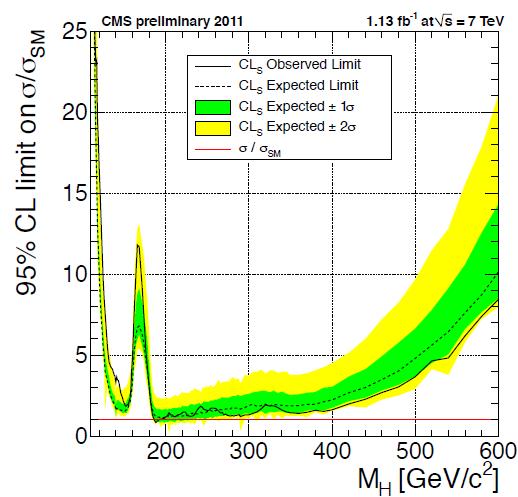
You could easily see exclusions in the final plots (called "Brazil" plots because they reminded somebody of the flag), and some limits, but there was also what looked like a little spike on the low mass side in one class of analyses, for both CMS and Atlas. The quiet mutter was "2.8σ, imagine if CMS and Atlas were able to present a joint result, maybe we're starting to find the Higgs?"

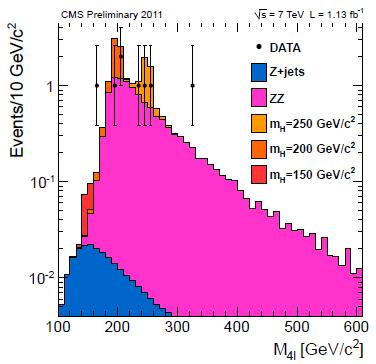
Well... If you look at some of the distributions that went into the final result, you can see nice looking colored histograms that come from the monte carlo, and little black crosses representing the data. And one of those little black crosses is on the left hand side of the peak representing background expectations. That means in the lower mass region, where we tend to have lots more data. Let me emphasize that again: until you start applying cuts on the data (muon isolation, jet Et > some value, and so on), that region of the mass plot has many orders of magnitude more data than the right hand side (high mass). The plot doesn't look like a hill in the middle of a field, but like an insane ski slope falling from left to right.

The monte carlo (random number estimators of the background, in this case) distribution we show rises very sharply on the left and falls more slowly on the right, and that lonesome data point is sitting where you don't expect much of anything--hence you get a spike in the final plot. The "gentle" slope is on the right and the cliff is on the left--and there's a datapoint out past the edge of the cliff. 10 events when you expect 8 is a yawner, but 1 when you expect 0 seems dramatic.

But this is very sensitive to how well you modeled your background. Suppose you goofed, and that sharply rising left side should really rise more slowly--meaning you expect more events at the low mass end. Now you see 1 event when you expect 1/3 (for example), which is nothing to write home about.

Expecting 1/3 of an event means something like this: If you triple the beam time you expect 1 event, or if you do the same experiment 3 times you expect to see 1 event--at some confidence level. Taking such small probabilities into account is important. Suppose there's a lottery drawing with 100 tickets. You have 1, Joe has 10, Ann has 15, and so on. Your chance of winning is 1/100 (pretty small), Ann's is 3/20 (not huge), and so on. But when you add up all those small probabilities you get 1--which in this case means somebody will win. (The experiment has no such guarantee, of course.)

So what could go wrong in the background modeling? All sorts of things, many of which are shared between CMS and Atlas, such as the parton distribution functions. "Partons" are the generic name given to quarks and gluons inside a nucleon. They appear and annihilate with amazing ease, and the fraction each one is likely to carry of the total proton momentum is the distribution function.

Little things can make a large difference when modeling large backgrounds. Recently CDF announced an anomalous peak where nobody was expecting one. D0 said they didn't see it, and a joint team is working on reconciling the difference. Rumor has it that the issue may be a difference in "jet energy corrections" for quark jets and gluon jets, and that the peak gets a lot smaller if you re-estimate the corrections.

Jets from an energetic gluon tend to be a little wider than those for quarks of the same energy, and since we use the same cone size for all kinds of jets (we don't a priori know which is which) the gluon jet will be measured slightly low. The corrections are needed because jets are extremely messy things. The E/M (electron and gamma) energy is typically measured very well in the E/M calorimetry and not so well in the hadronic calorimetry, so you need to correct the hadronic energy component a bit to get the correct total energy. There are also losses due to neutrons escaping from the hadronic calorimeter--you don't know what they are so you have to include some kind of average correction term. And there's random energy from other stuff in the cone that you have to subtract out.

Update: I added some plots that I swiped the links for from Dorigo's site, which actually come from his work area. He's a very good source about CDF and CMS work.

Friday, July 22, 2011

Edging ahead

CMS is reporting results on the Higgs search and Bs and a number of other topics. For some searches the Tevatron is now officially in the dust behind them (not for all studies: qqbar initial states are much easier with proton on antiproton). Lots of hard work went into this race.

Thursday, July 21, 2011

Last US manned flight?

The last shuttle landed safely, and there's nothing planned, and given the NASA culture and funding profiles, there's not likely to be. That leaves the Russians and perhaps the Chinese, neither entirely stable and neither friendly. The EU has no interest, and Spaceship 1's children have a long way to go--and would you invest in a venture that relied on NASA's funding to buy your flights?

Perhaps it was inevitable--space is a hostile environment, expensive to get to, and there are fewer projects that require human intervention. With the economic doldrums ahead I suspect that resources for innovation and exploration will be hard to find even for the robotics, and nearly impossible for human flight. And if you wait long enough the experts die and you have to start from scratch, if you can.

There are worse legacies than a history of explorations and the knowledge they brought. They won't make tourists gasp a thousand years from now like the pyramids do, but maybe they'll make schoolchildren dream.

"I always knew I would see the first man on the moon. I never dreamed I would see the last." --Jerry Pournelle

Wednesday, July 20, 2011

For Youngest Daughter

If a chia horse dries up and turns brown, do you have a Botany Bay?

Sunday, July 17, 2011

Do they pay attention at all?

The Sun Prairie farmer's market is rather small--typically less than 30 stands. One stand in the far row offered "Free Range Eggs" for \$4.50/dozen. I'm still trying to figure out how that works: it sounds rather Sisyphusian and suggests extreme negligence on the part of the hens. The claim they really meant to make is quite unverifiable, but never mind that and take a look in the near row. Two stands less than 20 feet apart offered "Organic Eggs", one for \$3.50/dozen and the other for \$2.50/dozen. The stands were on opposite sides of the row, so each could see what the other advertised. Decisions, decisions. Should we ask if they'll match a competitor's price?
We went with "None of the Above" because we'd already bought some from a farming friend for \$2.25/dozen.

Saturday, July 16, 2011

Negotiations

Canadian Mark Steyn writes lively and lucid articles. He writes on politics, culture, and music; and is always interesting. His home page is here
Nothing good is going to come from these ludicrously protracted negotiations over laughably meaningless accounting sleights-of-hand scheduled to kick in circa 2020. All the charade does is confirm to prudent analysts around the world that the depraved ruling class of the United States cannot self-correct, and, indeed, has no desire to.

Friday, July 15, 2011

How to stop an elephant

If he's raiding your crops: try beehives built into the fences. I like it.

Wednesday, July 13, 2011

Faithfulness

I would be a poorer Christian, or perhaps not a Christian at all, if I had limited my contacts and reading to purely Christian influences. Lewis Carroll played a major role in my conversion with a stray couplet in a poem you’ve never read (because it isn’t very good ).

In fact I was somewhat allergic to "Christian books." I remember getting a book for my birthday that seemed like a fine enough story about a boy's adventures, but then in the last few chapters he was convicted of his sin and became a Christian. The terrible let-down and the ulterior motive to the story left me far too suspicious—when my father brought home a trilogy about The Lord of the Rings I immediately suspected similar chicanery and didn’t read it for many months.

The trilogy was immediately glommed by Dad, Mom, and one of my sisters. Dad got to read the books in order.

Over the years I’ve run across many illustrations about the importance of faithfulness and leaving the results to God. You’ve heard the story of the monk planting fruit trees who was asked "What would you do if you knew Jesus was returning tomorrow?" He answered that he would keep planting trees. Isaac dug wells that kept getting stolen, and Kipling lauded the man who could "watch the things you gave your life to, broken, And stoop and build'em up with worn-out tools." It isn’t dramatic, and nobody sees except God. Time and chance happen to all rewards on the earth, and we don’t see the judgment of the Eternal One yet.

But this perseverance without tangible reward is hard to picture and even harder to value. I had trouble with it: I wanted just endings. I might read some dark stories for fun, but in real life I wanted the blameless to be vindicated and rewarded before the world.

At some celebration a few years back on the Capitol Square there was a trio of Buddhist monks taking turns making a sand mandala. It is fascinating to watch, and many of us watched for a long time and came back and watched and came back. They use long metal funnels with little corrugations, filled with colored sand, and rub a rod over the corrugations to slowly spill sand out the tiny end. The 20 inch mandala took, I am told, more than a day. They meticulously dripped sand here and there according to the pattern, and when they were done—I was told they dumped the whole thing. They believed that the making of it was the "prayer" (or Buddhist equivalent), and that once it was done the image was of no importance.

I hold no brief for mandalas and do not believe one earns merit by making them. But it remains for me a vivid image of obedience and faithfulness. Keep planting trees, keep digging wells, keep doing what you’ve been called to do no matter how ordinary or unapplauded or unrewarded it seems; because the reward comes from the One who sees the faithful doing and not from the lackeys of fashion who throw some bones your way, or the small group clapping for the completed image.

I’m trying to put together a (highly condensed!) set of lectures on church history. My organizing image was going to be a tree, with branches here and there for the different groups. I wanted to show where churches came from and how we were related, but the theme of faithfulness thrust itself on me. There were centuries without new guidance, centuries of trouble, when the best you could do was keep trudging on. Moses tried to start a private revolt, and had to high-tail it out of town. And out of town he stayed for 40 years: 40 more years in which the Israelites had to keep enduring slavery. Why? Unless the faithfulness itself is of value, it seems wasted time, or worse. The church endured long stretches of persecution and disdain, and long stretches of chaos around it or decay within. There were times of renewal and growth too, when it was easy to see God at work. Does that make the people living during the other times less valuable? Perhaps the image of the tree is good in another way: you’d just have a pile of leaves on the ground if not for the unglamorous faithful trunk and branches. That trunk is what makes a tree a tree. Perhaps the years of endurance are like the strong wood that holds the unity of the body together.

We love the fruit and the laurel wreath, but we also love the beautiful wood.

That’s not altogether comfortable. I like the flowering and the excitement and I want the vision, and I want people to start saying "well done" now. (Jesus warned us about that last bit.) But I start to see, thanks to a sand mandala, the glory of faithfulness.

Tuesday, July 12, 2011

Iron Law

Don't ask what brought it to mind, but if you've never read it go read Pournelle's Iron Law of Bureaucracy. 7 sentences, and obvious when you think about it.

Buried landscape?

Oil prospectors sonar-searching the sea bottom may have found an ancient landscape buried 2km below the seabed. Have a look at it yourself. The color scheme guides the eye--perhaps too much; I get a little suspicious when things look this good. But they've taken core samples and found pollen in the layer, which is suggestive. The story didn't say what the density difference was, or what was supposed to make the different rock textures show up. I'll have to get ahold of Nature Geoscience somehow.

Sunday, July 10, 2011

Reading faces?

This article on use of machinery to pick up on non-verbal facial cues and tone changes, and whisper warnings in your ear. ("He is bored and confused"; "she is angry")

See what you think.

Opera or Musical

Youngest Daughter and I have a running (lighthearted) argument about whether Rogers and Hammerstein wrote operas. She claims they are not, and now she has the weight of a New York Times writer behind her, claiming that musicals are focused on the lyric and operas on the music. You would never bother to listen to "Anything Goes" if you didn't speak the language, but would happily listen to opera in Italian even if you only knew the word "ravioli."

Anthony Thomson is partly correct, but I wonder how he would classify Gilbert and Sullivan? Wild guess: "Despite tradition, it isn't real opera ™".

Saturday, July 09, 2011

Scope

Sound recording and reproduction and duplications technologies are amazing. An artist can provide the 32'nd run through that turned out perfect, and let that represent his work forever. A poor child from Middleofnowhere can hear the greatest performance ever of Aida, even if the singers died before she was born. Never mind the dreck--great stuff is available cheaply almost anywhere.

The unfortunate side effect of this is that each new musician competes not just with the others in his town, but with musicians around the world and for decades before. Should I listen to the Sun Prairie outdoor concert's rendition of part of Eine Kleine Nachtmusik or hear the definitive performance (with no dog barking) from the finest orchestra? Maybe I'll buy the CD of a friend, but am I going to hear about the wonderful singer in Eau Claire? More likely I'll hear about the national names, even if they're only marginally better.

The stars, be they lucky or just a hair better than the rest (or puffed to prominence) have global scope for their talent, but the less celebrated are much more confined. A singer who a century ago would have been a star in her state is probably only known in her own hometown now.

The stars can rake in bucks from sales (not as largely as the distributors, of course), but the "almost as good" bands make what living they can from gigs--everybody else needs day jobs. The star's global scope is "nice work if you can get it" but it takes the oxygen out for everybody else. (It isn't like that in all fields: Starbucks innovation and global scope opened the field for plenty of competitors.)

I can sigh and count it as the cost of bringing high culture to the millions (and low culture and pure puff), or I can agitate for local music, or I can try to come up with some government scheme to enforce on everybody. Just for laughs, let's think about the latter.

Practical government schemes are those that benefit either big contributors, big voting blocks, or bureaucrats. The only big contributors in this mix are the music distributors, so you'd want some regulation that compelled the purchase of a lesser-known group's CD every time you bought a Lady Gaga CD. That's intrusive, benefits the powers that be, lets the enforcers feel like they're doing good, and requires an additional bureaucracy--win win win win. But it would probably accelerate the growth of MP3 pirating, and so might not be all that helpful.

One "impractical" scheme is local, as befits the problem. Require that dance halls and bars beyond some size provide 14 hours of live music per week (no karaoke) to keep their liquor license. Gigs for locals aren't as good as million seller recordings, but it keeps locals working. It is also intrusive, raises costs of visiting the establishments, and who knows, maybe some people don't want live music at a bar, because they can ignore canned music but have to acknowledge a band in some way. (I want to keep talking and not have to stop to clap when the song is over.)

I don't really recommend either approach, of course. If tastes change to more public music local groups will benefit. If the economic equation changes due to new technology who knows what will happen--but music is already dirt cheap and people feel entitled to get it that way. It is very hard to ratchet back a sense of entitlement.

I've heard Verdi's Requiem on LP, CD, and live. Live was much better. But I've only heard it once that way, and that will probably be the only time I ever do.

Gardening

Lessons learned:
  1. The temperature rises fastest on days set aside for gardening
  2. "One for the cutworm, and one for the crow; one for the taxman, and one to grow"
  3. Plants have amazingly creative names, none remotely descriptive
  4. Everything looks alike
  5. To tell a vegetable from a weed--give it a yank. If it breaks or comes up easily, it is a vegetable

Wednesday, July 06, 2011

Black Widow Males

This BBC post on black widow spiders has the headline: "Male black widow spiders sniff out cannibal females." I don't know if the headline is due to the author (Victoria Gill). (The science page headline is "Black widows sniff out cannibals") I hate this kind of juicing-up of stories. What the researchers found is that male black widow spiders, by tasting a female's web with their feet, can tell roughly how well-fed the female is by some chemical quality in the silk she spins. They were more interested in the well-fed ladies.

Well-fed has two effects--the female is less likely to want to eat him (hence the headline), and she is also likely to produce better eggs (not mentioned in the story). He wants a good quality mate, right? That's the theme in when researchers describe other creature's mating habits. But the reporter wanted an angle...

Monday, July 04, 2011

America

We took some Chinese students to see the Token Creek parade: "The biggest little parade in the world." It is about 3 blocks long. They started with the pledge, and then America the Beautiful, and then the Star Spangled Banner. It struck me how much of "America" is prayer. The unsung punctuation makes it hard to hear, but each verse ends with a petition. Except for the dangerously impossible "alabaster cities" (not possible in this vale of tears, and those who've believed in secular utopias have proved to be the bloodiest enemies of mankind the world has seen), the song is a humble one. "Lest we forget, lest we forget..."

True, this was not designed as a Christian nation (and union of church and state corrupts both). But without that underpinning it will not be a nation at all--but an empire instead. We are too diverse to be held together by tribal bonds.

Saturday, July 02, 2011

DSK

I hear some of the French are cheering that Dominique Strauss-Kahn is free, and likely won't be charged at all. As soon as he was safely in trouble, women came out of the woodwork in France to accuse him, suggesting a significant lack of innocence on his part. And now the woman turns out to be a liar (about her asylum application, about events of the day, etc) and likely a prostitute as well. We heard a bit of soul-searching from France about how men in power behave. I think it is now time to ask some hard questions about Sofitel, and about Local 6, and about the professional asylum scammers.

Friday, July 01, 2011

One of these things is not like the other thing

On the Amsterdam to Detroit leg of the return trip, our seats were fitted with personal entertainment systems: watch your own movies. I had earplugs in. I've tried to watch movies before, but you lose so much of the quiet moments thanks to engine roar that it has never been worthwhile. But, just to see what was there, I flipped through the menu and shut it off. About 4 hours later, something nagged at me: one of those was one I'd wanted to see: "Of Gods and Men." The menu offered details: French with English subtitles. That could work....

I fiddled with an earbud and started it up. 8 French monks in Algeria discover that the brutal Islamist revolt is likely to target them. Should they accept a government guard? Should they leave, "fleeing to the next town?" Should they stay and accept the same dangers their neighbors do? Martyrdom isn't high on their list of preferences, but the village needs the medic monk, and they've been part of the community for decades: invited to parties and helped out when things break down. And the government is corrupt and almost as brutal as the Islamists.

The movie takes you through their debates and worries, up to the end that we all know because we read about it, because it is a true story. It is a captivating and moving work (see it if you can--one scene is pretty graphic though).

At the end I was reflecting on the real pain and real uncertainty they and their friends endured, when I saw the title of the book one woman on the plane was reading: Things are Going Great in my Absence, How To Let Go And Let The Divine Do The Heavy Lifting; a pop-Hindu self-help book. No pain or hard decisions, just fluff... God preserve us from drowning in fluff.

Thursday, June 30, 2011

Teaching

I have always hated hearing a parent tell his child "God says 'Children obey your parents' " when a dispute arose. True though it is (and the kids would be wise to follow that command), when the father (or mother) called God in on his side at such a time it seemed to me to take God's name in vain. It is disproportionate and offensive. The time to teach that law is when all is well and the kids are already obeying. Then the command is learned happily and with its promise from the Lord, and not as a tool in the hands of the mother.

The man who flashes a fat roll of large bills and tells me "Thou shalt not covet" is not warning me for my benefit but for his. The parent also seems to be teaching for his benefit and not for the child's.

The same principle applies to the admonitions that a wife should submit to her husband. The SBC made an issue of it and--quelle surprise--apparently a non-negligible number of men decided to use it as a club with which to browbeat their wives.

Suppose we let women teach such a rule, and men keep their mouths shut on the subject. And likewise, women not pester men to lay down their lives for them, but let men warn other men "Why don't you do right, like some other men do?" We accept such rules from Paul, who was inspired, single, and with no ulterior motives in any given relationship today. But let the teaching and explanation of such things be done in ways that do not tempt us to abuse them.

I will not at this point take up the question of whether Paul's rule is to be interpreted strictly and absolutely, taken as a general rule, or as "guidelines" (a la Pirates of the Caribbean), or ignored because it isn't fashionable. "Paging Junia..."

I gather from The Internet Monk that some of the fringe types are taking A Full Quiver as gospel. I read the book years ago--at this late date I have no idea who gave it to me. The thesis was simple and not terribly controversial: children are a gift from God even though the world measures them as burdens in dollars and time and loss of favorite recreations. And some secular cults begrudge them the food they eat and complain about the CO2 they breath out

The authors hammered away on the point, and I don't recall much recognition of health issues. I suppose that sort of one-sided stance is inevitable, and perhaps even appropriate, when addressing some grave problems; but it makes the book a lousy pastoral document.

At any rate, I read it, and put it away somewhere and out of mind. At the time I thought vaguely that there was a difference between being open to children and trying to sire as many as possible. The former is more explicitly a servant's attitude, and I'd think more likely to welcome adoptees. Couple the latter with the non-negligible absolutist "wife obey your husband" population and you have a recipe for cooking up unhappy marriages--and unhappy children. And I gather that has happened, though at what rate I couldn't say--sampling bias rears its head again, and the Internet Monk is no use for that kind of analysis.

I wonder what these families would have been like without the book to give the attitudes shape. No doubt some would have been train wrecks in any case--some people shouldn't marry and others should pay attention to warnings from family and friends. But I suspect some mean well--or as well as most people--and were led astray by poor teaching or pastoring, with the result that fragments of doctrine assembled into something false. And false teaching has consequences; in this case reducing a woman's role into "more kids now." (I wonder what they make of Prov 31?) (Michner The Source Urbaal: "if he had different gods, he would have been a different man.")

Wednesday, June 22, 2011

Higgs

Lederman's name for it is just plain wrong. You might call the Higgs a "Priest Particle" though: you can't have mass without it.

My version of a joke going the rounds

Tuesday, June 21, 2011

Views of Travel

If you haven't read AVI's description of how different a trip looks to adults and to the children, go read it. If you ever traveled as or with a child, you'll recognize yourself.

I knew we'd all have different views of our big trip to Montana, and I knew memory was slippery, so I took notes every night and asked my wife to take notes every night and insisted, begged, and offered bribes to the kids to take notes. After the trip I wrote up my and my better half's notes, and then asked for the kids'. That was over 10 years ago, and I'm still waiting. Every now and then they let slip something they did or saw, but ... I wanted their stories seen through their eyes recorded so that their memories of the trip wouldn't be shaped by my story. Memories can fade a bit, but black and white stories don't. I'd like to hear their descriptions of the emergency visit to the doctor, or waiting on a crumbling precipice while I went to find rope, or wolfing canned stew before the thunderstorm hit. The floor is open :-) I can try to write up the tale you told of trying to kill a wasps' nest with a cousin allergic to bee stings

Sunday, June 19, 2011

Self Improvement

For the compilers of the little book before me are great on philosophy and ethics. ... Under the title of "How to Think" there are twenty-four rules of which the first few are: "Empty Your Mind," "Think of the Best Things," "Appreciate," "Analyze," "Prepare Physically," "Prepare Mentally," and so on. I have met some earnest students of this school, who had apparently entered on this course, but at the time of our meeting had only graduated so far as the fulfilment of the first rule.

And on vegetarianism:

The body is a sort of magical factory where these things go in as vegetables and come out as virtues.

Or this

For after all, blame is itself a compliment. It is a compliment because it is an appeal; and an appeal to a man as a creative artist making his soul. To say to a man, "rascal" or "villain" in ordinary society may seem abrupt; but it is also elliptical. It is an abbreviation of a sublime spiritual apostrophe for which there may be no time in our busy social life. When you meet a millionaire, the cornerer of many markets, out at dinner in Mayfair, and greet him (as is your custom) with the exclamation "Scoundrel!" you are merely shortening for convenience some such expression as: "How can you, having the divine spirit of man that might be higher than the angels, drag it down so far as to be a scoundrel?" When you are introduced at a garden party to a Cabinet Minister who takes tips on Government contracts, and when you say to him in the ordinary way "Scamp!" you are merely using the last word of a long moral disquisition; which is in effect, "How pathetic is the spiritual spectacle of this Cabinet Minister, who being from the first made glorious by the image of God, condescends so far to lesser ambitions as to allow them to turn him into a scamp." It is a mere taking of the tail of a sentence to stand for the rest; like saying 'bus for omnibus. It is even more like the case of that seventeenth century Puritan whose name was something like "If-Jesus-Christ-Had-Not-Died-For-Thee-Thou-Hadst-Been-Damned, Higgins"; but who was, for popular convenience, referred to as "Damned Higgins." But it is obvious, anyhow, that when we call a man a coward, we are in so doing asking him how he can be a coward when he could be a hero. When we rebuke a man for being a sinner, we imply that he has the powers of a saint.

But punishing him for the protection of society involves no regard for him at all. It involves no limit of proportion in the punishment at all. There are some limits to what ordinary men are likely to say that an ordinary man deserves. But there are no limits to what the danger of the community may be supposed to demand. We would not, even if we could, boil the millionaire in oil or skin the poor little politician alive; for we do not think a man deserves to be skinned alive for taking commissions on contracts. But it is by no means so certain that the skinning him alive might not protect the community. Corruption can destroy communities; and torture can deter men. At any rate the thing is not so self-evidently useless as it is self-evidently unjust and vindictive. We refrain from such fantastic punishments, largely because we do have some notion of making the punishment fit the crime, and not merely fit the community. If the State were the sole consideration, it may be inferred a priori that people might be much more cruel. And in fact, where the State was the sole consideration, it was found in experience that they were much more cruel. They were much more cruel precisely because they were freed from all responsibilities about the innocence or guilt of the individual. I believe that in heathen Rome, the model of a merely civic and secular loyalty, it was a common practice to torture the slaves of any household subjected to legal enquiry. If you had remonstrated, because no crime had been proved against the slaves, the State would have answered in the modern manner: "We are not punishing the crime; we are protecting the community."

Or about humans being the only creatures that laugh:

We may come upon him in some quiet dell rolling about in uproarious mirth, at the sight of a violet. But we shall not find the violet in a state of uproarious mirth at Mr. Moore. He may laugh at the worm; but the worm will not turn and laugh at him. For that comfort he must come to his fellow-sinners: I shall always be ready to oblige.

Saturday, June 18, 2011

Rediscovery

The turtles I've had experience with were all armored pretty thoroughly, so it was something of a surprise to discover that a foot-long snapper didn't slide when I tried to shove it out of the middle of the road with an ice scraper. (A 3 foot long scraper, of course!) Pried it over (briefly, they're quick)--and the bottom of the thing was mostly leather.

Yes, I tried getting it to bite onto the scraper--it kept letting go after about a second, so I couldn't lift it. Maybe it didn't like plastic.

It would have been nice to have a smart phone and a data package--I'd have searched the web and found out how to pick them up. Though I'm not sure I'd have cared to try the experiment for the first time on one so large.

Wednesday, June 15, 2011

Adding capacitors

The New York Times ran a story about a battery powered model car in Imperial College. In order to add extra capacity and smooth out battery charging, they incorporated capacitors in the sides and hood. Cute idea.

But, can't you just see fender-benders lighting up the road when a crunched door capacitor shorts out? Or hailstorms turning the hood into reactive armor? I don't know about London, but we get some pretty good-sized hail here from time to time, and if you are storing enough energy to move a car around you'll get some lively pyrotechnics when it shorts. The first vandal who tried to key the car would get a little surprise. (Ever dropped the wrench when trying to take the cable off a battery post? I did...)

Sunday, June 12, 2011

Chesterton and the EU

From The Well and the Shallows:
Authority ruling men must be respected; it must even be loved. Men must in the last resort love it; for the simple reason that men must in the last resort die for it. No community or constitution can survive and retain its identity at all, that has not in the minds of its subjects enough of an ideal identity, to appear to them in certain extremes of peril as the vision of something to be saved. It is on that ideal, inhering in the reality, that every state will depend when there is a struggle of life and death. Men must feel something more about England than that she is commercial, something more about France than that Frenchmen are practical and careful about money, something more about America than that she happens at the moment to be monstrously rich, before any healthy and humorous human being will kill somebody else or be killed himself, and go out from the sunlight and the sane loves of this world, for the sake of any such abstraction. It will be found, therefore, that the practical theory fails at the most practical moment. It is useful while there is question of whether the commonwealth shall continue to be rich, or continue to be imperial, or continue to be monopolist. It is useless when there is question of whether the commonwealth shall continue to be. The materialistic state, cemented only with money as with mud, will fall apart under the blow of any people who have love or loyalty to their leaders or their cause; for the simple reason that those who care most for money care more for life. One may like or dislike the Fascism of Italy, the fiery nationalism of the Poles, the deep Catholicism of the Irish; but there is no doubt that their ideals can be idealized. They are conceptions for which real men can be worked up into a real rapture of sacrifice. The images under which they are presented to the world, and especially the world of their worshipers, the golden or the silver eagle, the breastplate of St. Patrick, the Roman salute, are things that do in fact lift up the heart, and were made by the mind so that they should uplift the heart. In short there is in them poetry; and that poetry is the most practical thing in the world.

This was written when he had only the beginnings of a glimmering how nasty Mussolini would be. Hitler was a much more obvious evil.

I have been asking for several years what the foundation of the EU is: does a Frenchman consider himself French first and EU second, or vice versa, or does the EU not figure prominently in his mind at all? Aside from the purely economic advantages of being in a single economic sphere (assuming honest accounting...), the only things I have seen so far that unite Europeans are a desire to push back against America and a disdain for the death penalty. I'm not sure these are adequate bonds to weather the inevitable storms.

Thursday, June 09, 2011

who says essayist says egoist

Chesterton on blogging again

He predicted the self-absorption of the typical blogger: The Well and the Shallows.

But anyhow, I will affirm, on the same model, that who says essayist says egoist. I am sorry if it is an alliteration, almost a rhyme and something approaching to a pun. Like a great many such things, it is also a fact.

.... If I go out of my way to tell the reader that I smoke Virginian cigarettes, it can only be because I assume the reader to be interested in me. Nobody can be interested in Virginian cigarettes. But if I shout at the reader that I believe in the Virginian cause in the American Civil War, as does the author of The American Heresy, if I thunder as he does that all America is now a ruin and an anarchy because in that great battle the good cause went down--then I am not an egoist. I am only a dogmatist; which seems to be much more generally disliked. The fact that I believe in God may be, in all modesty, of some human interest; because any man believing in God may affect any other man believing in God. But the fact that I do not believe in gold-fish, as ornaments in a garden pond, cannot be of the slightest interest to anybody on earth, unless I assume that some people are interested in anything whatever that is connected with me.

Monday, June 06, 2011

Three Cheers for the Danes

2 miles is a good start!

UPDATE: I must be fair; the expensive government programs they sneer at were what made their work possible. Few are the individuals who can afford to explore and research with no hope of return in their lifetime--at their best governments can.

Sunday, June 05, 2011

Coiners

Malebolge, pit 10.

Chesterton and the Internet

From the wonderful title chapter of The Spice of Life read this prediction of the Internet and its flame wars:
If you consider what are the things poured into him, what are the things he receives, then indeed they are colossal cataracts of things, cosmic Niagaras that have never before poured into any human being are pouring into him. But if you consider what comes out of him, as a result of all this absorption, the result we have to record is rather serious. In the vast majority of cases, nothing. Not even conversation, as it used to be. He does not conduct long arguments, as young men did when I was young. The first and startling effect of all this noise is silence. Second, when he does have the itch to write or say something, it is always an itch in the sense of an irritation.

Saturday, June 04, 2011

Bird sightings

On top of the van, claiming that vasty territory for his own: a red-wing blackbird strutting back and forth, calling out over and over with a flutter of his tail feathers on the last chirp.

A ratty-looking teenage robin walking around with his mother nearby on his maiden voyage from his nest (in a crook of the downspout) to the garden. A dove, that famous symbol of peace, left off wandering under the bird feeder and jumped to attention with the right wing open at the ready, lunging with stabbing pecks at the teenager, though never quite closing--the meaning obvious: get away from the spilled birdseed or die. Mama robin didn't move and the teenage robin seemed bemused, and eventually hopped away.

Ducks landed in our backyard to mate. Don't ask me why--there's no pond here, though the garden had just been thoroughly watered.

The wren lands on every high place in the back yard and loudly asserts his claim--most often on the lattice by the porch. Probably figures we're the big trouble-makers and and that we need a stern reminder.

"Walkerville"

Madison agreed to allow a "tent city" (all tents supposed to be down by 7am, sanitation restrictions, etc) to allow the professional protesters to have a convenient place to stay where they won't run up huge hotel bills. I predict that enforcement will be a bit lax, and that I'll have to find a slightly different route to work.

Friday, June 03, 2011

Clever Romans

Without refrigeration, how do you transport fish long distances?

How about building a large fish tank in the ship, with piping that a small pump could use to suck oxygenated water from the ocean into the tank.

OK, the tank is hypothetical, but the piping is there--not as suitable as other means for pumping out the bilge but adequate, using a small hand pump, to maintain good water in a 4m^3 fish tank. Apparently the Romans transported live fish at least once (Pliny the Elder: to introduce a valuable species into a new region), and there'd be obvious luxury markets for live fish for ornamental purposes and for fresh exotic fish dinners. Mostly dinners.