Showing posts with label Teaching. Show all posts
Showing posts with label Teaching. Show all posts
Monday, June 15, 2026

Thursday, March 05, 2026
To pour wisdom into young minds
Remember your senior year in high school? My memory is fuzzy – it was more than 50 years ago – but a few moments, and some of the people, still stand out. The yearbook has a photo of me reading a book in between classes, which probably helps illustrate why my memories of the rest of the place are faint.
Imagine yourself in one of those 50-minute classes. The now-year-old you would be bored silly by the material, and frantically trying to recall the names of the classmates around you.
Now imagine that 17-year-old you suddenly has the now-year-old you's mind and memories. You have 45 minutes – 5 to persuade the teacher to let you speak, and 40 to address your friends (aka captive audience). What do you say?
"Buy Microsoft" is pretty trivial advice. What do they need to hear? Can you warn them, inspire them, encourage them?
- They're young, and think what they've grown up with is permanent. "Almost all of you will live to see the USSR come to pieces without war." "The country of Poland was in a different place, within living memory!" I'm showing my age here.
- They have no idea yet how much their ideas and values are swayed by popular culture, and how much these will change along with the culture, without any thought on their part. Maybe a spot of Socratic dialog?
- They only think they know themselves and what they need in life. "We need to be needed." or "You want to be happy? Be grateful."
- Do any of them need an apology from you?
- Do they need to be warned that youth are ignorant, despite the popular call to "listen to the youth", and that the only change they'll make in the world is the little that will actually be in their scope?
- Do you explain your current religious or political faith?
- For that matter, are you a creature of current culture? If so, do you actually have any wisdom to impart?
- And, what would you promise the teacher to get permission to take over the class?
Would any of it do any good? Maybe just the apology...
It might be fun to guess how your friends might answer. Everybody at a table secretly writes what they would do, and then everybody guesses who wrote what.
Sunday, February 15, 2026
Hands-on science demonstrations
The elementary school science night is coming up next month, and I'm debating what to demonstrate this year. Part of the point of it is getting the kids up close and personal with the equipment (or the rocks, or the crafts, or the snakes in the case of the snake show people), so the demonstations have to be short – no big lecture hall demonstrations, all hands-on or hands-close.
I have the usual lasers and lenses, diffraction gratings and polarizing filters, and this year I can do a double-slit demonstration too. And I can do some electrostatics demonstrations this year, not just the usual magnetic field demos.
A kids' favorite is the Newton's cradle with 1 pound steel balls. It is a bit too battered to be a nice momentum/energy demo (it doesn't keep clacking back and forth for very long), but with bits of paper in the middle there's a nice connection to meteors. Unfortunately the fishing line breaks a lot on that one and the younger kids want to make the balls flail around, so it needs extra supervision.
This year I got a cheap geiger counter, and wonder if some simple demonstrations of radioactivity are in order. Pro: they may not see this again until college, if then. Con: some people freak out easily and fear is contagious. But then people seem OK with the snake demo crowd, so maybe that's OK.
Since I'm alone at the table I have to supervise all the demonstration gear and do the spiel for the current demo at the same time. That's another limit on what I can do.
I've a uranium glass plate that makes the counter sing, but not much else. I could open up a smoke detector (I'm not such a fool as to try to get the source out of the well, though), but I'd probably get in trouble for that unless I posted it. The counter's not sensitive enough to pick up potassium chloride pills, much less bananas. The old thorium lantern mantles haven't been made for years. Any inexpensive suggestions? I can order some uranium ore, but I've already got uranium in the plate.
What would you have gone for? This is indoors, so nothing explosive or flammable, and the age range is 4 to 11 years or so.
A daughter generally does rocks and minerals at a different table. A rocket club shows some of their rockets but doesn't launch anything. A pity. Outdoors we could tether a rocket to wrap around a bar, or try a pinwheel.
Sunday, April 14, 2024
Teaching mathematics
"Every working mathematician knows that if one does not control oneself (best of all by examples), then after some ten pages half of all the signs in formulae will be wrong and twos will find their way from denominators into numerators."
(The Cours de M Hermite so highly praised here seems not to be in English.)
Thursday, September 01, 2022
Math brains
"Are All Brains Good At Math"
Elizabeth Landau should have been clearer about what math is. Counting ability seems hardwired but needs a language that is the start for math. To be able to understand something in math when it is explained to you is another capacity. Being able to use the abstractions yourself is yet another, and being able to do research a fourth (and much rarer) thing.
The answer to her headline question is, as you instantly guessed, "No." She should have asked some parents about their children and math. Some take to the first three types quite easily, others get the first and sometimes the second but struggle to use the abstractions. Same environment, same genetics--random variation.
I believe we can do much better with the second type (understanding when it is explained) with better explanations. I'm trying some things myself. Youtube has some excellent teachers and animators (motion works so much better than little arrows on a page!)--much better than I. And as far as I can tell, Barbara Oakley is correct--you need a foundation of memorization. Perhaps one can find ways to make the requirements less frightening (timed tests could be scary), but there's no royal road.
Wednesday, August 19, 2020
Sunday, February 23, 2020
"mansplaining"
Althouse has a post up on the "subject." I don't know if this approach is strictly relevant, but in case you aren't familiar with the story...
Laura Fermi wrote:
Leo Szilard stayed several years with the phage group between two periods of intense political activity. Before revealing his interest in the phage, Szilard had visited Luria's laboratory at the University of Indiana. 'Doctor Szilard, I don't know how much to explain,' said Luria, embarrassed by the presence of the great nuclear physicist. 'I don't know what to assume ...' 'You may assume,' Szilard replied promptly, 'infinite ignorance and unlimited intelligence.'
Friday, April 05, 2019
Ack
Sometimes you almost want to cry for the wasted opportunities.
Today was Engineering Expo day for school-kids, and I was helping chaperone. It was too cold for the IceCube T-shirt, so I didn't do a lot of IceCube PR.
The first thing the 6 under our care were curious about was a talk called "Changing the Universe." I will omit the man's name. He was a relatively slow speaker, which was a bad sign, but introduced himself as having worked on the ISS from the inside, and also on the IceCube experiment, which were good signs.
He started by introducing Ptolemy's model using an old illustrated picture that nobody could read, said things about planets going backwards, and then introduced Copernicus using a similarly old drawing and mentioned Kepler's contribution. Then he started explaining the 1/R^2 rule by describing a candle inside a sphere.
By that time 3 of the 6 kids were nodding off. We bundled them out.
Even for adults the lecture would have been slow and unclear. For 5'th graders it was awful. I later explained why the 1/R^2 rule made sense, by talking to them about lawn sprinklers, and getting more or less wet the closer or farther you were from it.
You may ask if I could have done better.
Sure!
He was using Powerpoint. That supports animations.
OK, show what people observed in the night sky. Animate it. Start with the Sun and Moon, which are nice and simple. People figured out those patterns early on, and it is easy to illustrate those with easy animations of the Moon's position against the "fixed stars." Yes, that requires a bit of animation-fu, but it isn't rocket science. I'm fairly sure there is educational software that does that sort of thing already.
Then show the planets, and how they move against the "fixed stars." That's a little trickier to animate if you want to do it right, but I assume you want to do it right. A little patter to point up "What the heck are those lights in the sky doing?" doesn't have to take very long, and you get to start out with a simple puzzle to try to catch their interest.
Illustrate Ptolemy's model with a clear animated cartoon, not a thousand-year-old illumination. Then remind them of the weird epicycle clunkiness of the model, and show them Copernicus's animated cartoon. It isn't hard to show, with a couple of lines drawn on that cartoon, that a Sun-centered model doesn't need epicycles.
Then, instead of saying that the Milky Way is made of lots of stars, show it. Zoom.
Instead of starting with 1/R^2, start with the question--how far away are these stars--and then talk about how you start with the simplest assumption: the stars are the same brightness (not true, but you have to start somewhere), and then you need a relationship between apparent brightness and distance.
You introduce the 1/R^2 relationship by talking about things from their experience. Parallax you introduce with cartoon illustrations (I've seen plenty of these), instead of the eventual trig problem. If the kids know trig they'll figure the connection out themselves, and if they don't there's no point in it. A cartoon gets the idea across just fine.
That's where we left.
I figure working up the slides to get this far would take several weeks. There's a lot of stuff to get looking right, and PowerPoint presentations always take me forever even without animations.
But afterwards even 5'th graders could walk out understanding how and why our picture of the universe has changed. You'd even have time to point out the shock a non-Earth-centered description was to naive thinking about our position in the Universe.
... Deep breath ...
On the other hand, the kids seemed to enjoy some of the other demonstrations, and making catapults, and directing robots, and making vacuum-formed plastic, and so on. Yours truly thought that making marshmallow towers would be a terribly frustrating exercise, but since you get to eat your failures I suppose it has its attractions. There was even a Candy Crusher, in which a machine used to test the strength and resilience of materials was used on different varieties of candy. "This springs right back after being squeezed, while this never does quite recover..." The reactor wasn't open this time.
Wednesday, October 31, 2018
Teacher union
I have said before that the industrial union adversarial model is problematic for public-sector workers--the result is inevitably adversarial, inescapably political, and as experience shows, often becomes a Praetorian Guard.
But if you ever wonder why teachers might need something to represent them, read this about Liberton teachers.. The powers-that-be demand that they teach 8 violent students (thrown chairs, injuries, police calls). 8 students, and even with 7 aides it wasn't possible to keep them from fighting. When the powers-that-be get an idea in their collective skull, there's no way to let reality intrude.
We get the same problem in this country, of course.
Friday, August 31, 2018
Illustrating math
The site MathWarehouse has some nice tools.
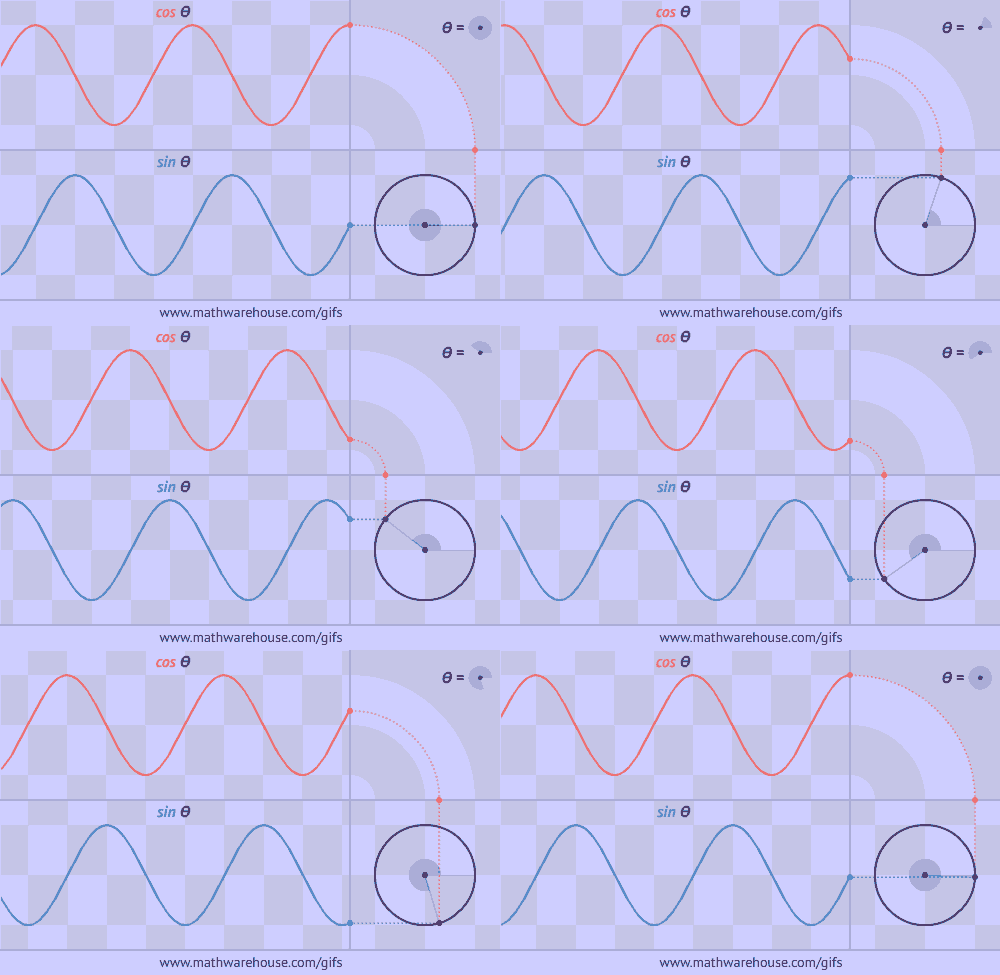
I'm a big fan of using examples, and animated gifs let you step through them easily.
Just for laughs, from a different site:
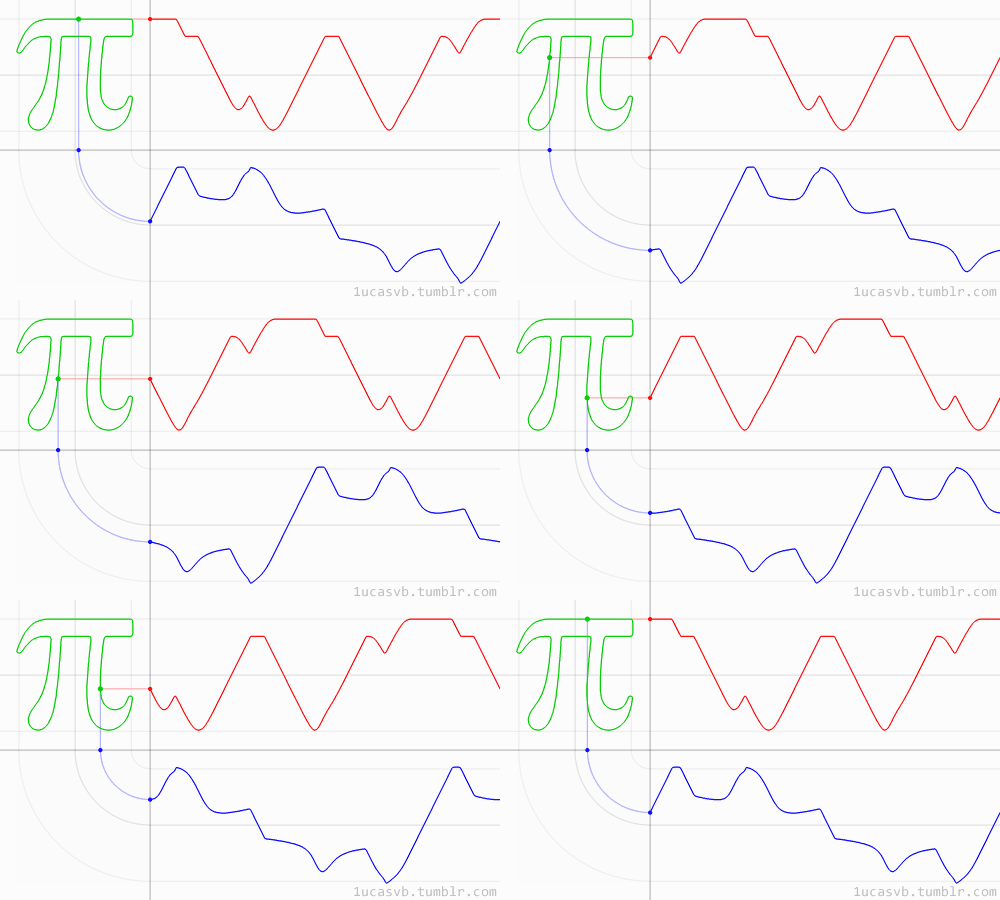
UPDATE: See the comments
Sunday, August 12, 2018
What message to teenagers?
Years ago I noticed that the church youth weren't learning some things that seemed fairly important—such as what the real differences and similarities were among denominations. So, I wrote a book to correct this, about the background for the faith. I gather from the lack of responses from test readers that it is not a page turner.
I did not feel as though I was the best person to write about how to live a Christian life (physician, heal thyself). But over time I've learned a few things, even when my applications of them aren't entirely thorough.
Suppose I was given time for a short talk to the youth groups. And imagine for the moment that they weren't distracted (fat chance, I know). What would they most need to hear?
No doubt that's very individual. Still, some things should not be surprises—and they often are.
- There is often a dark night of the soul. There can be days, months, years of silence. Do not doubt in the darkness what you saw in the light.
- Suffering is not abolished, but transformed. All God's children got troubles, and the more you love, the more people can hurt you. And somehow you come closer to God as you enter into His suffering.
- God often wants us to wait. Moses didn’t appear on the scene to lead the Israelites to freedom right away, and even when he did try, he had to back off for another 40 years. Jesus didn't show up full grown. Get ready and wait. Persevere.
- Joy and love have lots of imitators, and sometimes only time or stress distinguishes the fakes from the real. Or you can learn from the experiences of people who made those mistakes. "Good time lovers" don’t love you. The thrills of a youth group activity aren't really joy and the happy feelings from a concert aren't love or the voice of the Holy Spirit. "Now you've left off preaching and gone to meddling."
- Your lives are eaten up with amusements—and usually passive ones. You have more entertainments at hand in an average day than any but emperors did before—and at the end of the day what have you accomplished? Really. Jesus was pretty clear that God wants fruit from our lives. Maybe that will have been playing with the baby, but I'm pretty sure that it isn't watching videos all day or checking Facebook/Blogger every few minutes.
- You are rich. Christianity has some warnings for the rich. Retail therapy is part of the deceitfulness of wealth.
- Pop culture is lying to you about sex and money.
- Silence is an important part of life. Do you have time for any?
They won't sit still for them all. What would you say first?
Sunday, September 15, 2013
Feynman lectures
Volume 1 of the Feynman Lectures on Physics is online now.
Physicists widely admire them, and some teachers re-read sections because his exposition is so clear and clean: especially the first volume. It can help you keep your teaching focused on the main line and not distracted by details.
But I gather it doesn't seem to work so well as a first-year textbook. It is excellent for teaching you what you know, but is hard to climb into when you don't know much about the material.
I remember sitting through Statistical Mechanics, and everything seemed so clear and simple. Then I sat down for the exam: "Calculate the specific heat of copper." Brain freeze.
I think the textbooks that work for new learners stop frequently and make the student exercise what he's learning. You have to keep your eyes on the prize, and Feynman was very good at that, but I have to step through some of those details myself to anchor them--the lucid A through Z lecture doesn't seem to find a resting place.
Subscribe to:
Posts (Atom)