Showing posts with label Culture. Show all posts

Tuesday, July 23, 2024

Gnostics

You may not thank me for reminding you of the Eurythmics most famous work: "Sweet dreams are made of this. Who am I to disagree? I travel the world and the seven seas. Everybody's looking for something. Some of them want to {use you/get used by you/abuse you/be abused}".

Yes, it's supposed to be a song expressing disillusion. The way it does is gnostic.

Those with the Knowledge know better than the rest of us, and are free from the demands of the world's illusions (like love). Check.

The original Gnostics thought material existence was flawed and even evil. Check.

The original Gnostics taught that there was a chain of creators and Aeons and whatnot. Doesn't quite match. Anyhow.

The song ties in to our strange reductionist belief that the meaning of things is always trivial; that the less beautiful/ thoughtful/ moral/ supernatural explanation is always the true one. There's no such thing as essence, only action, and only the actions that I care to monitor matter. Because I have the Knowledge.

The "operations-only" approach has its uses and strengths, but also unacknowledged limits.


Early in my UW career I carpooled for a while with a woman from our neighborhood. One week she picked up her daughter too, who was due to be married shortly. Naturally she sat in the front and chose her favorite station, which was playing Sweet Dreams. As she sat back, satisfied with her selection, I hoped it didn't reflect her attitude to the upcoming wedding. Never found out...

Saturday, June 04, 2022

Uvalde

JMSmith has an interesting take on Uvalde et al. Among other things: "Peer pressure is good for people who are worse than their peers!"

"They begin with the obvious truth that the root of the problem of school shootings cannot be guns, or mental health, or bullies, since school shootings are a distinctly American problem. Every country has enough guns, and nuts, and bullies." ... "Since Americans are unusually prone to run amuck, there must be something about America that drives people especially crazy."

No.

Something about our culture shapes the craziness into this form. The language of our imaginations is the language of our memes and movies and songs: "Let me make the songs of a nation, and I care not who makes its laws." I doubt that it's a single aspect that shapes it, and that makes it extremely hard to pin down--you could make an argument for almost anything. Superhero movies--the hero has to keep himself secret, but he's really a superpowerful being who could take revenge if he was pushed too far. Or our apotheosizing of children--if they're so much smarter than the adults, they're the ones really responsible for my situation. Etc.

It probably would help to Damnatio memoriae the culprits. And combat the notion that "the measure of their violence ... is ... the measure of the injustice done to them". Is there a good reason not to start?

These things wouldn't be universally popular: people like to know whodunnit, and the Internet is forever (sort of). Some enjoy special power through their disproportionate reaction to subjective slights and stand to lose that power if we start honoring measured response and self-control.

Hardest of all, these changes are things we have to do ourselves and in ourselves.

School shootings are, outside of gang battles, rather rare. It's hard to understand why we have them at all; hence the arguments. The "gang" fights, on the other hand are getting more common in the local schools. But that's a touchier subject, so the noise is about the rare and dramatic problem.

Tuesday, January 18, 2022

McLuhan

Graham Majin at Quillette makes a case that Marshall McLuhan's influence here is much like Foucault's. McLuhan championed the idea that the medium has an impact on the effect of a work of art (or history or)--which seems straightforwardly clear. He took it farther to say that the effect of the medium dominates, especially in aggregate, and a radical change in media changes the culture--never mind what people seem to be saying.

I read Understanding Media back in high school, and my impression was: well, ok, but ... Majin's article accuses him of helping normalize the idea that journalism makes the news and that truth isn't literal. I don't remember that, though I only read one part of his works--maybe I just forgot. (I thought The Medium is the Massage was self-indugent and silly.)

If he were alive today, he'd look at the isolated phone-veneraters riding the bus and say "I told you so:" Although our disembodied culture was certainly not what he hoped for.

Friday, October 08, 2021

Souvenirs to remember what?

While touring a small (and extremely pricey) tourist town I won't name, we were struck by the nature of the knicknacks for sale. I asked my wife if there was an analog for "kitsch" for the terminally self-satisfied. I've seen plenty of friendly or pious plaques in people's homes, but not often the vulgar or nihilist types. She offered smug--maybe "smugtchke" would work intead of tchotchke.

Saturday, October 02, 2021

Looney Tunes

AVI noted how the Looney Tunes used a variety of music in sophisticated ways, and Aggie commented that their humor was often aimed more at adults than children. I liked it, and I'm still fond of Rocky and Bullwinkle too.

Someone has probably done a thesis applying Myers-Briggs to cartoon characters and drawing deep conclusions from the frequency with which certain traits appear. Maybe certain personality traits just don't lend themselves to types of humor. Academic tool meets pop culture--and maybe says something interesting/useful?

Pop culture meets pop culture might be a bridge too far, for a thesis on D&D classifications of Looney Tune characters. Bugs Bunny as a Chaotic Good Bard?

Friday, January 29, 2021

Knock wood

I never learned this. I'd heard that it had to do with invoking spirits of the wood, and dated back to when dryads inhabited trees. But something about that doesn't ring right. Maybe a Greek woodcutter would do some ceremonies before cutting down a tree. The connection to modern knocking on wood seems tenuous. After all, most of the wood went into fires, and I've never heard of anybody "knocking" firewood before tossing it in the stove.

According to the font of occasional knowledge sometimes this is to ward off some negative statement, and sometimes (Vietnam) to invoke something positive. Most of the examples are from Euro-MidEast culture--which if the tradition is old enough we can consider as a single thing.

Wikipedia cites as "unreliable" an Italian tradition of "touching iron" instead, though it's no hardship to find other sources testifying to it. I had a vague notion about how that might tie in with "touch wood", but the alternatives for touching that the article cites don't quite fit the notion.

Some rituals are complex (pull earlobe and knock twice), but most are perfectly simple.

Some of the ritual's meaning probably comes from the senses--how does it feel to touch wood after hearing something you fear? It's a contrast with the words--you feel something solid and different. It takes your attention away from the words of fear. Knocking, if not touching, makes noise too--a counter-sound?. It feels like you are doing something for yourself and the others, even if only symbolically, against the fearsome words.

Maybe consistency is a bridge too far in superstitions. Still, why not use stone? Reasons for: Stone is solid and strong, in contrast to our fuzzy words and flimsy hopes. Stones could be sacred too. Reasons against: Chthonic spirits seem more alien, maybe less friendly, than trees. It makes little noise. It probaby hurts more to knock stone.

Tuesday, June 30, 2020

Filling in the context

We're all seen the picture of the man with the AR and the woman holding the pistol, in front of a huge home.

The viewer can see fear, and weapons, and a big house (and the woman's finger on the trigger). The photograph was a little window, in one direction.

Is that enough information to know what's going on?

I know a few people for whom the mere presence of weapons meant the figures in the picture were bad people.

I wonder how much of the current animus towards policemen is the knee-jerk "only bad people have weapons."

The unseen people were described as demonstrators or protestors. I saw no photos of the group. You get to fill in whatever you want. If they're protesting in a good cause, they must be good people and you can fill in peaceful images of chanting or kneeling marchers. If you are more concerned with the riots that sometime accompany the demonstrations, you can fill in the rock-throwers and molotov-cocktail throwers. We had some of both kinds of marchers in Madison.

Once you've filled in your background, you re-interpret everybody in the scene. If you have populated the invisible side with peaceful black marchers for justice, the pair you see must be motivated by more than just fear--there must be some bigotry too.

If you've filled in your background with a wild-eyed mob, the pair must feel they're in mortal danger.

If you insert yourself into your imagined scene, you get to feel morally superior or smarter than the pair.

Inserting yourself into the real scene takes a little more work, and maybe more humility.


I wasn't there, I hadn't seen pictures of the marchers, and by now you can guess how reliable I find reporters. But I gather there were about 100+ people, who'd torn down an iron gate, and were marching past the couple to the mayor's home to threaten her. The couple yelled at the crowd to get out, and came back outside with guns.

Hmm. That's not a peaceful march. Maybe some members were, but their intention wasn't. On the other hand, there was not (yet) a direct threat to the couple.

(The mayor may have crossed a line, but that's outside the scope of this scene.)

What would a "reasonable man" have done? I have some ideas of what I would have done in their shoes, but there's been some dispute over whether I'm a reasonable man, since I differ politically from my betters. But of course I wasn't there.

Wednesday, January 22, 2020

Barbaric


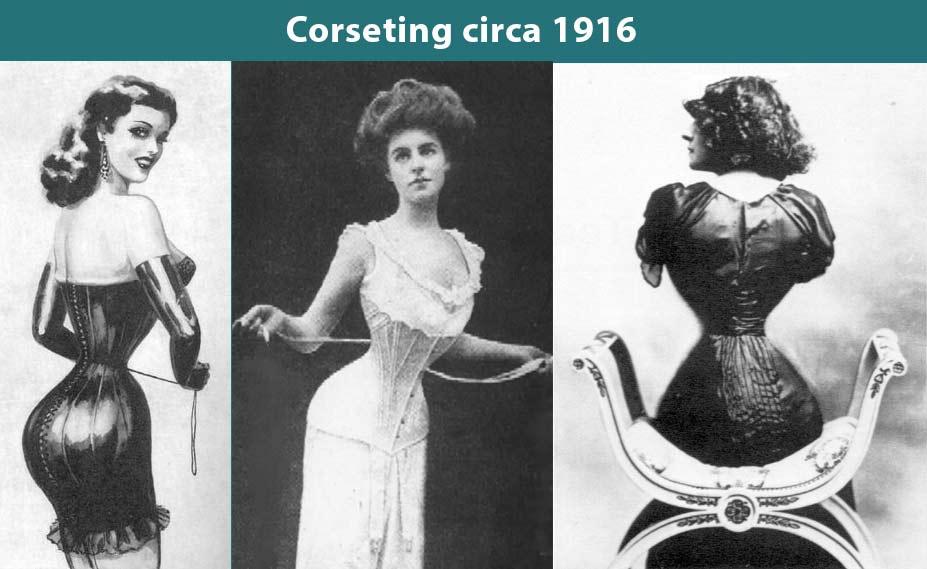
We'd never use whalebone corsets to force a woman's waist into such an unnatural shape, or bind a girl's feet to make them look like Consort Pan's(*). That was cruel, and kind of creepy.

No, instead of squeezing body parts to be permanently smaller, we inject alien substances to make parts permanently bigger. Surgery is obviously kinder and less barbaric.(**) And more body positive: Positive means plus, right?

No, I lie. We do body reductions too. I forgot about liposuction. But we're not the barbarians they were. We use High Tech™


(*) Lin Yutang suggested that it wasn't just the modern Chinese government decrees that abolished foot-binding, but the discovery that Western high-heel shoes gave the same look and gait without much pain or expense.

(**) Yes, I know that the practice of vanity surgeries makes reconstructive surgery reasonably safe and affordable. Few things are entirely without some good effects.

Thursday, January 09, 2020

Moral truncation

On thinking about it more, moral truncation is much more generic than politics. You can easily see it anywhere. I can hardly do better than Uncle Screwtape in showing how it develops.
Do what you will, there is going to be some benevolence, as well as some malice, in your patient’s soul. The great thing is to direct the malice to his immediate neighbours whom he meets every day and to thrust his benevolence out to the remote circumference, to people he does not know. The malice thus becomes wholly real and the benevolence largely imaginary. There is no good at all in inflaming his hatred of Germans if, at the same time, a pernicious habit of charity is growing up between him and his mother, his employer, and the man he meets in the train. Think of your man as a series of concentric circles, his will being the innermost, his intellect coming next, and finally his fantasy. You can hardly hope, at once, to exclude from all the circles everything that smells of the Enemy: but you must keep on shoving all the virtues outward till they are finally located in the circle of fantasy, and all the desirable qualities inward into the Will. It is only in so far as they reach the will and are there embodied in habits that the virtues are really fatal to us. (I don’t, of course, mean what the patient mistakes for his will, the conscious fume and fret of resolutions and clenched teeth, but the real centre, what the Enemy calls the Heart.) All sorts of virtues painted in the fantasy or approved by the intellect or even, in some measure, loved and admired, will not keep a man from our Father’s house: indeed they may make him more amusing when he gets there,

Your affectionate uncle Screwtape

Wednesday, January 08, 2020

The Righteous Mind by Jonathan Haidt

The format is a bit unusual: much of the book is autobiographical, telling the story of how he evolved his conclusions. He got there by observations, measurements, and actually living in India rather than just reading Western interpretations of it. And then iterating on his results.

Probably everybody knows his conclusions: moral choices are based on 6 moral foundations: the spectra of

  • Care/Harm
  • Fairness/Cheating
  • Loyalty/Betrayal
  • Authority/Subversion
  • Sanctity/Degradation
  • Liberty/Oppression

It turns out that “conservatives” are able to describe “liberal” positions more accurately than the reverse, and he interprets that within his framework as further evidence that his fellow liberals use only 2 ½ of the 6 moral foundations: they value Care, Liberty, and to a lesser extent Fairness overwhelmingly more than Authority or Sanctity or Loyalty. Conservatives were more evenly spread. Each group regards itself as obviously moral.

In the third part of his book (motto: “We are 90% chimp and 10% bee”) he examines what bonds people. We are social creatures, and have developed many rituals for bonding ourselves together—and they work very well, whether they are in psyching up for a football game or drilling in boot camp. He notices that the main question of leadership is not “Why does someone want to be a leader?” but “Why does anybody follow?”

He takes great care to make sure this all fits into an evolutionary model—though his work is nowhere nearly as forced as some of the just-so “selfish gene” stories to explain altruism. His model of the “super-organism” works better.

His first model of human behavior is the “elephant and rider”: the first and generally final reaction is not driven by conscious thought; it is usually justified ex post facto.

And yet, at some level that elephant is driven by thought.

Haidt reminds us of the twin studies that show that separated-at-birth twins often wind up with quite similar tastes and politics—and even similar spouses. In our culture, that taste in politics is guided into the liberal or conservative framework (or libertarian, which he discusses and I will ignore). In the liberal case, the child’s inchoate preferences wind up with either the 2 ½ moral foundations and in the conservative the 6.

But. When else in history have people, born with the same innate preference suites, divided into these particular kinds of social/political groups?

History is full of divisions, but until the growth of the WEIRD culture, has any subgroup shown this particular kind of moral truncation? I don’t believe we’ve evolved a new kind of human so fast—and in any event the modern ultra liberal attitudes have no Darwinian future (he also notices this). If people are the same, the difference comes from the social environment.

I have to conclude that the division isn’t entirely intrinsic to people’s preferences. We have to model what’s happening as a moral re-training that magnifies one set of moral foundations and lets the rest wither. How? Exercises of moral imagination, selecting one set of narratives over others, defining a new group identity in terms of a specific moral matrix—That sounds a bit like a religion, doesn’t it? And Rodney Stark showed that most religious conversions came about through a preponderance of friends from the new cult. One writer recently complained that Howard Stern had turned wimpy and PC in his old age {never heard him myself}--I wonder what Howards friends are like.

WEIRD can be rich, but it tends to be barren. I’m told the Roman Empire cities tended to be population sinks. People could get relatively rich, but tended to die off in plagues and whatnot, so only a continuous stream of aspirants from the countryside kept them going.

You can think of comparable, though not identical, instances of moral truncation in the past: the fiery hands of Moloch--“Caring” was not exactly the chief moral pillar in those lands. “If he had different gods, he would have been a different man.”

So I think the elephant, at least in part, can be shaped. Perhaps not so much by the “rider”, since it takes a lot of self-awareness to know what effect the sea you swim in has on you (*), but by the society you interact with, and the subgroups you gravitate toward.

Qui bono from moral truncation? The Prince of this world, of course, but in our WEIRD land, the humans benefiting are the ones with the nicest places in the economic machine. When not tied down by family/community bonding, workers are conveniently fungible. As I estimated some time back, adult consumers consume more than children do. (Does that word “consumer” make your skin crawl? What a world of objectification is in it.) There’s lots of money to be made from anomie.

It is an interesting story, and his framework seems to have a great deal of descriptive power--possibly even predictive, if one can "shape the way the elephant grows."

AVI takes issue with "moral truncation", judging that liberals use all 6, but in ways that weren't captured by the questions. I think this makes calling our partisan divide a religious divide a more useful model. You judge:

An example of a moral question having to do with sanctity/degradation was: “A man buys a chicken at the butcher shop. On a whim, he has sex with it, and then cooks it and eats it.” People divided (in split seconds) into 2 groups: those who were disgusted and then came up with more or less relevant explanations of why the act was wrong, and those who were not and explained their position as “it Harms no-one.”

An example from AVI's approach might have been "A man builds a dam across a stream to make a millpond."


(*) Yes, I mix metaphors sometimes.

Thursday, November 21, 2019

Tame fear

In comments on a recent post, AVI wrote "courage involved embracing reality not adding in risks."

Which points to an interesting (to me) question I hadn't started researching properly yet. Pick rich countries in history. How many of them developed something like the roller coaster--an amusement that provides a safe experience of fear?

Maybe the Roman animal show counts--in theory the tiger could leap up into the stands, though I doubt they ever did.

And maybe ghost stories are related, though I don't know if other cultures treated them the same way we do. I suspect they were often more for warning than amusement--they certainly don't read like entertainment to me.

It's no trick to find people (mostly young men) engaging in risky behavior--a Maasai lad isn't a man until he kills a lion. But the danger is real, and is the point--it isn't safe.

Nothing comes to mind. Are we the only culture to provide tame fear?

Monday, November 04, 2019

European culture

The book The Search for Europe, Contrasting Approaches was sitting begging for a home. I'm not planning to give it one, but nobody else wanted it, and there was one essay, in amongst the economic and foreign policy blah blah blah, that addressed a question I've had for a while: Julie Kristen, Home Europeus: Does a European Culture Exist?

The headline rule applies, I'm afraid. If the headline is a question, the answer is "no."

She's hopeful, and convinced that multilingualism will be its foundation ("calls upon the French to become polyglot").

"But tolerance is only the zero degree of questioning; when not reduced to simply welcoming others, it invites them to question themselves and to carry the culture of questioning and dialogue into encounters that problematize all participants. This reciprocating questioning produces and endless lucidity that provides the sole condition for "living together." Identity thus understood can move us towards a plural identity and the multilingualism of the new European citizen."

Like hell it will.

Endless questioning produces endless fuzz, and there's no mention of any positive statement; no central value or belief. Everything she describes is process.(*)

In a footnote she cites Augustine as saying that "in via in patria": "there is only one homeland, which is the voyage itself." I can't find that, though I do find that he said the exact opposite: "Thou hast made us for thyself, O Lord, and our heart is restless until it finds its rest in thee." I suspect she doesn't understand him.


(*) People often write about democracy being an American value. I'm not persuaded that's right. Liberty is an American value, and the democracy is a procedural tool that follows from, and is supposed to help ensure that.

Friday, April 12, 2019

A letter out of retirement

Benedict's letter seems to be causing a bit of a stir. The usual suspects hate it ("divisive!"), but there was enough fuzziness in reporting about it (*) that I decided to read it myself.

The translation isn't ideal, and there are clearly some philosophical terms in play that don't get clear explanation--I'm coming in on a conversation where I don't know all of the background, where a trial is described in terms of competing goods.

Aside from that, if the translator hasn't left things out, then I think Benedict is very tired. It reads as though sections were written separately, and some connective bits were left out. The reader can figure out what they are, if he makes the effort to understand Benedict.

He tries to remind us of one of those ugly little secrets from '68--the sexual revolution proponents were often very much ok with pedophilia. The collapse of sexual morality was dramatic. It had been in the works for a while, of course, as he mentions. Whether the antinomianism derived from the sexual greed or the other way round, or both developed together, is a point he should have tried to address--it would have tied his essay together better.

He touches on the rise of homosexual cliques which came to dominate some seminaries.

He describes the revolt against absolute truth, and links it to an abandonment of the use of "natural law." He seems to support the claim that a complete moral system can't be based exclusively on the Bible. The Bible doesn't address every single issue in that kind of detail, and a substantial amount of "common sense" is needed to deal with the rest. I admit I haven't considered the matter in that kind of detail, but it's a plausible claim.

He goes on in a long parenthesis to explain how the procedures and structures of church discipline made it difficult to convict/defrock an abuser. I don't know if the translation got in the way, or if I'm missing some important details about procedures here.

One victim of the failure to deal with abuse is the Church, in the sense of the body of the faithful who were scandalized and betrayed. Several news stories are deliberately obtuse about this point.

He wraps up with a call to focus on the Eucharist and not to think of the church as a mere political institution.

Franz Böckle, ... announced in view of the possible decisions of the encyclical Veritatis splendor that if the encyclical should determine that there were actions which were always and under all circumstances to be classified as evil, he would challenge it with all the resources at his disposal.

...

Martyrdom is a basic category of Christian existence. The fact that martyrdom is no longer morally necessary in the theory advocated by Böckle and many others shows that the very essence of Christianity is at stake here.

....

Above all, a criterion for the appointment of new bishops was now their "conciliarity," which of course could be understood to mean rather different things.

Indeed, in many parts of the Church, conciliar attitudes were understood to mean having a critical or negative attitude towards the hitherto existing tradition, which was now to be replaced by a new, radically open relationship with the world. One bishop, who had previously been seminary rector, had arranged for the seminarians to be shown pornographic films, allegedly with the intention of thus making them resistant to behavior contrary to the faith.

There were — not only in the United States of America — individual bishops who rejected the Catholic tradition as a whole and sought to bring about a kind of new, modern "Catholicity" in their dioceses. Perhaps it is worth mentioning that in not a few seminaries, students caught reading my books were considered unsuitable for the priesthood. My books were hidden away, like bad literature, and only read under the desk.


(*) Mainstream reporting about religion is always at least incomplete, and often completely wrong. It's like they're trying to report on a news story written in Chinese, by looking at the pictures.

Thursday, October 11, 2018

I saw Esau by Iona and Peter Opie

I Saw Esau: The Schoolchild's Pocket Book is an updating of their older book, this time profusely illustrated by Maurice Sendak. It contains schoolchildren's rhymes, "clearly not rhymes that a grandmother might sing to a grandchild on her knee."
Tommy Johnson is no good,
Chop him up for firewood;
When he's dead, boil his head,
Make it into gingerbread

or

Patience is a virtue,
Virtue is a grace;
And Grace is a little girl
Who doesn't wash her face.

The second is the natural riposte to the original: "Patience is a virtue, virtue is a grace; both put together make a very pretty face."

I'm a book owner, and like this one:

Who folds a leaf down,
The devil toast brown;
Who makes mark or blot,
The devil toast hot;
Who steals this book
The devil shall cook.

No, it isn't Shakespeare, and it is often rather vulgar, and some of the customs jar--"selling a wife" was a poor man's form of divorce. You probably used some variation or another of these British chants when you were little. This may help you get a better feel for the past. For the longest time I didn't understand the point of the "Taffy was a Welshman, Taffy was a thief" poem, but once I learned the key it made English attitudes clearer. I remember joining in with other first graders to chant a ditty at a chubby classmate. I had no idea what exactly it meant, and from his reaction I'm not sure he did either, but it was supposed to be insulting.

Sunday, May 27, 2018

Teenage money

During a conversation with my Better Half, she suggested that the 50's and 60's had a sea change in entertainment, teenagers had money and entertainers were eager to flatter them.

Which led me to wonder: where did they get their money? From the number of economic illiterates who litter this county I incline to a sneaking suspicion many just got it from their parents' miraculous money well, but apparently the same sort of confusion was popular back in the 20's and 30's.

Some teenage money was earned, but at least since the 70's that's been dropping assuming the years selected are representative: from 1974 to 2014 the proportion of teenagers with a summer job dropped from about 57% to about 33%--a bit over 40% decline. I'd like to know what it looked like from the postwar era on--I'd be interested in seeing if it rose. Since a lot of students didn't finish high school, I'd think it started pretty high--the graph at the link mixes students and the self-supporting.

It may be hard to tease out the information--maybe the details exists for married vs unmarried teenage employment. Before I go diving, does anybody know an easy place to find out?

(I think the decline in summer jobs is terrible. Education isn't just sitting through classes and taking tests.)

Sunday, March 25, 2018

Following a quote

I was reading The Victorian Age in Literature, by G. K. Chesterton, and for a change was surprised by a quote that wasn't Chesterton's, but seemed addressed to modern culture. I suppose it was, since there are direct connections from that era to this.

I'd never heard of William Watsony. The part Chesterton quoted is highlighted. Today we call this "authenticity."

I have not paid the world
The evil and the insolent courtesy
Of offering it my baseness for a gift.


And unto such as think all Art is cold,
All music unimpassioned, if it breathe
An ardour not of Eros' lips, and glow
With fire not caught from Aphrodite's breast,

Be it enough to say, that in Man's life
Is room for great emotions unbegot
Of dalliance and embracement, unbegot
Ev'n of the purer nuptials of the soul ;

And one not pale of blood, to human touch
Not tardily responsive, yet may know
A deeper transport and a mightier thrill
Than comes of commerce with mortality.

Saturday, December 09, 2017

I Sleep in Hitler's Room, by Tuvia Tenenbom

I’m glad I read The Lies They Tell first.

I wish Tenenbom had tried to use different fonts to distinguish observations, fantasies, and questions. Other people's responses are in quotations, but he mixes then and later musings together freely.

Early on in I Sleep in Hitler's Room he meets a friendly hardline Nazi in Club 88, who thinks he’s a fellow-traveler. He is appalling. So are the friendly Turks and other Muslims who also hate Jews. So is the willful blindness of the other Germans and the media to the Muslim hatred of Jews. Thus far there's nothing terribly controversial in the book—if you look hard enough you can find Nazis, Muslim attitudes towards Jews are well known, and so is the make-believe about those attitudes.

He "discovers" the equally-well-known connection between leftist politics and detestation of Israel. Since German politics tends left—surprise! Disproportionate condemnation of Israel. (When challenged about Chechnya or other problems, most of those he talks to seem to have no notion of what he's talking about.)

Having read The Lies first, I’m a bit suspicious of his sampling for this book. He claims in the preface that it is representative, and tells the story of how his publisher screamed at him and refused to publish the book without multiple changes and deletions. (The publisher tells a different story.)

This is important, because one claim that crops up over and over is that the Jews run finance and governments. Is the attitude really that widespread?

Tenenbom makes numerous wry references to how he ought to spend his share of this vast wealth Jews allegedly control. It is humorous at first, but after a while I noticed how much he was spending. No, he doesn’t run Goldman Sachs, but a New York theater director doesn't seem to have to make the same hard financial choices as most of the rest of us.

That Jews are disproportionately represented in such positions is well known. It is perhaps less well remembered that they are also disproportionately represented among Nobel Prize winners and other measures of accomplishment (as opposed to control). So perhaps the attitude is widespread. It doesn't appear in the circles I frequent. It does show up in online comment sections--but I've no way to estimate how common it is in the general public.

One scene, in which a family invites him to dinner, ends with him leaving the man crying. Tuvia doesn't come across as the most pleasant of guests.

He finds a staggering number of Germans who allege a Jewish grandparent, and pretty much everybody asserts that either their parents 1) had no idea what was going on or 2) never talked about it. He also finds references to Israel or the Holocaust everywhere, and professes to be annoyed with it.

Two of his favorite opening questions are "Are you proud to be a German?" and "What does it mean to be German?" The latter is probably not answerable, and the former isn't much better.

IIRC, after WWII, the Allied powers had a problem: they could assert (with some accuracy) that the bulk of the Germans were complicit in crimes, and try to punish accordingly. Or they could distinguish Nazis from normal Germans, and blame the Nazis—who were plainly more guilty. What eventually resulted seems to have been a hybrid: officially the Nazis are blamed and ordinary Germans absolved, but unofficially everybody equates WWII Germans and Nazis, and blames Germans in general. The former seems like a recipe for encouraging people to try to hide everything, pretend it didn't happen, and try not to draw attention to themselves—and maybe the poison would decay away with the next generation. In practice it seems to me as though people were asked to take a kind of attenuated blame for something they felt officially absolved for. I wonder if that would encourage ways of "baming the victim." Mix that (especially among the guiltless second and third generations!) with the popular leftist rule of "blame the powerful," and concentrating on Israeli villainy seems to follow naturally.

Back to Tuvia: He concludes that German anti-Semitism has "to do more with the psychological history of the German than with thought-out anti-Semitism." "Polish anti-Semitism, as far as I can tell, is grounded in religion. Germany’s is grounded in psychology and narcissism." (ditto for Islamic anti-Semitism) "It will be much easier to make peace between Israelis and Palestinians, and between Arabs and Jews in general, than to uproot the Jew hate of the German. The first two are on the table, no surprises; the third is wrapped in heavy brainy arguments and eye-blinding magical color shows in addition to being hidden behind the many masks so common to our present-day Western culture."

Hold the phone. Jew-hatred grounded in religion is "on the table?" Tuvia was raised Orthodox, but is no longer religious, and it shows.

Friday, December 08, 2017

Tuvia Tenenbom

AVI pointed out a link about antisemitism in Germany. The source for the article is a book by Tuvia Tenenbom, a journalist writing about people he talked to in Germany. I Sleep in Hitler's Room hasn't arrived at the local library yet, but The Lies They Tell was handy.

Tuvia is Jewish, but usually pretends to be German in this picaresque tale of his experiences during a 6-month tour of the US. He likes to go to the strange or dangerous places. And he wants, in particular, to find out how/why people like or dislike Jews. (And why Jews seem to detest Jews.) And whether belief in climate change correlates with dislike for Israel.

He tells the stories well, and professes to have discovered unexpected delight in the American landscape, in driving, and even in shooting. In the end, he determines that Americans are afraid to speak, racist, and rather hypocritical--and, as one rarely finds in the world, ashamed of being tribal.

The problem with his conclusions is that he picked and chose the people he wrote about in depth. I don't believe he met that few people on his trip. Drama and contrast he wanted--that's what he put in.

He might object that the majority of the people along the way were busy with their phones or their netflix and weren't available to interact with him. But seriously--what fraction of the people in the USA own 100 guns? And I generally don't have any difficulty in learning who people voted for--they often volunteer that. (Whatever became of secret ballots?)

In one chapter he interviews Untermeyer, who was unaware of the depth of Jew-hatred in officialdom of Qatar and Saudi Arabia--ambassadors get escorted in, and don't see their documents rewritten to have a birthplace of New York rather than Tel Aviv.

What seems to leave him most aghast is the way people fret over Palestinians without a care for the homeless a few blocks away. That seems a bit overdrawn to me--I know people who are somewhat like that, but there's a little nuance in their attitudes that Tuvia didn't see, or didn't report.

He understands enough to know that you have to visit churches if you want to know the people here, but he's pretty tone-deaf. His "superiority" grates after a while.

Yes, read it--people like them are out there--but don't trust his conclusions.

And when the book on Germany arrives, I'll try to calibrate his reporting on Germany accordingly.

Friday, November 17, 2017

Side note on a grim story

Indonesia is forcing pagan tribes to convert to Muhammadanism. The excuse is that they can't get birth certificates (and therefore schooling), unless they adhere to one of the recognized religions. They're not happy about it. "There is no compulsion in religion" is once again more honored in the breech than the observance.

One novel bit about the story was the relationships of the tribesmen to their Muslim neighbors. The tribe described is nomadic:

"We have no space to live. We are always told we are nomadic people with no religion, no culture," he told me.

"Our religion is not respected. The government is always insisting that we convert and live in houses in one place. We can't do that. Our way of life is not like that."

And there are sources of friction:

The officer, Budi Jayapura, took me aside to check my documents and said: "We need to watch over them.

"They don't understand the concept of stealing. They say the fruit grew by itself on the tree so it can be taken, but it was planted by someone. Maybe in their belief system it is OK, but not in our society."

The fact that they hunt and eat wild pigs also creates social tensions, he added.

"This is a Muslim community. If they see the pig's blood and the leftover bits, they are disturbed," the officer explained.

What is taboo, or haram, for the Orang Rimba directly contrasts with what Muslims eat, explains Mr Manurung.

"Orang Rimba will not eat domesticated animals such as chickens, cows or sheep. They think it's a form of betrayal. You feed the animal, and when it gets fat you eat it. The fair thing to do is to fight. Whoever wins can eat the loser."

I read of a visit to an Amazon tribe, where people hunted and ate every sort of animal, but if somebody brought it into the village and treated it like a pet, nobody would harm it.

Monday, September 25, 2017

Attitudes towards authority

AVI's parable reminded me of a couple of anecdotes.

About 40 years ago I was listening to a preacher who was talking about the calling of God. He described the last question the ordination committee put to him: "If we decide not to ordain you, what will you do?" He said (I paraphrase) "I gave them the only answer I could--
'Whether you ordain me or not, I must preach because God calls me to.' It was the answer they wanted to hear."

Simon Stylites chose a curious approach to austerity--living on top of a 6 or 8 foot high (but the Egyptians built them wide!) pillar. Instead of finding himself alone, thousands flocked to hear him and ask for advice. Church elders weren't sure what to make of him.

Elders living in the desert heard about Saint Simeon, who had chosen a new and strange form of ascetic striving. Wanting to test the new ascetic and determine whether his extreme ascetic feats were pleasing to God, they sent messengers to him, who in the name of these desert fathers were to bid Saint Simeon to come down from the pillar.

In the case of disobedience they were to forcibly drag him to the ground. But if he was willing to submit, they were to leave him on his pillar. Saint Simeon displayed complete obedience and deep Christian humility. The monks told him to stay where he was, asking God to be his helper.

Of course in Simon's case obedience meant he wasn't crazy, so the cases differ there. But in both cases they asked the same question: are you willing to accept the judgment of your elders that you are mistaken about your calling? The great difference is in the expected right answer.