Thursday, February 23, 2017

Bootstrap

The article Physicists Uncover Geometric ‘Theory Space’ in Quanta magazine isn't quite clear to me. Partly it's because I don't understand anti-DeSitter spaces, and partly because it isn't clear that the writer knows either.

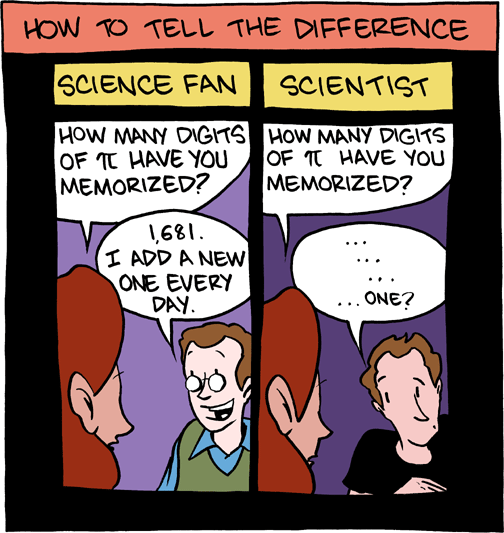
And little things slipped by the editor, like "By 2016, Poland and Simmons-Duffin had calculated the two main critical exponents of the theory out to their millionth decimal places." That seemed completely crazy--and yep, the linked paper showed 1 part in a million, not a million decimal places. SMBC gets that right.

You may want to take some advice from Peanuts: WRT The Brothers Karamazov--Charlie Brown says, "But don't you get confused by all those long Russian names?" Linus says, "Oh, when I come to one I can't pronounce, I just bleep over it."

Researchers are pushing in all directions. Some are applying the bootstrap to get a handle on an especially symmetric “superconformal” field theory known as the (2,0) theory, which plays a role in string theory and is conjectured to exist in six dimensions. But Simmons-Duffin explained that the effort to explore CFTs will take physicists beyond these special theories. More general quantum field theories like quantum chromodynamics can be derived by starting with a CFT and “flowing” its properties using a mathematical procedure called the renormalization group. “CFTs are kind of like signposts in the landscape of quantum field theories, and renormalization-group flows are like the roads,” Simmons-Duffin said. “So you’ve got to first understand the signposts, and then you can try to describe the roads between them, and in that way you can kind of make a map of the space of theories.”

That's a bit of jargon to go wading through, but can you see what's wrong here? Take this: "the (2,0) theory, which plays a role in string theory and is conjectured to exist in six dimensions" This sounds like a theory in search of an application. (I've tried my hand at that myself--it wound up looking more complicated that what it was supposed to explain.)

String theory, for all its attractive foundation, hasn't produced anything substantial yet, and you know you're really at sea when a theory is just "conjectured" to exist in six dimensions. That doesn't mean this (2,0) research isn't interesting--it probably is--just that the connection to the physical world is likely to be tenuous. At best.

The renormalization theories were developed to handle equations that gave infinities (what is ∞ - ∞ ?). When your equations behave like that it seems like a clear sign that this isn't the optimal way of expressing the problem. Maybe this bootstrapping paradigm can be a way of re-expressing problems--though Simmons-Duffin seems to think renormalization is still going to be there.

One particular physics problem looked as though it lay on a "corner" of the boundary of the space of possible configurations of one kind of bootstrap transformations. That's certainly odd, and worth exploring. But when the amplituhedron gets pulled in as a possible connection, it doesn't exactly increase my enthusiasm for the project. That beast is a highly speculative model that hasn't shown any solid connection to real "electron hits pion" physics. Like another theory mentioned above.

UPDATE: FWIW, Motls likes the ideas. He's a string theorist, and has a little different idea about how well string theory has been doing.

Sunday, February 19, 2017

An independent opinion

I posted about "Sensitivity Readers" a few days ago. I don't think this is "sensitivity," exactly, but perhaps the people who created this garden object might have run the prototype past a bigger selection of people. I saw this in Jungs yesterday. The titling is in English and French: Retro/Nostalgie. It purports to be a flowerpot holder. It looks like--well, nostalgia isn't high on the list of connotations.

Perhaps I just don't think of things the right way: I thought the PT Cruiser looked like a cross between a VW Beetle and a hearse, but a couple of friends were startled that I didn't love the design.

Friday, February 17, 2017

From a posthumously published autobiography

"Then, confound you! Sir, you kept me up till three o'clock this morning. But what are you doing here in a wig and gown--what are you doing here?"

Very soon I found cause to echo the question and to answer it in the words, "No good." The British solicitor, and indeed the British client, cannot be induced to put confidence in anyone who has become well known as an author. If he has confined his attention to the writing of law-books, he may be tolerated, though hardly, but if his efforts have been on the imaginative side of literature, then for that man they have no use. That such a person should combine gifts of imagination with forensic aptitude and sound legal knowledge is to them a thing past all belief.

A page or so back I said that my experience might possibly be of use to others, and already the suggestion seems in the way of proof. If what I write should prevent even one young barrister who hopes to make a mark in his profession, from being beguiled into the fatal paths of authorship, I shall not have laboured in vain.

Did you guess from the style?

There has always been a tradition in my family that we sprang from a certain Sir Andrew Ogard, or Agard, or Haggard (I believe his name is spelt in all three ways in a single contemporaneous document), a Danish gentleman of the famous Guildenstjerne family whose seat was at Aagaard in Jutland.

...

This Sir Andrew was a very remarkable man. He appears to have come from Denmark with nothing and to have died possessed of manors in eleven English counties, besides much money and the Danish estate which he seems to have inherited. ...

I regret to have to add that there is at present no actual proof of the descent of my family from this Sir Andrew.

Sensitivity readers?

The Chicago Tribune's new article is trying to gin up interest in a new editing job: Sensitivity Reader. You advertise your specialty, and somebody trying to write a book that involves characters in your category pays you to read it over and decide if they're being sensitive and accurate. Or maybe an editor pays you instead of the writer.

If this is for research, it kind of makes a bit of sense. As they point out, Rowlings got some egg on her face with her most recent book that didn't portray American Indian magic creatures accurately. Inaccuracy of this sort is no crime--often it's an artistic necessity--but in general it's good to try not to dynamite willing suspension of disbelief. I have trouble reading the old Skylark science fiction books: science and technology just don't work that fast. You can't reverse engineer an entire new spaceship propulsion paradigm in a week. Ben Franklin was smart, but put him in a helicopter and see how far he flies. Or like stout Cortez Balboa when with eagle eyes He star'd at the Pacific—and all his men Look'd at each other with a wild surmise—Silent, upon a peak in Darien.

But I have a suspicion this isn't the focus.

Still, some sensitivity readers feel they are in part contributing to the problem. Clayton said she's unsettled by the idea that she's being paid for her expertise, but also is helping white authors write black characters for books from which they reap profit and praise.

"It feels like I'm supplying the seeds and the gems and the jewels from our culture, and it creates cultural thievery," Clayton said. "Why am I going to give you all of those little things that make my culture so interesting so you can go and use it and you don't understand it?"

Hmm. Think Dan Brown would be interested in paying a Jesuit to review his books for accuracy? Or maybe John Boorman should have hired a redneck or two for the Deliverance script? (Or did he? No idea.) Think of all the cultural appropriation being done by people writing about other people. Maybe the only safe thing to do is to write a monologue.

Reporting on math

I followed a link to the Quanta article on "the fight to fix symplectic geometry. I didn't know what symplectic geometry was, but the link said this was about the foundations of one field of mathematics. So did the article itself:
The field continued to grow, even as the errors went largely unaddressed. Symplectic geometers simply tried to cordon off the errors and prove what they could without addressing the foundational flaws. Yet the situation eventually became untenable. This was partly because symplectic geometry began to run out of problems that could be solved independently of the foundational issues, but also because, in 2012, a pair of researchers — Dusa McDuff, a prominent symplectic geometer at Barnard College and author of a pair of canonical textbooks in the field, and Katrin Wehrheim, a mathematician now at the University of California, Berkeley — began publishing papers that called attention to the problems, including some in McDuff’s own previous work. Most notably, they raised pointed questions about the accuracy of a difficult, important paper by Kenji Fukaya, a mathematician now at Stony Brook University, and his co-author, Kaoru Ono of Kyoto University, that was first posted in 1996.

If, however, you go on to read the rest of the article, you find (executive summary) that they thought Fukaya's original paper hadn't quite proved what he set out to prove. After some back and forth, and 300 pages of explanation and elaboration by Fukaya, everybody thinks it's OK now.

Not foundational, except that a lot of people were using the techniques Fukaya said were OK. Nor errors, exactly. His proof wasn't complete, but the result looks like it was OK.

I guess writers have to try to make every story exciting. I was going to write more about this, but Lubos Motl already savaged the article, twice. Of course, he tries to make stories exciting in his own way. (If you want a less polemical essay by Motl, try one on Churchill as astrophysicist.)

Every now and then a story really is big news, but the constant overhype wears on me after a while. And that's just in the science section.

Sunday, February 12, 2017

Blacksmith

Isaiah wrote of the potter, shaping, reshaping, starting over.

Sometimes it seems as though a different sort of craftsman is at work.

At re-enactment sites or fairs, one booth never seems to lack visitors--including me. The blacksmith's work is fascinating and familiar. Whether is is a scrap iron bar being made into a grass cutter or a bit of rod stock into a pot hook, the cycle is the same--heat, then hammer and bend.

It isn't precisely parallel to our lives. Sometimes the fire is trouble and sometimes what softens us is a coal-bed of love (hotter now than the wild flames we started with). Sometimes the hammer is a crisis, and sometimes the bending comes from day by day little changes.

I'm not what I was, nor remotely who I ought to be. Maybe if I loved more it would go faster. And probably go harder, too.

Saturday, February 11, 2017

Gifts

Anybody remember the "Spiritual Gift" sessions? Everybody was encouraged to take the survey, or the class, or whatever, and find out what their spiritual gift was.

I saw this several times. The first time I was pretty young, and thought it was a nice idea, but I already had a pretty fair idea of what I was good at and what my role in church was shaping up to be.

The second time it came around, I pointed out that the program seemed to be just encouraging people to run around saying "Hey, look at my hammer!"

The next few times I had to wax the driveway those nights.

Now there are varieties of gifts, but the same Spirit. And there are varieties of ministries, and the same Lord. There are varieties of effects, but the same God who works all things in all persons.

Maybe we're pushing a rope. What effects do we want, what service will produce those effects, and what gifts are needed in those services?

If God sends another Billy Graham, that seems like a good signal that the church needs a new evangelism program. If somebody has some obviously remarkable gifts that seem to require new modes of service, that's great, but I think most of the time things are less obvious.

Where did the time go?

If you want to spend time on youtube...

"Smarter Every Day" is a fun series of videos about science and engineering and cool stuff (e.g.Tesla coil gun. Does the arrow fly farther when you hold the draw for a moment first? What does a Prince Rupert's Drop look like as it shatters, and why?

I ran across Lindybeige: a reinactor talking about medieval arms and armor and other topics. He speaks both from research and experience with reinacted battles. He's interesting and plausible, though when he leaves his field of expertise and starts talking about (e.g.) holographic tank optics, you get nonsense. His experience is in reinacting battles, and not in urban combat and enforcement. A couple of weapons he deprecated look like they'd be more useful in narrow alleys with nobody beside you than in battle array with buddies around.

And, of course, auto repair videos. I've been watching a bunch of them lately. I'm still not quite sure how they got one piece to come loose so easily; I can't get it to budge.

Wednesday, February 08, 2017

Scots Irish

I read Born Fighting recently. I didn't post about it right away, because I wanted to think about a question I had. The Scots-Irish were intensely violent not that long ago. They are still one of the more violent white ethnic groups, but their rate has gone down, and other groups are now much more violent. What led to the decline, and are there lessons we can apply elsewhere?

I haven't found out yet if this has been studied, or if we just have the usual "jobs and education" claims without evidence of causality. Olmstead's book suggests that neither was an attractive option.

Friday, February 03, 2017

Music by subtraction

I'd been curious whether one could play all the notes except those for the melody, and still recognize the music. My experiments along those lines were dismal failures, and as AVI reminded me in the last post, you can recognize quite a few songs simply from the rhythm, without notes.

I think I need to find the music for some melodies I don't know, and use a computer to synthesize the "reverse" notes, and try listening to those. One problem is, how do I know that I don't know it unless I listen to it? Maybe I could translate them into one-note pieces, and listen to those, and if I recognize one chuck it and experiment with the rest.

Seems like a good rainy-day exercise.

Wednesday, February 01, 2017

Music memory

I'm puzzling again about how memory works.

Something about songs makes them easier to remember. Maybe it’s the combination of sound and word; maybe the effective narrative holds it together.

Some ear worms are just fragments of songs playing in loop, so the memory of a song can be chopped up somehow into segments handy for the brain. And I find that sometimes chunks of different verses mingle.

For example, I remembered part of a famous hymn as “Thou Who almighty art, mildly ordainest judgments unsearchable, famine and sword. Bid not Thy wrath in its terror o’ertake us...”

I looked it up. Oops. “God the Omnipotent.” “Thou Who almighty art” looks like an import from a different song, which just happened to have the same rhythm . “Wisely” turned into “mildly:” I’ve no idea why. The “bid not Thy wrath” section is from a different verse. So I assembled this version from a phrase with the same meaning and rhythm, a single-word shift, and chunks of two different verses.

This suggests that I store some songs in the form of chunks and a set of links, and link the chunks together on demand. It looks like both rhythm and words serve as keys. Meaning may not be a reliable key, but it does get used.

The instrumental music playing in Urgent Care(*) included a song I’d not heard since the 70’s, and I realized I couldn’t recall more than a few lines. The melody I could reconstruct easily. (I don’t usually mix melodies together—in contrast to lyrics--though now and then I do.)

When we got home I went to look for the song--and kept coming up blank.

Executive summary: the tune was the Airport love theme, which is almost entirely instrumental, with only a couple of lines sung at the beginning and end about the winds of chance. My brain expected the rest of the words to be there, and did its best (modulo substituting “restless winds” for “gentle winds”). Missing part was especially irritating.


(*) It turns out a Mansfield bar doesn’t protect car tops when the trailer jackknifes. She had no apparent injuries, fortunately.

Somebody's been reading classics?

"Severities should be dealt out all at once, so that their suddenness may give less offense; benefits should be conferred gradually, and in that way they will taste better."

Niccolo Machiavelli

Saturday, January 28, 2017

LHC robots

Symmetry has an article about the robots of the LCH.
As you might expect, the subterranean tunnel which houses the LHC is not always the friendliest place for human visitors.

“The LHC contains 120 tons of liquid helium kept at 1.9 Kelvin,” says Ron Suykerbuyk, an LHC operator. “This cooling system is used to keep the electromagnets in super conducting state capable of carrying up to 13,000 Amps of current through its wires. Even with all the safety systems we have in place, we prefer to limit our underground access when the cryogenic systems are on”.

Unfriendly is a bit of an understatement. When the magnet quenched the resulting explosion shoved a 35 t dipole magnet into its neighbor, and the escaping liquid helium allegedly condensed the air.

Near the collision points the radiation levels are pretty doggone high. I'm not sure robots would survive in the collision halls--for that matter I don't know if they can go in. And you have to worry about little things like the fringe of the magnetic field for CMS--high enough to mean that power supplies have to be kept far away from the electronic devices they power--which costs some DC power loss.

So, meet TIM. Except the picture at the top of the article isn't of TIM ("the Train Inspection Monorail. TIM is a chain of wagons, sensors and cameras that snake along a track bolted to the LHC tunnel’s ceiling"). The video is, though.

Thursday, January 26, 2017

Davila

David Warren posted this link to a translation of a short work by a Colombian I'd never heard of before, on the subject of The Authentic Reactionary. "If the progressive casts himself into the future, and the conservative into the past, the reactionary does not measure his anxieties with the history of yesterday or with the history of tomorrow."

Wednesday, January 25, 2017

Political postings

In the run-up to the elections in 2008, I came to the conclusion that commenting on politics was bad for my soul. The temptation to despise seemed overwhelming. During the past 8 years I've more or less held to my resolution to back off. And when all's said and done, much that's said never changes any minds anyway--sometimes the values and presuppositions are too different.

Is liberty valuable, and if so what is its scope? For that matter, what is it? Not a question people like to discuss, but an illuminating one...

The tribe that believes that people are perfectible doesn't generally value liberty very highly--probably for the same sort of reasons that kings punished heretics. Monarchs owed it to their subjects to protect them from those who could mislead them into hell--or, these days, from being perfected subjects with all traces of evil ideas scrubbed away.

Naturally that protection requires more and more centralization, and more and more micromanaging, and more and more careful parsing of anything that might smack of subtle evil ideas (an analysis that apparently only certain people are capable of--and as with The Force, they must trust their feelings).

No, an essay on "why you should deliberate carefully when trying to overhaul the health care system for a nation" is not going to change any minds across that kind of divide. Nor are those impatient to undo the damage going to listen to an essay about "why there needs to be some bandaging to let things grow back."

I'm probably not going to be commenting much during this administration either.

Thursday, January 19, 2017

Pulsars

Pulsars are neutron stars whose EM radiation (light, radio waves, gamma rays) seem to blink or pulse. This is related to how they rotate (and their rotation can be measured to be slowing down). Because the magnetic poles don't usually line up with the axis of rotation, sometimes the pole is pointed more in our direction, sometimes less so--and it seems to pulse.

But what they radiate seems to be all over the map. Sometimes they radiate gammas but not radio, sometimes radio but not gammas, sometimes both. Why? Maybe it has to do with which way the star is pointed relative to us.

based on these observations, Geminga’s magnetic poles appear to be oriented at the top and bottom of the neutron star from our point of view, which also align with its spin poles. Because these areas are where a pulsar’s radio emission should originate, it makes sense that no radio waves are detected. The pulsar’s gamma rays, however, are created over a larger area at higher altitudes, causing them to sweep out over a larger area of the sky and making them detectable from Earth.

It makes sense. Verifying that would be kind of hard--we'd have to have a clear idea of how far from the rotational axis the magnetic poles point, and then try to correlate that with the ratio of gamma to radio. But I've no idea how to measure that angle. You could get some notion of the direction of the axis of rotation from the jets of stuff shot away from it (you'd measure the doppler shifts of each of the two lobes to try to pin down their speed and direction), but measuring the magnetic field direction sounds hard. Polarization of light would be going this way and that with the moving field, and I'm not sure you could tell that from randomness.

Tuesday, January 17, 2017

Differences

Pick one:
NASA has approved a mission to explore 16 Psyche, an iron-rich asteroid whose contents are said to be worth over 100-thousand times the value of the entire world economy.

Or
"Psyche is almost certainly an iron-nickel alloy asteroid, possibly formed after a larger body, like a dwarf planet, had its mantle stripped away from a violent collision with another asteroid. So, Psyche is probably the exposed core of a small planet," Bercovici said.

Do you want to pull your hair out when you see "gee wow" reporting like this? "Psyche is an asteroid with a diameter in excess of 125 miles, about the same size of the state of Massachusetts, and is almost entirely composed of iron and nickel. The abundance of these metals gives the asteroid's contents an estimated worth of a staggering \$10 quintillion — that is a one, followed by 19 zeros. Comparatively speaking, the world economy is estimated to be worth just under \$74 trillion. Psyche's contents are worth approximately 130,000 times as much as every single human industry put together." Transportation costs aside, supply and demand considerations make complete nonsense of this sort of calculation. You're supposed to get excited about big numbers, even when they don't make any sense.

If Psyche is indeed the remains of a much bigger object, that's more exciting. The problem is, I don't know if explorations would tell us much about a long-gone planetary crash. So it may just be exciting in a T-Rex skeleton sort of way. (The Field Museum's Sue exhibit has a case with some extra "belly bones" and the confession that nobody knows where they fit.)

Maybe the composition and structure can tell us about how planetary cores form--though the details of the composition will surely have been different from Earth's. Unfortunately the probe is supposed to launch in 2023 and arrive in 2030. A bit of a wait.

Paris streets

I saw a report today from the Mirror saying that French told not to fear wolves roaming Paris streets as 'they only eat four-legged animals'.

That sort of encouragement doesn't comfort. Even if Parisians were OK with wolves that only ate pets, wolves still threaten everybody.

But who else is on the streets? I don't think wolves stand a chance. People can be very thorough when dealing with threats.

Thursday, January 12, 2017

Merging black holes

We all remember the LIGO discovery: a pair of black holes merging to produce a beautiful gravity wave signal. It was followed shortly thereafter by a smaller pair producing not-so-nice a signal, but good enough.

LIGO didn't take data very long, but got 2 signals in only a few months. (They're starting up again.)

From that rate, Ioka et al estimated how many mergers there have been in our galaxy so far (mostly much smaller ones, and obviously we weren't looking at the time--weren't here for most of that time). (Basically they figure that if LIGO detected really big ones at the range they did, it would have missed the many more smaller ones in the same volume, because it wasn't sensitive enough.)

When two orbiting bodies like that merge, the result has fantastic angular momentum. If you spin a bicycle wheel and grab it, you know that it "doesn't like" being stopped. Imagine if the bicycle wheel were made of lead, and spinning that fast. You might break your hand trying to stop it. Now spin it up faster, and faster. There's a lot of energy in that thing now. There's unimaginably more in the black hole you get from merging two others.

The first direct detections of gravitational waves (GWs) from black hole (BH) mergers, GW150914, GW151226 and LVT151012, give a robust lower limit ∼70000 on the number of merged, highly-spinning BHs in our Galaxy. The total spin energy is comparable to all the kinetic energy of supernovae that ever happened in our Galaxy.

They go on to estimate what kind of activity you can get from interstellar gas falling into these things, which is of interest to people trying to study cosmic rays (like IceCube).

Let me emphasize that most of these black holes aren't very big--only a few solar masses. Still, 70,000 merged black holes in our galaxy--wow.

Of course there are some assumptions that go into that--like assuming that the rate of black hole merger is essentially constant in time. I'm not sure that's realistic. And they may have the distribution of the rate of production of different size black holes wrong. But nobody found any showstopper problems with it at the meeting today.