Wednesday, February 01, 2017

Music memory

I'm puzzling again about how memory works.

Something about songs makes them easier to remember. Maybe it’s the combination of sound and word; maybe the effective narrative holds it together.

Some ear worms are just fragments of songs playing in loop, so the memory of a song can be chopped up somehow into segments handy for the brain. And I find that sometimes chunks of different verses mingle.

For example, I remembered part of a famous hymn as “Thou Who almighty art, mildly ordainest judgments unsearchable, famine and sword. Bid not Thy wrath in its terror o’ertake us...”

I looked it up. Oops. “God the Omnipotent.” “Thou Who almighty art” looks like an import from a different song, which just happened to have the same rhythm . “Wisely” turned into “mildly:” I’ve no idea why. The “bid not Thy wrath” section is from a different verse. So I assembled this version from a phrase with the same meaning and rhythm, a single-word shift, and chunks of two different verses.

This suggests that I store some songs in the form of chunks and a set of links, and link the chunks together on demand. It looks like both rhythm and words serve as keys. Meaning may not be a reliable key, but it does get used.

The instrumental music playing in Urgent Care(*) included a song I’d not heard since the 70’s, and I realized I couldn’t recall more than a few lines. The melody I could reconstruct easily. (I don’t usually mix melodies together—in contrast to lyrics--though now and then I do.)

When we got home I went to look for the song--and kept coming up blank.

Executive summary: the tune was the Airport love theme, which is almost entirely instrumental, with only a couple of lines sung at the beginning and end about the winds of chance. My brain expected the rest of the words to be there, and did its best (modulo substituting “restless winds” for “gentle winds”). Missing part was especially irritating.


(*) It turns out a Mansfield bar doesn’t protect car tops when the trailer jackknifes. She had no apparent injuries, fortunately.

Somebody's been reading classics?

"Severities should be dealt out all at once, so that their suddenness may give less offense; benefits should be conferred gradually, and in that way they will taste better."

Niccolo Machiavelli

Saturday, January 28, 2017

LHC robots

Symmetry has an article about the robots of the LCH.
As you might expect, the subterranean tunnel which houses the LHC is not always the friendliest place for human visitors.

“The LHC contains 120 tons of liquid helium kept at 1.9 Kelvin,” says Ron Suykerbuyk, an LHC operator. “This cooling system is used to keep the electromagnets in super conducting state capable of carrying up to 13,000 Amps of current through its wires. Even with all the safety systems we have in place, we prefer to limit our underground access when the cryogenic systems are on”.

Unfriendly is a bit of an understatement. When the magnet quenched the resulting explosion shoved a 35 t dipole magnet into its neighbor, and the escaping liquid helium allegedly condensed the air.

Near the collision points the radiation levels are pretty doggone high. I'm not sure robots would survive in the collision halls--for that matter I don't know if they can go in. And you have to worry about little things like the fringe of the magnetic field for CMS--high enough to mean that power supplies have to be kept far away from the electronic devices they power--which costs some DC power loss.

So, meet TIM. Except the picture at the top of the article isn't of TIM ("the Train Inspection Monorail. TIM is a chain of wagons, sensors and cameras that snake along a track bolted to the LHC tunnel’s ceiling"). The video is, though.

Thursday, January 26, 2017

Davila

David Warren posted this link to a translation of a short work by a Colombian I'd never heard of before, on the subject of The Authentic Reactionary. "If the progressive casts himself into the future, and the conservative into the past, the reactionary does not measure his anxieties with the history of yesterday or with the history of tomorrow."

Wednesday, January 25, 2017

Political postings

In the run-up to the elections in 2008, I came to the conclusion that commenting on politics was bad for my soul. The temptation to despise seemed overwhelming. During the past 8 years I've more or less held to my resolution to back off. And when all's said and done, much that's said never changes any minds anyway--sometimes the values and presuppositions are too different.

Is liberty valuable, and if so what is its scope? For that matter, what is it? Not a question people like to discuss, but an illuminating one...

The tribe that believes that people are perfectible doesn't generally value liberty very highly--probably for the same sort of reasons that kings punished heretics. Monarchs owed it to their subjects to protect them from those who could mislead them into hell--or, these days, from being perfected subjects with all traces of evil ideas scrubbed away.

Naturally that protection requires more and more centralization, and more and more micromanaging, and more and more careful parsing of anything that might smack of subtle evil ideas (an analysis that apparently only certain people are capable of--and as with The Force, they must trust their feelings).

No, an essay on "why you should deliberate carefully when trying to overhaul the health care system for a nation" is not going to change any minds across that kind of divide. Nor are those impatient to undo the damage going to listen to an essay about "why there needs to be some bandaging to let things grow back."

I'm probably not going to be commenting much during this administration either.

Thursday, January 19, 2017

Pulsars

Pulsars are neutron stars whose EM radiation (light, radio waves, gamma rays) seem to blink or pulse. This is related to how they rotate (and their rotation can be measured to be slowing down). Because the magnetic poles don't usually line up with the axis of rotation, sometimes the pole is pointed more in our direction, sometimes less so--and it seems to pulse.

But what they radiate seems to be all over the map. Sometimes they radiate gammas but not radio, sometimes radio but not gammas, sometimes both. Why? Maybe it has to do with which way the star is pointed relative to us.

based on these observations, Geminga’s magnetic poles appear to be oriented at the top and bottom of the neutron star from our point of view, which also align with its spin poles. Because these areas are where a pulsar’s radio emission should originate, it makes sense that no radio waves are detected. The pulsar’s gamma rays, however, are created over a larger area at higher altitudes, causing them to sweep out over a larger area of the sky and making them detectable from Earth.

It makes sense. Verifying that would be kind of hard--we'd have to have a clear idea of how far from the rotational axis the magnetic poles point, and then try to correlate that with the ratio of gamma to radio. But I've no idea how to measure that angle. You could get some notion of the direction of the axis of rotation from the jets of stuff shot away from it (you'd measure the doppler shifts of each of the two lobes to try to pin down their speed and direction), but measuring the magnetic field direction sounds hard. Polarization of light would be going this way and that with the moving field, and I'm not sure you could tell that from randomness.

Tuesday, January 17, 2017

Differences

Pick one:
NASA has approved a mission to explore 16 Psyche, an iron-rich asteroid whose contents are said to be worth over 100-thousand times the value of the entire world economy.

Or
"Psyche is almost certainly an iron-nickel alloy asteroid, possibly formed after a larger body, like a dwarf planet, had its mantle stripped away from a violent collision with another asteroid. So, Psyche is probably the exposed core of a small planet," Bercovici said.

Do you want to pull your hair out when you see "gee wow" reporting like this? "Psyche is an asteroid with a diameter in excess of 125 miles, about the same size of the state of Massachusetts, and is almost entirely composed of iron and nickel. The abundance of these metals gives the asteroid's contents an estimated worth of a staggering \$10 quintillion — that is a one, followed by 19 zeros. Comparatively speaking, the world economy is estimated to be worth just under \$74 trillion. Psyche's contents are worth approximately 130,000 times as much as every single human industry put together." Transportation costs aside, supply and demand considerations make complete nonsense of this sort of calculation. You're supposed to get excited about big numbers, even when they don't make any sense.

If Psyche is indeed the remains of a much bigger object, that's more exciting. The problem is, I don't know if explorations would tell us much about a long-gone planetary crash. So it may just be exciting in a T-Rex skeleton sort of way. (The Field Museum's Sue exhibit has a case with some extra "belly bones" and the confession that nobody knows where they fit.)

Maybe the composition and structure can tell us about how planetary cores form--though the details of the composition will surely have been different from Earth's. Unfortunately the probe is supposed to launch in 2023 and arrive in 2030. A bit of a wait.

Paris streets

I saw a report today from the Mirror saying that French told not to fear wolves roaming Paris streets as 'they only eat four-legged animals'.

That sort of encouragement doesn't comfort. Even if Parisians were OK with wolves that only ate pets, wolves still threaten everybody.

But who else is on the streets? I don't think wolves stand a chance. People can be very thorough when dealing with threats.

Thursday, January 12, 2017

Merging black holes

We all remember the LIGO discovery: a pair of black holes merging to produce a beautiful gravity wave signal. It was followed shortly thereafter by a smaller pair producing not-so-nice a signal, but good enough.

LIGO didn't take data very long, but got 2 signals in only a few months. (They're starting up again.)

From that rate, Ioka et al estimated how many mergers there have been in our galaxy so far (mostly much smaller ones, and obviously we weren't looking at the time--weren't here for most of that time). (Basically they figure that if LIGO detected really big ones at the range they did, it would have missed the many more smaller ones in the same volume, because it wasn't sensitive enough.)

When two orbiting bodies like that merge, the result has fantastic angular momentum. If you spin a bicycle wheel and grab it, you know that it "doesn't like" being stopped. Imagine if the bicycle wheel were made of lead, and spinning that fast. You might break your hand trying to stop it. Now spin it up faster, and faster. There's a lot of energy in that thing now. There's unimaginably more in the black hole you get from merging two others.

The first direct detections of gravitational waves (GWs) from black hole (BH) mergers, GW150914, GW151226 and LVT151012, give a robust lower limit ∼70000 on the number of merged, highly-spinning BHs in our Galaxy. The total spin energy is comparable to all the kinetic energy of supernovae that ever happened in our Galaxy.

They go on to estimate what kind of activity you can get from interstellar gas falling into these things, which is of interest to people trying to study cosmic rays (like IceCube).

Let me emphasize that most of these black holes aren't very big--only a few solar masses. Still, 70,000 merged black holes in our galaxy--wow.

Of course there are some assumptions that go into that--like assuming that the rate of black hole merger is essentially constant in time. I'm not sure that's realistic. And they may have the distribution of the rate of production of different size black holes wrong. But nobody found any showstopper problems with it at the meeting today.

Tuesday, January 10, 2017

Appendix

I've never been confident in the claim that the appendix is a useless vestigial organ. Everything else is doing something, sometimes many somethings at once. Why waste energy growing something useless? Maybe it is a bacteria reservoir?
They discovered that the appendix has evolved independently in several mammal lineages, over 30 separate times, and almost never disappears from a lineage once it has appeared. This suggests that the appendix likely serves an adaptive purpose.

Saturday, January 07, 2017

Dust never sleeps

Or, when it does, the ultraviolet wakes it up.

On the Moon, and presumably any airless body, UV-stimulated emission and re-capture of electrons in the cavities left between dust grains can charge the dust, and the negatively charged particles can be levitated by electrostatic repulsion.

We have recorded micron-sized insulating dust particles jumping to several centimeters high with an initial speed of ~0.6 m/s under ultraviolet illumination or exposure to plasmas, resulting in an equivalent height of ~0.11 m on the lunar surface that is comparable to the height of the so-called lunar horizon glow.

Since there's no reason it should jump straight up, a particle will fall down again some distance from its original location. So dust will spread.

This is only significant in airless regions, so don't blame the state of the bookcase on UV light.

Friday, January 06, 2017

Mark your calendars

Molnar et al are predicting that a binary star system will merge and explode in 2022. If true, Cygnus will look a little funny for a couple of years.

The eclipses of one star by the other are coming faster and faster, and if V1309 is anything to go by the pair should spiral in and merge in a moderately dramatic way in about 5 years.

If this event is anything like the 2008 explosion, it’ll take about six months to rise to its full brightness — 10,000 times greater than the brightness of the original. When it comes to space phenomena, it can sometimes be hard to tell what big numbers are actually as impressive as they sound and which are not actually big at all relative to, you know, the scale of the universe. This is the former. It will mean a noticeable change in the brightness of the night sky.

And if it takes 6 months to grow, the weather shouldn't get in the way, as it tends to with things like solar eclipses and comets and auroras.

Tuesday, January 03, 2017

Pithy wisdom and slogans

Back in 2013 I wrote about proverbs that "I don't hear these much, though perhaps I don't travel in the right circles, and I suspect we suffer for it." Since then I've been looking for places where old proverbs, or what used-to-be familiar scripture would fit in.

I'm surprised that I didn't hear anyone cite "Better the devil you know than the devil you don't" about the last presidential election. It was certainly one of the major themes.

You hear plenty of slogans and phrases encapsulating some political or social ideas, but that's not quite the same thing. The slogans anticipate, while the proverbs react to, classes of situations. For example "The people united will never be defeated" is an aspirational slogan (and piano composition): history is chock-a-block with counterexamples and compromises that only vaguely resemble victory. "He who slaughters a beast does not hesitate about skinning it," on the other hand, warns the wishful thinkers in every age. We hear "Liberty, Equality, Fraternity," or "no justice, no peace"--both aspirational (since the latter implies that there will be peace once there is justice). But "A camel never sees its own hump." You know people like that.


I like this one. Albanian: "Fire, water and government know nothing of mercy." And this "A benevolent man should allow a few faults in himself to keep his friends in countenance."

Saturday, December 31, 2016

New Year

In honor of the day and the celebrations of the evening, a little Peter Sinclair (who should please publish a new collection one of these days):

Yes, we're planning a low key evening. How did you guess?

But I can't resist one last dig at 2016:

Year in Review

I generally enjoy Dave Barry's Year in Review columns. This year,
NOVEMBER

… the Chicago Cubs win the World Series. Finally! Yay! What a fun month! OK, that’s our summary of November. Now it’s time to move along to the events of …

DECEMBER

Sometimes it pays to wait

Remember that story about the bags of plastic rice in Nigeria? It sounded pretty wild, just the sort of story you'd like to comment on, and maybe speculate about. Except--how did they know? The original story said it smelled chemical-ly, and when cooked was extremely sticky. That's not very solid evidence.

Nigeria rice 'contaminated, not plastic' - NAFDAC

Customs officials' claims that the rice seized in Lagos last week was "plastic" sparked confusion and official denials. ...

Tests on samples of the rice showed that it was "unwholesome for human consumption", exceeding the maximum limit for bacteria including "Coli form", Nafdac said in a statement.

The Nigerian customs service, speaking at the same press conference, said that it had acted on "credible intelligence" that "large consignments of plasticized rice were.... to be shipped from the Far East to Africa".

Probably somebody washed the rice in waste water. That would account for the smell and the bacteria.

Saturday, December 24, 2016

Nativity set

I remember looking at a ceramic nativity set when I was quite small. I didn’t think I’d seen anything prettier than those smooth white clean figures. I got to touch one, and it was as lovely to touch as to look at. I wanted them, of course—and our little plaster figures didn’t seem to quite measure up. I didn't have the words to say so then, but could painted plaster possibly represent purity as well as unstained ceramic? I don’t know if we had the plaster set at the time, or got it later—it doesn’t matter, I’d seen them at church already.

My Youngest Daughter has such a set now, handed down to her by her sister from her grandfather, who had a ceramics business for a while. They are set up around the Advent wreath and candles. I can still see what I admired in them. True, the features are not crisp, and the postures represent a fleeting moment of greeting, and I’ve an adult’s painful awareness of how fragile they are. But I appreciate others now, and don’t covet ceramic anymore.

A large wooden set from Liberia, standing wobbly(*) under the tree, is the family traditional set. I remember each of the children doing their part with them. That matters a lot more than silky feel.

Nativity still life scenes aren’t meant to be realistic. Mary wouldn’t be kneeling, she’d be sitting to rest, or lying down. The animals would be outside, and of course the magi didn’t show up for a while—and they didn’t stick around long enough to give Mary an undergraduate course in astronomy. It doesn’t matter. Do I take a moment and remember? That matters. When Youngest Daughter sets up hers again next year, she'll remember her grandfather and her sister, and baby Jesus--and that matters.

And I remember what babies are like. The smooth ceramic is like a baby’s smooth skin—but cold.


(*) Every year I promise myself I'll flatten out the bases to stop the wobble, but it is cold in the winter, and the set is packed away by spring.

Extreme nutcracker

Crack walnuts with a grenade. Yes, I agree, it was probably a practice grenade. Still, it will be a good story to tell his grandkid. I like the comment: "It's more stable than a Samsung phone."

Wednesday, December 21, 2016

Jets of iron

Did you ever, when washing dishes, shove a funnel wide-side-down into the water to see how high the water would jet up from the narrow end? Or, in the tub, put your palms together underwater and quickly squeeze them tightly together, to see how far the water would shoot? When you're dealing the continent-sized chunks of molten and solid iron moving around, it seems you can get fast-moving jets of iron under the mantle. Of course "fast" is a relative term: O(40)km/year isn't going to rival the jet stream, but it represents quite rapid progress through rock.

The image at the site is a little misleading--it's just a toy model of what things might be like. Nobody really thinks there are cylinders like that in the core.

The discovery of the jet involved tracking two massive but unusually strong lobes of magnetic flux originating from the core-mantle boundary, situated beneath Canada and Siberia respectively, but moving with the flow of the molten iron. Because their motion could originate only from the physical movement of molten iron, the lobes served as markers, allowing the researchers to track the flow of iron.

Livermore likens it to being able to track the course of a river at night by watching candles floating on the surface. “As the iron moves, it drags the magnetic field with it,” he says. “We can’t see the flow of iron itself, only the motion of the flux lobes.”

Three satellites sensing the magnetic fields as they orbit the Earth found some variations with time, and it looks like these variations come from the mantle-core boundary.

I don't know if seismography would have the resolution to confirm this.

Wild notions department

The woman with the hemorrhage who touched Jesus' clothes was unclean. So was the coffin of the dead boy which Jesus touched. She became clean. The dead boy, restored to life, was now clean. When John baptized Jesus, did Jesus' touch make the waters clean--baptize the waters?

Sunday, December 18, 2016

Word of the day

"Wouldling"
"The kind of religion that God requires, and will accept, does not consist in weak, dull, and lifeless "wouldlings"--those weak inclinations that lack convictions--that raise us but a little above indifference." Jonathon Edwards

Obviously useful in many contexts...

Instrument question

The rising of the sun

And the running of the deer,

The playing of the merry organ,

Sweet singing in the choir.

"Merry" is not usually the word I'd associate with a pipe organ. One site claimed that the word meant "great," which would certainly fit, but volume 1 of the OED and a jeweler's loupe found nothing resembling that, so the usual "happy" meanings apply. ("Merry-bout" meant what you probably think it did.)

So was the organ a merry accordion, perhaps? Or a jazz organist on the church organ? The song is older than 1700, but there were plenty of church organs then. Were church songs upbeat, as a rule?

Along the way, I stumbled on this from Wikipedia: "Henry VIII wrote a love song Green groweth the holly which alludes to holly and ivy resisting winter blasts and not changing their green hue So I am and ever hath been Unto my lady true."

Friday, December 16, 2016

Good manners

From Galateo: or, A treatise on politeness and delicacy of manners: some unexpected advice.
For the same reason, it is by no means a decent custom for any one, upon meeting with any thing offensive in the way, (as it often happens) to turn immediately to his companion, and point it out to his notice: much less ought he to hold up any thing foetid to another, that he may smell to it; which some people are apt to do; and are even so impertinent as to thrust what is nasty up to their very noses, and smear them with it: "Pray smell it, I beseech you, how it stinks."

On the other hand, some things don't change much:

It is also very impolite to appear melancholy and thoughtful; and, as it were, absent from the company where you are, and wrapt up in your own reflections. And, though this perhaps this may be allowable in those, who, for many years, have been entirely immersed in the study and contemplation of the liberal arts and sciences(*): yet in other people, this is by no means to be tolerated. Nay, such persons would act but prudently, if, at those seasons when they are disposed to indulge their own private meditations, they would sequester themselves entirely from the company of other people.

(*) Thomas Aquinas, dining with the king of France, after a short pause, with his eyes fixed, struck his hand upon the table, crying out; "I have confuted the Manichaeans."

Or

But, however this may be, we ought not to bring a gloom over the minds of those with whom we converse, especially in places where people meet together to enjoy themselves, and not to lament the miseries of human life: although, perhaps, we may sometimes meet with a gloomy mortal of weak nerves, who is fond of squeezing out a tear upon all occasions; whose longing one might easily satisfy by the acrimony of a little mustard, or by entertaining him in a smoaky room. ... To introduce a narration, therefore, of such dismal and melancholy events, on such an occasion, is so very absurd that it were much better entirely to hold one's tongue.

This one struck a little chord:

When, therefore, you address a single person of any rank, who represents a number of people as a society, you do not pay him that civility on his own account: and, if you should speak to him in the singular number, (and call him thou instead of you) you would deprive him of what was really his due, and certainly affront him, by giving him an appellation which belongs only to mere rustics, and men of no importance.

In A Secular Age Taylor notes that there was a change in the meaning of etiquette and good manners some centuries past, in which one was to treat peers, and even inferiors, with courtesies due superiors. I suppose that's the reason we use you universally, with family and rulers alike. (And y'all if we need a plural.) I often run into people who think Thou is a sacred word used only for God. The font of knowledge cites Webster saying that thou had vanished in southern England by about 1650. (Similarly in Dutch?)

I was told to be quite careful about vous and tu usage, but I'm told that tu/toi is getting to be fairly universal. I wonder if there is, or once was before the meaning was forgotten, a difference in attitude between addressing men equally ("When Adam delved") by being formal/respectful, or by being familiar.

Sunday, December 11, 2016

Spur one another on

AVI expressed some worry about the popularity of mystical Christianity-Lite. As he says, if book X were so transformative, teachers and students should stand out as models of sanctity.

OK, that's hard to quantify, since the greatest is the servant of all, and therefore maybe not terribly visible. Unless, as he said, you have eyes to see.

Still, the winds of fashion blow through Christian literature just as strongly as they do elsewhere, and mostly blow tumbleweeds. I remember when the Prayer of Jabez was all the rage--in fact I was asked to lead a study on it. I declined and strongly suggested alternatives.

What should we study? Or more broadly, how should we be training each other? It is risky to ask me for an answer--recall that in the contest to be King of Beasts the lion said judge by the roar, the eagle said by how high they could fly, and so on.

Luke commended the Bereans for their careful study of Scriptures. I think we have lots of good opportunities for that, for people with a studious bent and some even for people without one. Paul commends the Macedonians for their generosity. We get lots of appeals for generosity--I'm not sure how well we respond overall.

But the bottom line is "What does God expect of us?" Faith, hope, love. Fruits of the Spirit: love, joy, peace, patience, kindness, goodness, faithfulness, gentleness, self-control. Efforts to cultivate faith, moral excellence, knowledge, self-control, perseverance, godliness, brotherly kindness, love. Or the three T's: charity, clarity, purity.

The knowledge, or "clarity" we have sermons and Bible studies for. And thematic studies, and life situation studies, and study studies for all I know. The other two T's demand practice. You don't become kind or patient from a worksheet or a sermon. Generosity, humility, self-control--you have to exercise these.

We don't need groups of the elect telling the rest of us what to do, of course. I, gifted with reasonably good health and pleasant circumstances may superficially seem like just as nice a person as you, who have achieved this through heroic virtue. I don't think the "elect" will be able to tell the difference.

"Spur one another on to love and good works." How?

"Hey, Bill, I like how you've been so humble lately!" Umm. Maybe not quite what the doctor ordered. Good try.

Still, encouraging encouragers seems like a good pastoral focus.

What else?

Maybe if groups focus on some aspect of Christian life or experience, read stories of great examples, practice together, each find a confidante or spiritual director for whichever practice each is trying to build up ("General purpose" spiritual directors are probably overbooked.) For example, for developing regular prayer, simple plans are probably good. Plan it and work the plan and get a little accountability. For pruning away fruitless parts of our lives--that can be a lot more intimate and not so easy to plan. Although things like "Quit watching Netflix for Advent" test runs are probably easy to arrange. "See what your life is like when you get up from the computer earlier."

I wonder how many churches use the equivalent of general officer to manage the logistics involved in putting together service teams. We live so far apart and our schedules are so booked that getting a group to help fell a tree for a widow can get complicated. At one church there was a somewhat mentally handicapped man who made it his service to the church to organize teams to help people move. He had his list of contacts, and he'd call up one after another until he had a team and vehicles. Some projects are a lot more complicated. Our church has pastors in charge of different functions of ministry, but we're not a small church.

Patience and joy are tough virtues to encourage in somebody else. I haven't met anybody yet who appreciated a call to "be patient" or "be happy (so I can think you're joyful)." Any ideas?

And how can we encourage the cultivation of love?


UPDATE: To clarify what I mean by "special purpose spiritual director" think of Titus 2:4; the older women teaching the younger.

Christmas history

From a review of a book:
By 1800, Christmas was in bad shape, associated largely with working-class drunkenness and violence. But in the early 19th century, Christmas "revivalists" like Washington Irving and Charles Dickens began recasting it as a generically religious, culturally wholesome, and family-centered holiday.

Saturday, December 10, 2016

Christmas Music 24x7

A local station goes to 24x7 Christmas music after Thanksgiving. I generally don't listen to it in December, unless I need traffic reports or something like that. I snaffled this afternoon's playlist, representing from 11:30 to 6, and counted up the contents. Some songs had different singers, or even instrumental versions--I counted them all the same. (The same singer/song combo appeared several times, e.g. "Holly Jolly Christmas" with Ives.)

Since this is an ancient Christian celebration, I thought I'd see if the songs were explicitly Christian, as opposed to referencing the trappings (bells, etc), but I refrain from further comment. Except: "Do They Know It's Christmas" isn't explicitly Christian but it seems to fit the season. I've never heard it.

CountTitleReligious?
4A Holly Jolly Christmas
4All I Want For Christmas Is You
1Ave Mariareligious
1Baby It's Cold Outside
1Believe
2Blue Christmas
2Carol of the Bells
1Caroling, Caroling
2Celebrate Me Home
1Chipmunk Christmas
2Christmas Canon (instrumental)
2Christmas Eve in Sarajevo
2Christmas Time Is Here
2Do They Know it's Christmas*
2Do You Hear What I Hear?religious
1Dominick the Donkey
2Feliz Navidad
4Frosty the Snowman
2Happy Christmas
1Happy Holidays
1Hard Candy Christmas
4Have Yourself a Merry Little Christmas
3Here Comes Santa Claus
1Hey Santa!
1I Saw Mommy Kissing Santa Claus
1I Want a Hippopotamus for Christmas
1I'll Be Home for Christmas
3It's Beginning to Look a Lot Like Christmas
2It's the Most Wonderful Time of the Year
2Jingle Bell Rock
1Jingle Bells
2Let It Snow
1Linus and Lucy
2Mele Kalikima
1O' Holy Nightreligious
1O' Tannenbaum- O' Christmas Treereligious
5Please Come Home for Christmas
1Rockin' Around the Christmas Tree
2Rudolph the Red Nosed Reindeer
1Santa Claus Is Coming to Town
1Silent Nightreligious
4Sleigh Ride
1The Christmas Shoes
1The Christmas Song (Merry Christmas To You)
1The First Noelreligious
3The Little Drummer Boyreligious
1There's No Place Like Home for the Holidays
1Underneath the Tree
1Up On the Housetop
1Where Are You Christmas
4White Christmas
2Winter Wonderland
2Wonderful Christmastime

Thursday, December 08, 2016

Glenn

I suppose it wasn't quite fair that John Glenn should have gotten so much of the fame, but I wasn't of an age to question it much, and I was thrilled with all the flights. We chanted countdowns at any opportunity. He was our hero.

It was a let-down when he went into politics, and at least one of his firm stances was not worthy of the man. But he tried and achieved more than all but a very few of us, and he represented us in our adventure, just as his fellow-Ohioan Armstrong did. Fare well, and may God receive you.

I wonder who we have today like him? Would we hear about them?

Sunday, December 04, 2016

Testing and reality

The sermon today was on God testing Abraham. (Abraham hadn't always done very well under stress before.) We all know the story and the complications.

Why would God need to test Abraham, though? Doesn't He already know everything? One answer I heard to that was "Well, yes He does, but now Abraham knows too." True, but not entirely satisfying.

Let me chase a rabbit a bit.

One of the principles of quantum mechanics is that an object can be in a set of a number of different states simultaneously. An anonymous electron is flying through space. Which direction is it's spin pointing?

Unless you measure it, you don't know. If you haven't measured it, the correct and accurate way to treat it is as though it was a bit of both at the same time. If you don't calculate as though that were the case, the results don't work. When you do the results look great.

The spin isn't pointing forward, or backward, until you measure it. Then you can say "The spin points forward for this electron." It doesn't really do that until you measure it. Before a test, before a measurement, you can say "This is a mix of states X, Y, and Z" After the test you can say "This is state Y." It was a mix of states (potentially only one), now it is only one.

Maybe a test is a way of making something real, and not just potential, in our lives. Potentially, I'd be a steadfast martyr. Potentially, I'd burn a pinch of incense after a few lashes or perhaps merely after being ostracized. A test would make me one or the other. In the meantime, neither is really real.

Please do not construe this as a request for hard testing. I regularly pray to not be lead into that.

Wednesday, November 30, 2016

Oops on Starshot

You may remember the Starshot proposal: to use light sails and giant laser arrays to drive zillions of tiny space probes at nearby stars.

It turns out that the high acceleration phase might have some problems. High intensity lasers tend to shred photon sails. I gather the simulation shows that the mass of the electrons starts to become significant in the response of the conductive sheet. The article gives a pretty clear explanation, but the gist is that in order to reflect the light, the electrons in the conductor shuffle back and forth in response to the electric field of the light--but not perfectly. At high intensities the result is that the ions in the lattice of the metal get shaken too much.

So the light sail idea, while it may still work, will probably require lower intensities and a longer acceleration time. Pesky reality has a way of screwing up science fiction plans.

Sunday, November 27, 2016

Sci-Fi

Is science fiction our era’s characteristic art form? Themes from it permeate the culture. I’ve overheard earnest conversations about how much they are looking forward to having their brains downloaded into a computer. And confident assertions that we’ll be able to cure criminal behavior. And that we’ll have FTL travel soon. Some of these were strangers, so I don’t think my observations are skewed by having odd friends. And SF (1960) described the equivalent of the Gaia Hypothesis before it got its name (circa 1973).

"What If" can be a wonderful question, and the setting for great stories. People will still read She years after the crop of novelists featured in today’s Entertainment section are forgotten dust. (They hit all the fashionable notes, and I’d rather watch paint dry. I think next decade's readers will agree.)

"What If," to yield a good story, has to have the rest of the environment stay familiar. If you have interstellar travel, and are writing about human beings, you will sooner or later have interstellar piracy and war. Familiar things. Too much "What If" and it gets hard to use the reader’s expectations. Think of what happened with the Marx brothers movies when they got full control--it was more chaotic and less funny.

A good "What If" can make you think, not just enjoy a good yarn. But if you immerse yourself in this, if "What If" is the sea your thoughts swim in, I’d suspect that your knowledge can wind up diluted in the flood of possibilities. We don’t always have a solid handle on things that aren’t part of our everyday work anyway.

The notion that we can define ourselves is clearly science fiction. When technology adds illusion to "What If" some people start to believe they can actually change sex. Or be unfrozen, resurrected, and cured. (As both Simak and Niven pointed out, why would future folks bother?)

The upside of "What If" is an optimism about problem solving—or at least that used to be the case with earlier sci-fi. I'm not able to say much about recent works. I gather quite a bit of the recent stuff is didactically PC, but that doesn’t get past my filters. Limited money and time... The downside of the upside is a belief that a few select wise people can solve problems for everybody, and ought to.

Perhaps these influences aren't overwhelming, but I seem to find small traces all over the place. Or I may be missing something, since I'm not plugged into pop culture very strongly.

Translations

A student from Spain joined our Thanksgiving crowd. She told us they had to study Don Quixote in school, and virtually nobody finished it. She asked if anybody else had. I pled guilty, and said I actually liked it--the sequel not so much. But I read it in translation, and she in archaic Spanish. Perhaps there was some poetry in the original that I completely missed, but the story by itself was fine enough to survive translation. I wonder if Shakespeare is easier in translation too.

Simple groups

This is a follow-on to my earlier post about sequences: alternative topics in math that a highschooler can pick up. (I tried this out on some 3'rd graders. I have no idea how much they remembered two weeks later.)

To begin, think about clocks.


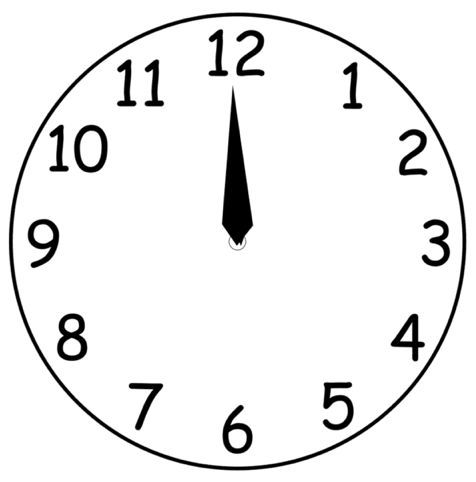
This one is too complicated. Try something simple.


This one says 12 o’clock. Or just 12.


The left-hand clock above says 4. You can think of this several different ways. It could be the time of day: 4:00. Or it could mean 4 hours of time. Wait for 4 hours.

Let’s think of it the second way. You can add waits together. Waiting 4 hours, plus waiting 4 hours, is like waiting for 8 hours on the clock.

Suppose you start at some time (pick a time, any time, say 12:00) and wait for 4 hours, and then wait for 8 hours. What time is it?

As far as the clock is concerned, you’re right back where you were.

4 ⊕ 4=8, 4 ⊕ 8=12, and 8 ⊕ 8=4. In other words, clock counting wraps around itself. I use the symbol ⊕ instead of + because it isn’t quite like adding ordinary numbers.

We use the numbers 1-12, but you can just as easily use Roman numerals, or label the hours with degrees of rotation, or put Chinese numerals in place—whatever you please. The way this works doesn’t depend on the labels you give the elements. All “12-hour clocks” will behave the same way.


Notice a couple of things about the 12-hour clock.

  1. Adding 12 to anything gives that same thing back again—just like adding zero. Rotating 360 degrees is just like not rotating at all.
  2. Whatever you start with, you can always “add”something to get to 12. If you start with 3 you can “add” 9 to get to 12. If you rotate by 85 degrees, you can rotate by another 275 degrees to get back to where you started.

Those two qualities define what mathematicians call an “Identity” element. If you have one you can ⊕ it with anything and the other thing doesn’t change. And there’s always an “Inverse” to every other element in the set. Just like 1+ (-1) = 0, 5 ⊕ 7 = 12.

Something else that may seem pretty trivial here, but isn’t always true, is that so long as I keep the order the same I can combine terms any way I like. (1 ⊕ 2) ⊕ 4 = 1 ⊕ (2 ⊕ 4) = 7.

We have to specify this because in everyday life this isn’t always true. Take concentrated sodium hydroxide, concentrated sulfuric acid, and sugar. If I mix the first two first, and then add the sugar, nothing dramatic happens. If I add the sulfuric acid to the sugar first, the sugar chars. Adding sodium hydroxide afterwards doesn’t “unchar” the mix.

The 12-hour clock is an example of what are called “cyclic groups.” They obviously get the name because they go in cycles. You can have a 24-elements cycle, a million-element cycle, a 2-element cycles—and there’s only one of a given size. Different labels for the elements don’t matter, all 3-element cycles behave exactly the same, so there’s really only one kind.

Triangles

The order you do even two things in can matter. You don’t get the same result if you put on socks and then shoes as if you put on shoes and then socks. socks ⊕ shoes ≠ shoes ⊕ socks.

You may have seen the little trick with two dollar bills in which you give them the same rotations, but in different orders, and wind up with George facing one way on one and the opposite way on the other.

Try this with triangles. I numbered the vertices of the original triangle and the one we rotate and flip to make it easy to see what’s going on.

The object is to rotate or flip the triangle so that it fits back on its original spot. If you rotate by 90 degrees it won’t land right—you have to rotate by 120, 240, or 360 degrees. I call these rotations B, C, and A—but remember that the labels don’t matter. The three rotations together make a 3-cycle; a 3-element group.


You can also flip the triangle, and there are 3 flips that bring it back to its original spot. If you flip it twice the same way, you get back to where you were before.


There aren’t any other rotations or flips that land it back where it was. Try it out for yourself, or count the number of ways the old vertices can match up with the new locations. There are only 6.

What do we get when we combine rotations and flips? I’ll save you the effort, but try it out yourself.

ABCDEF
AABCDEF
BBCAEFD
CCABFDE
DDFEACB
EEDFBAC
FFEDCBA

Flip D followed by Flip E looks like rotating the triangle by 120 degrees. Flip E followed by Flip D looks like rotating the triangle by 240 degrees. D ⊕ E ≠ E ⊕ D

This is a "group" which is not commutative. You may vaguely recall that word from math back in high school. It didn't matter in algebra or geometry--but it does matter here, in abstract algebra.

This group has 4 non-trivial subgroups: {A,B,C}, {A,D}, {A,E}, and {A,F}. There's more to say about this rather simple group, but the margin is too small to contain it.

Friday, November 25, 2016

Dogs

We were strolling through the meso-american section of the Milwaukee Public Museum, and I noticed that I didn't notice any figures of dogs. Was I not looking for the right features on the stylized images, or were they scarce to begin with? North American Indians had dogs--the South must have too.

Yes, of course. Chihuahuas, of course, among many others. And there were some paintings and some figures--the example Wikipedia links to looks very un-stylized and doggy. There was nothing about how frequently dogs were portrayed, but since they ate dogs they may not have thought them as quite as suitable for dramatic art as jaguars.

But one link leads to another(*)--did Indians domesticate coyotes? There aren't any Hare Indian's left, but maybe there are bones somewhere. The argument went that they looked like them (but other dogs do too), sounded like them (other dogs don't), other dogs hated them (as though they were another species). Not overwhelming arguments, but if people can find a little DNA somewhere, it might be worth checking. If wolves, and foxes, and culpeos, why not coyotes?


(*) Which leads to not getting any writing done...

UPDATE : See Retriever's detailed comment.

Antifragile

AVI recommended Antifragile, and I've started it. It does, as AVI says, demand an occasional time of cross-checking with your own experiences.

I know one example of how placidity hid information. When I lived in Liberia the place seemed quite stable. It had had wars in the past, but nothing significant lately, and the party line (one party) was that development was slowly happening and the future looked bright. I had no great interest in studying the political situation, and wasn't encouraged to, though Growth Without Development sat waiting on my parent's bookshelf. Not my business. And if some tribal Liberians weren't thrilled with the state of the state, they weren't likely to confide in a young American lad.

Tolbert made some changes, and was afraid to make others, and between growing expectations and some world-wide economic problems, there were problems. (I had headed off to college.) Then a coup(*) killed Tolbert, and Doe's rule was bad enough to provoke several counter-attacks, and finally a civil war with tribal splits. I didn't see any of this coming; it all looked quite peaceful. But a one-party state often looks peaceful.

I might have known better, with a little more observation and curiosity, but I was content in my bubble--like quite a few others up until just recently.


I notice that in his examples of "Interventionism" he includes "Copy editors trying to change your text," and says the iotrogenic cost is bland writing.

He's pretty down on "fragile" technology, so I wonder what he thinks of gas pipes. A small leak in a water pipe may or may not be a catastrophe (leaks in the floor above have been known to drip down to our server racks), but leaks in a gas pipe...


(*) Some conspiracies claim that the US was behind the coup. Given the kind of person Doe was, and his position at the time, this is inane.

Sunday, November 20, 2016

Gleaning the ungleaned

Years ago I read about jubilee and noticed that reversion didn't apply to city-dwellers (a short buy-back period, but no more). I looked at the land being farmed in back of our apartment complex and thought that if the whole complex grabbed a handful or three every day during harvest it would put a noticeable dent in the crop. In 5 days our complex could have probably snarfed up a quarter of the acre nearest us. A literal application of the principles wasn't going to work.

OK, cities are special cases, and industrial production doesn't fit the Leviticus paradigm very well. So how does one translate the principle of "not reaping to the edge of your field" into action in a modern environment?

One trivial thing I've done, or rather not done, is not pick up lost money. I used to, but after a while figured that a kid finding the dime would get more joy out it than I would, so I started letting it lie undisturbed, graduating to larger denominations over time. (I've never seen the original owner find it again, or even look for it.) There's no nobility in that--I can do without that dollar bill caught in the bushes without breathing hard (it isn't really even explicitly mine anyway)--I'm just trying to get a handle on the right attitude by being faithful in the least things. Least things first.

If you work in sales, you can cut the price a bit and take less commission if the client is poor. I don't know how many do that. Doctors and some lawyers sometimes do pro bono work. That's one equivalent of not gleaning to the edges. But if you're a janitor, or an IT manager, what's the equivalent? Giving money away is not the same thing at all. Widows and orphans and the disabled--yes, they often need direct support. But gleaning the ungleaned was work for the able-bodied without land or adequate employment of their own--they got food and self-respect and to be a model for their kids.

Another detail of the context is different: maintenance of a home is much harder. In most places around here you don't get to build without a plan for water and power and heat--and utility costs and taxes mean you need a non-trivial revenue stream just to stay in one place. That's not including repairs, which are an expense with houses anywhere. So either we should talk about a different paradigm for low cost housing (like the tiny house movement--but heating is a really big deal in winter!), or a "gleaning the ungleaned" that earns money.

I'd rather not reinvent the wheel here. Some folks are bound to have put some thought already into American equivalents of "gleaning the ungleaned," and some of that is probably useful. There'll be no silver bullet, of course--even the tiny houses have issues. (Imagine a little collection of them. Now imagine who will be staying in the neighborhood a year later.) I'm dubious of top down plans, unless the top dog happens to be God, and very few of the top dogs are.

Can anybody point me at who has done some reasonable work in this area, or thought through pros and cons?

Saturday, November 19, 2016

Knowledge

From a link to a link, when I should have been doing more useful things... Daniel Ellsberg said that esoteric knowledge corrupts.

Not always--not if you can and want to share it that's another matter. But I see his point; tangentially seconded by a good authority that "knowledge puffs up."

Wednesday, November 16, 2016

Moat Around Murchison's Eye

Niven and Pournelle collaborated again, this time for a third Mote novel. If you haven't read the first, the description here won't matter. The Mote in God's Eye was good.

This one is competent, but a bit disappointing. A red herring is waved too hard, there's way more focus on love lives than is useful to the story, and several characters, though well-defined at first, become less distinguishable later on. Pournelle's been unwell: I wonder if he didn't push back enough.

It seemed a little odd that the Moties didn't try a very simple probe of the Crazy Eddie Point: a small craft with a big engine in the process of reversing direction just as it passes through. Time it correctly and it would come right back quickly enough to let the Moties get a record of what was on the other side.

It reads like a finale, though I suppose a sequel in another generation is possible.

"Stay Healthy this holiday"

An insert in the Wisconsin State Journal this morning had suggestions about how to work off the dinner: 30 minutes of football for a slice of pumpkin pie (370 calories), or 10 minutes of hiking for a dinner roll (90 calories). I've a counter-proposal: work off that pie with some low impact exercise in the form of a nice 4 hour nap. You'll need it after all the preparations.

Monday, November 14, 2016

Earthquake lights

I'd heard of them, but never seen any pictures. Now we even have movies.

No, I don't know what causes this. I guessed that it was electric discharge from large-scale piezoelectric effects as the rock cracks for miles and miles, but that's just a guess.

Look at it.

Radioactive Boy Scout RIP

Back in 2004 I wrote about The Radioactive Boy Scout: David Hahn, who tried to build a breeder reactor in his back yard--and got it to produce extra radiation. Not quite self-sustaining, but a noble effort. So to speak.

He died this September. The obit doesn't give any cause, but apparently as recently as 9 years ago he was trying to lay hands on radioactive material--americium from stolen smoke detectors. The obit didn't say whether he died of cancer.

He had his problems (pretty severe, if getting charged with theft for tiny quantities of americium is any indicator), but he dreamed big. A home-made reactor: that's deadly crazy. But cool.

Sunday, November 13, 2016

Virtues gone wild

"The modern world is not evil; in some ways the modern world is far too good. It is full of wild and wasted virtues. When a religious scheme is shattered (as Christianity was shattered at the Reformation), it is not merely the vices that are let loose. The vices are, indeed, let loose, and they wander and do damage. But the virtues are let loose also; and the virtues wander more wildly, and the virtues do more terrible damage. The modern world is full of the old Christian virtues gone mad. The virtues have gone mad because they have been isolated from each other and are wandering alone. Thus some scientists care for truth; and their truth is pitiless. Thus some humanitarians only care for pity; and their pity (I am sorry to say) is often untruthful.

Orthodoxy, by G.K. Chesterton

It seems to describe the wild claims and counterclaims of the party faithful--full of righteous indignation because they, in fact, do have part of the truth.

Friday, November 11, 2016

Daylight Savings Time

I think the rabbit doesn't like it.

Does anybody have some numbers for how much energy/time/lives-lost-in-night-accidents we're supposed to save with this bi-annual jetlag?

Monday, November 07, 2016

A season for returns

The NYT says the networks are worried: they're all ready for the big election night,
But as television news gears up for 2016’s big finale, an intense public distrust in the media is threatening the networks’ traditional role as election night scorekeeper.

I watched election returns one night years ago. I have not been tempted to try the exercise again. From one quarter hour to the next the changes were small, and misleading without the "Well, this district usually votes Republican, and this one includes the cemetery and votes the other way" explanations.

It's not like watching a ball game, with dramatic offense and defense and obvious skill. It's pretty abstract, and slow, and unless you believe that your intense stare will help your side win, nothing you do matters anymore.

Part of problem is commentary. They don't say it in so many words, but "Why do you think the people of Kansas are so stupid?" or excitedly "Look, the good guys are winning!"

The next day will be good enough--or, in the case of the Presidential election, bad enough. I'm not going to be happy no matter who wins that one. (*)

Donald Sensing proposes to leave the radio and TV off, and watch a move that night. Good advice. I've a little project I should attend to...

(*) Looking at the polls, I strongly suspect that the machine will successfully get out the vote for Hillary. Looking at the lawn signs, I see 3:1 Hillary:Trump in hard left Dane county (!), and O(10:1) in the countryside. But I think that just reflects lack of enthusiasm; they'll vote for the party when the time comes.

Friday, November 04, 2016

A courtesy

Don't ask people how they voted. It is rude--why is a secret ballot any of your business? I don't think it's a good precedent to assume that that kind of information is available on demand.

On the flip side, I don't need to know who you voted for--or who you retroactively voted for now that you know the result. It's generally virtue signaling or prompting (I showed you mine, now you show me yours), though for ancient history it could be just background. Maybe you think you know what my motives are in picking one Senator over another. AVI would say that I probably only have a fuzzy picture of that myself, and that a lot of our reasoning is ex post facto rationalization.

I have, in the past, explained why I deprecated one candidate or another. (That's shooting fish in a barrel this election--and everybody else has done it already.) I doubt that I persuaded anybody, but I tried, and persuasion is part of the game. But still, don't ask. The man with the 6' Trump sign probably didn't vote for Jill Stein. Don't ask. (Do you floss every day? Don't ask. Boxers or briefs? Please don't ask.)

This year's presidential election I think shows even more clearly the value of this little courtesy.

Thursday, November 03, 2016

Letting the punishment fit the crime

Police in Shenzhen (southern China) "are punishing drivers who dazzle other road users with full-beam headlights by making them stare into the lights for a minute".

"Shenzhen's traffic police have opted for unconventional penalties before. Last year, they made jaywalkers choose between paying a fine or wearing a green hat and vest while directing traffic."

Jubilation

My better half is a long-standing Cubs fan, who could probably have passed Royko's true fan quiz. "Lovable losers" has almost been the Cubs' trademark, but this year... Somebody pointed out that a number of the Cubs are Catholic, and Catholics have the Jubilee Year of Mercy this year.

Tuesday, November 01, 2016

Is my conclusion swayed by bias?

Protein is good for you, and the new results say that dietary fat is good for you. So I'm going to start classifying bratwurst as health food. Dress it with tomatoes (fruit), onions, pickles--you're getting close to a complete meal here. (The Lamaze instructor ages ago, when talking about morning sickness, said that pizza made a good meal.)

Sunday, October 30, 2016

Repairs of the tomb

Restorers found rubble filling the area under the lid. The lid is about 500 years old, and deteriorating, so some renovation was in order. The article quotes Hiebert: "but we will finally be able to see the original rock surface on which, according to tradition, the body of Christ was laid." Actually, if I understand correctly, Hakim the Mad had the earlier building over the Holy Sepulchre destroyed and the ground beneath it chiseled away as well. If so, maybe that rubble fill was rock saved from the demolition, and is the actual rock Jesus lay on. Or replacements from nearby as relic-hunters scavenged originals. Or maybe it was something readily available to support the marble lid.

Alternative math

I've claimed that there were other things you could do in high-school math besides learn how to divide polynomials in algebra.

One possibility: learn about the zoo of sequences.

If you have a rule for generating numbers: a first, second, third, fourth, and so son--what does the list look like? The order matters, so you can number the terms in the sequence if you need to: term 1, term 2, etc: T(1), T(2), T(3), etc. You usually need to number them.

The answer to that question has applications in measurement, chaos theory, control systems, and on and on.

Zeno knew about this one 2500 years ago: (1, 1/2, 1/4, 1/8, 1/16, 1/32 ...). The next term in the sequence is half the previous term. The numbers get small pretty quickly--closer and closer to 0 but never reaching it. This kind of sequence "converges:" it has a limit.

A boring example is (1, 1, 1, 1, ...).

You've probably heard of Fibonacci's sequence: (1, 1, 2, 3, 5, 8, 13, 21, 34, ...). The next term in the sequence is the sum of the previous two, and it gets larger without any limit ("diverging"). You can show that if you go farther and farther along, that the ratio of a term to the one before it is (1+√5)/2.

Some do neither: (1/2, 1/2, 1/4, 3/4, 1/8, 7/8, 1/16, 15/16, ...). The first, third, fifth, etc (odd) terms converge to 0, while the second, fourth, sixth,etc (even) terms converge to 1.

It isn't hard to predict what this will do: (1, -1/3, 1/9, -1/27, 1/81, ...)

Pick a rule. How about a continued fraction? Start with something something simple: T(n) = (1+1/(1+1/T(n-1)))

Let the first term be 1. The second is 1+1/(1+1/1) = 3/2. The third is 1+1/(1+1/(3/2)) = 8/5. Look at the Fibonacci sequence and see if you can guess that the fourth term of this sequence will be.

Suppose we use T(n) = 1 + 1/(2 + 1/T(n-1)). Start at 1. (1, 4/3, 15/11, 48/37, 173/133, ...). That converges to (1+√3)/2 or about 1.36602...

You can start at other numbers besides 1. How does the sequence change?

Things can get downright weird. Suppose you define a sequence T(1) =1, T(2) = 1, T(n) = T(n -T(n-1)) + T(n -T(n-2)). This is "Hofstader's Q Sequence." When a sequence gets a name, you know that there's either something very important or something very weird about it. The first numbers are pretty easy: (1, 1, 2, 3, 3, 4, 5, 5, 6, 6, 6, 8, 8, 8, 10, 9, 10, ...). As you keep on going, though, there can be wild swings. Mostly the numbers stay close to T(n) ≈ n/2, but they jump around a lot. These aren't random numbers--they're all well-defined. However, it isn't even known if the sequence dies somewhere along the line, by trying to refer to an undefined term (like the -1'th term).

The heaviest algebra I've referred to so far is the quadratic equation.


I'm not the first to think of different math directions; I got the idea from learning about some people who were trying to develop materials for exactly that purpose.

The New Mathematical Library series of books was "written by professional mathematicians in order to make some important mathematical ideas interesting and understandable to a large audience of high school students and laymen." The book from that series on continued fractions is available as a PDF.

Friday, October 28, 2016

Inflation

A few days ago when I commented on an announcement claiming that the universe's expansion is perhaps not accelerating. I mentioned in passing that I was not convinced of "initial inflation." After seeing posts defending dark energy from several directions, I thought I'd point you to a talk by one of the developers of the theory, who thinks it doesn't work. Hat tip to Peter Woit). That's an insider's take--I'm not at all expert on inflation. He thinks the theory inconsistent, that it doesn't work very well, and that it is not falsifiable. I took it to be an ad-hoc explanation that just appeared out of nowhere to explain why a model doesn't work right. ("In the "Deerslayer" tale Cooper has a stream which is fifty feet wide where it flows out of a lake; it presently narrows to twenty as it meanders along for no given reason, and yet when a stream acts like that it ought to be required to explain itself.")

Wednesday, October 26, 2016

How the other half lives

Chabuduo! An article from Aeon about life in China.

Tuesday, October 25, 2016

Slow reading

When possible, read the originals instead of the commenters. I just checked the UW library system, and found 11,627 title that include the name Shakespeare. I'll bet Shakespeare is more fun to read than any of them.

So, when I heard about The Theology of the Body, of course I tried to read Male and Female He Created Them.

I am bald enough already, and I'm only 44% of the way through, according to the kindle meter. The intro was mostly interesting (explanations of where his philosophical themes came from), but the body of the work is the individual weekly addresses. He tells you what he's going to tell you, then he tells you, then he tells you that he told you. Then he recaps during the next week's talk.

Unfortunately skimming doesn't pay, since scattered here and there are some good brief insights and some "say what?" moments.

For example, in one section he mentions a model of the union with God in Heaven as though the beatific vision were all-absorbing, with no room for anything else. That's a plausible assumption, but you can easily model other possibilities. Orthodox doctrine says that after the resurrection we will be incarnate bodies again, not bodiless spirits. The whole point of creating incarnation and divinization seems to be to bring the spirit thoroughly in union with the world. While we're here we're to try to incarnate love and beauty and other good things from God; it seems plausible that in Heaven we are to do the same.

Nobody can know God in Himself as He is--no finite creature can--we can only know Him in ways we are designed for. (Exodus 33:20, anybody?) Here we are given the opportunity to love God through our neighbors. How would that be different in Heaven? And if we are to be interacting with each other, it seems plausible that we would also be reflecting God to each other, enlightening each other. Divinization would be both directly with God and in community.

But I've not been there, so I'm just guessing too.

Pressing on.

UPDATE: In a slightly later address, JohnPaul affirms something closer to my model than the one he mentioned earlier.

Learn something new every day.

Apparently when tossed a stuffed kitten by a 4-year-old at close range, my startled efforts to grab it out of the air (knocking it this way and that rather than closing on it) resemble a cat trying to catch a feather on a string. So she informs me. And wanted to see it again.

Saturday, October 22, 2016

Once in a lifetime

I gather Lucifer is looking quizzically at the thermostat. For once, no blues...

Just yesterday the story included "What did Jesus say to the Cubs?" says a popular T-shirt in Chicago. "Don’t do nothin’ til I get back."

Internet

The UW has decided to go to VOIP. The plans aren't finalized--or very far along, from what I hear. There's a deadline for contract renewal for the old system, and it isn't going to budge whether we're ready or not.

Pretty much everything else runs on the net, why not the phones too?

That makes the net a single point of failure. I hope yesterday's attacks suggested something to the powers that be. We have dumb phones, but also have a tablet, which doesn't handle phone calls but which can handle Skype. Provided the net is up. At least mobile phones aren't run over the net yet.

All the wonderful ideas: pay your bills with smartphones, pay bus fare with smartphones, use smartphone for ID, use smartphone for RFID key entry--do the inventors have any notion how fragile their system is?

Dark Energy

I've always been leery of claims about dark energy and the universe expanding more rapidly (and of the initial inflation). Do we really understand the behavior and distribution of Type 1A supernovae well enough to draw conclusions? " The teams found that more than 50 distant type 1a supernovae are fainter than expected for their measured redshift." 50 is not a very big number.

A recent paper says no; with more supernovae and a different statistical analysis approach that doesn't treat them all the same finds that the distribution is consistent with a constant expansion. Please follow that last link, and look at the second figure. The blue curve is the dark energy model and the red dashed line is the constant expansion model.

I don't know if this group made any major mistakes--I'm not expert enough on supernovae. But it looks like the foundation for dark energy was worse than I thought. (And I'm not convinced about initial inflation.) "Laws are like sausages, it is better not to see them being made."

Thursday, October 20, 2016

Math as seen through a glass, darkly

A professor of education and mathematics education (but not, I notice, of mathematics) announces that "mathematics can be decolonized." Oh joy. She can't see any obvious ways of changing the content, so she looks for the "human aspect:" how do students see themselves.

"what mathematics actually is... Mathematician and academic Jo Boaler points out that mathematics is the only subject where students and mathematicians give very different answers to this question."

Mathematicians view the subject as an exciting, creative endeavour in which problem solving, curiosity, excitement, intuition and perseverance play important roles - albeit in relation to abstract objects of study.

For school and even undergraduate mathematics students, these aspects of mathematics are often not experienced and remain opaque. Students tend to believe that mathematics is a set of procedures to be followed. They think only particularly gifted people can do and understand these procedures.

Not true. IIRC Latin was another subject that the skilled and the students had wildly different opinions about. PE is another: humiliating agony for some of us, fun for others. I saw premeds struggling with physics.

One reason for this is given by a study in the US, which showed that the more a field attributes success to giftedness rather than effort, the fewer female and black academics are in that field. This is because the field perpetuates stereotypes about who belongs in the field. The same study found that mathematics professors hold the most fixed ideas about giftedness.

But this view of giftedness versus effort is not borne out by research. A number of scholars have argued that all people are capable of learning mathematics, to high levels.

Go ahead, follow that link. It's a 2-page PDF book review, and it doesn't say what Prof Brodie says it says. The book discusses human mathematical ability in general, not in degree. Nearly everybody can abstract to 1+2=3. Most of us can master the times tables and get some feel for fractions (not always taught well). Somewhat fewer, but still a lot, can learn algebra and proofs. Fewer of those are skilled at it, but that's not a problem--they've been trained in the rudiments of a new language and way of knowing things. I didn't use high school French much for years afterwards either.

If Prof Brodie actually did a little math, instead of math education, she'd know that accomplishment is about giftedness. I've a BS in math, and my only solo paper is in mathematical physics. John Baez is a mathematical physicist. I'm not in his league. He's not in Erdos' league, and would be the first to say so.

Whether stereotypes have any significant effect is open to question. For this or that individual, perhaps. I've seen nothing convincing that shows any causal link of the right order of magnitude. On the contrary, elementary textbooks (perhaps not in South Africa) are drenched in "diversity." The problem-solving children in the explanations are carefully mixed in race and sex. Side-bars extol the accomplishments of 2nd tier mathematicians in order to achieve the right sex ratio. The way is made as friendly as possible--but it turns out there's no royal road to math after all.

That's not to say that we can't do better in math education. There are plenty of subfields. Some kids do fine in algebra but bomb proof-based geometry; some do the reverse. At least the rudiments of algebra are very widely used, but some aspects of topology or knot theory might be accessible in place of more "advanced" algebra (e.g polynomials) or geometry. I tried to teach some TAG 3rd graders a little bit about abstract groups, and I think some of it stuck for at least a week.

But "decolonization" of something as thoroughly abstract as math? There's no ethnic culture associated with it, no economic culture--there are a few mathematical cultures, if you like, but nothing that screams "dead white men."

No, I'm afraid that her real goal is in the tail:

Everybody deserves access to its beauty and its power - and everybody should be able to push back when the discipline is used to destroy and oppress.

That sounds very much like "if the numbers mean something I don't like, I get to reject them." And reject them in good conscience, because labels like decolonization and liberation automatically put you on the side of the angels. Perhaps she means she doesn't like certain technologies, but she puts the blame squarely on math, and I assume she means what she says.

Tuesday, October 18, 2016

Time for Kremlinology?

Humor me in a little Kremlinology.

Never mind the D and R honorifics for now. Most politicking never shows up in the news--it consists in jockeying for empires within and between bureaucracies.

Even in the armed forces, when fighting a common enemy, infighting and empire-building go on, and have been known to even involve assassinations. Not just the Japanese: we also lost some people in WWII because of inter-service rivalry (and politician stupidity).

So suppose the FBI and CIA are having a spat, or the NSA and the Pentagon, or NASA and the DOE. Or suppose there's an internal squabble in State. What might you expect to see?

Leaks, for one. Stuff that's supposed to be secret that somehow shows up. It might be embarrassing, or it might be supposed to be top secret and the agency responsible for the secret gets egg on its face for not keeping secrets. Or it might kill an ongoing operation that was Not Invented Here.

Embarrassing incidents, like the infamous "Reset" button. That whole idea was so tone-deaf that it had to be an enthusiasm from higher-ups, but the mis-translation on top of everything else really put the icing on the cake. Unless Hillary used the dictionary herself, somebody probably got fired for that little bit of carelessness--and if so, I'll bet it was the wrong person.

Strings of replacements of leadership. If one category of administrator or general officer seems to be systematically replaced by another, probably somebody lost the political struggle big time. One big problem is that you won't understand what you see, because outsiders don't always know what the categories are.

Noisy leaders or wannabe's or whistle-blowers that suddenly decide to retire to be with their families.

Agencies starting to arm up. Just in case, of course. Not for shooting, but so that the Department of Education doesn't let the Bureau of Land Management intimidate them when they show up in force at some contested site.

All these things happen all the time at some level, of course. How do you know when the activity is significant? When does it strike you that (e.g.) there've been a lot of high profile suicides lately? Is that random chance, greater popularity, more reporting, or more intense pressure? Note that a national database of phone contacts can with difficulty find a few terrorist needles in the haystack, but it is ideal for tracking the contacts of somebody you want to get the dirt on.

No, I'm not looking for conspiracies. You don't have to. This just seems like the kind of behavior you expect from competing bureaucracies. It might even be more bitter at the University level ("the stakes are lower"), but when the organizations get really big the troubles for the rest of us get bigger too.

Friday, October 14, 2016

Paleo diet

It turns out that 400,000 year old skulls had tartar. Tartar is porous, and stuff can get entrapped. Researchers found "charcoal from indoor fires; evidence for the ingestion of essential plant-based dietary components; and fibers that might have been used to clean teeth or were remnants of raw materials." "Within the calculus, the researchers also discovered small plant fibers, which they suspect may have been used to clean teeth—prehistoric tooth picks."

There are also traces of fatty acids and bits of starch, presumably from nuts and other plants.

The real paleo diet didn't prevent tartar buildup. I wonder what else it didn't prevent. Attacks by cave bears, ...

Thursday, October 13, 2016

Reporting from Russia

Another headline: Putin ally tells Americans: vote Trump or face nuclear war. A headline calculated to get your back up, no?

Vladimir Zhirinovsky, a flamboyant veteran lawmaker known for his fiery rhetoric, told Reuters in an interview that Trump was the only person able to de-escalate dangerous tensions between Moscow and Washington.

That's way less dramatic, and a lot less impertinent.

But for still more information, it might help to check somebody who knows the players a little better: a Czech string theorist.

You know, he is a boss of a nationalist party in Russia – one of the four parties in the Parliament. No self-declared anti-Putin party has made it to the Russian Parliament. So Reuters calls him "a Putin ally". It's a very problematic label, of course, because he is still leading a different party that competes with Putin's. Putin is mainly an old-fashioned conservative politician not too different from Helmut Kohl and many others. Zhirinovsky is the head of a highly idiosyncratic nationalist party. To say that they're "the same" means to show the lack of understanding for Politics 101.

Also, I've been watching Zhirinovsky for some 25 years. He's been a part-time clown. All of his famous propositions that have made it to the media were tainted by some conspiracy theories or immense exaggeration – and, I believe that in many cases, intentional humor (which is a good thing in Russia because they usually have a shortage of it). In some cases, I could feel a sympathy with the "core" of his proclamations. Sometimes, I disagreed. But I don't remember that his propositions could have been considered as accurate, trustworthy predictions or realistic plans.

Is Lubos more accurate? Maybe. He's been a bit of a Putin apologist: sometimes even a lot of an apologist. He wasted a lot of bits arguing that Russians didn't shoot down Flight 17 when obviously they did and were seen high-tailing it out of there. He's worth paying attention to, though.

Physics had some visitors from Poland back when Solidarity was making headlines. They read emails from back home, and told us that even the best US papers generally missed the point of the events they reported on. A local may have a bias in his views, but he probably knows the situation better than foreign reporters.

Some years back Rantburg had a Greek commenter who often had very contrary views about the EU. The Greeks had dictatorship and near civil-war within living memory, and it would hardly be surprising if they thought that, on the whole, even a suffocating central government was better than what they'd had on their own. I was sorry when he dropped off the site. I didn't have to agree with his take, but it was good to have somebody near the scene who understood other aspects of what was going on.

Headlines vs body

"Electronic spoons which make food taste sweeter on horizon". Or on Drudge: "veggies taste like chocolate."

Wow! Except here's what's in the body of the story

For sweet tastes there is a channel called TRPM5 which is temperature sensitive, so people taste more sweetness when the food is hot than cold. So to mimic sweeter tastes the device changes the temperature of the tongue rapidly from 77F (25C) to 104F (40C.)

So it warms up the tongue just a bit to make some foods taste sweeter. What a let-down.

"The team say that they are also working on producing different tastes which they claim is time consuming because even the difference between a lemon and a lime is vast."

Sunday, October 09, 2016

Preparing for elections

AVI has posted a series on the election and our role and influence. As of this writing he's presumably got a few more in the pipe.

Somebody pointed out that while contempt of congress is a crime, contempt for congress comes naturally. That's fine--if you insist on being in the public eye, you'll be judged. Not always wisely, perhaps, but that's life.

It is interesting to hear what people say about this election. Not pleasant, but interesting. This is Dane county--Trump comes in for matter-of-fact abuse. (Not many Hillary signs out, BTW--more for senator or representative.) The vicious invective is reserved not for the candidate, but for his supporters. I had a brief email exchange with one of the local reporters asking him who they were (I didn't know any personally), and his final letter casually dismissed them as stupid and unworthy of attention because they were Trump supporters.

"Everybody knows" that Trump supporters are racists, terrified of change and hating people different from them. Hmm. I could with equal (perhaps better) justice claim that Sanders supporters are envious ignoramuses, who just want free stuff at everybody else's expense; and profess myself duly horrified at how many fellow Americans have descended to this level. However, I think the Sanders phenomenon wasn't really an endorsement of socialist economics, but a kick in the pants for the Democratic party and an assertion that the status quo is broken--the big financial institutions are making the rest of us assume all their risks while they rake it in.

Likewise I think the Trump phenomenon is a kick in the pants for the Republicans, and an assertion that that the status quo is broken--the governing groups are disconnected from the public interest and the public will.

The critiques are similar, and the differences have more to do with the values the groups hold. BTW, I doubt that Sanders voters will sit out the election--they'll hold their noses and vote for Hillary even though they despise her, because she, even if distantly, claims to support their tribe's values.

So why the viciousness? Is this the default setting? A radio show suggested that WW-II produced a generation of politicians used to fighting on the same side to preserve the US, and suggested that though the politics might be wildly divergent, they had a sense of being in the same boat. Maybe so.

OK, assume this is the true normal. I don't think this kind of bitterness is something Jesus would approve of. So how do we combat the bitterness and do better than normal? I can hear some folks already: "Compromise--do it my way." Or words to that effect. Maybe instead "Dine with a Democrat" or "Share a Repast with a Republican" or "Lift a Libation with a Libertarian?" Find something in common--but that may be harder than it looks, given the way preferences seem to cluster. Better might be "Haul sandbags together while the river rises." Which I suppose is the WW-II unification hypothesis with a different enemy.