Sunday, September 23, 2018

Resistance

It sometime seems that when it comes to a besetting sin, there are essentially three kinds of Christians.
  1. Those that were gulled into thinking that it isn't really a sin
  2. Those that are struggling with it
  3. Those that gave up struggling and gull themselves

Me? Depends on the sin, but I hope most are in 2 or 1 and not in 3. Quite likely wrong, though.

"S. Dorotheus relates of a certain holy monk that he grieved at being freed from temptation, and exclaimed: “Am I not then worthy, 0 Lord, of suffering, and being a little afflicted for Thy love?” "

(I'm reading some of the desert fathers. Interesting mix of advice; sometimes contradictory. "It is human not to know yourself." -- also v.x.69 is fun -- also "If a diligent person lives with those who are not, he does not make any progress, for the whole point of being diligent is to prevent yourself by means of your work from becoming second rate. But if a lazy person lives with those who are diligent, he does make progress, or if he doesn't, at least he cannot get any worse." )

V.x.92. A brother asked an old man, "Father, what is the point of asking the seniors and getting good spiritual advice from them if I don't remember anything of what they say? Why ask seeing I don't profit by it? I feel as if I'm totally unclean."

There were two empty bowls near at hand, and the old man said, "Take one of those bowls, pour some oil into it, burn some flax in it, pour the oil back and put the bowl back in its place."

And he did so.

"Do it again," said the old man.

And he did so.

After this had been done several times, the old man said, "Now pick up the other bowl and tell me which is the cleaner."

"The one I put the oil in," he said.

"It's the same with the enquiring mind," said the old man. "Although you can't remember what you have been told, nevertheless you become cleaner than those who never ask any questions at all."


Ecclesiastes

Perhaps I'm weird (some near and dear will heartily assent) but I found that in younger years when I was in a funk I found that reading Ecclesiastes was a good way of getting out of it. Right there in the Bible--they got it! And at the end of the day they had some hope anyway.

I'm not suggesting it as cure for depression--all I had was the blues. And I wasn't trying to cheer myself up--I was looking for something that spoke to my mood.

Friday, September 21, 2018

Rule of Thumb 17

If the product claims to be compost-able or flush-able, carefully return it to the shelf and back away slowly.

Thursday, September 20, 2018

Nuclear pasta

Their models may be wrong, and the details may turn out to not quite work, but you must salute the sense of humor of the researchers trying to calculate how the crusts of a neutron star could crack or break.

The crust might break if something falls into the star, or if in-falling debris slowly piles up into a tiny mountain. "How large a mountain can you build on a neutron star before the crust breaks and it collapses?"

Wednesday, September 19, 2018

First impressions of The Benedict Option

I've been hearing about this for some time, and after AVI said he was going to be teaching from it, decided maybe it was time to get and read it.

Thumbnail: Western Christendom is in free fall, and the West is already becoming hostile to orthodox Christianity. Christians need to build Christian communities to preserve the faith, encourage and sustain each other, and most importantly worship God. Most churches are not such communities.

His view that Western Christendom is in collapse seems accurate. He doesn't address the eventual side effects of this on the secular West, since that isn't his focus, but even the best case is pretty grim for everybody but the lucky elite. "What can't go on forever, won't."

He describes the desacralization of the West (from Charles Taylor) and the changes in philosophy that led us to our current mess. He doesn't suggest that there's an intelligence behind the changes, but I think there is.

In several places the book assumes that the local church can serve as a nucleus of community-building. Looking around at a few I know, that seems a bit optimistic, and even in the book he suggests that quite a few churches are past saving already. (Who knows what God will do, though.)

He emphasizes (rightly, I judge) the importance of liturgy--that's kryptonite to a number of people I know.

Understanding our history he calls vitally important--and that's something that's been on my mind for years. I noticed that the youth weren't getting much in the way of instruction, but a lot in the way of entertainment, and decided to do something about it. That's taken a lot longer than I hoped.

Teaching your children is vital too. He mentions some things I wish we had tried, and some things we did.

He doesn't know how these communities should organize. He describes a few, but recognizes that they will have to be organic, and probably vary somewhat depending on the circumstances. They will be local; there's no substitute for being there when somebody needs you.

Prayer, focus on God, and mutual support for living, working, and teaching will be the foundations of whatever finally works. Hold tight to the truth. Tell the positive story of sex and its importance, against the deluge of trivialization and nonsense we're immersed in. (Robot sex dolls? Really?)

Discipline yourselves--fasting, fasting from electronics, learning to appreciate manual labor. Recognize now that many professional jobs will be closed to orthodox Christians, and be ready to rework your life accordingly.

He comes back over and over to the monks at Nursa and how the principles of their community point to things we need.

My thoughts: To first order, as he points out himself, the Benedict Option is essentially trying to live a Christian life in community--something we should be doing no matter what the socio-political weather.

What should I be doing? Maybe following through with the education plan, assuming I haven't wasted my time on it. Collaring a few people in the church and talking with them about this. Maybe doing some legal research on mutual responsibilities in communities.

Most plans are going to fail, and sometimes dramatically, when people are too lax or too tight with the community rules. As little hierarchy as possible is probably best--otherwise you lose the organic nature of the community and wind up with an out-of-touch elite. Some is needed.

I need to think about this some more, and learn about what's been tried.

UPDATE: Another, much more detailed, take.

Tuesday, September 18, 2018

Code of conduct

Linus Torvalds apparently had it explained to him that his behavior towards other developers was destructive. So the Linux development community has a new code of conduct.
"In the interest of fostering an open and welcoming environment, we as contributors and maintainers pledge to making participation in our project and our community a harassment-free experience for everyone, regardless of age, body size, disability, ethnicity, sex characteristics, gender identity and expression, level of experience, education, socio-economic status, nationality, personal appearance, race, religion, or sexual identity and orientation."

You noticed too? Political affiliation isn't included. (The covenant is also quite sex-obsessed, taking up almost a third of the factors.) The Contributor Covenant starts off with some explanation about how meritocracy is a very bad thing, but the actual covenant is mostly innocuous--except for the loophole you can run a barge through.

"But you wouldn't want to work with a Nazi or a racist, would you?" No, not really. But unless their beliefs change what they do, how do I really know what they think? I've probably worked with some racists--but if so they were generally quiet about their views of gweilo, so who cares? And Nazis are rare, never mind what google's HR claims. The closest approximation to Nazis around here is antifa, and there aren't a lot of them either. (*)

What matters is not what you do, or even so much what you say, or what people infer about what you believe--but what label they can slap on you.


(*) "Nazi" means something specific not just about attitudes but about plans and actions. Racists of one stripe or another are not hard to find; tribalists who try to arrange the ascendancy of their tribe are ubiquitous--racists who work to destroy other races are much less common. Maybe you're God and can judge them both alike, but I have to evaluate deeds.

"Embracing My Inner Ent"

Have a look at this medieval scholar's post "On not taking sides." "After all, if my goal had been to impress anybody, I would do much better (numerically speaking) trying to impress the friends whose views I already knew I disagreed with, at least to judge from the jokes that they tell."

Or a more recent post of hers: "Get thee to a library!"

I wrote earlier this week about how senior colleagues keep urging me to get back to my proper work, the scholarship for which I have been trained and on the basis of which I hold the professional position which I do, the implication being that I should not be allowing myself to be distracted with ephemera like, I don’t know, being slandered by colleagues in my field, but rather that I should be concentrating on the work that will last for eternity, or at the very least beyond my own lifetime.

I can hear Hamlet now: "Get thee to a library, why wouldst thou be a feeder of liars?"

But that, of course, is exactly what I did thirty years ago at the beginning of my training as a scholar—get to a library.

That is where I found all the lies!

Or look at the importance of the Scots in the world.

Wednesday, September 12, 2018

Agrapha

Paul quotes Jesus saying something not found in the Gospels: "It is more blessed to give than to receive."

There turn out to be a small number of sayings attributed to Jesus, and not in the spurious "gospels" like "Thomas." Agrapha="non written"

Wikipedia has a list of them. Some of them just don't smell right at all: " Except ye make the lower into the upper and the left into the right, ye shall not enter into my kingdom." Nah, wrong style--bogus.

Others, such as "For ask for the great things, and the small shall be added to you," seem like variants of Gospel sayings.

One which Justin Martyr cites seems on the hairy edge: "In whatsoever things I apprehend you, in those I shall judge you." In other words, what I find you doing when I come or you die, will be used to judge you. That seems a bit out of tune with the rest of His words, except for Mark 13 "Therefore, be on the alert—for you do not know when the master of the house is coming, whether in the evening, at midnight, or when the rooster crows, or in the morning— in case he should come suddenly and find you asleep. What I say to you I say to all, 'Be on the alert!'" (And, of course, its parallel in Matthew 24.) And there's Ezekiel 18 too. And lots and lots of people who try to clean up their acts at the end of their lives find the principle plausible.

Keep your eyes on the prize.

Monday, September 10, 2018

A difference in attitude

I don't recall much about the book, but when I was quite young I read a history which included Daniel Boone, and mentioned how he had "kilt a bar." It took the time to make the point that although many people could spell better, few could kill a bear at close range.(*) (A sentiment apparently shared by his father.)

I don't see quite as much appreciation for the accomplishments of our ancestors--there's generally a caveat reminding us of their hurtful attitudes about this or that. I can see how this is supposed to shape children's attitudes into appropriate channels, but the unwarranted feeling of superiority seems like a high price to pay.

(*) Daniel apparently could read and write well enough, and liked to bring along reading matter on his hunting trips. He apparently fancied himself as a land speculator, but wasn't any good at it. "Boone's remaining land claims were sold off to pay legal fees and taxes, but he no longer paid attention to the process. In 1798, a warrant was issued for Boone's arrest after he ignored a summons to testify in a court case, although the sheriff never found him. That same year, the Kentucky assembly named Boone County in his honor."

Saturday, September 08, 2018

Obscenity

I remember in a description of the USSR I read back in high school, the phrase "communist science." I thought that was an obscenity then. On mature reflection, I still think it is an obscenity. Truth is made subordinate to the desires of The Party.

Which brings me to this story. Go have a look at it. Executive summary: The author wrote an applied math paper attempting to find an evolutionary reason why males (in a vast array of species) show far greater variability than the females. This was attacked before publication by WIM, and after publication it was made to vanish from the journal.

The first question about this is, of course--is it true? The story is straightforward--were the events really that clear? I have never heard of a published article being replaced without comment before.

Was the opposition entirely driven by the fear of political repercussions? The author names names (Penn State WIM administrator Diane Henderson, Nate Brown, Mathematical Intelligencer’s editor-in-chief Marjorie Senechal) and cites quotations from them.

This is, if true, pretty damning. The loyalty of these, and presumably the rest of the WIM (Women In Mathematics) leadership (I don't know about the rank and file), is plainly not to truth but to the tribe and party. What makes this especially horrifying is that a representative of a large institution (the National Science Foundation--which--full disclosure--pays my salary) agreed.

So, what does one do--aside from forming a counter-party, which would likely degenerate the same way these have?

UPDATE: A mathematician doesn't like the paper on other grounds, but that doesn't exactly address the quoted remarks. Another party claims that the paper was only accepted on the basis of politics. The full emails mentioned might clarify things, but so far I'm still seeing politics victorious over math.

Thursday, September 06, 2018

California bail

They claim that using algorithms to estimate flight risk and not demanding bail is more equitable, since the poor have a harder time making bail. The latter is true, but I wonder about the consequences.

First, I am not persuaded that an algorithm will be less biased(*) than the average of judges.

Second, there is likely to be a difference between the sets of "flight risk" and "flight risk when you have a sizeable chunk of money at stake." The second set is going to be a lot smaller--that's the whole point of bail, if you do it right.

I figure the algorithms-that-be will screw up a lot, and in addition will deny release to a larger number of people than before. If you try to force the before and after rates of bail-denial to match, the system will have a larger number of no-shows.

Perhaps that's a feature and not a bug? More no-shows means fewer convictions which means less stress on an over-full prison system.

(*) Google "fixed" its algorithm by removing gorillas from the training set.

Tuesday, September 04, 2018

Soil lead and blood

There's always a little lead in the soil, but sometimes there's way too much--and it gets into the kids. The soil is much harder to deal with than walls or floors, and the safety limit for soil is "37 times higher" (or 151 for the new interior standard) than for floors. That's probably not unreasonable. But.

"In August 2005, Hurricane Katrina flooded 80% of New Orleans, thereby creating a unique natural experimental condition not ethically possible by any scientific standard.. Ten years after Katrina, the same research team was reinstated to remap New Orleans"

Yep. Lead levels dropped in the soil, and in the kids--a factor of 2.63! (They used the same census tracts to compare apples and apples.) But, of course, it wasn't just the soil. The population wasn't quite the same, and the cleanup sometimes involved repainting. And the stuff that gets picked up may be superficial, so if you can clean up the first few inches you probably cut down on the dust and subsequent transfer by a lot.

Before you ask: phytoremediation is hard. "despite some promising preliminary studies of sunflowers’ phytoextraction of lead, more extensive research has been disappointing. Since the 1990s, plants, including sunflowers, have been shown to increase accumulation of lead when a chelating agent, such as ethylenediaminetetraacetic acid (EDTA), is added to the soil. Although the additive raises lead's solubility in the soil, EDTA is extremely expensive. Moreover, EDTA works in combination with other soil practices, such as adding compost, which are proven, cost-effective responses on their own."

"That said, another type of phytoremediation, called phytostabilization, does work. With phytostabilization, soil amendments are added, and the contaminant is sequestered, diluted, and prevented from becoming bioavailable. “The ability to phytostabilize lead is very strong and well demonstrated,” Chaney says. “Most lead problems can be solved by treating the soil with phosphate, limestone, and organic matter.”

Saturday, September 01, 2018

Turns of phrase

People sometimes do amazing things with the language. You have heard of "Rapid Unscheduled Disassembly." You can read about that here, together with such other marvels as "lithobraking maneuver" and "deconstructive deceleration" and "kaputnik."

Apparently Lady Godiva suffered "accidental excursions." As did Godiva II. ("middle melted, disks warped, and bolts stretched") Does it inspire you with confidence to read that "due to a miscalculation, Jemima was assembled with too many disks (of U235); this caused an excursion of 1.5 x 10^16 fissions"?

Friday, August 31, 2018

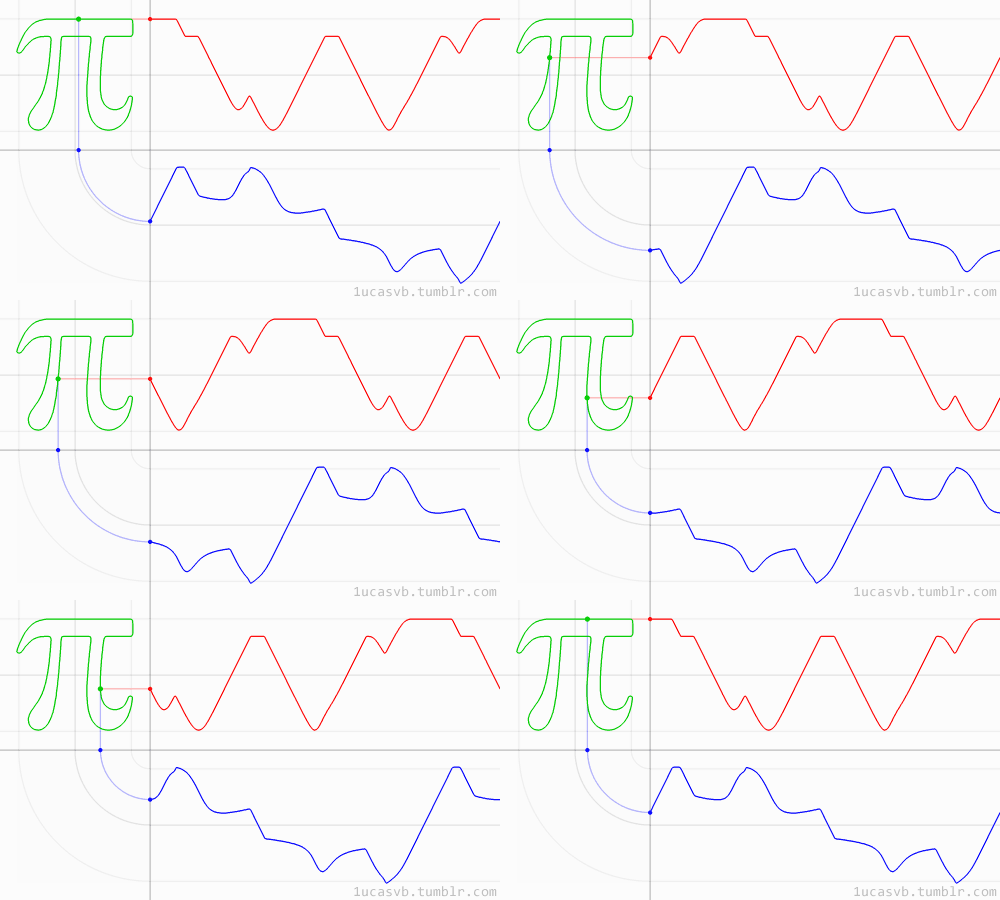
Illustrating math

The site MathWarehouse has some nice tools.


I'm a big fan of using examples, and animated gifs let you step through them easily.


Just for laughs, from a different site:


UPDATE: See the comments

Thursday, August 30, 2018

Misleading headlines

We've had a significant uptick in shootings in the Madison are in the past year or so. Typically the police report that those involved knew each other and that there was no threat to the general community (although I notice that there's also an uptick in mugging and commercial robberies too). Generally these seem to revolve around retaliatory shootings or drug deals.

I see the headline McFarland man shot in hand in targeted act of violence, Madison police say. In other words he was shot because people were shooting at him, which is the unsurprising default. But it is supposed to convey some soothing "Don't Worry" to the public.

The two culprits were eventually nabbed. Two men charged with robbing and shooting driver of car after waving at him to pull over. They shot at him when, after robbing him of his cell phone and cash, they attempted to take possession of the car and him. The rest of the story, which the police knew at the time, was "Worry--armed robbers are attacking random drivers." (in a residential area just a block away from a main street)

Friday, August 24, 2018

Pop

I am not the best person to judge how accurately this man's video assesses pop music then and now. I'm not up to speed on modern pop. Maybe one of you is? I have some difficulty telling the big female stars apart.

He claims three things have changed, and changed for the worse:

  1. Music company costs to advertise a new song are sky high. They are therefore risk-averse, and biased toward "same old stuff." (It is exceedingly cheap to get something published on Youtube, but the process of getting it into enough ears to sell a lot of copies is more difficult and costly. There's lots of creative people in niches, but where?)
  2. Many of the top singers use the same songwriters, so their stuff, unsurprisingly, sounds similar. (Is this true?)
  3. A cheap way of getting attention is loudness, and a simple way of doing this is compression--bringing soft sounds up to similar levels as the louder ones, at the expense of dynamic range. (FWIW we use this in the other direction. Some preachers get pretty loud, and we compress them down. Don't tell.)

Vending machine

OK, it isn't really what you think of as a machine, since it was human powered, but it was anonymous vending.. The inventor wrote an autobiography which cannot be accused of humility, and probably not of strict veracity either.

A Canadian look at 1812

"The real legacy of 1812? It never happened again"

I'd heard that the war went went into extra innings, but apparently the treaty wasn't signed by both sides until a month later.

Thursday, August 23, 2018

Flooding

Cross Plains got 15 inches--we got about 5 where I live.

The Yahara looks like a real river now. The lakes are rising, the number 2 arterial is closed and the number 1 likely will be tonight. We're supposed to get a bit more rain tomorrow. Since it took an hour and a half to get into work this morning, I think maybe telecommuting is wise.

Wednesday, August 22, 2018

The Road to Serfdom by F. Hayek

I finally got around to reading The Road to Serfdom. Yes, it is worthwhile reading.

He undertakes to show how any attempt to redesign a society along centrally planned lines, as every version of socialism (National Socialist or Facist or International Socialist or Democratic Socialist) tries to do, will, by the logic of planning and the limits of the human mind, tend inevitably to try control not "merely economic things" but by extension every aspect of life, control information, and revise the meaning of words. And so it has proved. For a simple example, those enamored of centralized re-education have spent the effort to try to redefine words like "racism" and "free speech" to try to eliminate contrary positions without debate.

The book draws more heavily from German examples than Soviet ones, because it was written during WWII, when the USSR was an ally which nobody wanted to antagonize, but for every German example you can easily find plenty of Soviet counterparts. It draws heavily on British politicians and thinkers because it was meant for publication on the other side of the pond.

One aspect of society which Hayek does not mention is religion, possibly because he did not understand it well. The commonalities are obvious, though. God can demand anything of us, and so can the totalitarian state. However, pastors and bishops are obviously not omniscient, so in practice we tend not to experience such thorough guidance. Only God has the intellect to manage billions of human lives with individual attention and love. Human planners have to think in terms of faceless lumps--and not think very well, either. But because the divinity in a planned state is vested in human constructs, there's no vast gap between the god and the representatives, and they can and do demand compliance with more and more intrusive rules. "Who died and made you God?" is answered by "The Plan/Party/People is God and I am part of it."

Another aspect he did not foresee, though others did notice it, is that as liberty is further and further restricted, people would be thrown the bone of "sexual liberation."

The Reader's Digest produced a condensed version of the book when it first came out--and I can easily see how it could have been condensed. His style is a bit wordy.

And, FWIW, he is not averse to things like a guaranteed minimum provision for citizens if the nation is wealthy enough, but is alive to the extreme problems of how to define the minimum and what happens at the border between states, one of which has a larger minimum provision than the other.

Monday, August 20, 2018

LHC experiments hope to cast a wide net

The LHC experiments have done careful targetted analyses of their data, looking for expected variations on the standard model. You can't go all hog wild and try any old model, because you know that whatever the final version turns out to look like, it is going to have to make very similar predictions to the standard model for the usual interactions. In other words, the standard model works pretty well, and any replacement is going to have to do at least as well.

They've been running out of candidates. Not that there's a shortage of ideas, but there's a shortage of ideas proven to work as well as the standard model. Most fail that test, and there are so many things any new model has to compare against that the effort to validate isn't trivial.

One important feature of these kinds of searches is that you can make a prediction and then check the data. If I predict that you have two aces in your hand, it is a lot more impressive if I haven't seen a thing than if we're playing stud poker. If I predict that a process will produce an excess of muons flying off at 30 degrees from the beam line, and I find a small excess, we can cheer a bit.

On the other hand, if I don't know what I'm looking for and I see a small excess of muons at 30 degrees from the beamline, that means nothing much.

I was looking at dimuon mass plots for my thesis, and found about a 2.2-sigma peak at the D0 mass. That would have been wild--the D0 wasn't expected to decay into mu+ mu- at a rate we could have observed. But random bumps happen. (I was curious and looked at the events that made up the peak--enough were garbage to account for most of the peak). Not important.

My advisor used to say that "prior knowledge is worth 3 sigma."

So, the experiments are going to go for "we don't know what we're looking for" searches. I predict there will be plenty of 3-sigma deviations.

Since the monte-carlo simulations that are supposed to predict what the data should look like aren't perfect, they may wind up seeing points of disagreement that merely represent failures of prediction. It will be a big project, and "deep learning" isn't as much "learning" as people like to think. OK, you've got a bump there. What does it mean? Is it a bump from leptophilic Z' or a bump of Amativeness? Or is the simulation of the photon interactions in the TRD not quite right?

But at this point they don't have much choice.

Sensus Fidelium

You have probably read that Saint Chrysostom said "Hell is paved with the skulls of bishops." Or, "The road to hell is paved with the skulls of bishops." Or, "The road to Hell is paved with the bones of priests and monks, and the skulls of bishops are the lamp posts that light the path."

Or you might have heard a version of this attributed to St. Athanasius (presumably refering to the Arians). Or John Eudes.

Googling around suggests that none of them actually said that. Although there have been plenty of holy bishops, there've been enough counterexamples in all eras to keep the saying alive.

Dorothy Day is supposed to have said something along the lines of "I don't expect much of bishops; it is the saints that keep the church afloat."

Saturday, August 18, 2018

Faith in education

The received wisdom says that with proper education you can make a person better, and that if everyone is given the proper education the whole society will be good. It might take a generation or two to weed out the bad thoughts and bad influences, but the world will be good and people will do the right things and the useful things. That may seem an extreme example, but the basic ideas are very similar.

I strongly suspect that those most devoted to this belief have not raised many children. For instance, take something as simple and non-threatening as asking the kids to read a specific book (when they reached the same age, of course). Remember how that turned out?

Revelation 20 speaks of a thousand year rule by the holy. At the end of it, the bulk of the people turn evil again. I dunno about how symbolic or literal that is, but the principle seems perfectly accurate: the best government and the best education and the best environment in the world (like a Garden of Eden, maybe) won’t fix what ails us.

And, of course, who promises us that the educators have their heads on straight? Some materials I've seen are OK, and some convey anti-information.

Monday, August 13, 2018

Geometry on the bus

I gather "manspreading" is the offense of sitting wider than a woman would. I assume this is related to the widespread practice of "purse-flopping," in which a purse or backpack is used to reserve the adjacent seat.

I remember how weirded-out one youth got when I squeezed into the remainder of the seat beside him, and how flabbergasted the young lady and her friends were when I dropped her purse into her lap. (I had a sore knee and wasn't going to stand if I didn't have to, and she didn't take a hint.) Some folks just want extra space, and devil take the latecomers. The sideways sleepers are worse.

OTOH, there's a bit of geometry and physics involved. Seat heights suitable for the average leave those of us with longer tibia and fibula a choice between sitting straight with the femurs uncomfortably unsupported, crossing the ankles, or spreading the knees sideways. Or cross your legs--and that takes up even more space. It turns out men tend to be taller than women, and have to use a bit more sideways distance to get the hypotenuse to fit. Such is geometry.

When the seats face the aisle, there the stop/start of the bus brings some physics into play. Men usually have a higher center of mass than women, and without some extra torque will tend to flop sideways in a sudden stop. Crossed ankles reduce the lever arm against the seat, and thus the available torque. Unless your seatmates like having people fall on them, crossed ankles isn't the best choice.

Which leaves "spreading the knees out a bit" as the best option. At least until everyone is packed in like parka-ed sardines. Then you have to all sort-of rotate on the seat--everybody with the right shoulder forward and the left back, or stagger sitting at the forward edge and at the back of the seat.

No doubt this is all "so 2017," but the bus ride brought it to mind.

Sunday, August 12, 2018

What message to teenagers?

Years ago I noticed that the church youth weren't learning some things that seemed fairly important—such as what the real differences and similarities were among denominations. So, I wrote a book to correct this, about the background for the faith. I gather from the lack of responses from test readers that it is not a page turner.

I did not feel as though I was the best person to write about how to live a Christian life (physician, heal thyself). But over time I've learned a few things, even when my applications of them aren't entirely thorough.

Suppose I was given time for a short talk to the youth groups. And imagine for the moment that they weren't distracted (fat chance, I know). What would they most need to hear?

No doubt that's very individual. Still, some things should not be surprises—and they often are.

  1. There is often a dark night of the soul. There can be days, months, years of silence. Do not doubt in the darkness what you saw in the light.
  2. Suffering is not abolished, but transformed. All God's children got troubles, and the more you love, the more people can hurt you. And somehow you come closer to God as you enter into His suffering.
  3. God often wants us to wait. Moses didn’t appear on the scene to lead the Israelites to freedom right away, and even when he did try, he had to back off for another 40 years. Jesus didn't show up full grown. Get ready and wait. Persevere.
  4. Joy and love have lots of imitators, and sometimes only time or stress distinguishes the fakes from the real. Or you can learn from the experiences of people who made those mistakes. "Good time lovers" don’t love you. The thrills of a youth group activity aren't really joy and the happy feelings from a concert aren't love or the voice of the Holy Spirit. "Now you've left off preaching and gone to meddling."
  5. Your lives are eaten up with amusements—and usually passive ones. You have more entertainments at hand in an average day than any but emperors did before—and at the end of the day what have you accomplished? Really. Jesus was pretty clear that God wants fruit from our lives. Maybe that will have been playing with the baby, but I'm pretty sure that it isn't watching videos all day or checking Facebook/Blogger every few minutes.
  6. You are rich. Christianity has some warnings for the rich. Retail therapy is part of the deceitfulness of wealth.
  7. Pop culture is lying to you about sex and money.
  8. Silence is an important part of life. Do you have time for any?

They won't sit still for them all. What would you say first?

Monday, August 06, 2018

"A letter to me"

"If I could write a letter to me" turned up on the radio a couple of days ago. It's trivial to come up with a list of things I should have done differently. I could write quite the letter about it.

Unfortunately one of the first items on my letter of advice would have to be to "seek out and listen to more advice." A bit of bootstrapping there...

Saturday, August 04, 2018

Circles of love

Since we're finite we have some limitations. We love and sacrifice for our immediate family--work two jobs, feed the kids first, and so on. The next ring, neighbors and more distant family, we will still sacrifice for, but not usually as much. You start to hit the "150 limit" here--you just can't know all these people. The tribe or the city we don't love as strongly, and the nation (a relatively modern extension of the tribe) is even more abstract. The rest of the nations you just don't meet at all. If you travel, a very tiny fraction of them become, for a few short moments, your neighbors. The rest you never see.

AVI wrote "When we pretend to be better than we are we are in enormous danger, and those who are loyal to international enterprises smuggle in some much more primitive prejudices. They do not transcend nationalism, as they imagine, but replace it with something that aims higher but strikes lower."

Uncle Screwtape put it well: "Do what you will, there is going to be some benevolence, as well as some malice, in your patient's soul. The great thing is to direct the malice to his immediate neighbours whom he meets every day and to thrust his benevolence out to the remote circumference, to people he does not know. The malice thus becomes wholly real and the benevolence largely imaginary."

Do I need to cite examples?

Friday, August 03, 2018

Do you like to skip rocks?

This won't surprise many of us, but these kids have a great uncle. Watch the video.

No, it doesn't take the fun out of things to test them systematically.

Thursday, August 02, 2018

Liquid lens

I knew about oil immersion and microscopes--I'd watched my mother put a dab of oil on the bottom lens when she needed extra magnification. (She was typically looking for worm eggs.) The amount of magnification wasn't exactly reproducible, but it suited the purpose well enough.

Apparently one can now use a liquid lens. An electronically controlled iris lets you adjust the focus extremely rapidly. As the circumference shrinks, the drop's curvature changes, and therefore the focal length of the device.


Clever. Of course the lens will perform best when it is looking down (or up) at the object--otherwise the curvature will vary from one side to the other. Maybe not much--that depends on the surface tension of the liquid.

Quantum Mechanics Toys

Costas Papaliolios devised a little gadget for illustrating some quantum mechanical properties. It consists of a set of 21 hollow cubes with polarizing filters in them, labeled with Dirac's bra-ket notation. You know that if you use a polarizing filter to get light polarized vertically, another vertical filter will let the light through but a horizontal filter will block it (almost--the filters aren't perfect). But suppose you use a circularly polarizing filter instead? Some light will come through. And then if you put a horizontal filter after that, some light gets through.

But wait--didn't you just block all the horizontally polarized light with the first filter? Yes indeed, but then you re-measured with something that was a combination of both horizontal and vertical, and what gets through that is going to be, again, a mix of both horizontal and vertical. Measurements do not always commute. Even when you think you're not disrupting the system.

While Schwinger represented the atomic measurements of the Stern-Gerlach experiment as a matrix, Papaliolios represented the two states using the polarization of light. The quantum toys were equivalent to the magnetic field of the Stern-Gerlach experiment and to Schwinger’s matrix. By reordering, adding, or omitting blocks, you could see the unique characteristics of calculations made with matrices.

Very clever setup. The article is fun too:

Students recognized Schwinger’s brilliance, yet found his lectures impenetrable. Theoretical physicist and science writer Jeremy Bernstein recalled taking Schwinger’s course in 1950: “Schwinger was, it turned out, trying out an entirely new formulation of the theory on us—the old one would have been hard enough—and since he lectured from memory questions were discouraged.... After a few weeks I was lost.”

If you want to make your own, this article has instructions at the end.

Monday, July 30, 2018

Between the Kola Forest & the Salty Sea by C. Patrick Burrowes

Between the Kola Forest & the Salty Sea by C. Patrick Burrowes: A History of the Liberian People before 1800

At one point, he cites an author who gave a detailed and accurate description of elephants--and who then went on to claim that dragons liked to catch and eat them. This book appears to collect very interesting and new-to-me information about the history of the tribes that make up modern Liberia. Unfortunately, when he writes about things I do know about, I find startling errors.

The core, and most important part of the book, is the use of oral histories of Liberian tribes, tribes in other countries, and linguistic analysis to map out the tribal migrations. He contends that much of the region near the coast was very sparsely populated, and that groups squeezed out of more inland regions could find places to live. Their traditions preserve some information about where they came from--though identification is sometimes tricky. In a few cases he mentions a language vanishing from a region, which makes me suspect there were some forgotten exterminations.

Pressures from rising and falling empires shifted populations around West Africa, Muslim pressures did too, and when long droughts shrunk the range of the tsetse fly, horse-borne raiders came farther south and west--until the climate changed again.

My complaint about his overlooking Moslem slavers was premature--he gives a pretty thorough description later on of what's known. (It was larger and longer than the European slave trade in Africa, and to this day Mauritania still has slaves.)

Some details clarify: wrt Dan and Krahn wooden carvings--"in none of the figures is any stress laid on likeness to the original [human model]; but it is essential that the pattern of the cicatrization works on the body and face should be followed exactly. The mode of dressing the hair must also be reproduced accurately. Any ornaments worn must be copied, and the very common umbilical hernias are faithfully reproduced also. In the case of women, stress is also laid on a faithful representation of the breast."

I get the impression that the carvings are to represent you as you are represented in relation to your tribe (scars, ornaments and hair) and your family (umbilicus, breast). Representing you might be problematic: perhaps because you are not so easily knowable as your representation, or perhaps because a representation of you might be used against you. Or maybe the solitary you doesn't matter as much as the you in relation. I may seem to be drawing too many conclusions from a small detail, but this ties in with other things.

The European description of the Poro society back in 1616 mentions male circumcision, but that of the Sande omits female clitoridectomy. He thinks that means the latter is a relatively recent innovation, though it could be that men talked about different things and what happened to the women wasn't so obvious. It certainly wasn't obvious to me when I lived there.

My copy of the book has a number of corrections scribbled in it--and he would have done well to have an editor look it over to get rid of some typos. And he would have done well to put in some modern maps. Some fact checking would have been nice--a funeral feast isn't uniquely African, for example. And claiming that iron working was independently invented in Africa is kind of ludicrous.

If you are interested in what can be learned about history before the official histories, by all means read it. But don't trust everything. I'm glad I bought it.

Saturday, July 28, 2018

Swaps

I wish I still had a copy of the cartoon I saw decades ago. It was of a baseball field with the stands full, and in the field all the players were taking off their uniforms and exchanging them with the opposing team, while the announcer exclaimed "That's the biggest trade I've ever seen!"

It's an amusing jab at sports loyalties.

Anybody old enough, who was paying attention, sees the same thing in politics too.

Saturday, July 21, 2018

Yokes still in use?

I have heard it claimed that Justin Martyr wrote that Jesus made plows and yokes, and that during Justin's life some of these were still in use. I heard this again recently, with a gloss about how good the quality must have been, and wondered where I'd missed that--I'd thought I'd read all of Justin Martyr's surviving work.

Google pointed me to many references, of which the oldest I found (sorry, I didn't wander through them all) was The Jewish Encyclopedia, Volume 7, 1916, which reads

"It it known that he earned his living by his father's trade, that of a carpenter; according to Justin Martyr, plows and yokes made by Jesus were still in existence at his (Justin's) time, about the year 120 ("Dial. cum Tryph. %88)."

The reader is invited to read that passage from the Dialogs, but the relevant portion is

And when Jesus came to the Jordan, He was considered to be the son of Joseph the carpenter; and He appeared without comeliness, as the Scriptures declared; and He was deemed a carpenter (for He was in the habit of working as a carpenter when among men, making ploughs and yokes; by which He taught the symbols of righteousness and an active life)

If you want to search the whole list of Justin's works in one chunk, this OCR version is available, warts and all.

My best guess is that somebody quoted some lost works of Justin. Or perhaps one of the falsely attributed ones that isn't part of the current list. Or possibly one of the scholars contributing to the Encyclopedia screwed up, and the error has persisted via unquestioning quotation. Or perhaps both my memory and my keyword-fu failed me.

I have asked a couple of real patristics scholars to help out, and will update this with any more expert answers.

UPDATE: Or maybe the Latin translation they worked from was ambiguous?

Monday, July 16, 2018

Duels

Youngest Daughter is very fond of Eugene Onegin (the opera and the book), and the subject of duels came up at the table.

My Better Half noticed that the same phenomenon of looking for revenge for insults is alive and well today, and producing a regular supply of corpses and bullet holes in bystanders. But there's no formality or structure to the modern dissing revenge--the old style duelists would have thought them not worth dueling, and not just because the modern fighters are mostly black.

My first thought was that the duelists were embedded in their community to such degree that they drew their identity from how they were viewed, and that perhaps the decline of the duel went together with a rise in individualism. But the duelists didn't represent everyone of their era--just the upper echelons of a particular culture. Lower class folk weren't expected to duel the same way, though I gather they could be just as touchy about their public perception as the elite.

But if everybody is touchy, and not just the elite... Noblesse oblige--perhaps you have to take the risks of following the rules when you avenge your honor, to show that you are worth your rank?

The vices of that sort of "you are as you are viewed" are vivid to us--what about the virtues? Did they go in more for public acts of virtue (e.g. courage)? (in contrast to our preference for virtue signaling with trivial symbols) I don't know how to evaluate cultures like that in a systematic way, but I'd bet there were things they did better than we.

Revenge for insults is everywhere, of course.

Are there added virtues alongside the dissing revenge vices? I haven't seen any, but perhaps they are most visible in the upper echelons. These things vary; sometimes there aren't duels in the usual sense at all.

What the Spanish description fails to express for the Japanese is the old Confucian idea that a man cannot live under the same heaven as his father's enemies. This leads to a proliferation of revenge plays in Japan in which the hero sacrifices himself for his father or for his lord. There are fewer plays in which a man is dishonored personally by insult or adultery and wipes out his shame in blood; most often he acts on behalf of a superior.

...

D.E. Mills outlines the rules and describes the documentation that was required for anyone to carry out an official blood revenge. If the avenger wanted to escape punishment for slaying his enemy it was requisite that he first make application at his local government offices, and this was then recorded and passed on to the central government. Normally he was given permission and a document that he could present to the official of the province where he finally caught up with his enemy.

That last is so very not Scottish...

Sunday, July 15, 2018

Explosion followup

The explosion downtown came from a gas leak that started about about 6:20. The gas wasn't completely shut off until 9:30. Why?

The first response gas fitter (presumably tasked with turning it off) was caught in the explosion. Word on the street is that he has a severe concussion and no hearing. The explosion damaged a network of pipes and required a dozen valves be shut off.

2500 attended fireman Barr's funeral. That's over 7% of the population of the town. Our next door neighbor's son is in the volunteer fire department, and was on the scene. Barr had initially asked him to walk with him over near the intersection, and then changed his mind and told him to stay by the truck while Barr went on alone.

Friday, July 13, 2018

Sports beverages

I've always had an intuitive sense that chocolate milk was good for you--certainly it is good for morale, and that has to have an impact on your physical state, right? People were looking at it years ago to see if it was better than recovery drinks like Gatorade.

A newer study bears that out. Alas, there are caveats.

Even though this analysis pooled data from several smaller studies to get more robust results, it still included less than 150 people. Results from running or cycling exercise tests also might not reflect how chocolate milk would impact recovery from other sports.

"Any food that provides carbohydrate, protein, fluid and electrolytes and is well-tolerated will help promote recovery," Spaccarotella said by email. "In addition to chocolate milk, other popular choices are cereal with milk, smoothies, sandwiches or soup. A small meal will even work, if the athlete is feeling hungry."

I'll chance it. Although they probably weren't studying people with my level of inactivity.

And given a choice between coffee and cocoa on a cold day, I'll go with cocoa.

You can probably see a pattern here.

Thursday, July 12, 2018

Live Press Conference on Astrophysics Breakthrough

Live for now, will link the record later.

Recorded version. They fixed the dead time problem

The NSF representative bobbled some of her statements, but largely got things right. Halzen has a good sense of humor and of proportion--I like him. Some of the animations the presenters used make things much clearer.

This has been in the works for months, as people tried to make sure all the eyes were dotted and teas crossed.

Executive summary: For the first time we were able to tell where an extra-solar neutrino came from, and it pointed back to a flaring blazar. (That tells us something about blazars, too.) IceCube saw a neutrino, told the rest of the world, and fast telescopes looked to see if they could see it too. Fermi and Magic did, and said it was associated with a blazar that flares now and then, and was flaring right now. IceCube went back to the last time it flared and looked for an excess of energetic neutrinos coming from that region, and found them.

The old excess wasn't something to write home about by itself, anymore than seeing plants chewed down inside your garden fence tells you there's a deer. But if your neighbor says there's a deer around, and you see a deer track in the front yard, the chewed-down plants mean something.

Since only about 1 in a hundred thousand neutrinos at that energy will interact in IceCube, that means there were an awful lot of neutrinos coming from that blazar.


UPDATE:

We can tell from what direction gamma rays come, but most of the cosmic rays that hit us are nuclei, and charged. The magnetic fields of galaxies are weak but gigantic, and bend the cosmic rays this way and that. A proton from SagA* might wind up hitting the Earth from the opposite direction.

Gamma and X rays can come from two different sorts of processes--one which involves nuclei interacting with things and one which is pretty much entirely electron-in-magnetic-field-based.

Neutrinos come almost entirely from the first class of processes, as nuclei interact with stuff (e.g. other nuclei or the background light around the galaxy) to produce pions that decay to neutrinos.

Sighting this means that we have

  1. The first extra-galactic neutrino with an understood origin
  2. That source produces jets of nuclei, not just electrons
  3. Blazars (actually, any active galaxy--blazars are just active galaxies whose jets point at us) can produce the cosmic rays we've been trying to understand the origin of for a long time.

I haven't seen estimates for the numbers yet--they'll be pretty rough because we haven't seen very many neutrinos yet--but maybe we can get some idea of what fraction of cosmic rays come from active galaxies.

Tuesday, July 10, 2018

One problem with explosions

You can't always estimate them well.

When we heard it, I said to the neighbor boy who was helping us garden, "Sounds like a power transformer. I'll bet some neighborhood doesn't have power anymore." It wasn't the crisp bang of fireworks, or the bang of a shotgun or a rifle, and it wasn't dynamite--the noise had a gentler "attack."

Or it could have been a lot farther away--like a mile. I heard they evacuated the building after they smelled gas, but sirens have been going to and fro, and the smoke is darker and still rising after 2 hours.

I hope the neighboring buildings and businesses and residences were well insured. I like The Chocolate Caper.

The Barr House's previous tenant had put up amusing messages about the bar business, and kept it up even after they moved. Google street has "Life is not a fairy tale. If you lose your shoe at midnight, you're drunk."

FWIW, first reports got one of the streets wrong. You'd think that was pretty easy to get right, but I guess somebody got the landmark "Old City Hall" and turned it into "City Hall."

And they are evacuating around the area as well, so they must worry about the gas lines too.

UPDATE: A contractor hit a gas line.

UPDATE2: So far 2 firemen hurt and a cop had minor injuries. Sirens go to and fro.

UPDATE3: One fireman dead, 2 hurt. Part of the street flew in the air, according to a fellow I know who was driving in the area.

UPDATE4: When they write that a restaurant was "heavily damaged" they mean that the foundation still looks good. And maybe some of the walls. The volunteer fire captain who died owned the Barr House.

Sunday, July 08, 2018

Mazon update

I mentioned a detour to Mazon a few months ago, and said we collected some discarded concretions, one of which had an obvious fossil.

Instead of using a hammer and chisel, I soaked the concretions in water and then froze them. Repeatedly.

After about 20 iterations, during which little chips spalled off here and there, one that had an OK jellyfish opened up to show a fragment of a leaf on the other side. There's probably more, but I'm not sure how to peel back the rest of that layer. Yesterday, after a dozen more iterations, a little crack opened in another, and when I pried the thing apart it looks like a twig was inside. Not as exciting as a TullyMonster, but discovery is fun.

Ring neck doves

In Sheridan, Wyoming we heard a curious creature. When we got binoculars on the bird it was plainly a ring neck dove. But, contrary to the bird books, its call sounded like it was taking cooing lessons from crows. OK, sometimes it cooed, but sometimes made a sound halfway between a coo and a caw. Yes, there were several of them, so it wasn't a weird individual.

Has anybody else heard this?

Morning

One does not sleep in as long when tent camping.

"He who blesses his friend with a loud voice early in the morning, It will be reckoned a curse to him."

Although, to be fair, one does feel better waking up in the woods early after watching a fire until 10 than one does waking up at an ordinary time after working on a computer until 10.

Friday, July 06, 2018

Spiders soaring

Some spiders are light enough, and can spread their silk far enough, that electrostatic fields can levitate them. Go have a read
Bristol’s researchers exposed Linyphiid spiders to lab-controlled e-fields that were quantitatively equivalent to those found in the atmosphere. They noticed that switching the e-field on and off caused the spider to move upwards (on) or downwards (off), proving that spiders can become airborne in the absence of wind when subjected to electric fields.

"bumblebees can detect e-fields arising between themselves and flowers"

I suppose if you worry about spiders rising to meet you, this might not be pleasant news.

Vortex collisions

This is cool. Colliding vortices, when exactly balanced, spread out in a ring into smaller vortices at right angles to the original ones. Have a look. They did this in an aquarium so the speeds would be low enough to film easily, and without the complications of compression that you get in air.

Mammoth trap

One of the places we visited in the Black Hills was the Mammoth Site, a sinkhole that trapped a number of mammoths over the years. This has the largest concentration of mammoths in the world, and they think they've only dug about a third of the way down. Pay them a visit if you're in the area.

The mammoths seem to have fallen in and drowned, so the scientists think the sides were steep and covered with vegetation, making them a little more enticing in the winter. So far every last mammoth has been male. Maybe, as with elephants, the young males are chased out of the herd to fend on their own and find their own females. And, all alone, you don't get the benefit of other's experience or much help when you get stuck.

Right now they think the sinkhole (spring-fed) is about 140,000 years old, and only finished filling in relatively recently. During our wandering about the pit, I looked at the layers in the sediment and did some back of the envelope estimations. There aren't enough layers for 140,000 individual years, but if the layers represent extra wash from El Nino's (or Nina's, dunno which would send extra water to South Dakota during the various glacial periods), it kind of works out if the average time between Nino's is about 5 years.

It sounds like the place must have been a terrible trap, but if the number of mammoths yet undiscovered is proportional to the number found so far, the hole claimed only about 1 mammoth per thousand years or so. (And a few other critters as well.) So it didn't make much of a dent in mammoth numbers. Could be that most of the time there was an easy way out.

They found a few tiny fish bones--those probably don't preserve very well. The mammoth bones aren't fossils, and all DNA was washed out of them ages ago. Look but don't touch.

Dogs 2

Earlier I wondered about American dogs--among other things, where they went.

If this story is correct, even what I thought were native breeds (Chihuahuas) actually aren't.

Comparison of ancient and modern American dog genomes revealed that these unique, pre-contact American dogs rapidly disappeared following the arrival of European settlers and left little to no trace in modern American dogs. This disappearance was most likely due to a combination of factors, including new diseases, cultural preferences for European breeds, and extermination of native dogs.

I'd think that exterminating local breeds would rank extremely low on the to-do list of European settlers--but if the reports that European dogs hated the American breeds, it might be something they wanted to attend to. And if we tried to defend our dogs...

‘In fact, we now know that the modern American dogs beloved worldwide, such as Labradors, Xoloitzcuintli (Mexican hairless dogs), and Chihuahuas, are largely descended from Eurasian breeds, introduced to the Americas between the 15th and 20th centuries.’

The story goes on to suggest that the only trace of the old American breed is from a transmissible cancer that presumably originated in an American dog and infected the European dogs. Nice and weird.

People talk about trying to restore mammoths from DNA. I'd think dogs would be easier. If there were enough DNA samples. Maybe there are some frozen in the tundra?

Tuesday, July 03, 2018

Generations

AVI wonders how deep the differences are between generations. AVI thinks not deep, though he suspects that cars and teenage personal money made changes starting in the 50's and 60's.

Cultural fashions come and go, of course, and what is passe now may revive later. Permanent cultural changes (the spread of a new religion) or technological changes might have clearer consequences.

I wonder how much "use it or lose it" plays a role in shaping the way we think and solve problems. I've done some DAQ work, in which I had to care about what bits were on which traces in the interface card, and had to track down odd program problems with strace. I've also had to use icon-based administration. You think about problems in different ways, approach problems differently. Allegedly the latter approach lets you think "big picture," but corner cases pop up, and you wind up having to know some details anyway. I think about problems a little differently from most of the rest of my family; I suspect because I trained as a scientist.

We have our "go to" toolkit for meeting new problems. Sometimes this is disastrous--think of the folks who use the "nice doggy, here, have a treat" approach to Yellowstone bison. That toolkit is part of our culture. Our urban/suburban toolkit doesn't include anything dealing with edible animals. If it did, I suspect we'd have fewer vegan restaurants. It does include tools for giving the appearance of independence (your own apartment, etc), and the more popular philosophies magnify the importance of independence. I don't see the latter changing without a change in the toolkit, whether that is economic/technological (e.g. apartments get too dear) or religious (e.g. like the Beguines).

FWIW, we use Slack at work. One of the channels is titled "First World Problems." Those are the kind of things that the young and lucky(*) get worked up over. Do we have more of them than earlier generations? That'll certainly make a generational change.


(*) Luck includes wealth.

A garden in East Berlin

If you haven't read the story about the garden that was technically in East Berlin, though the wall was built on a shortcut that put it on the West side, go read it.
The East Berlin guards watched this exchange from a nearby watchtower. They could see he was really annoying the West Berlin authorities - so to annoy them even more, the East Berlin authorities made sure that Kalin had free and full use of the land.

The little glowing screen

When I look around the bus, about half the people are deeply involved with their cell phones. I'd think this was a new distraction, but I'm old enough to remember people deeply involved with their newspapers. And doing crosswords when not reading the stories.

When I rode the Chicago L some people still read newspapers, but if I recall correctly a goodly fraction kept their eyes peeled for tottering strap-hangers. Some of the turns rattled us around a bit. I don't remember having to keep an eye on dicey passengers--not much at rush hour, anyway. At 10pm, somewhat, but the platform seemed riskier, and the entrance still more. The cars themselves were well lit and you could easily see through one to the next.

After running a few numbers, I conclude that the monthly price for a smartphone (over and above the dumb-phone price) is probably comparable to the price of the newspaper--which has been going up lately. Hmm. Have to cough up something for the online access too, so it doesn't quite balance. I don't play candy crunch or whatever it is, I read Facebook maybe twice a month and am not going to display personal stuff to seatmates on the bus, a little bitty screen is hard to read books on, and I don't want to be accessible by email wherever I go. (Contrariwise, I sometimes do want to be able to email somebody else.)

Frequently I solve a thorny problem when I get on the bus and am far away from anything but pen and paper. Maybe that has to do with changing the scene or changing the mode I'm thinking in--and I might prevent that if I brought along a little computer to look at.

Monday, July 02, 2018

Convergence

When in Caspar we drove by Christ Convergence Church several times. The name didn't seem auspicious. In math-land convergence has a clear and common meaning, but the plurality of popular uses I see are associated with New Age stuff. I looked up the church.

They say they are evangelical, liturgical, and charismatic. I don't know how they square that circle, but if that's what they mean by "convergence," God bless them and I hope it works out.

Friday, June 29, 2018

More Chesterton

And in precisely the same fashion a poet must, by the nature of things, be conventional. Unless he is describing an emotion which others share with him, his labours will be utterly in vain. If a poet really had an original emotion; if, for example, a poet suddenly fell in love with the buffers of a railway train, it would take him considerably more time than his allotted three-score years and ten to communicate his feelings.

and

Poetry deals with primal and conventional things--the hunger for bread, the love of woman, the love of children, the desire for immortal life. If men really had new sentiments, poetry could not deal with them. If, let us say, a man did not feel a bitter craving to eat bread; but did, by way of substitute, feel a fresh, original craving to eat brass fenders or mahogany tables, poetry could not express him. If a man, instead of falling in love with a woman, fell in love with a fossil or a sea anemone, poetry could not express him. Poetry can only express what is original in one sense--the sense in which we speak of original sin. It is original, not in the paltry sense of being new, but in the deeper sense of being old; it is original in the sense that it deals with origins.

and

It is only the smaller poet who sees the poetry of revolt, of isolation, of disagreement; the larger poet sees the poetry of those great agreements which constitute the romantic achievement of civilisation.

and

When a lady in Italy said, on an occasion when Browning stayed behind with his wife on the day of a picnic, that he was "the only man who behaved like a Christian to his wife," Browning was elated to an almost infantile degree. But there could scarcely be a better test of the essential manliness and decency of a man than this test of his vanities. Browning boasted of being domesticated; there are half a hundred men everywhere who would be inclined to boast of not being domesticated. Bad men are almost without exception conceited, but they are commonly conceited of their defects.

and

Humanitarians of a material and dogmatic type, the philanthropists and the professional reformers go to look for humanity in remote places and in huge statistics. Humanitarians of a more vivid type, the Bohemian artists, go to look for humanity in thieves' kitchens and the studios of the Quartier Latin. But humanitarians of the highest type, the great poets and philosophers, do not go to look for humanity at all. For them alone among all men the nearest drawing-room is full of humanity, and even their own families are human. Shakespeare ended his life by buying a house in his own native town and talking to the townsmen.

and

Prejudice, in fact, is not so much the great intellectual sin as a thing which we may call, to coin a word, "postjudice," not the bias before the fair trial, but the bias that remains afterwards.

and

But there are, when all is said and done, some things which a fifth-rate painter knows which a first-rate art critic does not know; there are some things which a sixth-rate organist knows which a first-rate judge of music does not know.

and

A man must love a thing very much if he not only practises it without any hope of fame or money, but even practises it without any hope of doing it well. Such a man must love the toils of the work more than any other man can love the rewards of it.

Despotism

Despotism indeed, and attempts at despotism, like that of Strafford, are a kind of disease of public spirit. They represent, as it were, the drunkenness of responsibility. It is when men begin to grow desperate in their love for the people, when they are overwhelmed with the difficulties and blunders of humanity, that they fall back upon a wild desire to manage everything themselves. Their faith in themselves is only a disillusionment with mankind. They are in that most dreadful position, dreadful alike in personal and public affairs--the position of the man who has lost faith and not lost love.

This belief that all would go right if we could only get the strings into our own hands is a fallacy almost without exception, but nobody can justly say that it is not public-spirited. The sin and sorrow of despotism is not that it does not love men, but that it loves them too much and trusts them too little. Therefore from age to age in history arise these great despotic dreamers, whether they be Royalists or Imperialists or even Socialists, who have at root this idea, that the world would enter into rest if it went their way and forswore altogether the right of going its own way. When a man begins to think that the grass will not grow at night unless he lies awake to watch it, he generally ends either in an asylum or on the throne of an Emperor.

and

A Liberal may be defined approximately as a man who, if he could by waving his hand in a dark room, stop the mouths of all the deceivers of mankind for ever, would not wave his hand.

Somebody didn't get the memo.

I think in the first paragraph Chesterton is writing about people who support the despotism--likely enough the wolves at the top got there because they don't care for anyone but themselves. But you know rank and file people just like those he describes, don't you?

Browning's father

Chesterton wrote an interesting biography of Robert Browning. There you may find:
In early life Robert Browning senior was placed by his father (who was apparently a father of a somewhat primitive, not to say barbaric, type) in an important commercial position in the West Indies. He threw up the position however, because it involved him in some recognition of slavery. Whereupon his unique parent, in a transport of rage, not only disinherited him and flung him out of doors, but by a superb stroke of humour, which stands alone in the records of parental ingenuity, sent him in a bill for the cost of his education. About the same time that he was suffering for his moral sensibility he was also disturbed about religious matters, and he completed his severance from his father by joining a dissenting sect. He was, in short, a very typical example of the serious middle-class man of the Wilberforce period, a man to whom duty was all in all, and who would revolutionise an empire or a continent for the satisfaction of a single moral scruple.

and

Robert Browning senior destroyed all his fortunes in order to protest against black slavery; white slavery may be, as later economists tell us, a thing infinitely worse, but not many men destroy their fortunes in order to protest against it. The ideals of the men of that period appear to us very unattractive; to them duty was a kind of chilly sentiment. But when we think what they did with those cold ideals, we can scarcely feel so superior. They uprooted the enormous Upas of slavery, the tree that was literally as old as the race of man. They altered the whole face of Europe with their deductive fancies. We have ideals that are really better, ideals of passion, of mysticism, of a sense of the youth and adventurousness of the earth; but it will be well for us if we achieve as much by our frenzy as they did by their delicacies. It scarcely seems as if we were as robust in our very robustness as they were robust in their sensibility.

I suspect if he were writing today, Chesterton might be a little less flattering about our ideals. One of our ideals is that revolution is a proof of a good change.

Saturday, June 23, 2018

Bighorn

We drove 16 to Ten Sleeps. The weather cooperated (not so much for the folks camping next to us who went to Shell Falls), and the scenery and the details were beautiful. Except for the descent/ascent at the west end--I'm a flatlander with a white knuckle dislike of heights. And, now that I think of it, the minivan ran a bit hot too--I don't think it likes steep grades.

We arrived at one lookout in time to see a man dash across the road and up the scrubby hill chasing a dachshund. The dog is 14 and supposedly blind, but she saw a marmot on the hill and took off after it. The man pulled her out of the marmot's hole. The breed was bred for that...

Most places the deer crossing sign shows a white-tail leaping. Here it depicts an elk standing as though it owns the road.

The cattle drive really owns the road, though. We passed a woman by a pickup at the side of the road who was waving an orange flag about; she nodded at us, we waved back, and wondered what she was trying to do. Around the curve about 300 cows and calves trotted loosely in our direction, with a line of cars backed up behind them. Several mounted cowboys and a fast little dog tried to keep the cows going more or less down the road.

There are even more large pickups on the road than RVs (most pulled by pickups themselves).

Cruise control isn't very useful in the Bighorns either. Dangerous would be a better description. And, maybe you can use your brakes to manage one downhill 8% grade, but don't risk it for more than one. My Better Half took lots of pictures while things cooled down.

Friday, June 22, 2018

Memorials

The reenactment of Custer's last stand was rained out--too wet for people and probably dangerous for the horses--so we went to the Little Bighorn Battlefield National Monument instead. That was pretty wet too, but we didn't have to gallop uphill. The white tombstones on the hill and through the valley were evocative--but incomplete. They haven't put any in the ravine. And, it turns out, when the Feds sent the monuments sent to be installed they included some for another battlefield. Many markers are in pairs, but the archaeologists usually found evidence of at most one burial. They suspect that the bodies were covered, not buried, by scooping the loose dirt on top--and sometimes they scooped from both sides, leaving a depression on each side. When the markers went in, they went in by the depressions. And since there were too many markers sent, nobody noticed at the time. Duplicate markers cannot be removed, since they are now historical in their own right.

On a hill close to the cavalry's monument is a monument to the Indians who fought--it includes a list of all the warriors. (Some names have a lost story somewhere: "Not Good for Anything.") This monument tells the Sioux side (including a quotation from Custer promising he would never shoot at gun at them again) and celebrates their fight for their way of life.

The monuments celebrate courage and faithfulness.(*) On a rainy Friday morning it was crowded, and the docents were busy.


(*) Hmm. Maybe we could do something like that with the American Civil War? Do you think people would go for not just having monuments for the heroes of the winning side, but monuments for the heroes of the losing side as well--putting it all behind us and celebrating courage?

Thursday, June 21, 2018

Fat

We consume amusements with such dedication that the only word for it is gluttony.

Traditional gluttony leaves you pretty fat and slow (Shut up, mirror!). Amusement gluttony does too--when was the last time you heard somebody singing or whistling for themselves, outside a choir? (Singing along to the radio counts.) Acting for fun at parties--even charades? (LARPing counts.) Does the correlation between Facebook use and loneliness involve a vicious circle?

I do sing along to the radio sometimes. Without autotuning.

Sunday, June 17, 2018

Planning

Toiling, rejoicing, sorrowing,
so I my life conduct.
Each morning see some task begun,
each evening see it chucked.

You can probably identify who I was reading last night within two guesses.

If you have the chance to see Ashfall Fossil Beds, do. I would not make a trip out west just to see it, but it is worth a detour. The ash from the eruption didn't kill everything at once--some of the creatures lived for weeks. (The final bursts piled another 4-6 feet of ash on top. At least I think there was more than one--or else continuous ash fall for months.) The predators, not having to stuff their noses into dust to eat, outlived everybody else.

Snakes crawl into the digging pits in the Hubbard Rhino Barn at night, and they must be escorted out before the day's excavations begin.

Friday, June 15, 2018

Wyoming

We're riding off into the sunset for a few days. Not much internet, but I don't expect drastic withdrawal symptoms.

Sunday, June 10, 2018

Tempting fate

I put the snow shovel back into storage yesterday.

Now that I think of it, I could use the snow shovel for getting the maple "helicopter" seed piles off the driveway.

Thursday, June 07, 2018

Bright idea

Those who manage computer servers know that you can tell the machine to blink a light for a particular disk or sometimes for a particular controller, so that when you yank the defective item you get the correct one.

I was helping with some cable tracing yesterday.

You are familiar with those LED cable lights that turn from color to color to color.

They'd be an extra-cost item, but imagine a network cable that was twinned with such an LED strand, so that you could tell the server to turn the light on and find out where the cable went.

If that doesn't seem obviously wonderful, look at this and remember that the cable run started out nice and neat, but over the years replacements make it look just a little different.


Of course, by the time you realized that you really needed such an item, it would be too late to install it. There's probably a theorem to prove that whichever cable you really need to trace is going to spend at least part of its length at the bottom of the pile. I can count the exceptions on my thumbs.

Saturday, June 02, 2018

Time to rest

Over at Real Clear Science Gottschalk recaps some of his book about the acceleration of life and how it is harming us. He notes that "many spiritual and philosophical systems Buddhism, for example, suggest that detaching from daily concerns and spending time in simple reflection and contemplation are essential." This shows a curious allergy to Judaism and Christianity, which are explicit about a day of rest. I suppose the exotic, being more distant, is less demanding if it turns out to be true.

"Acceleration" is a bit more generic than the usual "over-work," since it includes also the unproductive time spent "keeping up with things" on the net. "Keeping up" isn't anywhere near leisure--we treat it as urgent and therefore stressful, but by and large there's little we have do about the things we "keep up" with, and there's nothing we can show for the time we spent--it trends "dissatisfying."

I just spent an hour. I started out researching pressure air hose fittings (my hose broke), but when I was done I didn't stay done...

Monday, May 28, 2018

"It is time for"

Back in '08 I heard it claimed that we should all vote for Obama because "it is time for a black man to be president." To be as kind as possible, this is not rigorously persuasive. Similar claims abounded in '16--though I suspect these were only persuasive to the already-decided.

But under what conditions does "it is time for group X to have a representative as leader" become a persuasive argument?

The most obvious case is when the office is purely honorary, and we assign it to this or that person in turn, in recognition of their accomplishments or those of the group we call on them to represent. Legislators spend a little time on school children's proposals to designate state birds, state landforms, and so on. It's part of teaching kids how government works. The outcome doesn't matter--if every state has vanilla as its state ice cream flavor, maybe it's the turn of butter pecan.

I'm not sure this is the case with the US President. Plenty of power still inheres in the office, despite the vast unaccountable bureaucracy that never stops growing. Discard this case.

With that option out of the way we come to grimmer prospect. If we rule out "it doesn't make a difference" we're left with "it makes a difference." That difference can be symbolic or substantive.

If it is symbolic, and is only done for encouragement, this implies three presuppositions--actually four.

  1. Said group regards itself as distinct from the rest.
  2. It needs encouragement.
  3. The symbol will effectively encourage.
  4. And that there is no plausible way for any of the selected group to achive that position on their own.

That sounds a bit patronizing. And notice that all four requirements are necessary but not sufficient--there can be any number of reasons why is is useful but not time right now.

On the other hand, if simple use of a symbol is going to be effective, whatever it may be that seems to separate the group must not be very dire. That can argue for or against using the symbol: "it isn't badly needed" vs "easy to fix."

The other option--that the difference is substantive--represents a very bad situation.

It means that the interests of the different groups are substantively different, and that members of one group cannot be trusted to respect the interests of any other. The reason it is the "turn" of group X is that without their turn in power they will be oppressed, and may turn violent. You can easily find examples of this sort of thing in multi-ethnic governments. Lebanon worried along with a system in which different ethnicities were assigned different positions in government--because without such a balance of power they tried to kill each other. BTW, the system broke down.

Is that what you want to say we have? Not e pluribus unum, but warring tribes? If warring tribes is what we have, that's what we have, and we must deal with it. Ugly compromises will have to be made--the US Constitution includes a few (and a clever one--the Electoral College).

I want "e pluribus unum." I want "neither Jew nor Greek." I want us "all in this together." But if we've gotten too big to hold together, I want some clarity in the discussion.

Sunday, May 27, 2018

Entertainments and pleasures

From Utopia of Usurers
Every religion, apart from open devil worship, must appeal to a virtue or the pretence of a virtue. But a virtue, generally speaking, does some good to everybody. It is therefore necessary to distinguish among the people it was meant to benefit those whom it does benefit. Modern broad-mindedness benefits the rich; and benefits nobody else. It was meant to benefit the rich; and meant to benefit nobody else. And if you think this unwarranted, I will put before you one plain question. There are some pleasures of the poor that may also mean profits for the rich: there are other pleasures of the poor which cannot mean profits for the rich? Watch this one contrast, and you will watch the whole creation of a careful slavery.

and

A house with a decent fire and a full pantry would be a better house to make a chair or mend a clock in, even from the customer’s point of view, than a hovel with a leaky roof and a cold hearth. But a house with a decent fire and a full pantry would also be a better house in which to refuse to make a chair or mend a clock—a much better house to do nothing in—and doing nothing is sometimes one of the highest of the duties of man.

Even the "free" pleasure of surfing the net demands some money for a machine and a network connection. The free pleasure of singing or whistling to yourself seems to be little-exercised.

Of course "doing nothing," while it may be a high duty, is also a chore magnet.


I have never understood why Satanism gets to be classified as a religion, when it is by construction an anti-religion.

Teenage money

During a conversation with my Better Half, she suggested that the 50's and 60's had a sea change in entertainment, teenagers had money and entertainers were eager to flatter them.

Which led me to wonder: where did they get their money? From the number of economic illiterates who litter this county I incline to a sneaking suspicion many just got it from their parents' miraculous money well, but apparently the same sort of confusion was popular back in the 20's and 30's.

Some teenage money was earned, but at least since the 70's that's been dropping assuming the years selected are representative: from 1974 to 2014 the proportion of teenagers with a summer job dropped from about 57% to about 33%--a bit over 40% decline. I'd like to know what it looked like from the postwar era on--I'd be interested in seeing if it rose. Since a lot of students didn't finish high school, I'd think it started pretty high--the graph at the link mixes students and the self-supporting.

It may be hard to tease out the information--maybe the details exists for married vs unmarried teenage employment. Before I go diving, does anybody know an easy place to find out?

(I think the decline in summer jobs is terrible. Education isn't just sitting through classes and taking tests.)

Hindu musing

In irrelevant reading I found that a woman interested in becoming a Hindu was told that her best chance was to be reincarnated as a Dalit.

Yes, I thought that rather odd. This popped up as the first reference. Executive summary: some experts say you can convert, but probably you can't, and you are going to have the caste you inherited. Details of belief may vary, but caste is cast in stone.

We know the obvious conflicts between Christian and Hindu doctrine--their claims cannot both be true. Jesus said that the one who would be greatest must be the servant of all. That would be the Dalits. Christianity stands their caste system on its head. I'm imagining a Brahmin hoping to be reincarnated as an Untouchable...

Brat Fest

I've worked in the Madison area (with a year and a half stationed in Illinois) for 33 years and never been to the world's largest brat fest.. I'm not a huge fan of crowds and over-amped bands. Or 92 degree heat.

But someone locked keys inside the van, so as long as I was there already...

The battling bands had their speakers oriented to not interfere with each other much: somebody has been planning well. The centerpiece is the brat tent (well, for a lot of people the centerpieces were the beer tents), which was wide and 2-sided and quite fast: 30 seconds of being in line and 10 seconds to buy and I was headed to the condiment tent. I had my choice of celebrity cashiers: a local NPR radio personality, Miss Wisconsin, or a middle school teacher. (I went with the teacher.)

Just like any fair, there was a midway, and there were booths for this and that, and kid crafts and a petting zoo, and a pond to watch birds by, and a horse show (aren't fairs like that where you live?). And, in honor of Memorial Day, they had a subset of the Vietnam memorial with pictures of Wisconsin soldiers who had died in the war.

At 92 degrees it wasn't crowded at all.

Maybe in another 33 years I'll go to State Street Halloween.

Tuesday, May 22, 2018

Splashing is complicated

But it looks like some MIT engineers may have found one of the keys to understanding droplet formation. Jerk matters.

For some reason this reminds me a bit of the oddity with bubbles: with a bubble on each end of a straw, the pressure is lower inside the bigger bubble, so it grows and the smaller shrinks.

Patrons

I wondered who would be the best patron saint of computers or of computer managers. For the latter, I figured St. Barbara(*), although St. Dymphna was plausible too.

It turns out that somebody already worked it out: A scholar named St. Isidore is supposed to be the patron of computers and maybe the internet too.


(*) Patron of artillery men and mathematicians (?). If you wonder how this applies to computers, think of this: I often do.

P-38

On the topic of simple things: Read about the history of the "Opener, Can, Hand, Folding, Type I".


"In a pinch it might be used as a screwdriver to help field strip a weapon, cut seams on a uniform, or scrape mess kits clean. To accomplish a mission it could strike flint, measure inches, strip wire, deflate tires, adjust a carburetor, or pick inside a wound. Need a box cutter, marking tool, or decorations on a makeshift Christmas tree?"

The article claims that it was not named after the airplane, and that some suspect that it and its bigger "also-not-named-after-an-airplane" brother the P-51 were named after the number of squeezes needed to open a can. I humbly submit that it probably was named in honor of the plane, especially given the second name. Looked at from the side by a child or a tipsy adult, the tool has an airplane look to it. I have a mental picture of a couple of little boys playing zoom zoom airplane with prototypes that daddy brought home from work.

Friday, May 18, 2018

Until you see the whites of their eyes

The group photo had us standing on the hill and looking down at the cameraman. He had a clever idea: "Close your eyes and open them when my countdown reaches 1". He wanted to cut down on blinking. It was not 100% successful.

Dark eyes everywhere.

Wednesday, May 16, 2018

Mazon

On the way back from Louisville we detoured and spent about an hour and a half fossil-hunting in the Mazon Creek park. There were once coal strip mines, and the tailings include some very well-preserved soft-bodied fossils. The loop we walked was very much overgrown and covered with long dry grass and medium height green grass, alive with ticks. (We disposed of at least 60 on the first leg of the trip--very few on the rest.) Here and there one could find a few promising rocks, but the bulk of those I picked up were by the road.

You can sometimes crack a rock open with a hammer, but that's not reliable and can crack it in the wrong plane to view anything. The approved approach is to soak them in water and then freeze them--perhaps repeatedly. We'll see. I picked up quite a few opened and discarded rocks by the roadside--some of which look rather jelly-fishy. Somebody was impatient.

The strip mines are now oddly shaped lakes, with hills in between.

Saturday, May 12, 2018

Engineering

Two extremely different bloggers, Joseph Moore and Lubos Motl, recently wrote about the role of engineering in the world, coming to the same conclusion--without a lot of dedication to making things work, and work better, all the knowledge in the world comes to nothing.

And as Lubos points out even the knowledge of how-to (e.g. The Manual for Civilization) requires enough people actually doing it in order to have the resources to build more.

(How do you make a screw by yourself? You use a lathe? Who makes the parts to fix your lathe?) You need a critical mass of people who not only know how, but are actually doing stuff, in order to make better stuff.

I remember a sci-fi story from a collection ages ago in which an exec sold his soul to the devil for youth, time travel to before Henry Ford, complete specs for building a car, and enough $$ of the correct vintage to start building his factory. In the town he arrived in, the local metallurgist was a blacksmith. They knew more at a university, of course, but getting the new-fangled kinds of steel was going to be hard even in small batches. (Spoiler--he forgot to check the fine print and didn't wind up with the youth he needed either.). Even with prior knowledge, it was going to take about as long for him to build his car as it did in the real world.

Even the little pencil I linked to in an earlier post--you can construct something crude that mostly works, but the modern version has so many refinements that nobody could make one by himself. Build your own toaster?

Yes, I run into people who think they're incredibly smart because they can use the technology that a team of other people designed, and many teams of other people made, and an invisible army provides the infrastructure for.