Tuesday, October 16, 2012

I _can_ blame headline writers for this

The BBC made as the off-page headline for this story about creativity and mental illness this monstrosity: "Creativity 'a mental illness'". The actual story headline was "Creativity 'closely entwined with mental illness'"

Anyhow... after saying that writers were at risk for anxiety and bipolar and depression and substance abuse (and photographers and dancers to be bipolar), they report Swedish researchers as concluding

As a group, those in the creative professions were no more likely to suffer from psychiatric disorders than other people.

But they were more likely to have a close relative with a disorder, including anorexia and, to some extent, autism, the Journal of Psychiatric Research reports.

And the article includes the usual celebration:

Similarly, the disordered thoughts associated with schizophrenia might spark the all-important originality element of a masterpiece.

Only if the writer has the discipline to whip it back into order. Otherwise you don't get originality but randomness. I can't recall who pointed out that thousands of poets used laudanum or the like, but only one wrote Kubla Khan.

Beth Murphy (at Mind) pleads for a little sense of proportion:

It is important that we do not romanticise people with mental health problems, who are too often portrayed as struggling creative geniuses.

Too late for this article...

Near-Death

You can't blame the headline writer for "The Scientific Cause of Near Death Experiences" this time. The authors of the paper in question have startling chutzpah: "Only then will discussion of near-death experiences move beyond theological dialogue and into the lawful realm of empirical neurobiology."

But if you look more closely at their paper they have a lot of A is like B therefore A may be B. They do not have a "scientific cause", they have an untested hypothesis in which some of the effects (such as the bright tunnel) are like known effects that might be associated with dying, and others are associated with "brain pathologies" (no explanation of how these brain pathologies arise when the brain is shutting down). "For example, dopamine and opioid systems become
active when an animal is under predatory attack." is invoked to explain a feeling of peace. The UK Medical Council did not get their money's worth.

About the only thing that seems to be new is a breakdown showing ratios of near-death experiences: those who didn't get them, those who did, and those who did even though they weren't at risk.

Check it yourself if you like.

Sunday, October 14, 2012

Baumgartner

Congratulations to Baumgartner! You couldn't get me in the balloon, much less stepping out of it; and there's no way I'd have broken out of the tumble--that demanded experience.

Before the kvetchers start in complaining that this was a dangerous waste of money just to satisfy ego, let me counter-assert that we'd never have gotten anywhere if it weren't for people who wanted to do useless things; things like paddle a log upstream or fiddle with electric tubes that glow in the dark.

Maybe nothing will ever come of learning how to jump from space, but I celebrate the urge to explore the limits. And give a thought for the ones who died trying.

BTW, this isn't quite the same thing as teenagers tightrope walking on a bridge cable. Baumgartner planned.

Thursday, October 11, 2012

Is the Internet undermining print and radio?

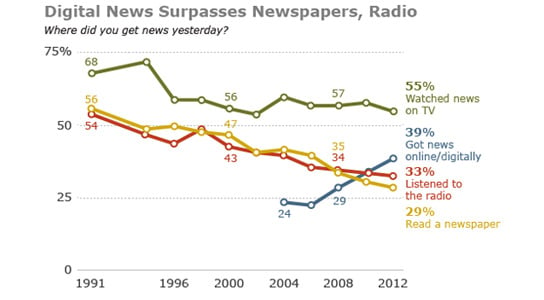
According to Pew more people read news online than read the newspaper for news. I've worried before about how reporting is supposed to be funded if everybody gets news for free, but that's a side issue here.

The received wisdom is that people quit reading papers because the newspaper cost money, but online news is free.


This image is from Pew Research Center.

They don't show numbers from before 2004 for online news, but two things jump out at me here. Rates of reliance on newspaper and radio news are almost the same, and show a long steady drop that began well before there was much in the way of internet news. And the rate of increase of internet news use grew faster than the newspaper use dropped.

I can guess why TV news didn't fall that rapidly: they have the tools to jazz it up and make entertainment of it in ways radio doesn't. Reading about an attack isn't as gripping as seeing the blood, and though you don't actually learn anything new watching a reporter standing in the hurricane you get the race-car thrill of wondering if something will blow him away.

Radio news is succinct: so much so that there's neither depth nor breadth. All Some Things Considered is a bit of an exception to the depth, if you make proper allowances for their bias in material to report on.

But the newspaper allows quite a bit of detail. True, most of the stories tend to be thumbnail reports, and important local trends are sometimes covered up.

Why both newspaper and radio track each other so closely puzzles me. Perhaps both were found wanting and people gave up on news? Since the trend is independent of internet developments I don't see how the net is responsible for their losses.

The rapid rise of internet news readers shows there is a market for news. There's no breakdown for how many different sources or aggregators people used. I'd like to see that, and also what sources they used.

For example, if John Doe watches MSNBC his iPhone, is that TV or Internet? If it is the same program? If it is the same style of infotainment even if it isn't the same program?

Is it news if it is about celebrities trying to get attention?

From the lack of effect on other media I tentatively guess that a goodly part of the rise in internet news is really a rise in TV-affiliated infotainment.

We have no TV (years ago I learned that the information density in TV news was very low). We subscribe to two newspapers: a county daily and a local weekly. I listen to the radio for about 30 minutes a day (15minutes to and 15minutes from work), only about 2-4 minutes of which is news. The vast majority of news I find online, because it is there and not available in the paper or the radio.

Nature imitates art; or funny honey

Yellow/orange is so last year.

You've probably seen the pictures of the French blue and green honey produced when bees dumpster-dived M&M residue at a factory that reprocesses waste from a Mars chocolate factory. If these were clean candies and dyes that might be fine, but this is undefined waste and who knows why any particular batch was chucked. So the beekeepers can't sell the honey.

Different pollens give slightly different flavors, though it looks as though, contrary to popular myth, bees don't make intoxicating marijuana honey. Apparently the pollen doesn't have any THC, and bees allegedly don't pollinate it anyhow.

If the truth be known, I can't always easily distinguish one variety of honey from another. The note of sugar tends to overwhelm my palate. (Not that that's a bad thing...) There are subtle differences, but perhaps the fact that I don't have words or images for them makes it harder to recognize them and file them in memory.

But I think I could tell blue from red.

Wednesday, October 10, 2012

Sanity in Falun

By now everybody has heard of the school Swedish chef Annika Eriksson and Katarina Lindberg, the bureaucrat responsible for telling her to make the kids' food worse. In trying to follow up on this I found stories from France to Indonesia: all sourcing the same news story above.

And then what? There was a storm of unhappy comments on the news site above and presumably elsewhere as well, and Katarina was forced to back down, though she is, naturally enough, trying to spin it as a misunderstanding. Figuring out the real issue isn't rocket science, though: the Swedish students put together a Facebook page in support of the cook which referenced

Sweden's "Jantelagen" ('Jante Law'), the name for a typically Scandinavian value system which emphasizes the collective over the individual, sometimes resulting in the devaluation of success or achievement.

BTW, I got nowhere trying to google the story until I tried the bureaucrat's name. It turns out the chef's real name is "Britannica Eriksson." Modulo some c/k spelling shifts.

Monday, October 08, 2012

Tagging art

A man scrawled a slogan on a Rothko painting at the Tate museum. He claims to have "added value," presumably because even if the painting is restored his actions add a bit of extra history to the piece. His explanation involves something incomprehensible about "yellowism" about which the less said the more sane we all are.

Over at Althouse several of the comments have pointed out that it is difficult to ruin a Rothko painting because it never had any artistry to begin with. (I summarize.)

It is hard to contradict them. From an artistic viewpoint, this is no worse than the tagging on an alley wall.

Probably the painting's dollar value was nothing more than a counter in the "what can I invest in" game played by the ultra-rich. But a lot of sheep have persuaded themselves that the painting was wonderful, and he was trying to slime what they valued--not to demolish idols and save souls (or at least the soul of the art world), but to make himself look important. I don't know what he thinks in his heart of hearts; I only know what he is reported to have said.

I think I could face a major collapse in art prices with equanimity.(*) I have my own "Rothko" in the garage where I wipe the paint out of brushes before soaking them. But this fellow is vile. Maybe he is crazy too. It is possible to be both.


(*)Our holdings are quite small and represent things in the heavens above or the earth below or the waters under the earth. Or dragons painted by EldestDaughter.

Friday, October 05, 2012

Punishment and society's scale

While driving away from MiddleDaughter's neighborhood the other day I was relieved to note that the four main drug dealer families(*) in the cul-de-sac were gone. But I couldn't let well enough alone and took to wondering: what became of them? They're not in prison, just evicted. So some other unhappy neighborhood has to deal with them. It's a game of musical houses; who gets stuck with the crooks when the music stops? Or like Greyhound therapy for the mentally ill street people who won't cooperate.

In theory the crooks will eventually make a mistake and wind up in prison, though if assault isn't good enough to do the trick I don't know what will be. Then they will be safely tucked away where they can't harm the general public. Penitentiary was supposed to give them a place to be sorry for their crimes, though in practice it seems to work best as a "keep them away from us for a while" facility.

I'm not going to try to figure out what's ideal.

But centuries ago punishments were much more draconian. There wasn't any prison in the villages, so you were fined or whipped or modified or executed; no sitting in prison for 10 years. You stayed locked up until you were punished. A criminal could run away to another village to escape punishment, and that's presumably one of the reasons people didn't trust strangers very much. (Without someone to vouch for you you might not be permitted to stay in town. An innkeeper might do that for you, if he liked your looks and cash up front.)

So to first order a village had two choices in dealing with a bad actor: expel him and hope he goes somewhere else, or apply some fairly dramatic punishment to encourage him to stop being such a villain. If nothing worked and his actions were still intolerable, you can see that there might be a groundswell of support for a permanent solution. If you can't persuade the guy to stop stealing, make it impossible for him to steal. (IIRC small villages weren't typically authorized to hang or whack off hands. I'm just saying they wouldn't necessarily find the punishment disproportionate.)

Of course if the punishment for theft is loss of hand, that's the punishment, and it is apt to apply to the fellow stealing from hunger as well as the fellow who steals because he won't work. So that punishment's going to be seriously unjust sometimes, as well as cruel. Yes, cruel--would you want to be the man who does the whacking? If so be prepared, nobody wants to be around you except the seriously creepy.

(The rich expanded the number of capital offenses if it suited them.)

In England things started changing around 1800. (Follow the link; a sentence of death didn't mean you died.) England had quite a large list of capital offenses, some of which (as linked earlier) weren't that serious. So they started reforming the laws.

There's a chicken and egg question here that I don't know enough details about to guess the answer to. Did there grow a moral revulsion to having so many death sentences, or was the society large enough that it was now possible to "keep them away from us" and reduce the sense of urgency for harsh punishment? Or was there a bit of both? It might be possible to get some idea by looking at opposition to the reforms as a function of community isolation.

If today every neighborhood was stuck with the handling of its own petty and not-so-petty criminals, what would the punishments look like?

(*) No, we didn't see drugs change hands. But at all hours, she saw "friends" of the four stop over briefly with a bag from MacDonalds and share "food."

Corrected which daughter

Thursday, October 04, 2012

Hungering for potential

Let me insert a short preface on sex, to make sure we're talking the same language. We understand that because something is popular or common doesn’t automatically make it natural, though it will only take its power from some urge that is natural.

When a woman's eyes and body say "You could have me" she typically isn’t just communicating that she wants a romp in the hay. That's part of the message but trying to spell the rest out in words sounds clunky. Better go with Shakespeare, who wrote (Macbeth: Malcolm is being persuaded to be a king) about the many women who "will to greatness dedicate themselves." Twain complained that most women would rather have a fraction of a great man than a mediocre man all to themselves. The word "have" is key, and it isn’t symmetric.

The man's standard role in that relationship is partly that of protector/provider, which in our twisted-up world means women flock to the rich and powerful. But it also involves expressing something great: women notoriously flock to rock stars too, and to a lesser degree to other artists. (I've not noticed a lot of groupies around mathematicians, though. Perhaps those who can appreciate the more austere arts are more astute, and the more astute women look for great character.) The "you could have me" message is therefore very powerful, since it signals that I am great. Perhaps I'm great enough to have more than one!

I'm a little reluctant to try to describe what the woman's side is like ("sexist pig!") since I'm not a woman. Both sexes serve each other, so it isn't "service", 50 Shades of Grey's popularity to the contrary. FWIW the only people I've seen reading that book are women, so there's some female attraction to it; portraying some natural urge buried in the weeds somewhere that is distantly related to the attitude of the heroine to her master.

There are a lot of things in this world whose explanations don't speak of the power and nuance in the things. The word "home" could be explained as "the place I eat and sleep and am used to being comfortable" but think how much the explanation leaves out! So forgive me if I don't try to tease out a description of what that natural urge will be: it would mislead at best. Here be traps and monsters.

As "Shades of Grey" and the whole rest of the industry of porn prove, the natural can be buried far enough to be unrecognizable, especially when dressed in symbolism. For example if you know of pole dances, they're more symbolic than erotic--those aren't the gestures of a woman reaching for her man. (If you don't, don't go looking: you'll either be perplexed/revolted or enticed, and perhaps both--and you can't un-see a picture.)

End of preface.


We're in love with potential.

I don't just mean the way everybody loves babies. Babies have lots of potential, but they're also innocent people interacting here and now. I mean money. I mean hatred of commitment. And more.

Money is nothing but potential. Unless it gets used for something in the future it does nothing for me except serve as a scorecard for competition. It is important to have around: you want to be able to buy food tomorrow, and save a little potential so you can get more food when you're temporarily out of work. But we love some of that potential, don’t we?

A college freshman has the choice of many majors: lots of potential. You may have known someone who kept changing majors; never quite satisfied or perhaps afraid to commit the effort to succeed. After graduation, there's a wide choice of careers—and surely you know/knew someone who waited for the right job.

Can you point to someone who is waiting for "the perfect mate" and can't seem to choose anybody who is preferable to their current life of "potential?" Who's afraid to marry because somebody better might come along? Me too: not in my circle of friends but among my children's generation.

The young lady posing on the dock with the come-hither look communicates potential--a potential the wife fulfills; but the young lady catches the eye and the imagination anyway. (Not that the husband is dissatisfied; the attraction appeals, as pointed out in the preface, to masculine pride. And to possibilities.)

The "new and improved" calls out "potential!" This cereal might really be satisfying!

I wonder if those of us who have trouble starting (or perhaps finishing) projects have a similar niggling in the back of the mind: right now it is still full of potential, but when the paint is dry the blobs and nicks may not look so good.

Pop songs rejoice in young love. Lots of potential there. Some country songs speak of family and growing, but pop is pretty firmly in love with potential, and has been so for decades. ("With pen in hand," "Isn't she lovely," and "Tea for two" come to mind quickly as exceptions; so this isn’t 100%--but nearly. If the song isn't about new love it's about breakup; kids don't enter the picture.)

The fall TV lineups used to evoke excitement. The new shows sounded like they’d be wonderful. I remember that the anticipation was generally much better than the real shows. It is probably still the same but I'm out of touch.

Results take work and time, but potential is right there and we can dream of it any time--at least until it ages away.

Flowers for potential, fruit for fulfillment: we're a flower culture. Or at least we've a very large (and barren) flower sub-culture.

My eyes hurt.


Now yours will too.

Dream of how shockingly senseless and alien today's fashions will be in 40 years.

Lovecraft could do it justice

The image changed under me, so I uploaded a new one

Letting campaigning pass by

Fortunately this isn't New Hampshire where one is obligated to meet a dozen presidential candidates every four years.

I was able to work from home, and am grateful for the opportunity. The traffic tie-ups when a president comes to town are miserable--not as disastrous as in L.A., but hard to avoid in a city caught between lakes.

The threatened rain never became a serious downpour, so the thousands that went to do darshan probably had their desire. I had to pick up YoungestSon from MATC, and saw state troopers blocking off access to the interstate as I drove by: we'd left just in time. 10 minutes more and the turn lanes would have been backed up half a mile and started blocking a lane in the construction zone. I guess they wanted the interstate empty for when AirForce 1 flew over it.

"Make way for your betters!"


No, I didn't watch the debate. I know only a little about Romney (not all good), but by now I know more than enough about Obama.

UPDATE: This morning I found out the SS was randomizing the route, and the motorcade took the Beltline to the Interstate. A long route, but I guess they like to change things up.

Tuesday, October 02, 2012

I'm not a luddite, but

The Navaho and Hopi and a dozen other tribes are ticked with Arizona Snowbowl, which plans to use effluent (somewhat treated) to create snow this year. We
are assured that "the treated water meets the highest standards — just below drinking water" and some reports suggest that the snow machines will use a mix of treated and fresh water instead of 100% treated. The story emerged last year but this Feb a judge said it was OK to go ahead with using the treated water in the snow mix.

I tend to de-weight Indian claims of sacred territory. Treat that as a moral failing if you like. Nevertheless I think I'm on their side this time, even if it is the losing side again.

There's no research I know of showing effects on humans, but various studies show deleterious effects on fish and roaches from estrogenic chemicals. What the effects of elavil and darvon residues are is anybody's guess at this point. One also finds caffeine at rates up to micrograms/liter. Those are small concentrations, but when the organism is young small concentrations matter. Slosh the mix on the mountains, pour it down the streams: we're conducting a grand experiment on the waterways; and on ourselves for that matter. I won't go so far as the say the mountains are especially sacred, but I do think this isn't wise.

Does anybody know what work is being done to clean these things out of the water?


Apparently one can even measure drug abuse rates in a city by measuring residues in treated sewage.

Winners by proxy

The past few weeks I've seen a number of fresh(wo)men (for the first month you can usually tell who's new) wearing Wisconsin Rose Bowl shirts. The last win was in 2000, when the freshmen were 6 years old and probably not following college football closely. Naturally the team that won is long gone. Nevertheless a sense of continuity, or at least the desire for continuity, is strong enough to induce freshmen to part with a few extra bucks to co-celebrate a distant victory.

Sunday, September 30, 2012

Courtship Rite by Donald Kingsbury

I’d heard of this vaguely somewhere before, but on the recommendation of Texan99 and John C Wright I found it in the library. (Malevil is also available, but I'm too lazy to tackle that--my French isn't smooth enough. There has to be a translation somewhere handy...)

I'll steal the description from Wright: "it was like a Jack Vance novel written in AE Van Vogt pacing." I like Vance's avalanches of creativity.

The thesis is that humans colonized a planet that had lots of life (no animals above insects mentioned), apparently out of desperation. The problem Kingsbury noticed is that the native life won’t have the same DNA and proteins, and no matter what it looks like it won't be good to eat. And getting our native plants to grow is way trickier than it seems, since down in the dirt it depends on lots of microorganisms that may not get along well with the native population. Result: very insecure lives, and the most important class is the bio-engineer types (called priests). (All quite logical, and I'd not thought of it before.)

The story opens with a cannibal feast at the death of the leader. (Food doesn't get wasted.) Three brothers are survivors of a crèche (3/4 of children there fail tests and are eaten). The story opens with the three brothers and their two wives (one marriage) being told they can't marry the woman they want (a brilliant physicist), but for political reasons have to marry a heretic in another tribe who teaches that people shouldn't be killed like that.

The various tribes are breeding for intelligence and strength and "kalothi", and by the end it is fairly clear that they are smarter than normal humans (except when somebody has to be tricked for the plot's sake).

On the plus side it has, as Wright said, Vance's creativity with good pacing. The reader is introduced to strangeness, and you have to think carefully about what is really happening. What is and isn't possible in the environment is also well thought out. On the minus side, the history they learn partway through induces too-rapid changes(*), and the subsequent quotation mix is a little jarring. And the characters are inhumanly sexually easy; only one shows anything like jealousy and that only intermittently. And I think the food energy budget is a little off, but that's a quibble.

It is well written, well thought out, overall well-done; and yet... I didn’t like it very much. The themes and background were off-putting enough to make it unpleasant.


(*)I work with people doing cutting edge stuff, and can assure you that Skylark-type "prototype to production model in 6 months" is wishful thinking. You discover things the manufacturer didn't know about your components when trying to make something new.

Saturday, September 29, 2012

Church and state

AVI asked what the relationship between the culture and Christianity is, and whether it is better if the culture supports it.

I'm going to duck out of the question of better or worse. And I'm going to duck out of Christianity and culture questions for the moment.

C.S. Lewis suggested that pantheism was the default religion people settled into. Watching how politics seems to play out here and abroad I tentatively conclude that having a chief/king is the default form of government people settle into.

It also seems that a union of religion and state is the default relationship between the two.

I'm not such a fool as to believe that all religions or cultures or forms of government are equally good or equally valid, or that the default is necessarily a good option.

Most of the small tribes I remember much detail about were led by a chief who was also one of the major religious figures in the tribe, though not necessarily the most important.

That has a kind of logic to it. The tribal culture defines what things are valuable, are to be sanctioned, are to be reverenced; and it provides legitimacy for the ruler. The cult is part of the culture, so the ruler is at least indirectly supported by the religion. Since the ruler represents the people it makes sense to involve him in those rituals that involve the tribe as a whole, so he would tend to be regularly involved in ways ordinary tribe members aren't. And since he is powerful, and since animist religions tend to look at things from a "who/what is powerful" angle, if he is involved in different ways than ordinary those ways will be important; maybe even the most important.

If instead the king's tribe rules a kingdom of other tribes, there may not be a single religion. I gather the Greeks tried to consolidate religions by equating their gods with something in the other nation or tribe's pantheon that was at least within shouting distance of being similar. I suspect that pantheons arose from accreting the different gods of different tribes into a single structure (presumably at the cost of devotion), but I don’t know where one would find evidence for this. (Did isolated tribes have more gods than trading ones?)

At any rate, the pagan king is apt to find more than one religious center. If it is possible to create an overarching pantheon, it is in the king's interest to encourage it in the hopes of generating a "we're all in this together" sense among the diverse devotees of Vishnu and Kali. Once again the king can represent all the peoples in ways nobody else can, so he should be important in the religions in ways nobody else can be, so there's some unity of religion and state, though because it is a more complicated environment who is more powerful isn't predictable. Nebuchadnezzar tried to institute a common religion, and so did the Roman emperors; presumably for the same reasons of imperial unity.

Now introduce into this kingdom a monotheist religion whose adherents won't join in the unifying rituals. If they don’t support the king they're soon gone, so assume that they do support the state, just in a different way.

The new/minority religion inevitably has different values and produces a different subculture. We can look at Jews or Gypsies to see how well-liked these groups tend to be. They find toleration sometimes, oppression and expulsion other times (especially if the group regards the majority as marks).

What happens when they proselytize, or when the cultural side effects of their religion (or its rationality) are clearly superior to those of the pagans around them? In China Falun Gong is, as far as I know, supportive of the state, but the Chinese state cannot put up with any organization or religion that does not derive its legitimacy from that state. Even if the minority religious culture is attractive and superior to the majority culture, the ruler may want to control it also, and get rid of it if he can't.

From the king’s perspective, he has two integrated sources of power in his role as king and his role as a religious leader. The growth of a new religion has to decrease that. It may not matter: "It's good to be the king." It might even help in political disputes with other cult leaders. But the more seriously he takes his religious duties the greater the risk that his representation of the people will seem inadequate when he doesn’t speak for all of them at once.

If on the other hand the kingdom is already ethical monotheist or dualist, the religious leader/king's religious duties take on a moral edge. For the safety of the kingdom and also of those the new religion he must point them to the correct path.

In Christianity or ancient Judaism or Islam the leaders can be appointed by God, and is therefore once again potentially a part of the religious order. Christianity says all leaders are so appointed, even the non-Christian or evil ones, so there's some barrier there, plus Jesus' words about Caesar and God--but even so if the leader is Christian there’s been a tendency to integrate him into the religious order of things.

In the past century various ideologies have acquired a scope previously only granted to religions. They generally don’t say much about the supernatural world, but they are emphatic that salvation comes through the state. For example "Green" environmentalists have a fairly complete set of parallels, with their versions of hell, sin, indulgences, and so on. Mere obedience is not always enough; you must not question the true faith that man is a burden to the world or that "alternative sexualities" are equivalent to traditional marriages or that the state can make all things better.

Religion and state seem to have some mutual attraction.

Thursday, September 27, 2012

Room temperature superconductivity?

I missed this story. Graphite doped with water superconducts? Well, maybe. There are several tests for superconductivity and so far the material hasn't been tested to see if it repels magnetic fields or really-and-truly conducts with 0 resistance. Instead it passes a more esoteric test, which is related to but may not guarantee the rest of them--which are the ones we're interested in.

Trying to make a wire out of doped graphite is going to be an interesting exercise. Maybe baking can fuse flakes together--but then you may change the molecular structure that gives it the (for the purposes of argument) "superconductivity."

"Vampire Squid"

Go watch the video as it looks like the "squid" turns itself inside out to eat. It looks like they have remora-like parasites too, but you don't get a really close look.

Tuesday, September 25, 2012

Toxoplasmosis again

I'd asked before how toxoplasma could change hormone levels from within a cyst. There's a new report in the European Journal of Personality that says yep, they do.
We found that Toxoplasma-infected male and female students had significantly higher extraversion and lower conscientiousness. The conscientiousness negatively correlated with the length of infection in men, which suggested that the toxoplasmosis associated differences were more probably the result of slow cumulative changes induced by latent toxoplasmosis, rather than transient side effect of acute Toxoplasma infection. The existence of this correlation also supported (but of course not proved) the hypothesis that Toxoplasma infection influenced the personality, rather than the hypothesis that the personality influenced the probability of the infection.

...

The final sample consisted of 181 Toxoplasma-negative and
30 Toxoplasma-positive female students and 95 Toxoplasma-
negative and 17 Toxoplasma-positive male students.

...

The important difference between the present NEO-PI-R personality profile and 16PF personality profiles of infected subjects was that the toxoplasmosis-associated differences relative to Toxoplasma-free subjects in Cattell's personality factors were mostly in opposite directions for men and women, whereas the differences in NEO-PI-R factors were generally in the same direction for both genders.

I must say I'm not excited about their Table 1. Yep, there are differences, but the standard deviations are pretty large.

But I had a look at some pictures and maybe the cysts aren't quite as impermeable as I'd have guessed. So they may be onto something, though unless I miss my guess this study doesn't show it. There just aren't enough statistics to look at the tails properly.

Clouds of hot gas

If you are standing in the waterfall, how can you tell whether the sky is foggy? There's too much spray in your eyes and mist floating around you to see clearly. But if you see sharp-edged shadows, the sky is probably clear.

Gupta et al used the Chandra X-Ray Observatory data to do something just as difficult. Here in our Solar System we're in not quite the heart but certainly the swirl of a large galaxy, surrounded by hot gas and cold dust and magnetic fields every which way. Look outward, and see hot gas wherever you look.

They did something clever. They were looking at absorption lines of oxygen in X-rays emitted from distant galaxies. Chandra is accurate enough about direction that they can look only at the kinds of galaxies that will be bright in X-rays but not too wild and wooly, and be sure they're not picking up too much stuff from galaxies nearby. The X-rays are emitted with a broad spectrum. Some of the X-rays are absorbed by oxygen in distinctive wavelengths: some absorbed at the distant galaxy and some absorbed nearby.

Here's the cool trick. Galaxies are moving away from each other, so the absorbing gas is moving too. They picked galaxies far enough away that the speed at which we are moving apart is great enough to make a large red-shift in the light spectrum. Therefore the gaps in the X-ray spectrum due to absorption by oxygen in the distant galaxies are red-shifted to longer wavelengths. The gaps due to absorption by local (our galaxy's halo) oxygen are where they ought to be.

The researchers can tell the difference, and conclude that there's a lot of local (and quite hot! 1,000,000 degrees K) oxygen in a kind of cloud around our galaxy.

If the proportions of hydrogen and oxygen are like those elsewhere in the galaxy (ie. lots of hydrogen and only a little bit of oxygen), then the cloud around our galaxy has to include an awful lot of hydrogen we can't see with this method. In fact, there should be as much mass in the cloud as there is in the galaxy itself!

If this is correct, then one annoying problem with models of big bang evolution may be solved: the models predict about twice as much baryonic (ordinary) matter as we seem to see in the glowing galaxies.

If the cloud is that large and that hot, it should have some interesting effects on galactic magnetic fields. I'm not sure how easy it will be to see the hydrogen.

I look forward to hearing more.

Excommunication

Catholic in Germany? Pay your church tax in Germany or face loss of the sacraments. At least so says the BBC's report of a German bishops' announcement. I don't read German or I'd try to verify this one: BBC is not famous for accuracy in stories about religion. To be fair, neither are pretty much all the other news companies. But see the CatholicNews version which emphasizes the public renunciation aspects of Zapp's announcement.

There's history involved, of course:

All Germans who are officially registered as Catholics, Protestants or Jews pay a religious tax of 8-9% on their annual income tax bill. The levy was introduced in the 19th Century in compensation for the nationalisation of religious property.

...

Catholics make up around 30% of Germany's population but the number of congregants leaving the church swelled to 181,000 in 2010, with the increase blamed on revelations of sexual abuse by German priests.

Alarmed by their declining congregations, the bishops were also pushed into action by a case involving a retired professor of church law, Hartmut Zapp, who announced in 2007 that he would no longer pay the tax but intended to remain within the Catholic faith.

The Freiburg University academic said he wanted to continue praying and receiving Holy Communion and a lengthy legal case between Prof Zapp and the church will reach the Leipzig Federal Administrative Court on Wednesday.

"This decree makes clear that one cannot partly leave the Church," Germany's bishops' conference said last week

From an American point of view one problem is obvious: churches should raise their own money. Then, presto!, there is no Zapp scandal any longer. His protests are now only between him (and the thousands like him) and his church. Caesar isn't in the picture any more, except for punishing crime. And the church finances still get the hit Zapp wants them to endure.

Money comes off the table entirely when talking about sacraments. Unless the bishops want to revive "So bald der Pfennig im Kasten klingt", which I hope they are wise enough not to dream of... Zapp's declaration would have to become more clear cut; right now it takes on a hint of tax evasion.

Hat tip to Maggie's Farm, and yes, I googled for Tetzel's rhyme: I don't even know that much German. I notice that the additional tax (waived for non-religious) is quite a bit less than 10%; only about \$300/head on the average or maybe \$1200/family_income.

Sunday, September 23, 2012

Roman Catholicism: Evangelical Protestants Analyze What Divides and Unites Us ed by John A Armstrong

This is made of 13 essays on various topics about "One, Holy, Catholic, Apostolic Church" and "Roman Catholic Theology Today" and "Evangelical and Catholic Cooperation in the Public Arena" and so on.

"Roman Catholic Theology Today" asserts that after Vatican II much of Catholic theology went rapidly in the modernist direction as "a consciously post-Enlightenment theology, the basic presuppositions and concerns of which are the same as those that have motivated Protestant theology in modern times." If true it certainly helps explain some of the things I’ve been hearing about Catholic universities.

Many authors complain that many Protestants churches have become terribly sloppy with doctrine, to the point of Pelagianism or worse: "therapeutic Christianity."

Much of the rest is fairly well summarized by "We agree on a lot of things, and can and should do a lot of things together, but Trent is still in the way."

In other words justification is either a "forensic" imputation with no human effort or a process that in the end depends on human effort and compliance. The latter is officially tied in to support Purgatory, and in popular theology (as opposed to the magisterium's version) became and still becomes a "salvation by works" doctrine.

Balance is difficult, and while I'd hope it is possible to think of justification with a little human cooperation without getting tied up in works-and-merits, it isn't clear that this works out very well in practice. In any event, Rome doesn't seem too eager to ditch the merits of the saints though I gather they've decided to be a little fuzzier about Purgatory.

I tend to a somewhat different view, though I haven't worked out the implications. Justification, sanctification, glorification, etc. look one way from a human time-based perspective, and must look quite different from the eternal Now. It is therefore risky to rely on time-based distinctions when talking about God's action. Likewise it is difficult to include both Divine knowledge and human choice in the same model. So rather than try to build a conceptual framework that handles both, look instead at what is required of us in one model, and look at what happens to us in another one. Requirements: 1) trust Jesus for salvation, and 2) try to obey God's rules to be fruitful in His world, and 3) when you sin review point 1. What this looks like from the eternal perspective is more like God turning vermin into gods.

Jesus and "wife"

I saw the story about the text fragment, and it seemed a bit odd (4'th century or 2'nd? What gives?) so I searched around a bit. I should have googled for the principals instead; it would have been faster. Karen Leigh is on the Jesus Seminar, an organization that rewrote the gospels by voting every verse with miracles or authority "off the island" (almost as though they had an agenda). Round file.

I know that even the devil tells the truth from time to time, but some groups have earned the reverse of "benefit of the doubt." If a Muslim Brotherhood rep wants to talk about Jewish conspiracies, I have better things to do than listen. (If he wants to talk about food prices that's another matter.)

It is a big deal to set that kind of default, and I try not to do it lightly. Political differences are too low a threshold to trigger it; though "How can you tell when a politician is lying?" isn't as huge an exaggeration as we'd like.

Friday, September 21, 2012

Senate update

Earlier I noticed that Senegal was thinking of getting rid of its Senate. Sall got his way. One detail I'd missed before was that the lower house is more heavily allied with his party, and the Senate more with opposition parties. Another is that half of the Senators are appointed. They also got rid of the office of Vice President, though that won't save any money since there hasn't been one yet. I'll try to keep posted. (Prediction 1: there will be smoke and mirrors about how much money is actually spent on flood control.)

FWIW, I tried to find out if Senegal was on the list of countries where France closed its embassy. Along the fruitless way I noticed that the logo for France Diplomatie reminds me a little of that for Major League Baseball.

Thursday, September 20, 2012

Before you buy a ticket on a warp drive craft

Once again we discover that faster than light travel is a little less impossible than thought. Except that the devil is in the details. Wikipedia has a more detailed history and description. You can skip the math, it doesn't help much unless you're ready to delve into families of initial conditions and solutions. I'm not.

The short answer is that all you need is some unobtainium (to give the negative energy density), which is possibly tachyonic (try and catch me!), built into worse than microscopically thin rings, and precisely calibrated so that tidal forces don't tear your spaceship apart. And I'm not quite clear what happens when you run into space dust along the way--it might mess up your careful tidal balance. And the pilot has a little trouble steering.

But hey: this time you don't need > mass of the universe energy available, or even mass of Jupiter energy; all you need is the energy of a bunch of H-bombs. So it is now "a little less impossible."

Resisting the temptation to connect the attitude with magical thinking by ... Must resist ...

A pity. I'd love to see Sag-A'. Though even if the drive worked there'd not be cheap passenger fares in my lifetime.

Update: Maybe I should have made this shorter:

Before you buy a ticket on a warp drive craft

Be sure you won't hit dust clouds on the way

For when your unobtainium ring bends back aft

Tides will shred your life support away

Just going to get worse

Wisconsin is a "swing state" and we've been getting phone calls. Hoo boy, have we been getting phone calls. It has been getting so bad that I hung up on a human being last night. I usually try to be polite, but ...

No, I don't do phone opinion polls: they usually turn into "Did you know that..." pushes, and in any event I want them to live in uncertainty. Just for laughs, let the candidates try to say what they mean rather than what they think will poll well.

And the assumptions behind the calls are rather insulting. Do they think I don't try to keep posted? That I can be swayed against intellect and conscience by smoke blown in my eyes?

Soon comes the deluge of glossy fliers that don't actually say anything. This year I'm going to save them and see how much they mass.

Monday, September 17, 2012

Creativity and Love (and doodles)

I’m composing this at Beaver Creek Valley, where about half the campers are Chinese and half are here for the archery season--with a lot of overlap. I saw one group running a blowtorch next to the grill cover, presumably to burn the crud off. It is noisy as all get-out and wasteful, but undeniably cool. But--why not add oxygen to the feed and make the flame strongly oxidizing? It would be faster and more dramatic--you’d have to worry about damaging the grill. This morning I moseyed over to the next campsite (they came in late and did the same thing while we were trying to sleep) and asked to see the result. Oops. I should have been wearing my glasses. Turns out they were cleaning squirrels; it is squirrel season too. Still, I like the grill cleaning idea. I’ll try it if I get the chance.

I remember overhearing the conversation between two brilliant scientists (one went on to win a Nobel prize) batting ideas back and forth. It was a joy to listen to, and also to participate in my own smaller way in similar discussions with friends. So what if most of the plans needed work, we could deal with the details when we picked a plan. (FWIW, both men were royal PITAs to work for. This may seem to sabotage my conclusion below, but the joy they had and I shared was real.)

Creativity can serve evil ends: history makes that overwhelmingly clear. But set that prospect behind us for now and think about other forms of creativity.

My experience and observation are naturally limited, but they are at least worth something. I find two forms of creativity.

One form is creativity oriented to some goal--getting a mouse out of the ventilation duct, or devising a faster way to clean the grill.

The other is creativity oriented to no immediate or even perceived goal--doodling a rocket ship in the margin of your English notes. Depending on your bent you might try to make the details aesthetic or functional, but my urge (and that of most I've watched) is to fill it out and not leave it schematic--unless that schematic has a beauty or completeness of its own. (Cartoons have their own aesthetic.)

I hesitate to call this "purposeless" creativity. The word "purposeless" is freighted with implications of randomness and waste. Neither corresponds with what I sense I am trying to do.

I'm composing this on a pad originally used by my youngest daughter for math. The inside front cover has a doodle of Legolas. She revised it here and there to make it more accurate. At the time she was captivated by Orlando Bloom as Legolas in Jackson’s movies. This had nothing to do with math, and she already had other and more accurate images of him—but she wanted to create something.

It seems as though creativity of this second sort is a fundamental urge or characteristic that isn’t derived from other thing--isn’t composite. In fact the first form of creativity--creativity aimed at some goal--is the composite, of "raw" creativity and filling a need.

At first glance goal-oriented creativity is easier to understand. I could try to define it as "If I have a need X, I think through the processes A, B, C that I know about to see if any of their goals or side effects can fit into a process that will achieve X." On closer inspection you sometimes have to define "process" so broadly that the description isn’t useful, and you wind up being circular with "creating new problems that solve the old."

You might sometimes look at non-goal oriented creativity as "make a problem and then solve it" where the problem is "This paper needs an image of Legolas" or "How convoluted an image can I draw in this margin without lines crossing?"

However you try to parse the definitions, creativity of any sort puts something in the world that wasn't there before. That shares in divine creativity, though we use an existing "something" to make our new things.

But creativity as we know it also comes with an impulse to do the thing well, whether that means beautifully or accurately or thoroughly, and we feel a lack when it falls short. The doodle among the English notes may have little time or care invested, but we’d really rather it looked good.

We want to make something new, something outside us, that we can make good, be happy with, and have affection for. Most of the time we will toss aside whatever resulted from the almost-aimless activity; judging it (correctly) not of the quality or importance to continue with, or perhaps a blind alley. But as for me I'd prefer that the margin's rocket design lack only the quotations for parts, and that not just the single dandelion I hold but the entire field explode in a whirlwind of fluff.

So creativity (as we know it) is generous--to the created thing. It seeks the best--of the created thing. It therefore--at least for human creators--partakes in the nature of love.

Given the rich detail of the world it isn't too far fetched to extrapolate that the creator of the universe created something outside himself that he could make well and be generous towards--be loving towards. (It doesn't matter if the creator is merely a gnostic demi-urge; the same extrapolation applies to whoever created the demi-urge up the fabulous gnostic chain.)

Is it possible that "God loves" is something we might have concluded from "God creates," in the same way that we might have (but didn't) conclude that God has the aspect of suffering servant from noting that God is just and that He hadn't destroyed us already? Some revelations seem needed to get through into our thick heads, and only after the fact can we say "of course!"

Friday, September 14, 2012

Time for a break

camping for a few days in Minnesota to rest and bird watch with Eldest Son.

The non-ancient non-Chinese curse "may you live in interesting times" seems to have landed on us all, but "sufficient unto the day is the evil thereof" and all that. I can't spend 24/7 standing athwart history and yelling "Stop!"

We all need a little quiet time to make sure we're centered on God, and not nudged askew by the Prince of the Power of the Airwaves (and the net).

Wednesday, September 12, 2012

"Astronomy" videos

These videos by Alex Parker are fun. The "Supernova Sonata" puts notes to a sky map of novas. I'll bet you didn't realize there were that many.

Obscure vanity

A Wisconsin plate read 84MUNU. This is what I thought of immediately, but I couldn't think of anybody involved then who was in Madison now.(*) Google didn't help a bit: perhaps it is from another language? Or perhaps someone misread the license application: someone I knew tried to put his name on the plate and an O was misread as a U. Obscure whichever way... Vanity plates are maximum 7-character tweets.

LVTHEM is easier to figure out. Or SUEM (in a law firm's parking lot).

(*)I was still in grad school; I joined later.

Tuesday, September 11, 2012

Rabbit grimacing

A UK team studyied whether analgesia was useful when tattooing a rabbit's ears.

The sample size is tiny (8 rabbits), but you'd think it wouldn't require an army of rabbits to figure out whether something hurts or not. They measured pain/disturbance in a number of ways (heart rate, rate of grooming afterwards, etc), and compared tattooing with handling and fake-tattooing, and found that (surprise!) it hurts unless you put some analgesic cream on first.

That's more of interest to 4H groups: what caught my eye was the idea of measuring the rabbit's pain by its grimace. There already existed a method of measuring mouse pain by mouse grimaces; this has been adapted to rabbits, and it looks like it works, at least for low levels of pain (they didn't try to inflict anything harsh).

So, is the rabbit squeezing its eyes shut, or flattening (sucking in?) its cheeks, or V-ing its nostrils, or laying its whiskers or ears back? Something is probably hurting it.

Did it just go into full kick and jump mode? You goofed trimming the nails...

Saturday, September 08, 2012

Categorizing people

At "Beyond Label or Category" Dan Dick describes a young lady who briefly chatted with a group at a coffee shop:
One morning, a cute, perky, deeply dimpled blond woman — maybe 21 or 22 — dressed in shorts, a tank top, and carrying a pink Hello Kitty backpack bounced in and joined the group. See chatted for a while and departed, and awhile later the whole group broke up and left. When I prepared to leave, I noticed that the young woman had left her backpack. I took it to the cashier and asked if he knew the woman, he said he did not, so I looked in the backpack for identification so we could contact her. Here is a list of the contents of the backpack:
  • an iPhone
  • a wallet, with an “Icthus” fish emblem
  • a set of headphones
  • two tampons
  • a strip of seven condoms (five opened and empty, two fully intact)
  • a well-used Bible — heavily annotated and underlined, with about two dozen bookmarks with yarn tassels marking favorite places. The Bible was held in a protective cover, and the cover had the following four stickers on it:
    1. "Abortion is murder"
    2. "We stand with Scott Walker"
    3. "All means all — Support Lesbian and Gay Rights"
    4. "Capital Punishment is a Hate Crime"
  • a pint of Raspberry vodka, two-thirds empty
  • a .22 caliber handgun

Okay, quick now — liberal or conservative? Republican or Democrat? Would this young woman be comfortable in your church? Would she be welcome? Does she "fit"? Is she the kind of young adult we have in mind when we say we want more young people? Is she "normal" in today’s world?

There's been very strong correlation between views on economic and moral issues, but part of this is due to "ethnic cleansing" in the political parties. You can generally tell what someone's views on abortion are by asking about whether the rich are taxed enough, but that's partly because the Democrats have tried to purge themselves of anti-abortion figures, and not so much because the two beliefs arise from a coherent philosophy.

This lady represents a different clustering of values.

  1. She is a Christian who is deeply devoted to studying the Bible.
  2. She's interested in social justice as exemplified in trying to retrieve the levers of power from entrenched public sector unions.
  3. She has at least a modest amount of disposable income, and follows fashion trends.
  4. She believes (it is the fashion!) that people are entitled to have sex independent of marriage or children. (Homosexual "marriage" follows from this disconnect.)
  5. She believes that it is evil to kill the unborn.
  6. She believes she is in dangerous situations from time to time and wants to protect herself (but apparently hasn't asked for advice).
  7. She believes that the state has no right to kill, though.

I recently put together a quick-and-dirty history of early Christianity for a church class, and found it interesting to compare our current divides with some of the early church (first few centuries) attitudes, and see where the young lady fits in.

Her attitudes
towards
American
liberal
thinks are
American
conservative
thinks are
Early church
would think are
1: BibleGoodGoodGood
2: WalkerVery BADProb OKWho cares?
3: moneyGoodGoodBad
wordly
4: sexProb OKVery BADVery Very BAD
5: abortionBadGoodGood
6: self defenseBadOKBAD
7: punishmentGoodBadYou kidding?
Don't cooperate

Yes, I know, I can think of exceptions to some of the judgments among all three groups, but the descriptions are close enough.

So, where does the lady fit in? The second century church would want her to show an amended life for a year before they'd take her. I suppose the modern churches want her to amend her life too, but they disagree on what the amendation should be.

Of the three, in which would she be more likely to find the grace to amend her life?

Antibiotic side effect?

The Washington Post reports on a pair of reports suggesting that just as meat animals grow a little faster with some antibiotics in their diet (I didn't know that!), people and mice do too.

One of the studies is a longitudinal (ALSPAC) study of 11K infants in the UK. The executive summary:

Exposure to antibiotics during the first 6 months of life is associated with consistent increases in body mass from 10 to 38 months. Exposures later in infancy (6-14 months, 15-23 months) are not consistently associated with increased body mass.

In their discussion they describe other factors: maternal weight, smoking, and other things that can correlate with infection rates. They found "remarkably weak" correlations with those variables (when you have such a large population you can segment by maternal weight if you want to).

The other (Blaser's) study was on mice:

Blaser’s team treated young mice with low doses of antibiotics and found that while the treated mice did not become larger overall, they were, in fact, more obese

Treated and untreated mice had different populations of gut bacteria.

The scientists then did a genetic analysis of the bacteria’s metabolism and found that some genes responsible for fat synthesis showed a higher activity in the treated mice. Overall, the scientists concluded that the treated mice had bacteria that were more efficient in digestion.

It is notorious that antibiotics mess up your gut bacteria, and there've been some reports suggesting that gut bacteria change the blood chemistry slightly (with things that mimic hormones, perhaps?). I'm not sure how much of fat synthesis happens in the gut, but if any does then a change to a different and more efficient population could change the input ratios of sugar and fat in the blood. I assume the body compensates, but long term that might make a difference.

You are what you eat, I suppose, but also what meds you take/were given. Notice that for the kids the major factor was whether they got antibiotics in the first six months; later didn't matter so much. That's a little odd, unless these sorts of bacteria have a gut habitat that tends to keep antibiotics out.

They didn't have good information on the types of antibiotics used (this was with parental questionnaire), and so that detail isn't included.

It should be straightforward to check those farm animal growth rates and see how much of that is increase in fat (well-marbled steak, anyone?). I should ask somebody over in Ag.

Friday, September 07, 2012

Twins

AVI notes that psychological twin studies have a weakness: different home environments within the US are not as radically different as researchers might hope. Our home is saturated with books (you often have to move them off chairs to sit down), while a neighbor's is almost bare of them, but the Zeitgeist is the same for both, and that shapes attitudes and expressions in both households.

I didn't play modern pop music at home; I played what I liked. The kids picked up a taste for modern pop anyway. The "air they breathe" is similar around the country, and there were more than a few things that made us cry "Where'd they get that?" We didn't have the TV on much--but the kids watched at their friends'.

As he says, "imagine running into an an age-mate from rural Laos and trying to find a point of connection in childhood reminiscence." Or in attitudes.

Galactic Haze

The Planck Cosmic Microwave Background satellite telescope has verified that there really is a haze of higher energy photons than expected. They infer a spectrum of electrons that falls with energy as 1/E^2.1, which is quite a bit harder than the run-of-the-mill supernova shock electron spectrum which falls as 1/E^3.1 . I love hearing about the kind of work in which supernovas are ordinary background.

Pavel Naselsky is quoted as saying "The radiation has a spectrum which has the same form as that of synchrotron emission, which originates from electrons and positrons circulating at high energies around the lines of the Magnetic Field in the center of the galaxy, and I believe that there are quite strong indications that it could come from dark matter." I think he has in the back of his mind the 130GeV spike in the spectrum found by another experiment (but not verified; quite a few groups are looking), because I don't quite see how the Planck results suggest anything like dark matter.

If dark matter could annihilate with other dark matter to produce electrons, you would get a lot of high energy electrons curving in the galactic magnetic field, emitting relatively high energy photons as they go. So they're consistent with one model of dark matter, but that's not exactly evidence.

Something is certainly different about what is going on in the "bubbles", and the paper is worth looking at if only for the pictures of the bubbles above and below the galactic core. I'm afraid my eyes started to glaze over while skimming the discussion of all the different models being compared to the data. That's a vital part of their research, and similar things are critical in my field also, but vital doesn't make it exciting.

FWIW, the primary cosmic ray spectrum looks like 1/E^2.6 at the high end (Auger), so maybe it isn't dark matter but some similar acceleration processes at work. That would get my vote.

In the meantime, we have a shining haze where nobody expected it.

Thursday, September 06, 2012

Tradesmen

I was reviewing the news of the DNC (I haven't watched any part of political conventions for years), and of course the Entrance and March of the Peers played in my head.


But as the lyrics ran on they came to the chorus, and the line "Bow, bow, ye tradesmen, bow ye masses."

Disdain for tradesmen is an old tradition among the nobility and the would-be nobility. And so it is today. It isn't just Walmart they disdain and try to rule over and squeeze money from.

Monday, September 03, 2012

Gadarene Swine

The story shows up abbreviated in Matthew (and with 2 demoniacs instead of 1), so I’ll use Mark’s and Luke’s versions. It is different enough from all the other stories about unclean spirits that it needs a little review.

At the obvious boat landing spot there’s a noisy and dangerous man who can’t even be chained up. He lives naked among tombs and cuts himself.

The man’s problem is demon possession, and possession by quite a number of evil spirits. It isn’t fashionable to consider that real, though sometimes one is allowed to mention that you saw some very odd things on a trip to South America once. Nothing in the story structure makes any sense if demons aren’t real, though.

Jesus tells the evil spirits to leave the man, and they don’t. Instead they beg him not to torture them. Odd. The rest of the time they just do as told.

Then instead of commanding again, Jesus asks the name, and they answer Legion because there are so many—and continue begging Jesus not to make them leave the area/go to the Abyss. Why does Jesus care about the name(s) of the demons?

Then they beg to be allowed to go into the pigs grazing on the hillside. Would observant Jews raise pigs? They’d not eat them, and at least one authority cites the Talmud as saying "Cursed be the man who would breed swine." (I can’t tell how old this prohibition is, but it cites an incident from the invasion of Aristobulus). This happens in the Decapolis, which was probably mostly pagan, so the swineherds were probably pagan. So the demon-possessed man probably was too.

Jesus gives the demons permission to infest the swine, and the pigs promptly commit suicide. Was that what they had in mind, or was that just the working out of their effects in a simpler creature than a man? And where do they go from here, now that their hosts are dead? Wander about, or head for the Abyss they were so worried about?

The next detail we all recognize: when the townsfolk come to verify the swineherds’ story they find it true—and beg Jesus to leave. Never mind the healing and that the danger is gone: those pigs were more valuable and they don’t want to risk any further loss. Jesus doesn’t seem to care tremendously about pigs or a torn-up roof, people come first.

So Jesus leaves; he doesn't force his presence on people who don't want him around. The formerly demon-possessed man begs to come with him but Jesus tells him to go back home and tell people what the Lord had done for him. Of course if Jesus had had pagans among his disciples nobody would have listened to him, but this wasn’t the only time he told people to go home. He only called some, though not all of them followed.

If I were making up stories about Jesus, I’d be interested in showing his power. OK, making a legion of demons go away is pretty dramatic, but why would I specify that they didn’t obey at first? And why would I make the townspeople so unhappy about a dramatic healing? And since I’d be Jewish, I’d try to make sure that it was understood that the demon-possessed man was Jewish. (Jews could get a little bent out of shape when reminded that God worked with gentiles too: Luke 4:23-29.)

Instead we have a story of a Jesus who even seems to care about what happens to demons and doesn’t worry about private property; a story which raises a lot of never-answered questions as Jesus heals a gentile. Jesus doesn’t fit neatly into little boxes. (And I don't think WWJD is a very good rule of thumb.)

Saturday, September 01, 2012

Community-building

Texan99 pointed me to an interesting web site concentrating on building resilient communities. This article is titled "How to Bootstrap a local barter economy", but that's misleading. The financial model of human relationships applies well enough in the larger society, especially among strangers, but it doesn't apply to families, and not very well to friends. The nearer the relationship, the more important non-monetary exchange is.

At any rate, the critical element of "bootstrapping" is the "Connector" who makes the first links, "to reach out to people in need with dignity and grace, and in return, those people return with what they can offer." There'll always be some moochers in the neighborhood, but they'll tend to get left out of the network after a while. If it works.

Thursday, August 30, 2012

An old Chinese political theory

"Early in the Qin dynasty, the man perhaps most responsible for the creation of singular Chinese state, Lord Shang, wrote:"
"To club together and keep your mouth shut is to be good; to be alienated from and spy on each other is to be a scoundrel. If you glorify the good, errors will be hidden; if you put scoundrels in charge, crime will be punished."

Of course the problem is to pick the right kind of scoundrels. We've not always been very good at that; quite a few of them club together and are alienated from everybody else.

It takes a thief to catch a thief?

From RollRollRun, which I found by looking for the source of a quote in another article.

hotDOGs

The BBC bobbled the subhead ("A space telescope has added to its list of spectacular finds, spotting millions of supermassive black holes and blisteringly hot, "extreme" galaxies."), but the WISE telescope seems to have found some interesting things anyway--and I couldn't resist the jargon. HOT Dust Obscured Galaxies. (Yes, scientists generally have a sense of humor.)

The report references 3 papers at arxiv, one of which describes the discovery of a hyperluminous (3x10^13 times the luminosity of the sun) infrared galaxy. There are some assumptions about the spectrum that may not be quite right, but they won't be wrong by more than a factor of a few: that thing emits a lot of energy. They estimate that this red-shifted (2.4= very distant) galaxy was generated new stars at a rate of 300million/year, or 200 times the rate in our galaxy. I wonder what the night sky would look like.

A second paper follows up with some other hyperluminous galaxies, and concludes that they don't seem to fit well "with existing galaxy templates, suggesting they are a new population with very high luminosity and hot dust. They are likely among the most luminous galaxies in the Universe. We argue that they are extreme cases of luminous, hot dust-obscured galaxies (DOGs), possibly representing a short evolutionary phase during galaxy merging and evolution".

The third paper describes how they use the spectra to try to tell which spots are Active Galactic Nuclei. The paper goes into gory detail about how they decided on the spectral selection rules. "Selecting sources with W1 − W2 ≥ 0.8 identifies 61.9 ± 5.4 AGN candidates per deg^2 at the 10σ". That 61.9 per square degree translates to about 2.5 million AGN they may see when they finish the scan.

Twinkle twinkle, little star, if you're so hot I'm glad you're far.

Wednesday, August 29, 2012

Lightning

Lightning is tough to model, impossible to predict, and only partly seen. For example, look at red sprites in action: They form above the cloud and go up. There are blue jets as well. Nobody seems to understand how either one works yet.

"When all of these factors are taken together it is not surprising that sprites have been so elusive. However, they can be seen with the unaided human eye." The area around us isn't very suitable for watching for them, but I'll have to try next time I'm out in open land. What you want is dark, dark-adjusted eyes, clear skies to a distant (200 mile) thunderstorm, and something (paper or whatever) to block out the dazzle from the bright lower lightening. Watch above the storm for faint flashes.

There are still lots of hidden and unexpected things not far away.

Discouraging

The Anchoress opened a post for comments a few days ago with the provocative title "I expect the crowd in power to destroy everything...".

The majority of the comments spoke of generators or "I have never owned a gun, but a recent incident has changed my mind" or of how they had already stockpiled food and ammunition.

One person more calmly wrote "Don’t look to the doomsday shows on Discovery to emulate – go talk to your Grandparents and great Grandparents. They are the role-models for getting-bye in the upheaval that’s coming."

I know the sampling is not random, but the overall tone was depressing. It isn’t just about Obama; he’s almost irrelevant to their sense that the powers-that-be are feckless at best. Of course the math is undeniable: we’re headed for inflation(=theft) or default, and a resulting deep economic shock, even if we actually try to implement honest budgets. The endgame gets worse the more monkeying we do with money.

And we’ve spent the past few decades carefully segmenting the population into grievance groups. That doesn’t sound like a recipe for mutual "we’re all in this together" aid. Blame fests seem more likely, and we know what happens when those are organized. Marriages redefined into self-fulfillment contracts don’t sound like a way to organize uncles and cousins into mutual aid either.

So, trouble, and long-lasting trouble at that. In the short term stockpiling for short interruptions or longish power outages is a no-brainer. (Even if you don’t believe in economic forecasts, believe in bad weather.) Long term you can’t plan for reliably.

But isn’t there something else we can do besides prepare ourselves? Some way of being examples and making neighbors neighbors? I’d hoped the Anchoress’ commenters would have had more ideas.

My gut feeling is that whatever it is, any changes in the larger society’s attitudes are going to be a by-product and not the goal.

Antarctic methane?

"Large volumes of methane - a potent greenhouse gas - could be locked beneath the ice-covered regions of Antarctica, according to a new study."

That sounded interesting. I was astonished to learn just how high energy costs are at the South Pole (high enough that we’re looking at whether SSD are cheaper overall than hard drives!), and immediately wondered if it was possible to harvest some of that methane.

The findings indicate that ancient deposits of organic matter may have been converted to methane by microbes under the ice.

Or in other words if the glaciers simply squashed the ancient green grass then its decay and subsequent transformation might produce clathrates or dissolved methane at the bottom. If the ice sheets scraped the land bare underneath (like the Canadian Shield), then there’s nothing much there.

So, is there anything under the sheets? They tried to look at the bottom of the sheets entering the ocean, and didn’t get very far—too much gravel and other clutter diluting the mix. So the paper is based on

Large sedimentary basins containing marine sequences up to 14 kilometres thick and an estimated 21,000 petagrams (1 Pg equals 10^15 g) of organic carbon are buried beneath the Antarctic Ice Sheet. No data exist for rates of methanogenesis in sub-Antarctic marine sediments. Here we present experimental data from other subglacial environments that demonstrate the potential for overridden organic matter beneath glacial systems to produce methane. We also numerically simulate the accumulation of methane in Antarctic sedimentary basins using an established one-dimensional hydrate model...

A cool idea, but coal mining would be a better bet.

Is a Senate needed?

Senegal's President Macky Sall doesn't think so. He'd rather use the money spent on running the Senate on flood control for Dakar. It sounds very caring; he's putting the people first.

Except that if he succeeds I believe he will find that the lower house is also a superfluous expense, compared to some other obviously compassionate cause.

To be fair, he's right--neither legislative house matters as much as the marabouts. But we know where this attitude leads, no matter whether it is baited with "we must be decisive" or "we must be caring."

Sunday, August 26, 2012

Without comment

I run across things I don’t plan to comment on (I can't improve on them!), but want to share.

If you like Tolkien’s work, here’s a discussion of who wrote like or not like Tolkien and why. And some recommendations. From John Wright

Understand how laws work. Or else! ( You may as well come along quietly, you’re guilty anyhow. ) From The Criminal Lawyer

British Intelligence told the Germans about the Dieppe raid! From Donald Sensing

Russian style protests

Apparently the "Pussy Riot" protest has aspects that aren't obvious to the non-Russian Orthodox. Their positioning in front of the royal gates facing the congregation was taken to be, and presumably intended to be, somewhat sacrilegious. They could have been a lot more provocative just by walking through the "royal gates" but they must not have wanted to go that far.

They complained about Orthodox leaders being joined at the hip with the government. That's a long-standing problem with Eastern Orthodoxy; a side-effect of their doctrine of the nature of the state.

Something else that's of long standing is the tradition of the holy fool. From the article cited:

Indeed, the patron saint of holy fools is St. Simeon Salos of Emress. He retreated to the Syrian desert in the 6th century to devote his life to prayer, living on nothing but lentils. A few decades later, Simeon returned to town a completely different man. He tied a dead dog to his waist and entered town dragging the carcass. Simeon would throw nuts at the priests during worship services and publicly ate sausage on Good Friday. The seemingly nutty monk also helped people in the town, though never when someone else might notice and never taking credit. Simeon’s saintly deeds were done in secret. And no one could dispute that Simeon was very holy person, even the priests he pelted with nuts on Sunday. Simeon just poked fun at every attempt people made to feel themselves "holier than thou."

In Russian history the greatest of the "holy fools" was Basil the Blessed, a man so revered that the famous Cathedral in Moscow’s Red Square next to the Kremlin was named in his honor. Basil walked through Moscow wearing nothing more than a long beard. He threw rocks at wealthy people’s houses and stole from dishonest traders in Red Square.

Few doubted Basil’s holiness. Tsar Ivan the Terrible feared no one but Basil. Basil was also given to eating meat on Good Friday. Once he went to Ivan’s palace in the Kremlin and forced the tsar to eat raw meat during the fast saying, "Why abstain from eating meat when you murder men?" Countless Russians died for much less but Ivan was afraid to let any harm come to the saintly Basil.

I'm not claiming that Pussy Riot is holy in any way, shape, or form. But I wonder if they think of themselves as working in the holy fool tradition. (If so I think they left out a few bits. Celebrity ≠ holiness)

Saturday, August 25, 2012

Neil Armstrong: 1930-2012

I remember the landing. I remember the dreams. He got to be there for all of us, and we thank him for that.

I've wondered what his life was like afterwards. After all, "What do you do for an encore?" I hope he was able to enjoy faithfully doing whatever was needed each day without comparing it to his moment in the limelight.

The stories will say that he'll be remembered forever, but forever is a long time--only One remembers that long, and He has somewhat different standards than we do. We'll do our best, though.

Rest in peace, and may the Lord receive you to himself.

Friday, August 24, 2012

Magic Numbers

Nuclear physics researchers at the Max Planck Institute have methodically been studying the mass of nuclei with atomic numbers 102 and 103 and varying numbers of neutrons, and they predict a new “magic number” for nuclei based on the result.

Atoms have a nucleus with electrons around it. Patterns of atomic behavior emerged pretty early on. For example, atoms with 2, 10, 18, 36, and 54 electrons were remarkably stable and nonreactive. This turned out to reflect some fundamental symmetries of the atom. The factor two came from the number of spin states of an electron (+1/2 and -1/2). Then the pattern looks like

  • 2*1
  • 2*(1+2*2)
  • 2*(1+2*2+2*2)
  • 2*(1+2*2+2*2+3*3)

The magic became clearer when looking at the higher energy states of hydrogen: the simplest representations of the groups of rotations, together with the two electron states, had numbers of states that corresponded to the numbers of electron states possible. This pattern showed why oxygen would have two “bonds” and what the excited states would be. 2, 8, 18, 32, 50; easy new magic numbers, and the numbers of electrons in a "shell": all side effects of that rotational symmetry.

The nice simple bond predictions come apart at the seams when the atoms become very big: all the other electrons interacting with each other make the system much blurrier. The nice simple "outer shell" we learned about in chemistry isn’t always quite on the "outside" of the atom, and counting bonds doesn’t make nearly so much sense when the atom can have 1, 2, 3, 4 or 5 bonds without breaking a sweat. Still, the pattern works OK for small atoms, and the symmetry is a fundamental law for all of them.

Nuclei are more of a mess. The protons and neutrons interact with strong forces, exchange identities, the protons repel electromagnetically, and they all barge around with startlingly high energies. This is thanks to Heisenberg’s principle: Δp Δx ≥ h means that when the nucleon is constrained to lie somewhere in a space the size of a nucleus, the uncertainty in its energy is of the order of 30MeV, or more than a million times the energy required to ionize most atoms.

It doesn’t help that heavier nuclei are less stable overall than lighter ones (on the average), and by analogy with the electrons around an atom you expect any patterns to be less clear. Even so, there are some patterns. Most nuclei are unstable and decay to stable nuclei. If either the number of protons or the number of neutrons is 2, 8, 20, 28, 50, 82, or 126 the nucleus is much more likely to be stable, and is more stable still if the number of protons and number of neutrons are both one of these magic numbers. For example He_4 has 2 protons and 2 neutrons and is extremely stable: it not only doesn’t decay but it isn’t that easy to disrupt.

2, 8, 20, 28, 50, 82, 126. That pattern isn’t so easy to figure out an origin for. A factor of 2 we understand: protons have two spin states also. But beyond that the sequence looks rather peculiar. At this point, the student is apt to beg: can you please tell me the next number in the sequence?

The answer, according to Blaum et al, is 156.

Have fun! A Nobel may have your name on it.

corrected a number

Tuesday, August 21, 2012

"Green" aphids

Back in 2010 a study appeared suggesting that aphids were a little different (emphases are mine):
From the abstract: "Unexpectedly, we found that the aphid genome itself encodes multiple enzymes for carotenoid biosynthesis. Phylogenetic analyses show that these aphid genes are derived from fungal genes, which have been integrated into the genome and duplicated. Red individuals have a 30-kilobase region, encoding a single carotenoid desaturase that is absent from green individuals. A mutation causing an amino acid replacement in this desaturase results in loss of torulene and of red body color. Thus, aphids are animals that make their own carotenoids."

This would have flown right by my radar if I’d heard of it at the time. Carotenoids? OK, the root word is carrots, right. And they're important why?
Carotenoids are used in more than the eyes.

From the abstract: "The abundant carotenoid synthesis in aphids suggests strongly that a major and unknown physiological role is related to these compounds beyond their canonical anti-oxidant properties. We report here that the capture of light energy in living aphids results in the photo induced electron transfer from excited chromophores to acceptor molecules. ... This appears as an archaic photosynthetic system consisting of photo-emitted electrons that are in fine funnelled into the mitochondrial reducing power in order to synthesize ATP molecules."

No other animal makes its own carotenoids, much less uses them in photosynthesis. They studied ATP production in green, orange, and white aphids (with respectively smaller amounts of carotenoid pigment), and found that more carotenoid meant more ATP if an orange aphid was in light, not so much if not.

BTW, the green aphids were the orange ones bred at low temperature! The green ones didn’t show a drop in their (larger) ATP dosage in darkness. Which is odd. Apparently low (non-ideal) temperatures turn on extra carotenoid synthesis, which makes a kind of sense. It is expensive to make the chemicals: more of a strain in non-ideal circumstances, but it means a little more free energy in leaner times, provided they survive that long. In good times they just suck plant sap to their hearts' content. There's a little difference between the two studies that I'd like clarified: the first one found green aphids lacked a particular carotenoid that the red ones had. Maybe there are two different strains of aphids, or of green aphids.

If they are running a primitive photosynthesis system, it clearly doesn’t provide enough juice to keep them from attacking the garden.

Orwell statue

According to the Telegraph, the BBC does not want a statue of George Orwell, a former BBC journalist, outside because "It's far too Left-wing an idea." That's kind of hilarious by itself, but this bit was wonderful:
His experience at the BBC became unlikely source material for Nineteen Eighty-Four. Orwell is said to have based Room 101 on a conference room at Broadcasting House where he attended staff meetings.

We understand.

Sunday, August 19, 2012

Micro thrusters

A couple of years ago Paulo Lozano came up with a single-power supply method of accelerating ions for a micro-satellite propulsion system. A liquid salt seeps through porous metal to the tips of tiny needles where an electric field sprays them away. Last week he announced progress with a postage-stamp sized system that generates 50 microNewtons of force from 500 needles fed from a reservoir. The idea is to have a simple (no piping) system capable of adjusting micro-satellites' (1kg!) orbits. You can't use such tiny thrusters to land, or make big changes; just small adjustments.

The press release is exasperatingly vague on the details, such as how fast the ions are emitted, whether the polarity is reversed from time to time to avoid static charge buildup(*), and how long the thrusters can currently operate. And the release says things like "The researchers envision a small satellite with several microthrusters, possibly oriented in different directions." "Possibly?" You mean "obviously" Ack. I haven’t been able to get at the conference proceedings for details.

50 microNewtons isn’t a lot, but if you’re patient it can do quite a bit for you. For a 1kg micro-satellite, in a day it would change the speed by 4.3m/sec. In 20 days it could change the orbital speed by 1%, which can make interesting differences in the orbit. Or it could rotate the satellite to a new angle, provided there were counter-thrusters to stop the rotation. See "obviously" above.

Of course sooner or later you run out of fuel, but in the meantime you have an uncomplicated rocket. I look forward to hearing more about that.


(*) "Reverse the polarity" sounds like Star Trek technobabble, but suppose you're firing off the positive ions. Your craft will gain a net negative charge, which has two bad effects: it pulls you backwards towards that positively charged cloud and thus reduces the thrust, and it adds some sideways complications as you travel through the Earth's magnetic field. Neither are huge effects here, but then neither is the thrust. So it would make sense to change the polarity of your needles and eject the negative ions for a while, and use the whole fuel supply. The reports were cagy about the nature of the salt, but probably the negative and positive ions are different enough that you could only optimize for good thrust with one variety and the other wouldn’t be quite as useful.

Saturday, August 18, 2012

Songs and marriage

At the Corn Fest a local choral group sang, among other things, a medley of tunes from "South Pacific."

I first saw that back in my early teens, on TV. Listening to its songs now reminded me of how much music defines our categories for understanding life and love. Back then I was pretty sure I understood "I am in a conventional dither, With a conventional star in my eye." I thought lines like "Younger than springtime, are you … Angel and lover, heaven and earth, Are you to me" were a little over the top--they didn’t match anything in my experience, obviously.

Fast forward a few decades, and I know what they were singing about: it was true—and misleading. There was something of being in love that touched the eternal (younger than springtime, or older), and of not something entirely earthly incarnate beside you. Charles Williams wrote of one of his characters seeing another as "bright as if mortal flesh had indeed become what all lovers know it to be." And why not, for God is love, and if you are in love you must in some degree be touching God(*)?

But the sense was always fleeting, and other things appeared in its place. Not loss of love, but other ways, quieter, plain, sometimes painful. Union with God as suffering servant isn’t nearly as merry as other kinds of love. It isn’t joy you feel as you try to pry open your eyes at 2am when you hear the baby sick. Faithfulness plays out in lots of boring ways too: another day, another brick on the wall, and you don’t notice (nobody notices) until the building is built.

There’s probably a little bias here because country/western wasn’t really on the dial much, but radio and movie music concentrated on the romance—just the two of you. Kids weren’t exactly on the radar, and the only stress was the possibility of falling out of love or in love with somebody else.

Kids weren’t on mine when we married.

OK, two. OK, three. You know we run out of hands after four? Looking back I wish we could have had more than our five. I grew up in the era of Population Bomb and breathed the attitudes about children that were in the air; and those concentrated on the burdens and not the joys. When I look around at other families it seems people aren’t good at balance: if contraception is hard couples sometimes wind up with too many kids, but if it is easy they seem to wind up with way too few and they don’t seem ... stretched enough, blessed enough? And if our attitudes toward marriage are shaped to think of it in terms of romance, children wind up only second thoughts—and something is lost.

It gets worse when marriage is defined in terms of personal fulfillment. Looking back I can safely say that I didn’t know what was good for me, and that I am a better man, with a better character, than I would have been if I'd lived my life by my notions then of the good life. a long way to go yet


(*) But love also has a shape and we have a nature. See Dante for a classic example of what can happen with: Love Excessive, Love Defective, Love Perverted. Just saying "it is love" isn’t good enough.