Most of us probably know Upidee better from this:
But perhaps this is weirder: the tune went into a hymnary to accompany a modified version of Longfellow's Excelsior!
I would have had a little talk with the music minister after the service....
Most of us probably know Upidee better from this:
But perhaps this is weirder: the tune went into a hymnary to accompany a modified version of Longfellow's Excelsior!
I would have had a little talk with the music minister after the service....
Somebody must have brought it here and either lost or abandoned it. Although alligators can survive a little while if the water is frozen over, it gets a bit too cold for them. Maybe one could bury itself deeply enough in the mud, but I doubt it.
The alligator's "brumation"--quasi-hibernation while still awake--is new to me. It doesn't sound like they can do much until they warm up, though
Now that I think of it, it reminds me of ticks, which in contrast are not rare here. They can sit still waiting for a host for months. But they spring into action immediately.
"Patriarchy" is a curse word. Extremes are obviously bad. Are flexible patriarchies also supposed to be evil? I missed the memo.
Sounds bad--there wasn't anybody keeping an eye on the area in the Madison Museum of Contemporary Art.
In March, a white staff member at the adjacent Overture Center for the Arts aggressively confronted Gee, who is Black, on her way back inside the building after retrieving art supplies from her car because she was entering a door not generally open to the public.The experience led Gee to halt work on her mural, intended to "give light to Black girls who have been silenced and erased," and display it unfinished, she said.
Gee's interrupted art installation looked like a workspace, with half-finished circular canvasses lying on a white table, a blank mural, paints, brushes and a video in which Gee recites an open letter she read aloud at the exhibit's opening.

A mother and 2 kids came in and did some painting of their own.
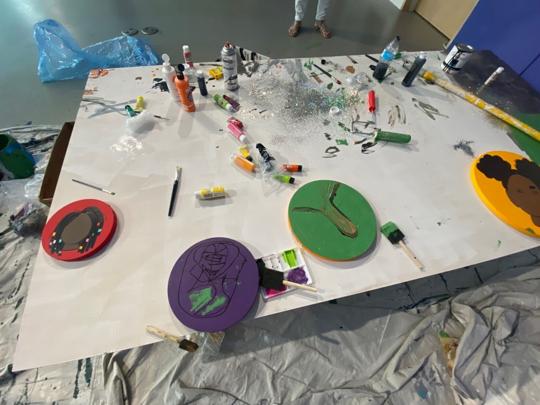
They tried to take their little canvasses home with them, but museum staff noticed them and stopped them. There was some unspecified "escalation" but nobody was arrested.
As of Thursday, however, there was no sign instructing visitors not to touch or interact with the piece.The point of the museum "is to break down barriers for participation in art," said Karin Wolf, the city's arts program administrator. While she stressed she hoped the incident would not create new barriers, Wolf said the museum should only open the area if it has staff to "facilitate" visitors' interactions with the art.
"Artists of color are more likely to be mistaken for not being artists, and to have their work taken less seriously," Wolf said.
"I want to know: How does this change how Madison views MMoCA?" Gee said.
I don't know about Madison, but you can probably guess how I view an art museum that displays skill-free art.
Let's see if I know enough of the lingo: If a political statement identifies as art, why is its purely verbal description privileged over its non-verbal semiotics?
Summary: If you found Albion's Seed valuable (I did), you will probably find this likewise valuable. However, his picture here is much less clear, because it is much more complex. You will very likely find it interesting too, and on that score I say "read it."
He looks at more regions:
Within each region, slaves came from different parts of Africa, depending in part on internal African politics. For example, one Bamana ruler fighting other Bamana clans decided he didn't want to kill his captured fellow-tribemen, so he made slaves of them and sold them as far away as he could. The result was a surge in Bamana slaves. (Most slaves went to the Caribbean or South America; relatively few to the current USA.)
African cultures varied as much or more than European ones did. With written records so scarce, it would be very hard to compare the various cultures as they were circa 1600-1700; Fischer only touches on the obvious ones like the Kru (watermen and fishermen, in great demand as pilots). I think the origin of the Jonkonnu celebration (p445 in the hardcover edition) might be a melding of wassail and the way Poro society boys are supplied: dancing masked spirits with an entourage visit the villages and collect food and other goods for the boys in the Poro bush school.
Sidenote: When US servicemen built an airfield in Liberia during WWII, they apparently had a Santa one Christmas, and Liberians on the other side of the fence devised their own Santa on the local "begging devil" lines. Santa Claus boys come round with a shrouded and masked dancing figure. They play (mostly percussion) and sing and explain Santa's tale of woe and ask for funds to help him get back home.
Louisiana was one of the places where the law and practice differed dramatically. The laws required humane treatment--it was one of the most feared places for slaves. And yet it was also one of the centers of freeman culture, and the freemen and slaves maintained strong connections.
... two African women owned by the Ursilines. Both woment were assaulted by a drunken soldier named Dochenet, and severely wounded with a bayonet. Dochenet had earlier commited crimes against other slaves ... The Ursilines' Reverend Mothers Xavier and Magdalene refused to press charges against him, saying that "they would prefer to lose their negresses rather than do anything against charity toward their fellow men." Louisian's Superior Council was less forgiving, and more protective of the slaves. It ordered Dochenet to be hanged.
Slave drivers were responsible partly for making sure the slaves worked, but also for resolving disputes between slaves. In some places the slave owners were terrified of their slaves, and in a vicious cycle treated them badly enough to make them more dangerous. In others, many masters didn't care what slaves did at night so long as they showed up for work.
But you're probably asking: what were the "Expanded American Ideals?"
I wouldn't have picked that subtitle.
It would be more accurate to say something along the lines of "changed American cultures." In some times and places the slaves and freemen and "half-slaves" (like serfs owing fealty) quickly picked up on how the legal system could work for them, and in many places where they couldn't were still able to pry loose some customary rights. Aspects of different African cultures and technologies came with them and merged with Indian and European ones. In many of the cases he documents, the new culture was pretty much limited to the black slaves, but things like new boat designs spread more widely. Mutual aid groups formed. Individuals earned prominence and respect.
Fischer gives a good sense of how much experience varied across regions. Explaining how it varied with ethnicity is probably too hard to explore in adequate detail (too much information was lost)--but some cohorts of slaves were captured warriors and brought over their attitudes and training.
On the downsides, he is a bit repetitious: in a short section he'll say the society was diverse, give the section's example, and then say it again. He overuses "unimaginable." Somebody told him "black" was supposed to be capitalized these days, and "people of color" loses the distinctions they made between mulattoes and quadroons and octaroons--which was kind of important in Louisiana, although the one-drop rule makes it useful in other regions.
There's lots of history, some to cheer for and some to deplore. Slavery was never unanimously supported: Oglethorpe tried to forbid it in founding Georgia and the Quakers were split but eventually came out in consensus opposition. As slaves became freer or free there was usually an outbreak of intense racism that hadn't been nearly so conspicuous before.
I spent some time following up on some of the footnotes--I've a few more I want to look through still--which is why this is a bit late.
Read it
The article on SpinLaunch--spinup to orbit--referenced Project HARP, which I'd forgotten about. Gerald Bull's idea was to send solid stuff to orbit with a cannon loaded with a rocket. You need the rocket to change the direction of your satellite once you get high enough and maybe get some extra speed as well--otherwise your orbit will intersect the Earth again. It could have worked, though the design would have needed some changes to get different orbit directions. Made of two 16 inch battleship guns, one version sits in Arizona and another in Barbados. They're impressive bits of hardware, though the Barbados one is pretty rusty.
SuperHARP is still active. It uses hydrogen/oxygen for the propellent (with some helium in there too) in a 2-stage push. For the same energy, the hydrogen and helium get higher speeds, which helps getting the maximum speed out of your projectile. They claim greater than Mach 32 for the record so far. "Green Launch estimates the acceleration forces involved will peak at around 30,000 G, and it's got a simple enough test for whether a piece of electronics can withstand that sort of shunt: sticking the component to a golf ball with epoxy and whacking it with a three wood."
SpinLaunch sounds interesting too, though it has its own problems--the jolt the bearing will take when the rocket is released, for example.
I'd bet there's some advantage to launching from a nice tall mountain--less atmosphere to go through.
I gather from my sister's videos that in Liberia they have innovated traffic lanes that are reversible on the fly. Is traffic too heavy? Move into oncoming traffic and claim the lane until something bigger than you are can't get out of your way. All lanes plus any pedestrian areas are available for such use.
It was sad to see what was left of the old house: it hadn't been maintained and a tree fell on it. Most other buildings were bulldozed and not replaced, including half of a duplex--the French NGO that rented the area apparently had more plans than money.
But just living there a few years doesn't give me a claim on anything. They're under no obligation to keep things the same, or even working. There are other priorities than being a museum.
Liz King, the senior program director for education at the Leadership Conference on Civil and Human Rights said: "She thinks the guidance should reflect recent research showing police in schools don’t reduce gun violence but do increase suspensions, expulsion and arrests of students — especially for Black students."
Lying. I hoped that maybe I'd learn something, maybe even something counterintuitive. But no.
In their central concerns I see the Puritans in the same stream as the ascetics and contemplatives of the Middle Ages. They shared both in the concern for discipline and in the concern for prayer which the latter had. True, the Puritans did not espouse celibacy or the cloistered life. However, they stressed sexual purity and, in regard to possessions, they called for frugality. They tried to get people who did not live in monasteries to live with the dedication of monks. Above all, they wanted contemplatives. Richard Baxter’s Saints’ Everlasting Rest is a Puritan treatise on meditation. It has much in common with the exercises taught in the contemplative tradition. Despite the avowedly anti-Catholic sentiment of the Puritans, it sounds much like Ignatius Loyola’s Spiritual Exercises in its use of imagination on scriptures.
I'd bet they'd have been shocked by the comparison.
Back in '74 a cohort of MK's were brought to Richmond for a get-together, survey, and trip to Colonial Williamsburg. One of the things the Board tried to do was make sure the missionaries didn't have to worry about their children, so they were checking up on how we were doing on our return to the States and giving us a little advice on integrating into US culture--all of which I quickly forgot.
The trip to Williamsburg was interesting and fun. I made the acquaintance of a very attractive young woman, and we toured together for the afternoon. No, I didn't see her again after that Saturday afternoon, and I don't remember her name, but "Come Saturday Morning" played in my head that day and for long afterwards.
I'd noticed for years that women could be fascinating, but it hadn't occurred to me until that afternoon that I could be fascinating in return.
It turns out fascination is just the start.
We've good composers--everybody knows John Williams, and there are plenty of others writing in classical styles, but they generally write for movies or play--and probably ads too. Not for concerts. I've not found much recent concert classical music to be memorable, even when it isn't unpleasant.
A review of The War on Music finds the book's thesis inadequate (postwar suppression of music the Nazi's liked and things they disliked), but its critique accurate:About one thing, though, he is absolutely right. He writes with derision about the “trinity” of postwar music: the donor (usually the government), the critic (not infrequently an idiot) and the institution (the university that employs the composer, the orchestra that commissions his music). It’s a nice arrangement, Mr. Mauceri remarks, but it “leaves out something quite significant: the audience.”
Wright has a somewhat polemical attempt to understand why recent efforts in books and movies have often been dull. Painting and sculpture have been famously weird for decades, and "performance art" seems to delight in nonsense and chaos. An old joke says that "Modern art is what we got when painters quit painting women and decided they had a better idea."
Francis Schaeffer suspected that the modern world slowly came unmoored from Christianity, from tradition, and finally from reason, with the disconnect starting with the more rarified disciplines (philosophy) and working its way out through the rest of culture.
It's hard to see how to maintain a connection to tradition and roles when you're hooked on novelty. After a while novelty-hunger corrodes everything else: nothing else matters as much.
Hat tip to Maggie's Farm
So, before we have to head off to music rehersal for the morning service, the father reseats the step and screws a temporary reinforcement in place.
The old carpet on the steps concealed a flaw that the home inspector missed 28 years ago: the free-standing stringer is splayed slightly at the bottom. Lower steps just barely fit in the slots, and are mostly held in place by the nails.
UPDATE: the carpet is held in place with over 55 staples per tread, each 1 1/2 inch long. In order to get the fresh support to be wood-to-wood, the carpet has to come off, and yanking those staples raises blisters.
His adventures and Knivet's are included with editor's comments. Names are not necessarily the same as modern names--for example Sierra Leone is probably not the modern country.
Granted, captives aren't always perfectly accurate witnesses (Knivet claims to have been places he probably wasn't), but I grant witnesses on the scene a bit more credibility than commenters centuries later.
Battell's group are not paladins:
We found a village of negroes, which are sent from San Tome, for the Portugals of San Tome do use, when their slaves be sick or weak, to send them thither to get their strength again. For the islands are very fruitful, and though there be no fresh water, yet they maintain themselves with the wine of the palm-trees. Having refreshed ourselves with the fruit of this island, we burned the village.
Granted, this might have been revenge against the San Tome folk, but then it would seem to miss the mark a bit.
In search of trade, he found himself captive (although a useful one) to the Gagas, when his Portugese captors abandoned him. ("Adventures" is a better description than "Travels".)
The women are very fruitful, but they enjoy none of their children: for as soon as the woman is delivered of her child, it is presently buried quick [alive], so that there is not one child brought up in all this generation. But when they take any town they keep the boys and girls of thirteen or fourteen years of age as their own children. But the men and women they kill and eat. These little boys they train up in the wars, and hang a collar about their necks for a disgrace, which is never taken off till he proveth himself a man, and bring his enemy’s head to the General: and then it is taken off and he is a freeman, and is called Gonso or soldier. This maketh them all desperate, and forward to be free, and counted men: and so they do increase. In all this camp there were but twelve natural Gagas that were their captains, and fourteen or fifteen women. For it is more than fifty years since they came from Serra de Lion, which was their native country. But their camp is sixteen thousand strong, and sometimes more.
Later visitors suggest this may have only been the children born inside the war camp--but maybe customs changed.
He succeeds in escaping, but the Portugese wind up with him again.
Here they made me serve like a drudge, for both day and night I carried some stone and lime to make a fort.It lyeth right under the Line, and standeth in a bottom in the middle of four hills, and about are many fogges [bogs] but not one river. It is the unfirmest country under the sun. Here the Portugals die like chickens. You shall see men in the morning very lusty, and within two hours dead. Others, that if they but wet their legs(*), presently they swell bigger than their middles; others break in the sides with a draught of water. O, if you did know the intolerable heat of the country, you would think yourself better a thousand times dead, than to live there a week. There you shall see poor soldiers lie in troops, gaping like camelians [camels?] for a puff of wind.
Here lived I three months, not as the Portugals did, taking of physick, and every week letting of blood and keeping close in their houses when they had any rain, observing hours, and times to go abroad morning and evening, and never to eat but at such and such times. I was glad when I had got anything at morning, noon, or night; I thank God I did work all day from morning till night; had it been rain or never so great heat, I had always my health as well as I have in England.
Perhaps the Portugals' approach to medicine left somewhat to be desired.
"Of all these friars the Italian Capuchins alone appear to have done good work; ... Many of the other friars seem to have been men whom their superiors in Europe were glad to part with; and the same may be said with reference to the secular clergy."
UPDATE (*): elephantiasis? but that's mosquito-borne. But there are snail-borne diseases, not all classified.
But somebody has to "bend tin", process the food to make it edible, package and move things--where do those people live? Don't tell me robots will do it all, and offshoring just shifts the problem somewhere else and generates a new one--unemployment. Where do the factories go? Where is the space for the children?
Fixing the crime problems are a sine qua non for restoring a city, and fixing the corruption would be an excellent follow-up, but the systemic problems of space (where do you put something when everything is already full?) and inhuman scales need attention too.
It is not enough for a popular monument to be artistic, like a black charcoal sketch; it must be striking; it must in the highest sense of the word be sensational; it must stand for humanity; it must speak for us to the stars; it must declare in the face of all the heavens that when the longest and blackest catalog has been made of all our crimes and follies there are some things of which we men are not ashamed.
If the smell of a little nard can last a couple of days, I suppose the smell from a pound's worth could have lasted 6 days, from Mary's anointing to Passover.
Of course Jesus wasn't announcing salvation, but accomplishing it--with His feet anointed. I wonder who noticed.
