Sunday, May 04, 2014

Samaritan, Mary, and Martha

In Luke 10 the parable of the Good Samaritan and the story of Mary and Martha are separated by at least hours if not days, so they have no natural common context, but they are juxtaposed in the text. So on that relatively flimsy basis:

The priest and Levite were supposed to be serving in the presence of God. Being in the presence of God is what Mary chose--the better part. Serving others, like the Samaritan, is what Martha chose. So can we read these as balancing passages? One emphasizes the superlative value of being with God, and the other the necessity to also serve your neighbor.

On the other hand, the priest and Levite were also supposed to be serving the people as they mediated between God and man, and so their job also partook of Martha's. Too focused on the formalities, they lost sight of the purpose of their service and avoided the man who, if dead, would have made them unclean and prevented their ritual service. Then the passages reinforce each other.

I suppose the question of which is the best reading depends on what are my attitudes to God and to service--am I going overboard one way or another...

Thursday, May 01, 2014

Wearing out

Blood of world's oldest woman hints at limits of life.
Born in 1890, Hendrikje van Andel-Schipper was at one point the oldest woman in the world. She was also remarkable for her health, with crystal-clear cognition until she was close to death, and a blood circulatory system free of disease. When she died in 2005, she bequeathed her body to science, with the full support of her living relatives that any outcomes of scientific analysis – as well as her name – be made public.

One key point from the article: mutations happen all the time, and from the pattern of mutations they determined that “about two-thirds of the white blood cells remaining in her body at death originated from just two stem cells, implying that most or all of the blood stem cells she started life with had already burned out and died.”

Or, of course, that the mutations in the other blood stem cells made them less prolific. Either way that’s kind of gloomy. The pleasant prospect that we may someday develop some amazing drug to spur rejuvenation seems less and less likely.

The article suggests that you might save up stem cells in your youth, and implant them as you age. Suppose that were actually feasible, and could extend your active life out to 150 years or longer. If someone were to seize the cells, they could cut years off your life without raising a hand to you. Would that be a form of mayhem? Premise for SF, anyone?

Banning leggings

I read this week that a high school was banning leggings, and realized that the garments had been becoming a trend. I don't tend to notice fashions particularly well: I can generally tell the difference between winter wear and late spring clothing, but don't press me hard on more details. But now that the subject came up, yes: there were a lot more of those things around than I ever remember before. In some places. Thanks to the complexities of allocating limited space in the Physics Department, I actually spend most of my time downtown near the Capitol. The costumes on display there tend to be a little different from those on campus: white collar, blue collar, sightseers, and homeless guys on the one hand, vs young kids and middle-aged faculty and staff on the other.

So while waiting at the bus stop on campus I did some quick counting, and about 40% (plus or minus about 15%) of the women wore tight leggings. (The next day was substantially colder and more windy; then it was more like 15%.)

I hear that it is necessary to suffer to be beautiful, or at least to get attention. If my undershorts get stuck that far from battery I look around for a place to inconspicuously adjust the uncomfortable situation. Those have to chafe.

Claiming that leggings cover more than other forms of clothing is disingenuous: they reveal the shapes precisely and without any even the visual boundaries that swimsuits give. As part of a series of layers no doubt they help keep one warm, but by themselves? Worn with callipygous intent.

Saturday, April 26, 2014

Dinner and a movie

Isn't technology wonderful? You can combine dinner and a movie, using a tablet and netflix. Be sure to crank the volume up loud enough that people at distant tables can hear every screeching brake.

Facebook

People have posted movies of Liberia as it was 50 years ago and as it is now, and I'm very grateful. I can learn of what relatives are doing and "see" people I haven't seen in ages. There's a lot of good here.

Rather disconcertingly, I have seen pictures from high school and barely recognized friends.

There's a lot to like.

But Facebook magnifies a weakness in us.

Everybody loves to be first. Reporters and scientists make careers of it in their very different ways, but everybody loves the attention and respect you get when you are the bearer of the hot news.

Your friends haven't yet seen the latest cute kitten video, or the oh-so-telling political poster, so you have the thrill of introducing them to these delights. And who can resist the temptation to overthrow conventional wisdom and pass along the news that Easter was named after Astarte, or that father Abraham was named after Abraham Lincoln, or other marvelous semi-factoids? The important thing is not that snopes agrees that it is true, or that the story accurately represents what the evil political party said--the important thing is that it is new and that you got to tell it first.

If you slow down to do fact checking, somebody else might post first, and maybe your conscience might keep you from posting it at all.

Wednesday, April 23, 2014

Noah

I won’t be bothering with the movie Noah. They didn’t succeed in interesting me enough to part with my time and money. Even worse, reports suggest that the movie is something of a turkey.

But it got me wondering what sorts of problems Noah would run into with other people...


”So, have you checked everything?”

The chubby inspector wiped his face and reseated his crow-feather hat. “Yes, I think so. We may want to go back and look at some things later. I need to settle down and draw up my report. You should join me to discuss it.”

”Will that help?”

”Sometimes details can be … um … explained, or negotiated.”

”I’ll be happy to help. What do you need?”

”I need a good smooth table in the shade, some clean water and clean fine rags, and a jug of good wine. And I fancy a silver cup to drink it out of—it helps me see better.”

”The rags will take a little while, and we can borrow a cup, but we’ll have the rest here in a few minutes. We’ll set up by the left ramp base.”

The inspector nodded and headed for the latrines.

Twenty minutes later they stood around a tall wooden table as the inspector spread out his vellum sheets and his brushes.

”Let’s start at the top,” he said. “You have no stanchions along the sides. You cannot tie up to a dock without them.”

”We don’t plan to use the docks. This is longer than any of the city docks—we couldn’t fit there.”

”The stone quarry dock is long enough. You built this to ferry stone for the new palace for King Caleb (may he live forever), but you didn’t think it through. You need to build stanchions in—how else can you tow it?” The inspector rapidly and accurately filled in the outlines of the upper decks as he spoke. There were little frowns drawn above the dotted images of stanchions.

”We got the license to start building this 85 years ago from King Jucline, and Ham has gotten that renewed by every king since. He asked for and got a waiver from King Clileb for upper deck furnishings.”

The inspector turned and spat. “Clileb, may his name be forgotten, was a usurper and a scoundrel, and any waiver he gave is invalid.”

”That’s what his inspector told us about King Cable before him. And Cable’s about the king before him. In fact, I think you were there that time. ... King Calib is certainly living longer than his predecessors.”

”Yes, he is (may he live forever), and since he is celebrating the first anniversary of his eternal reign with a new palace, your ark will do very well for transporting stone—with some deck modifications.” He paused. “Though I admit I don’t know how you plan to get it down to the river.”

”You no doubt reviewed the design plan before you came. This is designed to carry food, animals, and plants. The decks aren’t built to handle large stones. And we expect the river will rise to this level and float us off.”

The inspector looked up at him and pointed at the drawing. “Yes, I saw pictures of the statuary and how you meant to distribute the smaller work around the boat. You didn’t make the decks nearly strong enough—the beams need to be 3 times closer together. That’s not negotiable. And since decks 7 and 8 will be carrying stone slabs they need even more reinforcement. Plus new ramps. I don’t know how you got this approved with only one mid-deck loading port. It would take months to unload even with day and night slave crews.”

”Didn’t Ham explain that this is for live animals, not statues? They aren’t as heavy and they move under their own power. Look—would we need gaps and vertical shafts for ventilation if this was just stone? Or the dung shafts and the bucket chain to drain the sump?”

”No, Ham was waiting for an audience with the undersecretary for the Secretary for the Guardian of the Sublime Portal. And anyway, that sump is obviously for retrieving the lubricating slurry you need to drag the statuary.” He put his brush down and stepped back from the table to face Noah. “I’ve been an inspector for fifteen years and I know how boats work.”

He turned back to the table. “By the way, I really like the style of that cup.”

Tuesday, April 22, 2014

Political insinuation: plus ca change

Senator Prince Y. Johnson, hearing "President Sirleaf saying in an interview that if she were to seek a third term, her preferred candidate would be ex-mayor of Monrovia Madam Mary Broh," responded with "Madam Sirleaf, as an incumbent you should be neutral in election process."

He didn't stop there. After a while he really got warmed up behind his pulpit:

"God knows why I was elected as the most senior government official of Nimba County; the chairman is not the boss; I'm the boss of Nimba and nobody can force or stop it. God said it in his word that he will bless those who bless and curse those who curse so if you are chief fornicator don't fight me and if you are alcoholic don't fight because I am not like you no more and if you are a dumper don't fight me. I am a new born creature - be careful how you tamper with the man of God."

Never mind that he is using Liberian English (and I had to correct typos the reporter inserted). Doesn't that sound familiar? How many accusations can he stuff into one paragraph?

The day before he had other words for the president. He appealed to her to resign:

The source said, Senator Johnson said that due to the age of the president, most decisions being made currently were not taken by her. "The senator said that he thinks the old lady was not in control of most decisions. Old age can have effect on people at times. That is why the honorable decided to get to her."

How kind of him.

We have quite the tradition of insinuation and slander here too, as James Callender shows. I'd not heard of him before tonight, but he'd fit right in today--and probably be better protected than in his own era.

Some things don't change much.

A piano study

"The First Quarter-­Second of the Chopin G-­minor Ballade" by Matt Grayson, a commenter on Dorigo's site. If you're not mathematically inclined, don't let the differential equations scare you off; you can follow what's going on without them.

Spoiler--he's looking at the tones produced by the first couple of notes, and in the process learns about effects from the piano wire structure. Nicely done.

Monday, April 21, 2014

Private armies

I do not know if Cliven Bundy is in the right, though it is trivially obvious that the BLM indulged in horrifying overkill. That this sort of intimidation is what you expect from despots and not from servants of the people is also obvious, and others have dwelt on it at length elsewhere. The country was designed on the assumption that you can’t trust the powers that be to keep within bounds; that they would always try to accumulate greater and greater power. This incident fits that pattern as we watch nearly every agency assemble its own private army.

But why is the administration allowing it? I understand appeal of having your own armed forces to cut through red tape and enforce bureaucratic rules as though infractions were crimes.

But hasn’t it occurred to anybody that these federal armies aren’t going to be coordinated, and that down the road there are going to be conflicts? We have enough trouble trying to get the Army, Navy, and Air Force to fight the same enemy in wartime, and they have the same mission. As the agency leaders become more accustomed to using their private armies, they are going to step on each other’s toes. Who gets to seize the property of people accused of making meth on federal property—the BLM or the DEA?

Whoever gets there first with the biggest group of fighters.

Saturday, April 19, 2014

Repost: Between Good Friday and Easter comes the Sabbath

I don't usually re-post things, but this one struck me again.

On Good Friday we have the sacrifice and the dereliction. On Easter Sunday we have the resurrection and the joy. What's the Saturday in between for?

Imagine if you were there.

It was the Sabbath, when no one was supposed to work (except God, busy maintaining the world). OK, maybe you had to rescue the farm animals stuck in the ditch, or care for the sick, but otherwise everything went on hold. You had to wait to finish the schoolwork, wait to conclude the deal, wait to finish painting, wait to finish the preparations of the body for burial. The disciples had to wait before trying to skedaddle out of town (they could only go a Sabbath-day's journey), though the Sabbath gave them a slight break before the authorities would start hunting for them.

On that Saturday/Sabbath, there was nothing they could do. They probably didn't know what to do anyway, except lie low and wait.

One of the lessons of the Sabbath was "you don't hold up the world." For six days you work and for one day you rest and realize that the results depend on God.

Lots of life is bound up with waiting. A boy wants to be a fireman, but he'll have to wait. A couple want a baby--they'll have to wait. Why can't you learn to walk right away? Travel takes time. Growing takes time. Ripening takes time. Wisdom takes time. Even drying clothes takes time.

And God makes us wait in other ways. We read of many prophets, but there seem to have been spans of time with no prophet--especially the four hundred years before Jesus. "You have enough for now, follow what you know and wait." How long have we been waiting for Jesus' return? And, I suppose, how long has God been waiting for us to finish reaching the world?

Plant the crops and wait for rain. Mend the fishing nets and wait for the rain to stop.

Newlyweds find a monthly interruption to nuptial delights--and it lasts a week, too. Why? I don't know: Waiting again.

Someone said that 90% of life was showing up. That's kind of a primitive way of looking at it, but a lot of life is spent being there and being ready and waiting. And I guess God wants it that way. How to faithfully occupy our time while waiting is a matter for another meditation.

But for this Saturday/Sabbath, we wait, as they waited; for Easter isn't about what we can do.

Wednesday, April 16, 2014

Platonic?

I'm a little puzzled. There are ancient Platonist threads in Christianity, in which the physical, though created good, must be left behind as the soul reaches for God. The idea comes across to me as almost gnostic.

We were created, and therefore have a nature and form. Perhaps that form, like a caterpillar's can change to something else, but that in turn will also be a form.

To be united with God, therefore, happens through a particular form.

That does not have to limit the depth of the union: consider Jesus as the ultimate example. He had the form and nature of a man, but was also fully God.

So there's no intrinsic reason why divinization demands that we abandon our physical bodies. Some austerities may be required along the way (and in this fallen world almost always are), but they are only a secondary means. That we cannot know God as He knows Himself ought to be obvious, though we doubtlessly need regular reminders.

That all seems pretty straightforward. But quite a few Christians through the centuries hold pretty much the opposite.

What am I missing?

UPDATE: If the process of union were our operation instead of God's I could see a reason for the focus. But since divinization is God's doing, we should expect the miraculous and look to the examples we know: Jesus.

Microcracks to prevent cracking?

With a hat tip to the CERN Courier, look at a story about making glass less brittle by micro-grooving the glass and filling in the grooves.
Here we report the implementation of these features into glass, using a laser engraving technique. Three-dimensional arrays of laser-generated microcracks can deflect and guide larger incoming cracks, following the concept of ‘stamp holes’. Jigsaw-like interfaces, infiltrated with polyurethane, furthermore channel cracks into interlocking configurations and pullout mechanisms, significantly enhancing energy dissipation and toughness. Compared with standard glass, which has no microstructure and is brittle, our bio-inspired glass displays built-in mechanisms that make it more deformable and 200 times tougher. This bio-inspired approach, based on carefully architectured interfaces, provides a new pathway to toughening glasses, ceramics or other hard and brittle materials.

Unfortunately the site wants fees (unless your university has already paid up), but the pictures and the abstract should give the gist of it. It can surely be scaled up to small objects, though I don't know about windshields. Cool.

Tuesday, April 15, 2014

Uniforms

When I first put this uniform on,
I said, as I looked in the glass,
"It's one to a million
That any civilian
My figure and form will surpass.
Gold lace has a charm for the fair,
And I've plenty of that, and to spare,
While a lover's professions,
When uttered in Hessians,
Are eloquent everywhere!"
A fact that I counted upon,
When I first put this uniform on!

I said, when I first put it on,
"It is plain to the veriest dunce
That every beauty
Will feel it her duty
To yield to its glamour at once.
They will see that I'm freely gold-laced
In a uniform handsome and chaste" -
But the peripatetics
Of long-haired aesthetics,
Are very much more to their taste -
Which I never counted upon
When I first put this uniform on!
William Schwenck Gilbert

I don't clearly understand what my better half sees in me; though I'm profoundly grateful that she does find something attractive. So perhaps it doesn't make a lot of sense for me to spend any effort trying to figure out why women seem attracted to men in uniform. But

Gilbert emphasises the flashy aspect of the uniform, and I've heard others say it is the "safe bad boy"--somebody dangerous but disciplined; strong for you and strong for your children and likelier to have strong children with. The latter seems a trifle reductionist, but it probably plays a role.

BTW, I'm talking about the ideal of the soldier, not the real one the woman gets to know later. We can all find plenty of exceptions--or at least those of us who actually know policemen or soldiers can.

Another aspect occured to me yesterday. A soldier or policeman takes on an open-ended commitment. So does a parent or a spouse. (So also, whether they want to know it or not, does someone who becomes a Christian.) The ideal soldier is someone who is capable of commitment--a creature a little scarcer on the ground that he used to be. I'd think that would appeal to both sexes, but the effect in men is probably swamped by other preferences. Someone who has the sense of adventure and trustworthiness for the long haul is a good catch.

Monday, April 14, 2014

When the big one goes off

--which it will, eventually, somewhere--what should you do?

Back when I was in 6'th grade the school library had The Effects of Nuclear Weapons on the shelf and a couple of us read it. I know that doesn't match the current reading level rules, but we were too ignorant to know that the best authorities are sure we couldn't possibly have understand it, so we studied it anyway. If it had been part of the curriculum that might have been another story... It was fascinating reading. Nobody we knew had fallout shelters--nobody was going to bother nuking Liberia, and it wasn't in fashion back in the States.

People are still thinking about these things--more so as more and more countries decline to trust their erstwhile allies. (There's been a rumor for decades that Japan has all-but-final-assembly parts in hand, and if I were running Japan I'd have looked at Obama and completed the assembly.) Some are going to come loose, and some will be deniably shared with loyal partners.

So, what should you do?

Homeland Security thought about the most likely target (DC) and most likely weapon (small), and came up with some common sense suggestions. (Livermore helped) Don't run; hide for a day until the fallout dies away. The blast damage from a small bomb isn't gigantic. If you survive that OK, and your house doesn't catch fire, the biggest threat is the fallout--most of which decays to harmlessness in a few days. One day is what they suggest. One hour minimum sheltering where you are, and then getting into a place with thicker walls if it is really close by.

A car breathes (or else you'd suffocate on a long trip), so it will suck radioactive dust into the cab as you drive to escape. Plus, the car walls are kind of thin, and don't offer as much shielding as you'd like. And sitting in the worst traffic jam in DC history while radioactive rain goes pitter-pat on the windshield is probably not good for your blood pressure.

I'm not used to reading radiation safety discussions with doses this high--if your dosimeter shows 10mrad exposure people start asking questions about where you were and what you were doing. 10rad...

FWIW, chemical weapon defense is not too dissimilar. Hunker down someplace sheltered while things dissipate and don't run.

Saturday, April 12, 2014

San Francisco protests

You've read of the protests against Google buses and of the tipping of smart cars. Assume the second is related to the first, though maybe vandals just noticed how easy it was to do and the idea caught on.

At first blush it looks like an ugly case of envy and an unwarranted sense of entitlement.

At second blush, it still does.

But set aside the nonsense. I think they have reason to be angry. What is there for people who aren't that bright to do? We honor work that makes someone rich, work that makes someone famous, work that makes someone powerful. But when was the last time you heard of a business section feature highlighting a freelance handyman? We boast of automating away any work that isn't intellectual (and even some of that). Sci-fi has dreamed for years of humanity evolving into pure minds--those who aren't so bright weren't on the horizon at all. Brave New World is one obvious exception.

So if many of the simple jobs are automated, and cheap foreign labor is imported to do most of the rest, what kind of work is left? We're made to work and serve, and bread and lolcat circuses don't satisfy. Google isn't a villain for treating its employees well, nor is it to blame for what we as a culture have decided to do. The prejudice against manual labor is decades older than google. We've systematically reduced opportunities for whole classes of people. I don't think it was deliberate, mostly.

If that's the real problem, what's the real solution--or better, an improvement, there being no perfect solutions?

I know, I know--it takes a little chutzpah to think I might know their problems better than they do, and disregard what they actually say. I don't like it much when people explain to me how my consciousness hasn't been adequately raised to make me fully understand and bewail my "white privilege." Sauce for the goose is sauce for the gander--see how they like it.

Wednesday, April 09, 2014

Through the Looking Glass

I interpret the stories about Al Sharpton a little differently from the way his fan base does. If it is true that he worked as an FBI informant against the mob, I say that even a race-baiting demagogic extortionist can show courage and a love of justice. His fans say that the great leader would never stoop to such a discreditable practice as fighting crime alongside the FBI.

We may live in the same planet, but I'm not sure we live in the same universe.

Monday, April 07, 2014

Bits from non mainstream news

In an article explaining how the Liberian embassy's bank is closing their account, this bit:
The closure of the account has arisen fears among diplomats at Liberia's mission in the U.S. with some wondering how the decision would affect their salaries, rent for the office, phone, gas and heat bills and other related expenses. Employees are paid every three month period: January-February-March payment have reportedly been made already with the next scheduled payment set for April-May-June, a source told FPA.

That kind of payment schedule seems calculated to maximize uncertainty and hedging via under-the-table deals.


Ebola made an appearance in Liberia. This outbreak came from Guinea, not from a local reservoir, but some government officials are trying to be extra safe--and running into push-back.

Monkey, one of the animals listed as a carrier of Ebola is a favorite bush meat for many Liberians, an aged old food and convincing people to stay away from a food they have been consuming for years is proving difficult.

As quoted later (dry meat is, if I recall correctly, smoked bush meat; in this case monkey):

"They said the sickness came from Guinea and people in Guinea do not eat dry meat so they just trying to spoil our business," said Ma Tenneh.

"During the war, they were eating human beings, that one na make them sick, that now they say that meat making people sick. They are spoiling our business and it is our living. The people who are eating dog meat, what they will say about them? They are just complaining about dry meat, people eating itchy dog, it is not killing them.They know how far the sickness coming from before they lying on meat."

The language may be unfamiliar, but the sentiment is very familiar: the bureaucrats in charge don't have a clue. ("lying on" = telling lies about)

In Guinea where the outbreak began this would be a reasonable precaution, but the Liberian cases were different:

Noting that the result has shown that the virus exist in the country, Dr. Gwenegale further said the two results indicated a lady has died from the virus in Foya Lofa County while her sister taking care of her was infected.

He explained that the infected sister who contracted the virus had ridden a taxi late Sunday evening, and slept in the home of the taxi driver who is thought to be suspected of catching the virus.

That suggests a possibly more effective angle for control. FWIW, private cars are not common and taxis are not terribly expensive, so this infected driver doesn't just expose the rich.

Is it my imagination

Or does the Fleur-de-lis look like the end of a pike? Maybe I've an overactive imagination, or maybe the symbols were overloaded. Why couldn't it be a flower and a threat at the same time?


Friday, April 04, 2014

Crud. Too late

I postponed making a phaser pointer too long. This one is ridiculously small, though. (The price of models was off-putting: that's my excuse and I'm sticking to it.)

Wednesday, April 02, 2014

A few exercises...

Tall and tan and young and lovely,
The girl who looks so Swedish goes jogging,
And as she passes each one she passes goes "Ow"
Oh, but her knees knock so badly.
How can I tell her of biomechanics?
Yes, I would give advice glady.
But I thought it would be impertinent. And when she finally stopped to walk, and her walking stride also had the same feature, I was glad I hadn't made any suggestions...

Tuesday, April 01, 2014

Grail hunters

The two researchers, Margarita Torres and Jose Manuel Ortega del Rio, authors of the book, "Kings of the Grail," believe they found conclusive evidence from ancient Egyptian scrolls documenting that Muslims stole the infamous cup from Jerusalem and took it to Egypt. They say it was then disguised with jewels and eventually given to Spanish King Ferdinand I as a gift.

How do I doubt thee? Let me count the ways...

The story came out yesterday, so I'll give it the benefit of the doubt.

Reporters are apt to get details wrong, and also (for example) not notice that the researchers are promoting a book. They are often very trusting souls. But I'm kind of surprised the editor didn't notice that ancient Egyptian scrolls are unlikely to describe Muslim activities. I think the (much later) Muslims of the area would have been more likely to write on codices, but maybe I'm wrong. Still, disguising the cup with jewels, and then giving it to the infidels they'd be hiding it from? And most unlikely of all: a gold cup? In the hand of a carpenter in a group of fishermen (and a retired tax collector), after Judas griped about wasting money on frivolity?

And for those for whom it is significant, can even the original be more important than the cup we receive?

Saturday, March 29, 2014

The flip side of exotic

I wrote of the enjoyment of the exotic, and how stretching the imagination can enrich the knowledge of what we have.

But, as with the story of the animals choosing a king, knowledge is not the only possible measure of goodness. Novelty is a great thing, but not the only thing. My Better Half always knows what I'll answer to her question “What do you want for your birthday dinner?”

One of my flaws is a tendency to start new projects before I'm done with the old. One of the Benedictine vows is to “stability.” That can be a more sweeping rule than not just staying in one place and not being a gyrovague. For us it can be turning the compost into the garden year after year after year. Finishing the project. Being reliable.

Novelty can undermine stability. A culture is expressed in explicit rules and artifacts, and in unwritten values and courtesies. How long does your eye rest on someone before it becomes a signal? The MidWest does not agree with New York or with Dakar.

Mix everybody together--hooray for diversity and new ways of looking at things (and cool ethnic restaurants). Now, how do you signal someone that you want him to find a convenient moment to break off what he's doing and speak to you? Spell it out with new jargon? “Please grant me a class B3 interruption to your work.” What constitutes flirting? How can you communicate that you are in a great hurry?

At times like that diversity is obviously a burden. But I gather that it gets even worse. Can you fully trust someone whose values are different and with whom you have no shared history to give meaning to the nuances of language? Saladin and Richard shared martial values and could deal with each other on that basis, but neither would have successfully lived in a city ruled by the other.

Perhaps it is a blind spot in the articulate, that they sometimes think everything is defined in words or rules. But not everything is easily expressible; a constellation of little things can be huge. A man does not want his national home destroyed or even changed, because he can not even remember all the good things that go with it; just as he does not want his house burnt down because he can hardly count all the things he would miss.

And I haven't even gotten to some of the conflicts you get when introspective cultures meet unashamedly assertive ones.

The more diverse a society is, the more is going to have to be spelled out in detail--up to a point at which nobody can possibly know the rules. Beyond that, I suppose you have to have some kind of millet system, which isn't exactly the individual freedom ideal.

Advantage to not being famous

I have trouble remembering names. When people greet me on the street, I like to be able to remember who they are in time to reply. If everybody thought they knew me...

Thursday, March 27, 2014

Problems in re-designing college

AVI posted a question: “I wonder what we would design for post-HS education these days if we were starting from scratch?"

This is a subset of a bigger question: how do we want to educate people?

There are some traps to trying to answer that one. When the animals wanted to appoint a king, the eagle said the criterion should be how high one can fly, the lion how loud one could roar, and so on—all with quite plausible explanations of the utility of the skill.

I thought back on our home school plans, and though I still think the outline was good, it wouldn’t fit everybody—in fact it didn’t.

For example, advertising and propaganda are so pervasive and skillful that I considered some lessons in persuasion techniques and elementary statistics (and the deceitful “average”) essential. The problem is that you need some analytical skill to parse out the tricks. Not a lot, but more than some people have. It is easier to use the rule of thumb that "all advertisers lie and all politicians lie and most newspapers lie about politics and social issues and whatever their advertisers don't like."

And not everybody is going to agree on the contents. Back in the day European nobility learned dancing, reading, some arithmetic, and fighting: Lots of practice with the fighting. They needed it. We’re lucky enough at this moment not to need quite so much fighting skill, but I’m not fool enough to think good luck lasts forever. Maybe other things are more immediately useful than my list.

We tried to make sure everybody knew some elementary carpentry, could repair their clothes (maybe even make them), accompany themselves on the piano, cook for themselves, drive, write a coherent paper, swim, factor a polynomial, know countries and geography, know the rudiments of another language… and a few other things as well. To my regret there was no ground swell of enthusiasm for differential calculus and marksmanship didn’t make the cut.

I like the idea of preparing people to teach themselves—or having readily available facilities ( Khan academy, book clubs, Sunday School, etc) for people to learn alone or in groups. (Some things you learn better in groups—discussion is critical.)

And I like the idea of breadth—getting a taste of a lot of different things. Who except lawyers, for example, graduates from college with any clue about the reasons behind property law, or who understands more than the vaguest outline of medicine? First aid, sure, but I’m not sure about any depth. And I wish philosophy were introduced earlier.

But at a minimum (to return to AVI’s question) the university should appreciate the differences in the nature of mastery of different subjects. A lot of courses of study don’t square off nicely in 4 year chunks.

Sunday, March 23, 2014

Why re-reading

As I get older I find I finish fewer books.

Most writers I read once only. A lot of them fall into the "OK, got it" category. I understand the picture they were trying to draw, and that's that.

For other books my taste has changed. For instance, some years ago some of Cabell's books were reprinted, and for some reason they caught my fancy. He was a good wordsmith and had a pleasantly ironic style, and I went through about half of his output (university library). At some point it became a little repetitious, and I moved on. When years later I picked up one of the copies I'd actually bought, I found the style unpleasant--the irony covered a despairing core; a chocolate coating on a stale crouton. (It didn't help that I was happily married and now had a completely different idea of romance.)

But other writers I return to: in fantasy Lewis the lucid dreamer, Tolkien the rich dreamer, and Williams the dreamer of the unsee-able. Bradbury dreamed bubbles that held little worlds, Zelazny had mythic dreams, Wolfe hidden dreams within dreams; Simak's blended the alien and the grounded, and Niven... OK, I'm not sure why. At his best he uses rigorous logic to draw the fantastic stories, but so do others, and he wrote best in company with Pournelle or Gerrold. Maybe its the consistency of the alien environment--like van Gulik or Hillerman describing their alien societies.

Or maybe I just have a taste for books that look at the world with alien eyes: alien but not wrong. Achebe's look at the world from a different framework I keep, but I quickly weary of stuff that is obviously simpleminded or stupid. Berkeley of the Midwest is liberally supplied with socialist and "transgressive" art, but at the other end of the spectrum Ayn Rand is just as hard to stomach. These aren't "different viewpoints" on the world; at best they're just tiny slivers: so tiny that they're wrong. I used to read the Isthmus, but after a few years it was too trivial to predict what they'd say.

I like using different questions to partition a situation. There aren't always answers, but sometimes they shed a little light on the corners of what we mean, and make the problems more three-dimensional.

And some books describe the worlds these questions come from so well that they seem to have fresh applications each time. It helps a lot if they're fun to read.

Exotics

When I'm traveling my priorities change(*), and when lunching with colleagues I defer to majority tastes, but when going out to eat from home I prefer to eat something we don't make at home. Since our Youngest Daughter is in a culinary arts program, the latter category is getting smaller. That points me towards different cuisines--most recently Peruvian fusion and Korean. Bibimbap is a good comfort food. (When I first went into a Korean restaurant I decided to go as outre as possible, and the description "rice salad" seemed weird enough. I've liked it ever since.)

My reasons are mixed. There's a bit of "Why waste $$$ on something we can do ourselves?", a little "It isn't as good as yours" (or the dread "Can you get their recipe?"), and some of "If we're going to live differently tonight, let's go whole hog."

I don't know whether the tendency is world-wide, but we in the USA (me too) have a something of a fascination for the exotic. IIRC the French had it before us, and I gather so did the Romans before them. I can't tell about Liberians, for example, because the Western culture is omnipresent whether they like it or not. In Senegal the traditional wrestlers are heavily into oriental martial arts now, but it seems to be because they are more effective rather than because of any sort of fashion for the exotic.

I have to try to take this fascination with the exotic into account in other ways too. I've evangelical/baptist background, but when camping some months back where the only churches with convenient services were Methodist and Catholic, my first and ultimate preference was for the Catholic rather than the presumably more congenial Methodist. Part of that bias was because of the studies I've been doing in church history, but it didn't occur to me until later that I'd never actually researched Methodism as it is practiced.


(*) Food: rapidly, inexpensively, tasting OK, that I won't need Cipro afterwards for. Eating you can do anywhere. Dining you need friends for.

Phelps

I was curious about Fred Phelps career. I never ran into the man or his cronies, and so all I knew is what I read in the papers: and all sides agreed that the "church" was a nasty group of people, with strong intimations that they used lawsuits to support themselves.

So google around. The Topeka Capital Journal put together a series on his life. It is quite a bit more in depth than the Wikipedia article, but Wikipedia separately flags his civil rights history, which is hard to find in the Journal collection. Interesting. Did he change his attitude to blacks later? The Journal suggests yes, but it isn't perfectly obvious. Both collections touch on Gage Park, but there's no followup, though I recall reading several years ago that the city actually did clean up the park.

I set aside claims that he beat his children with a mattock--others deny it and I'd expect serious damage from such an instrument. But even without those claims, he obviously turned extremely nasty very early on, as witness his suit against Brady.

Years ago I predicted that his "church" would eventually break up over who got the money. I wonder why he was "excommunicated:" whether he had complaints about finances in the "church" or maybe started to have second thoughts about whether all outsiders were damned.

He plainly wanted to be defined by his opposition to homosexuality, so I don't think he can complain too much that his early civil rights work is ignored in favor of the hatred his later years.

Relativity

It was 13 this morning, and people complained about the cold spring. But I remember quite distinctly, less than two months ago, saying to Youngest Son "It is warm. It's 14. Go shovel the driveway."

Wednesday, March 19, 2014

Dust bunnies

When you blow out a candle, the air moves fastest and strongest close to your mouth, but farther away the puff fans out and, because it is pushing a bigger volume of air, weakens and dissipates. So you have no problem extinguishing a candle from a foot away, but across the table the flame hardly flickers.

I am informed that most household dust is not tracked in (though the front hallway testifies to the contrary), but is made of dead skin cells that flake off and dry out and are carried by the breeze, or the detritus left by the mites that eat the cells. They are small enough that some are able to sift through the weave of the fabric in the sheets and mattress fabric, and collect under the bed. Since we spend about a third of our time in bed, I'd expect that under the bed would be the most concentrated collection of dust--but it seems not to be so. Perhaps because we don't move so much, and don't rub off so much dead skin when snoring as when walking about. Or perhaps a lot of dead cells accumulate, stuck by residual oils to the mattress stuffing. Pillows get heavier with age, perhaps mattresses do too.

What seems completely unintuitive is the accumulation under dressers. Things can't fall through the wood. Probably dust, once it hits a collection, tends to stick. Then as the airborne dust whirls through the air some puff of breeze from passing feet will push it under the dresser. Of course the air pushed in will have to push other air out, but thanks to the dissipation I mentioned in the first paragraph, that will be weaker. Once under there, dust is more likely to fall undisturbed and clump.

Which seems a plausible reason for why the dust bunnies look like Harvey.

On the other hand Dave Barry claimed that men are biologically incapable of seeing dirt until it accumulates in quantities sufficient to sustain agriculture.

Pick your reason.

Economic predictions

"Come," they say, "let us get wine, and let us drink heavily of strong drink; And tomorrow will be like today, only more so."

Tuesday, March 18, 2014

BICEP2

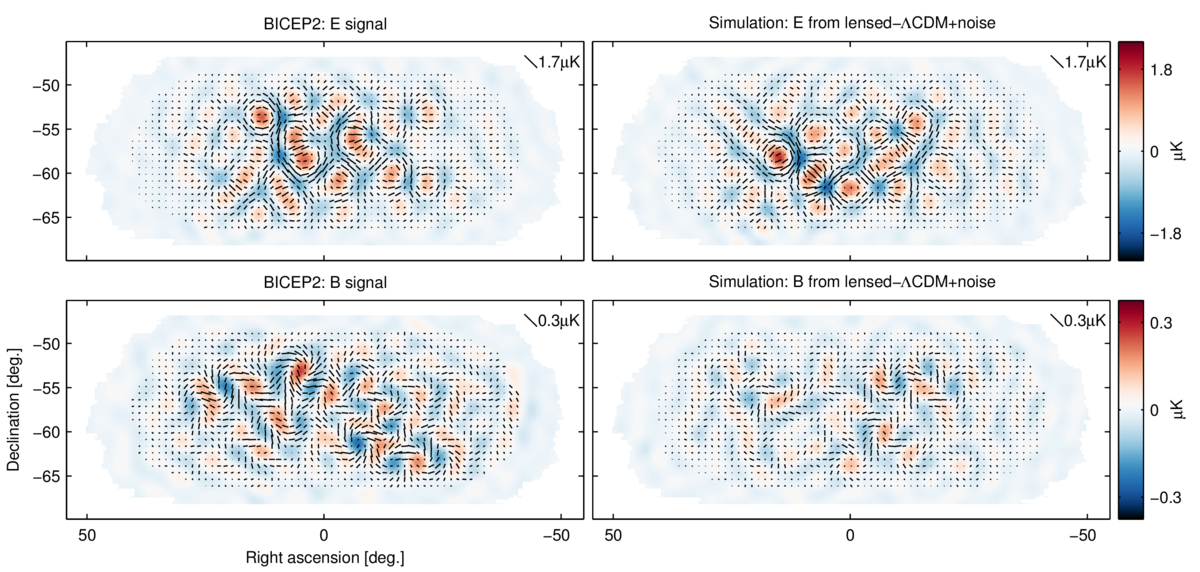
I am trying to understand the details myself. If you want hairy details, look here, here (Lubos has a guest poster), or here or here for a little more on how reliable it looks. Or have a crack at the paper yourself--I haven't finished it yet.

The coolest of the pictures show what look like twists. That's what they are. Light, being oscillating electric and magnetic fields, has a direction for the electric field and another for the magnetic field. Most of the time the directions in a collection of light are random, but you can get polarized light from particular sources, or by blocking out the polarization you don't want, and some more exotic ways.

The twists in those pictures...

You remember waves in the sea, and up and down waves on a slinky, and pressure waves along the slinky. In physics class you may have been introduced to "twisting waves" in a rod--you can't quite get those to propagate along the slinky--and not in the ocean or the air at all.

But gravity waves are different, and they can be "twisty" Please follow that link for the picture to see what a twisty wave can look like.. If, as looks more and more likely, the universe grew from a big bang, even relatively small fluctuations early on should leave some kind of imprint. Unless they've made some mistakes, they're looking at the impress of gravity waves on the universe very early on. (The pictures represent a small section of the sky.)

If this pans out, it is probably Nobel material.

Saturday, March 15, 2014

To be fair

The old line goes "Those who can, do; those who can't, teach; those who can neither do nor teach become critics." Which isn't fair to some of the excellent teachers I've known, but it's the critic aspect I need to reflect on.

I've tried from time to time to to walk back some science headlines and see what the story was, and try to explain the results (I hope) more clearly or accurately. I try to add a little value by pointing out some of the bigger picture, or some of the caveats.

Sometimes this is an hour's work--with more complicated ones it can be a little more.

Easy.

Much easier than writing the paper in the first place. I'm trying to put together a simple limit on dark matter cross sections during my copious free time. Background research alone has been over 20 hours. The back of the envelope calculation that inspired it only required an hour to get the preliminary info and code an estimate, but doing it right will take a good deal longer. And then I have to run it by somebody to see if I did anything dumb. I'll be lucky to have it see the light of day by June. And I'm just piggybacking on public data, not running my own experiment.

There are several orders of magnitude of difference between the effort of doing research and the effort of blogging about it.

Multiple meanings

The ad headline announced "Eye-catching frames" beside a picture of an eye-catching woman wearing glasses. Since earlier I had been fumbling one-handed to put on sunglasses while driving, with memorable effect, I read the headline a little differently than intended.

Thursday, March 13, 2014

High voltage power lines

The BBC reports that a team of researchers says that high voltage power lines produce UV flashes which most animals can see, and surmise that this can discourage animals from coming near the lines.
"It has always been assumed that power lines - masts and the cables strung between them - were passive structures standing immobile in the terrain, and therefore inoffensive for animals," said Dr Tyler.

"As a result of this work, we now consider them as chains of flashing light stretching across the tundra in the winter darkness, and that's why the animals find them so offensive."

The random and unpredictable nature of these flashes were particularly problematic, he added, as the animals could not easily adapt to them.

Apparently reindeer avoid the structures: "The animals keep as much as 5km (3 miles) from either side of the cables."

Do they avoid them in the daytime too? Corona flashes can be startling at night, but we generally had to turn out the lights and get dark-adjusted when trying to figure out where the discharge was. (Grad students peering in the dark close to a frame covered in 6000V wires, looking for slowing spots--what could go wrong?)

Also, 3 miles is quite some distance.

I'd have looked at noise. Corona often makes noise. And the noise rate from a semi-infinite wire won't change much with distance, until you get far enough away that the terrain starts to randomly block the sound: it will always be buzzing at you.

If the terrain starts to significantly block either sound or light when the visual angle to the top of the tower is about 1degree, and the towers are 30m high (pulling all numbers out of the air), I'd expect the critters to hover somewhere around 1.7km away to avoid the racket or the glow. So the buffer distance isn't crazy.

I didn't realize that so many mammals could see UV. I wonder what windows look like: partly transparent, partly reflective? What other little things glow that we don't notice?

Tuesday, March 11, 2014

Dark matter headline

New Analyses May Imply the Existence of a Dark Matter Particle. Reading further:
At a recent UCLA symposium attended by 190 scientists from around the world, physicists presented several analyses that participants interpreted to imply the existence of a dark matter particle.

The likely mass would be approximately 30 billion electron-volts, said the symposium’s organizer, David Cline, a professor of physics in the UCLA College of Letters and Science and one of the world’s experts on dark matter.

The physicists at the February 26–28 event were in agreement that “there seems to be an excess in the available data that could be due to dark matter,” Cline said.

"Source: UCLA Newsroom"

The conference proceedings are at this link, and are available to the public. Peruse freely. There are two semi-positive findings: Fermi and superCDMS. Fermi sees a narrow signal in the galactic center (too narrow, actually) where you expect a lot of dark matter to wind up, that has been decreasing with greater statistics. Worse yet, they see the same signal around the relatively small and lightweight Earth, which is a little like saying you see dark matter in your coffee cup. The other experiment sees a small excess of events--not enough to claim a discovery--and most of the excess is in a detector with a grounding flaw.

Where does this "in agreement" come from? Maybe from the people that try to do big bang evolution with different particle models; I'm pretty sure it isn't from the experimentalists.

The headline rang wrong immediately, but when I read the article I understood where it came from. I used to work for Prof. Cline. He is excellent at spreading ideas around from group to group, and quicker than I to pick things up, but he had a habit of jumping the gun. This is a better description of the dark matter playing field right now.

Monday, March 10, 2014

With only a few data points

When you don't know the whole story, and only get a snippet here and there, how do you know what's really going on? The reporting might be biased, in which case you've got a big problem, but even when it isn't...

Take this case:

Thousands of Liberians in support of the Central Bank of Liberia (CBL) on Thursday, March 6, 2014 stormed the Capitol Building to present a petition, calling on members of the 53rd Legislature to reconsider their decision taken to amend the 1999 act that created the CBL.

And what is the amendment that has them so worked up? It says that the bank officials can't stand for office. Does that seem likely to inspire this rhetoric?

The pro-CBL protesters were seen in a jubilant mood before the main entrance of the Capitol Building chanting slogans like: "That Modern Slavery, It Will Not Hold! You Are In Error! Ellen Don't Sign It! Don't Target One Person! Stop The Evil!" amongst others.

They were also seen holding placards with the inscriptions: "The Anti-CBL Bill Is Evil! We Love Dr. J. Mills Jones; Do Not Harm Him! Lawmakers Do Not Strangulate The CBL! Liberians Say No To Satanic Law! We Don't Support So-Called Bill! We Say No To The 4G Amended Bill!"

Jones has been on the job for about 8 years now, and recently stirred up quite a bit of grief when he sold off a large chunk of Liberia's US dollar reserve. This sparked a little inflation, though it wasn't clear he had much choice.

I couldn't find any hint he'd been affiliated with any of the warlords, and since he has apparently been doing a fairly decent job I doubt that he was warlord or warlord crony material. I couldn't find anything suggesting that he was starting a political party of his own, though I could very easily have missed that. If he was, that would explain the law and the support group.

Who was in the support group?

The pro-CBL supporters, who included marketers, elderly women and men, university students, and youths, amongst others, came from across Monrovia and other parts of the country.

"Youths" stand around aimlessly all around Monrovia--there are more youths than opportunities. Hiring a few hundred to do a couple of hours of chanting wouldn't be hard. And while some of the university students are hard working, it wouldn't be impossible to locate a substantial number of layabouts among their ranks.

But then again maybe Sirleaf et al are afraid of Jones. Ellen Sirleaf has done a lot for Liberia, finagling billions in debt relief, but I wouldn't put my finger in the fire to swear that she and hers have always stood up to the temptations of corruption.

If I was living in Liberia I'd be hearing a lot more of the details, but I suspect that most of them would be lies and smoke. It used to be a grand place for conspiracy theories--probably still is. It wouldn't be surprising; people have to make sense of things somehow.

Here also. I find that my first reaction when the Feds release economic statistics is "What are you leaving out?" More and more when there's some new kind of "green" initiative or education program I automatically try to figure out who is getting the goodies. That's not a nice way to think, and it is only a step or two from conspiracy-land. There have been pockets of corruption all along, but I think they're spreading.

Soothing poison?

Researchers admit they have no idea why one component of mamba venom should include a powerful painkiller. It isn't quite ready yet: "He cautioned that the mambalgins worked by injections into the spine so would need "significant development" before they could be used in people." They speculate that maybe this chemical acts differently in different families of creatures, or that maybe it keeps the animal from struggling too much. Very odd.

I remember stepping on something soft, looking down, and seeing a mamba coiled beneath my shoe. My subsequent speed might have satisfied my PE teacher for once... Yelling "snake" is a good way to assemble a collection of adults with sticks and shovels. It didn't occur to us to see if the creature was useful for anything.

Standards of beauty

The latest Sports Illustrated swimsuit edition is all over the newsstands, this time with three young ladies not dressed for any beach I've ever been to. But set aside fantasy for the moment.

Either my eyes are failing me or the three look startlingly similar. If they appeared only one at a time it wouldn't be so obvious, but together it seems as though they were picked as being the closest approximations to a single ideal standard of beauty, uniform from cheeks to cheeks. I recall pictures of a group of Rockettes who didn't seem as much alike as these three, and I'd have thought uniformity would have been a goal for that chorus line.

The last time I checked there was more than one way for a woman to look gorgeous. One wordsmith called the women Hefner surrounds himself with as "identi-kit playmates." Every flower has to look like a daisy... It seems a bit sad.

Since too-close inspection is unwise, I omit links.

Friday, March 07, 2014

Team sports

All the world plays soccer today.

But I couldn't think of very many places that originated their own team sports. So I went googling about. Yikes: the things I didn't know were legion.

Some we all know: In North America/Mexico they had lacrosse and its variants ("each team consisted of about 100 to 1,000 men on a field that stretched from about 500 meters to 3 kilometers long") and ulama. In Persia a cavalry training exercise seems to have developed into polo.

Now I got into new territory. I gather that the Greeks and Romans had something I'd not heard of before, episkyros/harpastum; though I don't see any signs that these survived past the collapse of Western Rome.

Mongolia has beikou, Malaysia has sepak takraw, France has a game dating to Rome and France, Spain, Netherlands and Italy has games of the handball/racquetball games. Russia has bandy/Russian hockey

But baseball/rounders, cricket, soccer, rugby, American football, Australian football, basketball, hurling, modern volleyball, modern hockey (though there are very ancient precedents) and so on seem to come from the sports-mad British Isles and their descendents. Even more new team sports were invented last century (Switzerland, Sweden, and so on).

(I'm not going to include the battledore, because it seems not to be exactly a team effort, though it was widely popular from antiquity. South Africa has a booklet of traditional games, including board games, stick fighting, etc: but I can't tell if the dibeke is old or new.)

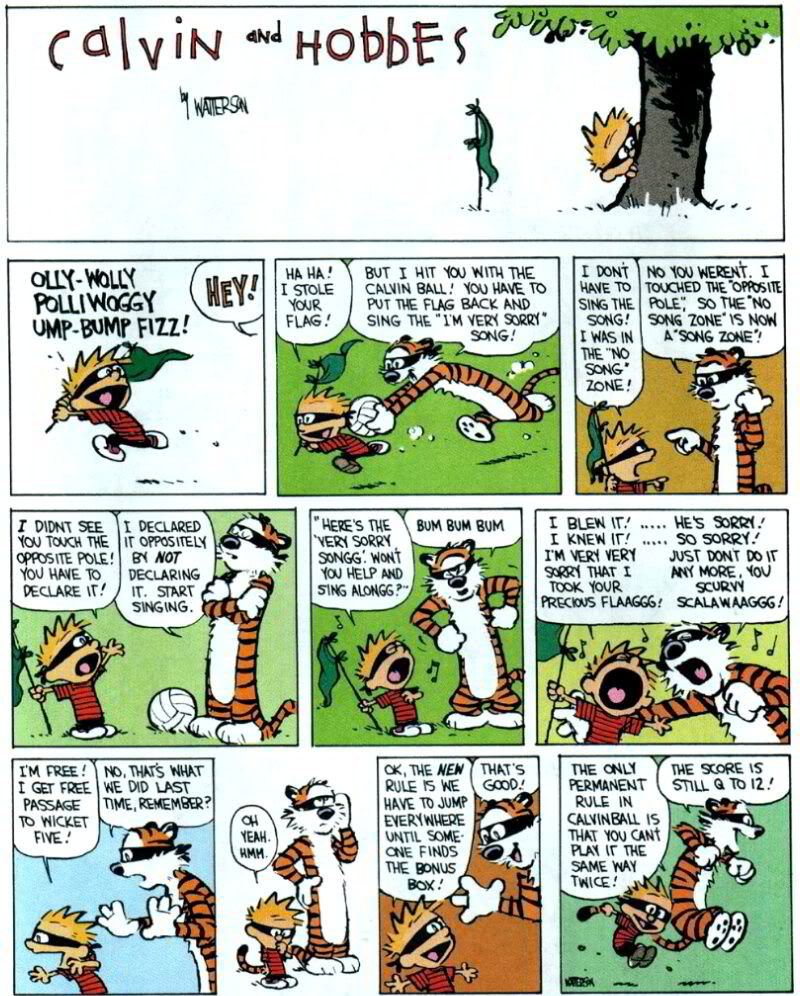
A few of these are pretty explicitly connected to warfare (polo), and old lacrosse and ulama seem to have had religious meanings, but most of the rest seem to have lost those connections, if they ever had any. Given simple high spirits and a few rules to give shape to the interaction (no Calvinball here); if the rules worked out well enough you'd have a traditional game.

Some sections of the globe are missing from the list. Everybody plays team sports now, but why didn't some cultures seem to develop any themselves? Or maybe they did develop some which fell out of favor with changing culture, or maybe the climate changed and they didn't have as much leisure (I'm thinking Amazon here--it looks like they used to build large farms there once upon a time). Or maybe the culture associated sports with childhood, and the visitors who documented the culture didn't pay attention to the kids.

Thursday, March 06, 2014

At the click of a button

Notice the dates:

7 February, 2001

February 27th, 2008

04 March 2014

Same guy. Color me dubious. If this is a real effect it must be extremely hard to implement. Risky, too. And he must get pretty bored in the winter if his press releases are all in February.

Also note that "The patent office will accept an application for, and issue a patent without any proof of its effectiveness."

Monday, March 03, 2014

Chasing the Ghost Particle

I wanted to like this one. Nils took the special iMAX camera to do filming at the pole, and we've got some fairly clear event animations that, with only a little explanation, show what's going on nicely. We've got some people who are used to explaining to non-technical audiences how things work and why. NASA has some great animations. Put them all together...

But some of the details ground my gears: the narrator talking about neutrino tracks, for example. And describing the really big kinds of explosions in space and saying that the really high energy neutrinos come from them (probably true, but we don't know that and we don't know how).

What really annoyed me was the Sesame-Street continuity. "Now let us go to the headquarters at Madison Wisconsin" jumps to a fast-motion street scene that has nothing to do with IceCube, and thirty seconds later it was back to pictures of big astronomical objects. True, there's not much exciting to look at at the headquarters: lots of people sitting around either doing analysis or in meetings, and a bunch of computers that do the heavy lifting. Still, if the scene is going to be boring, say so.

I saw it at the collaboration meeting "movie night." An iMAX's big screen would make the jazzy animations and continuity breaks dramatic, but even there a "general audience I" would leave not much wiser than I went in, though I might think I was.

Keith Reiminck's "No Horizon Anymore - A Year Long Journey at the Bottom of the World" (2008-2009 winter-overs) was better. Executive summary: 43 people living together in a frozen outpost through 6 months of night (plus a few more with some daylight) can get a little goofy, magnifying personality traits.


Banff is in a beautiful spot. Some of the sidewalks and roads are a trifle slippery. I tried one of the nearby trails and got about 100 feet before I realized that it wasn't going to work. It took me about 6 or 7 minutes to come back down--carefully.

Fukusima cleanup

This is an outline of what the Japanese may do to dismantle the Fukushima plants. It isn't easy. Read it to get an idea of the problems.

I suspect the reporter missed something, though. The robots can't communicate wirelessly with the outside because of the amount of shielding in the way, and unspooling communication cables turns out to be fraught with tangles and snags. But prepping the site with re-transmitters should be relatively straightforward: robots drag in the systems while unspooling power cables behind them. Since the operators would know where to put the re-transmitters before planting them, there is no backtracking that would tangle the cables, and they could even plan ways to dress out the cables so they didn't get in the way of later robots. With enough re-transmitters the robots could be sent anywhere. Of course, all the hardware they put in will be activated and have to be disposed of later, but in the grand scheme of things that's a minor issue.

Yes, some stuff might have to hang from railings, and be battery powered (and therefore replaced regularly). It could still work, though.

Saturday, March 01, 2014

Prince Igor

We went to see the live simulcast of Prince Igor this morning. (Pompeii was playing next door: every now and then there were some rumbles that didn’t have much to do with the action.)

Since Borodin had a day job (research chemist) and never finished the opera, producers have some freedom in how they organize it. The Met showed the Polovetzian sequence behind a scrim and projected videos of Igor or his dead soldiers when there were major transitions. This gave a slightly hazy appearance to the production, in keeping with the producer’s claim in an interview that the sequence was a hallucination of a man with a concussion.

The outline is simple enough: prince Igor goes to war. His army is destroyed and he (and his son and a few others) are captured. The next section is a somewhat disconnected/surreal collection of songs and dances surrounding Igor’s experiences in captivity. Meanwhile back at home his brother-in-law’s dissolute ways and attempted coup are wrecking readiness and leave the city unprepared for the counterattack. In the last act the city has been ransacked and a penitent Igor returns to a warm welcome.

This version used as the intro to the opera a quote to the effect that a man goes to war to escape himself. (Which seems a little odd, especially when applied to the current Ukraine conflicts.) The setting is WWI gear and weapons, which makes some of the lyrics sound a little funny, but meant that the projected battle scenes could be just people and explosions. At the end Igor pushes away his adoring subjects and starts leading by example in rebuilding.

Igor never seems to be very enthusiastic about his wife. That’s plot-driven, I suppose: in the first part he’s about to head off to war, in the middle he’s a glum hallucinating prisoner (who once says his wife will forgive him, and then largely ignores her when she shows up), and in the last he’s full of guilt. Still. . .

Either Russian has an incredible number of syllables or else the subtitle writers were a little terse.

As you would expect the music was excellent and the sets were imaginative and effective.

I’d forgotten about it completely until yesterday when Youngest Daughter suggested it as a date for me and my Better Half before I head out of town for a week. It was a good idea. Everybody knows the Dances section, but there was good music throughout.

It took some effort to keep my mind from playing through “Stranger in Paradise” during that section. (I tried to concentrate on hearing the Russian syllables.)

Time to replace Hail to the Chief?

"Hail to the Chief" is OK, but it doesn't have quite the right zing. It seems a bit bland, and incongruous with the use of the office.

This, starting at about 3:45, would be a more appropriate anthem to welcome the arrival of the President:


If that doesn't load right, check this, which starts at the right place.

Hail to the Chief we have chosen for the nation,
Hail to the Chief! We salute him, one and all.
Hail to the Chief, as we pledge cooperation
In proud fulfillment of a great, noble call.

Yours is the aim to make this grand country grander,
This you will do, that's our strong, firm belief.
Hail to the one we selected as commander,
Hail to the President! Hail to the Chief!
vs
[Dance of the Slaves]

Prisoners of the Khan, praise the Khan!
Sing songs of praise to the Khan, Sing!
Praise his generosity, praise his kindness, Praise!
For his enemies he is terrible, our Khan!
Who can be equal in glory to the Khan? Who?
With a blaze of glory equal to the sun is he.

[Dance of the Young Boys] - Interlude


IV. [Dance of the Men]

Equal to the glory of our forefathers is our Khan,
Khan, Khan Konchak.
Glorious Khan, Khan Konchak.

Wednesday, February 26, 2014

Un-drowned forest

A just-uncovered buried forest in Wales would be fun to wander through. The article asks if it is or inspired the stories about the city of Cantre'r Gwaelod. Since the forest's burial under a peat bog is only about 5-6000 years ago it isn't entirely impossible that there used to be something nearby, though:
There is no scientific evidence for any of this. Signs of physical habitation have never been found near Borth.

I really wish people wouldn't abuse the word scientific this way. "Researchers have found no relics of human habitation near Borth" would have been a lot more accurate. Who knows what will turn up next Thursday? And failing to find something on high ground doesn't mean there isn't something a little farther out, now underwater. Absence of evidence is not evidence of absence. Remember that silly report earlier this month that allegedly "rocked the Bible" because they hadn't found camel bits until O(1000BC) in Israel? Camels were known to have been in use in the East 1500 years before that, and the Genesis references are to people either from or with connections to Mesopotamia. Sheesh.

A walkway made of sticks and branches was also discovered. It's 3,000 to 4,000 years old and was built, it is believed, to cope with rising sea levels back then.

If I were to bet I'd bet that the forest, or something like it, inspired the stories, but wasn't the source. Though some literature is very old, and probably some stories are older.

However the legends ran, the place looks fun to visit.

Tuesday, February 25, 2014

Questions about family and property and Infernal Revenue etc

Maybe somebody else knows.

When I start digging around in "family law" I get swamped. What I’m looking for is family law (probably common law as opposed to statutory) regarding non-nuclear families; in particular mutual support in a single home of brothers and sisters.

You’d think precedents would be easy to find for extended family households: they've been around for longer than countries have. I’m thinking of mutual dependency based on sharing the same household and pooling the incomes. Adam and Becky are married with daughter Cindy and they share the house with Becky’s sister Denise and her son Eustace. Together they pool the incomes of Adam and Denise for infrastructure and emergency support, though some of the money stays nuclear.

In google and the law help sites I find lots of stuff about divorce, and the latest fashionable topics, but so far no sign of what I’m looking for. Domestic partnership laws are new, and aren't designed for the kind of layered authority and responsibility the situation demands.

There are options, of course, if you can squeeze into one of the state’s categories. The state wants to define everything in terms of individuals or corporations, fragmenting things as fine as possible for best definition and control. And then to prevent one kind of abuse they change the rules around willy-nilly.

There’s the non-stock non-profit corporation: a nice simple form. You need a registered agent and three directors, and the last time I was involved in one, the directors had to have different addresses. Ummm....

This is probably as simple as tying your shoes (though do you remember how long it took to teach the kids that?), but unless you know the right jargon google is not your friend. And if I sit down with a lawyer’s meter running I don’t want to waste time figuring out what I’m talking about.

Sunday, February 23, 2014

Home Fires by Gene Wolfe

This one is a science fiction mystery/adventure, and because it is a mystery motives matter a lot. So what are the motives of a beautiful but injured soldier who, thanks to special relativity, is 20 years younger than her lawyer husband? Or the manipulative dead woman whose mind was superimposed on another woman's wiped brain? Who is on this cruise ship?

Since the book is layers of surprises, I find it a bit hard to write a review without spoilers. So I'll cut to the chase and say that the book is fun, but not bubble-gum--you need to pay attention.

You always do with Gene Wolfe's books. I got stuck in There Are Doors (I suppose I should start it again), but I've liked all the rest I've read. He stretches your mind a little, and there are often things you only notice on re-reading.

UPDATE: Yes, after I slept on it I recalled two more points that hadn't been explicitly solved, and which change the nature of the ending somewhat.

Saturday, February 22, 2014

"Disenchantment in advance"

"I should begin my sermon by telling people not to enjoy themselves. I should tell them to enjoy dances and theatres and joy-rides and champagne and oysters; to enjoy jazz and cocktails if they can enjoy nothing better; to enjoy bigamy and burglary and any crime in the calendar, in preference to this other alternative; but never to learn to enjoy themselves. Human beings are happy so long as they retain the receptive power and the power of reaction in surprise and gratitude to something outside. So long as they have this they have, as the greatest minds have always declared, a something that is present in childhood and which can still preserve and invigorate manhood. The moment the self within is consciously felt as something superior to any of the gifts that can be brought to it, or any of the adventures that it may enjoy, there has appeared a sort of self-devouring fastidiousness and a disenchantment in advance, which fulfills all the Tartarean emblems of thirst and despair."

Chesterton, from The Comman Man

Friday, February 21, 2014

IBEX

One of those things you learn in E&M is that you don’t have static electric fields inside a conductor. That is easy enough to understand when you’re dealing with chunks of copper (though the exercise of figuring out the surface charge densities required for that were sometimes a bit painful). What isn’t quite so obvious is what happens when you move a conductor into a magnetic field: as it goes in, induced currents in the conductor push on the existing field. But you can try the experiment and feel for yourself that it works, so all’s well.

But out there in the vacuum of space, where do you find conductors?

Turns out that vacuum does have some stuff in it: not much, and mostly not ionized, but enough. Enough that on really big (astronomical) scales of space and time, that extremely dilute gas is enough of a conducting plasma to move magnetic fields around.

Some little time back there was a supernova in our neck of the woods, with the usual blast of hot gas following “slowly” behind the xrays and other zippy energy release. That expanding cloud of gas is still partly ionized, and acted like that copper plate you held in the lab demonstration to push the existing magnetic fields away. In fact, the existing galactic fields were sort of stretched around the expanding bubble of gas. The fields at the edge are pretty much tangent to the bubble; at right angles to the direction of the old supernova.

Our sun recently moved into the bubble.

Now if you look really closely at that copper plate you see that the electric fields don’t stop exactly at the edge—they fall off quickly though. When you’re talking about the rarified plasma that makes up the edge of the bubble around the old supernova, that fall-off isn’t small the way we think of small. So if you were floating all by your lonesome here without a star nearby, you’d still see some magnetic field—and it would be roughly at right angles to the direction of the old supernova.

Of course you’re on the Earth, which has a magnetic field of its own far more intense than the local galactic one. And the Earth is inside the heliosphere—the Sun blows its own bubble of charge particles. So we have a bubble inside a bubble in the galaxy, and we’re sitting on a planet with an even more intense field. How can we possibly measure the galactic field?

You can launch a probe or two and wait 40-50 years. That works.

You can also launch a probe to look at energetic neutral particles. Paulo Desiati had worked on IBEX earlier, and he explained the paper to the IceCube journal club Wednesday (he’s on IceCube now). I’ll pass over some of the gorier details, but the general approach is this:

A neutral particle doesn’t really notice magnetic fields much. If it is a dipole the field will twist its orientation, but it won’t change the direction. A charged particle does notice the fields, and its motion is a trifle complicated.

  • It doesn’t slow down or speed up
  • The component of its velocity parallel to the magnetic field doesn’t change. If it happens to be traveling completely parallel to the magnetic field, nothing happens.
  • The component of its velocity perpendicular to the magnetic field is shifted by a change which is perpendicular to both the magnetic field and the current direction of the particle. If the particle happens to be traveling completely perpendicular to a uniform magnetic field, it goes in circles.

In the general case, in a uniform magnetic field, charged particles move in spirals. If the fields are bent a little (as with the Earth’s fields), the spirals follow the bend of the field (not true mathematical spirals, but close enough).

So at the “edge” of the heliosphere, the bubble our Sun blew, charged particles are spiraling around along the field lines of the magnetic fields in the bubble the supernova blew. As they go on their merry ways, every now and then one of the protons will catch up with an electron and form hydrogen. The hydrogen is neutral: the magnetic field doesn’t bother it any more. Whichever direction it was heading at the time, it keeps on going: it breaks out of the spiral like a stone from a sling. If it hits IBEX, we can tell the direction it came from. The chances that any one particle will do this is very small, but the distances are so large that the number of particles available is very large.

And IBEX sees extra neutral particles coming from a band in the sky. That band is therefore like a kind of equator that tells us where the bent galactic magnetic field is most tangent to a sphere around us, and therefore mostly in its original direction. (Modulo distortions from the supernova bubble, of course. The original original field would have been somewhere in the plane defined by the current field and the direction to the old supernova.)

The abstract of their paper says that their result is consistent with anisotropies at higher energies, which is kind of odd when I think about it. They are indirectly measuring quite small fields using low energy neutral particles, but the sky map differences are most noticeable at very high energies, where these fields wouldn’t matter so much.

Very nice work. (Theirs, not my scribble-scrabble artwork)

Thursday, February 20, 2014

How does a star blow up?

Apparently the supernova simulation folks have been having some problems getting the simulations to go bang reliably: "the main shock wave often stalls out and the star fails to shatter."

I wasn't aware of that little problem, and my reaction is "OK, something is missing in your model."

Maybe what was missing was simple. The NuSTAR telescope was designed to distinguish the X-rays associated with the decay of radioactive elements. Since radioactive elements are largely produced in the hot cores of stars, not the outer layers, the distribution of elements around a relatively recent supernova should tell something about what the core looked like as it went bang. For example, are there jets coming out of the top and bottom?

“Stars are spherical balls of gas, and so you might think that when they end their lives and explode, that explosion would look like a uniform ball expanding out with great power,” said Fiona Harrison, the principal investigator of NuSTAR at the California Institute of Technology (Caltech) in Pasadena. “Our new results show how the explosion’s heart, or engine, is distorted, possibly because the inner regions literally slosh around before detonating.”

Go look at the pictures showing the distributions of different isotopes. They aren't very uniform.

Sunday, February 16, 2014

Opera musings

My Better Half got us tickets to a concert for last night, but couldn't go, so Eldest Daughter went. Finlandia, Hayden, Dr Atomic, Arutiunian, and Der Rosenkavalier, and a trumpet encore by Tine Helsing of a hilarious trumpet fanfare by somebody whose name I didn't catch. As advertised, she is able to play very well and to take the harsh edge out of the trumpet sound. All excellent, except for Dr. Atomic--which was interesting. In a century orchestras will still be playing Hayden.

The Dr Atomic sections were "In the Laboratory," "Panic," and "Trinity." I gather Adams was trying to reproduce some of the sounds and impressions of labs he'd either been in or watched in movies. I've worked in quite a few labs over the years, and usually the dominant
noises are from the air handling, vacuum pumps, and grad students trying to find the right connectors. And from yelling back and forth between the guy in the lift-a-loft and the fellow on the ground with the scope. (There's no way the big boom was going to be reproducible by an
orchestra.) I think Adams would have done better to provide an actual melody for the leitmotif of nuclear fission, though. Something that gets truncated by more chaotic sounds, but lasts longer and longer with each try until you get to hear it all.

Which left me wondering: who would have done Oppenheimer's story better as an opera? For some reason I can't imagine Bizet being interested in trying the project. In fact I think most of the classical era composers wouldn't be too excited about a "am I doing the right thing?" kind of story. A race to succeed against a human or supernatural villain, sure. Some might go for ending with a "What have we done?" moment. If the composer had the chops the result could be great. But a story of weather details or a story of self-doubt? They'd round file it.

So imagine you've given Wagner the general outline and a free hand (including permission to find a role for his favorite lady). Or Beethoven (assuming he ever finished it...).

Friday, February 14, 2014

Chesterton whiffed a few

Chesterton sometimes misfired. He wasn't terribly fond of Prohibition, and in one response penned the poem starting thusly:
Feast on wine or fast on water
And your honour shall stand sure.
God Almighty's son and daughter
He the valiant, she the pure;
If an angel out of heaven
Brings you something else to drink
Thank him for his kind attentions,
Go and pour them down the sink.
The omission of beer from the list wouldn't endear him to most Wisconsinites(*), but more dramatically in another stanza he wrote "Cocoa is a cad and coward, Cocoa is a vulgar beast."

He must never have spent an afternoon sledding and come home to thaw out with a mug of hot cocoa. You may argue in his favor that he didn't grow up with such things--but neither did I. It isn't necessary to have been born to something to recognize a perfect fit when it is handed to you.

I gather he held a grudge against Cadbury for the Cadbury newspaper's role in convicting Chesterton's brother of libel. Still, he was a man of enough humility that I believe he would have dropped his bias if given a cup and a seat by the fire.


(*) Although I would omit it too. Beer is fine for baiting garden slugs but it seems inhumane to inflict it on people.

Monday, February 10, 2014

Hotel California

France and Germany are grieved that non-EU-member Switzerland doesn't want to use EU immigration rules. "foreigners now make up 23% of the population. It is the continent's second highest foreign population after Luxembourg." I gather that even if you don't enter the Hotel EU you are never allowed to leave anyway.

So far I've read attributions of the (very slim) majority vote to anger at being priced out of metro areas, anger at the Germans, racism, boneheadedness, not being exposed to enough immigrants(*)--everybody has a theory, and most of them consider the Swiss dead wrong.

But although my French is pretty miserable and my German non-existent I did try to read the newspapers while I was over there, and I think the commentators are too simple. I'm not going to propose reasons myself because I'm tolerably sure that the reasons vary a lot from place to place. (We sometimes forget how federal Switzerland still is, and that there are some regional disagreements shading into animosities.) I'm waiting for somebody to ask the Swiss why--and I'm rooting for them to tell the pollsters to take a long walk off a short pier. I generally root for that anyway.


(*) This was a conclusion based on noticing that the vote was more anti-further-immigration in cantons that had less immigrant fraction. Possibly it didn't occur to the writer that there was more than one interpretation of that observation.

Sunday, February 09, 2014

Brave News World

At after-dinner conversation tonight (Youngest Son is taking a course in writing screen plays) it occurred to us that Brave New World missed a bet.

The Ministry of Truth from 1984 changes all copies of newspapers so that the current party line has always been the party line, and unpersons never existed. But in a society as immersed in amusement as Brave New World, or the USA, one of the amusements can be the news, and only the trending news matters. What happened last year is essentially forgotten, except by people who don't matter.

UPDATE: Now that I think of it, isn't that a theme in Fahrenheit 451?

Saturday, February 08, 2014

Calcutta and love

If you have not seen David Warren's most recent column, read it. You will probably not find entertainments so amusing for a while, though.

Wednesday, February 05, 2014

The woman captured in adultery

I read John's account of the woman caught in adultery again this morning, and noticed something for the first time after more than mumble mumble years of hearing it.

Jesus was in temple courts at the time. You'd not find loose stones on those pavements; they'd have had to drag her outside someplace for execution. And the temple was the place of reconciliation and forgiveness. Her accusers just had to look around to remember sacrificing to find God's forgiveness for themselves. True, the temple was also the place for religious teaching and study, but its primary function was reconciliation and meeting with God. They unwittingly brought her to the right place.

Sunday, February 02, 2014

The Idea of Nature by R.G. Collingwood

A few weeks back I asked about Babylonian mathematics on Grim's Hall, in reply to a post there. I'd only read (in a book comparing Egyptian, Babylonian, and Greek mathematics) that the Babylonians had found ways to solve certain classes of quadratic equations, but not the general case. Grim recommended The Idea of Nature as a start.

The library copy was originally stamped "3 hour loan," which is a bit humiliating since it took me a bit longer than that to read it.

It is a history of the philosophical idea of nature from the pre-Socratic Greeks to Whitehead. He admits it isn't thorough, only touching on representative (i.e. well known by the author (That's what he says)) philosophers in three main categories: ancient Greek, Renaissance to 18'th century, and modern.

Rude and crude thumbnail of the imaginative environment in which philosophers worked in each era: Greeks thought of the world as alive and that motion was a sign of life and acting toward some purpose. The Renaissance brought in a materialist and mechanistic idea of the world, including a mechanistic idea of biology. Modern philosophers hear of relativity and quantum mechanics and the resulting fuzziness and duality.

I'm afraid that when the author began his admittedly amateur explanation of modern physics I was tearing what little hair remains and scribbling in the margins. (If the librarian does not approve of the value added, the additions are in pencil...)

From the get-go people were trying to figure out thorny questions like why is there miscellaneous but similar stuff, where did it come from, what is the relationship of mind to matter, and where do the non-material things fit into the scheme of things. Some of the goofy-sounding ideas (everything comes from water) turn out to be less loony than meets the eye. What was meant by "water" wasn't really H2O but unknown primordial material that needed a handy name.

With (probably) Pythagoras proposing that what made matter and things from the primordial whatever was geometry came some new trends. FWIW, mathematical symmetries are all the rage among physicists today--searching for them and their consequences has been very fruitful.

The author skips over Christian philosophy and finds Renaissance philosophers in reaction to Christianity proposing a materialist universe.

Scientifically speaking, on the other hand, materialism was from first to last an aspiration rather than an achievement. Its God was always a miracle-working God whose mysterious ways were past finding out. The hope was always cherished that with the advance of science we should find them out some day; so the scientific credit of materialism was maintained by drawing very large cheques in its own favor on assets not yet to hand. ... a statement such as this, that the brain secretes thought in exactly the same way in which the gall-bladder secretes gall, might pass as a dogma of religion, but scientifically speaking was simple bluff.

From within that kind of framework it is hard to find an origin for mind, and there seems to have been a lot of ink wasted on worries about how much of the world is created by the observer.

With Darwinian ideas about evolution the older ideas about the striving of organisms to reach their full nature (bud into leaf, etc) fell out of fashion in favor of mechanical models.

Most of the modern philosophers he discusses are more interested in matter as activity, which is more in line with the approach of the physicists.

None of the philosophers satisfy the author, and he ends with a suggestion that they are starting with too small a base of suppositions. To understand science, you need to understand history, because science is based on history. Nobody does every single experiment; they rely on records.

I found it quite interesting and learned a lot--though not about Babylonian math.

It may have been the author's intent to convey that impression, but I got the sense that people were mixing up categories rather badly. Science works by creating models of how parts of the world works, abstracting away those things that clutter the measurements to be made. That "clutter" is absolutely essential in understanding everyday life; which is complex. Because it is outward focused and abstracting, it does not address the obvious questions involved with "whence came this I that is observing?"

Anybody who's had a pet dog or cat has had the opportunity to discover that they don't act like machines. Some in the AI crowd have been claiming that human intelligence emerged spontaneously from complexity, but that doesn't address the I. In any event, making a model of human reactions may look convincing, but so is a life-size photograph. The map is not the territory.

I haven't thought it all through, but just because I have a sense-based model of the operations of the world (that seems reliable enough to trust with my life) does not mean that the only kind of knowledge I can have is sensory. That living things can sometimes be modeled as machinery doesn't mean they don't have some telos. Where I come from complexity generally results in fragility, not robustness, and a small change in a program can sometimes change the output completely. That mental activity can be imitated by other intellects doesn't explain where it came from originally. And the moral realm is a whole other story.

I think our design is irreducibly complex.

Read the book.

Electronic and in-person revisited

We all know how abstract online communications can be: no gestures, inflection, wink in the eye, no touch or sight or smell. Being there in person is completely different, and it isn't hard to see why.

But there's another aspect of the abstract communication channels that only just occurred to me. Phone, email, text, Facebook, blogs only touch me if I choose. I don't have to answer the phone or log in. But in person communications are not under my control.

If the neighbors are having a quarrel when the weather is warm, I hear it. If one of the kids needs a bucket quickly, I learn about it whether or not I'd rather read the paper. I am not entirely master of all I survey when other people are nearby. Online I am. Milton's Satan would rather rule in Hell than serve in Heaven. (Insert your own comparisons between Hell and Facebook.) Now and then I feel like that too.