Monday, March 10, 2014

Standards of beauty

The latest Sports Illustrated swimsuit edition is all over the newsstands, this time with three young ladies not dressed for any beach I've ever been to. But set aside fantasy for the moment.

Either my eyes are failing me or the three look startlingly similar. If they appeared only one at a time it wouldn't be so obvious, but together it seems as though they were picked as being the closest approximations to a single ideal standard of beauty, uniform from cheeks to cheeks. I recall pictures of a group of Rockettes who didn't seem as much alike as these three, and I'd have thought uniformity would have been a goal for that chorus line.

The last time I checked there was more than one way for a woman to look gorgeous. One wordsmith called the women Hefner surrounds himself with as "identi-kit playmates." Every flower has to look like a daisy... It seems a bit sad.

Since too-close inspection is unwise, I omit links.

Friday, March 07, 2014

Team sports

All the world plays soccer today.

But I couldn't think of very many places that originated their own team sports. So I went googling about. Yikes: the things I didn't know were legion.

Some we all know: In North America/Mexico they had lacrosse and its variants ("each team consisted of about 100 to 1,000 men on a field that stretched from about 500 meters to 3 kilometers long") and ulama. In Persia a cavalry training exercise seems to have developed into polo.

Now I got into new territory. I gather that the Greeks and Romans had something I'd not heard of before, episkyros/harpastum; though I don't see any signs that these survived past the collapse of Western Rome.

Mongolia has beikou, Malaysia has sepak takraw, France has a game dating to Rome and France, Spain, Netherlands and Italy has games of the handball/racquetball games. Russia has bandy/Russian hockey

But baseball/rounders, cricket, soccer, rugby, American football, Australian football, basketball, hurling, modern volleyball, modern hockey (though there are very ancient precedents) and so on seem to come from the sports-mad British Isles and their descendents. Even more new team sports were invented last century (Switzerland, Sweden, and so on).

(I'm not going to include the battledore, because it seems not to be exactly a team effort, though it was widely popular from antiquity. South Africa has a booklet of traditional games, including board games, stick fighting, etc: but I can't tell if the dibeke is old or new.)

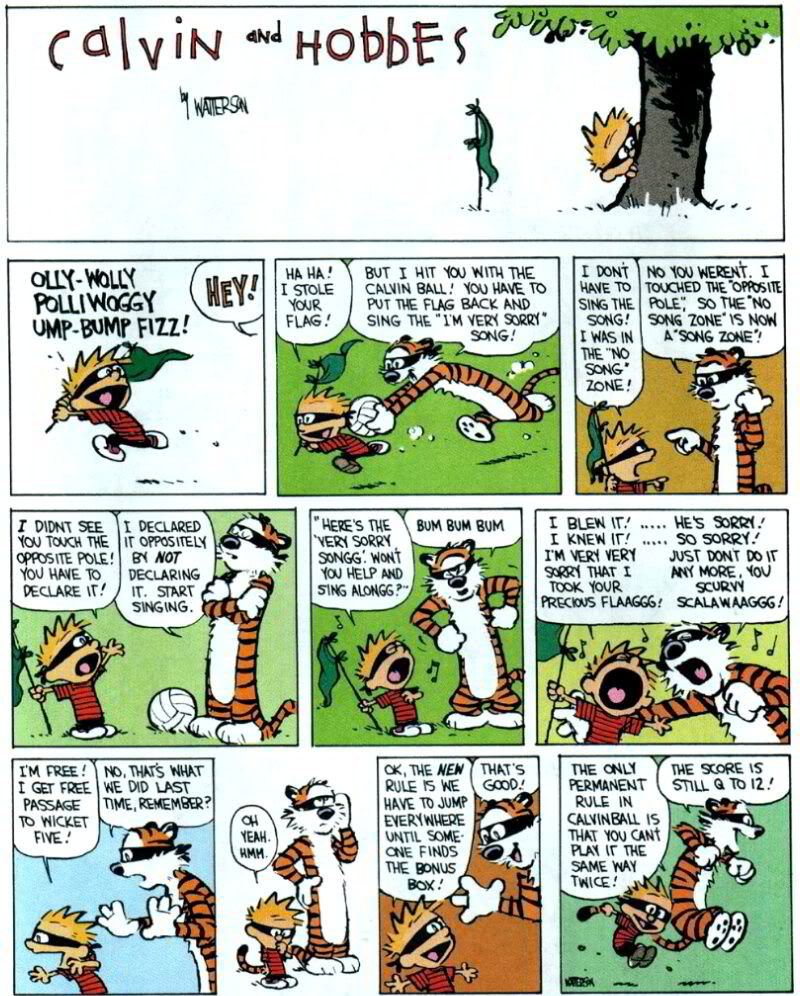
A few of these are pretty explicitly connected to warfare (polo), and old lacrosse and ulama seem to have had religious meanings, but most of the rest seem to have lost those connections, if they ever had any. Given simple high spirits and a few rules to give shape to the interaction (no Calvinball here); if the rules worked out well enough you'd have a traditional game.

Some sections of the globe are missing from the list. Everybody plays team sports now, but why didn't some cultures seem to develop any themselves? Or maybe they did develop some which fell out of favor with changing culture, or maybe the climate changed and they didn't have as much leisure (I'm thinking Amazon here--it looks like they used to build large farms there once upon a time). Or maybe the culture associated sports with childhood, and the visitors who documented the culture didn't pay attention to the kids.

Thursday, March 06, 2014

At the click of a button

Notice the dates:

7 February, 2001

February 27th, 2008

04 March 2014

Same guy. Color me dubious. If this is a real effect it must be extremely hard to implement. Risky, too. And he must get pretty bored in the winter if his press releases are all in February.

Also note that "The patent office will accept an application for, and issue a patent without any proof of its effectiveness."

Monday, March 03, 2014

Chasing the Ghost Particle

I wanted to like this one. Nils took the special iMAX camera to do filming at the pole, and we've got some fairly clear event animations that, with only a little explanation, show what's going on nicely. We've got some people who are used to explaining to non-technical audiences how things work and why. NASA has some great animations. Put them all together...

But some of the details ground my gears: the narrator talking about neutrino tracks, for example. And describing the really big kinds of explosions in space and saying that the really high energy neutrinos come from them (probably true, but we don't know that and we don't know how).

What really annoyed me was the Sesame-Street continuity. "Now let us go to the headquarters at Madison Wisconsin" jumps to a fast-motion street scene that has nothing to do with IceCube, and thirty seconds later it was back to pictures of big astronomical objects. True, there's not much exciting to look at at the headquarters: lots of people sitting around either doing analysis or in meetings, and a bunch of computers that do the heavy lifting. Still, if the scene is going to be boring, say so.

I saw it at the collaboration meeting "movie night." An iMAX's big screen would make the jazzy animations and continuity breaks dramatic, but even there a "general audience I" would leave not much wiser than I went in, though I might think I was.

Keith Reiminck's "No Horizon Anymore - A Year Long Journey at the Bottom of the World" (2008-2009 winter-overs) was better. Executive summary: 43 people living together in a frozen outpost through 6 months of night (plus a few more with some daylight) can get a little goofy, magnifying personality traits.


Banff is in a beautiful spot. Some of the sidewalks and roads are a trifle slippery. I tried one of the nearby trails and got about 100 feet before I realized that it wasn't going to work. It took me about 6 or 7 minutes to come back down--carefully.

Fukusima cleanup

This is an outline of what the Japanese may do to dismantle the Fukushima plants. It isn't easy. Read it to get an idea of the problems.

I suspect the reporter missed something, though. The robots can't communicate wirelessly with the outside because of the amount of shielding in the way, and unspooling communication cables turns out to be fraught with tangles and snags. But prepping the site with re-transmitters should be relatively straightforward: robots drag in the systems while unspooling power cables behind them. Since the operators would know where to put the re-transmitters before planting them, there is no backtracking that would tangle the cables, and they could even plan ways to dress out the cables so they didn't get in the way of later robots. With enough re-transmitters the robots could be sent anywhere. Of course, all the hardware they put in will be activated and have to be disposed of later, but in the grand scheme of things that's a minor issue.

Yes, some stuff might have to hang from railings, and be battery powered (and therefore replaced regularly). It could still work, though.

Saturday, March 01, 2014

Prince Igor

We went to see the live simulcast of Prince Igor this morning. (Pompeii was playing next door: every now and then there were some rumbles that didn’t have much to do with the action.)

Since Borodin had a day job (research chemist) and never finished the opera, producers have some freedom in how they organize it. The Met showed the Polovetzian sequence behind a scrim and projected videos of Igor or his dead soldiers when there were major transitions. This gave a slightly hazy appearance to the production, in keeping with the producer’s claim in an interview that the sequence was a hallucination of a man with a concussion.

The outline is simple enough: prince Igor goes to war. His army is destroyed and he (and his son and a few others) are captured. The next section is a somewhat disconnected/surreal collection of songs and dances surrounding Igor’s experiences in captivity. Meanwhile back at home his brother-in-law’s dissolute ways and attempted coup are wrecking readiness and leave the city unprepared for the counterattack. In the last act the city has been ransacked and a penitent Igor returns to a warm welcome.

This version used as the intro to the opera a quote to the effect that a man goes to war to escape himself. (Which seems a little odd, especially when applied to the current Ukraine conflicts.) The setting is WWI gear and weapons, which makes some of the lyrics sound a little funny, but meant that the projected battle scenes could be just people and explosions. At the end Igor pushes away his adoring subjects and starts leading by example in rebuilding.

Igor never seems to be very enthusiastic about his wife. That’s plot-driven, I suppose: in the first part he’s about to head off to war, in the middle he’s a glum hallucinating prisoner (who once says his wife will forgive him, and then largely ignores her when she shows up), and in the last he’s full of guilt. Still. . .

Either Russian has an incredible number of syllables or else the subtitle writers were a little terse.

As you would expect the music was excellent and the sets were imaginative and effective.

I’d forgotten about it completely until yesterday when Youngest Daughter suggested it as a date for me and my Better Half before I head out of town for a week. It was a good idea. Everybody knows the Dances section, but there was good music throughout.

It took some effort to keep my mind from playing through “Stranger in Paradise” during that section. (I tried to concentrate on hearing the Russian syllables.)

Time to replace Hail to the Chief?

"Hail to the Chief" is OK, but it doesn't have quite the right zing. It seems a bit bland, and incongruous with the use of the office.

This, starting at about 3:45, would be a more appropriate anthem to welcome the arrival of the President:


If that doesn't load right, check this, which starts at the right place.

Hail to the Chief we have chosen for the nation,
Hail to the Chief! We salute him, one and all.
Hail to the Chief, as we pledge cooperation
In proud fulfillment of a great, noble call.

Yours is the aim to make this grand country grander,
This you will do, that's our strong, firm belief.
Hail to the one we selected as commander,
Hail to the President! Hail to the Chief!
vs
[Dance of the Slaves]

Prisoners of the Khan, praise the Khan!
Sing songs of praise to the Khan, Sing!
Praise his generosity, praise his kindness, Praise!
For his enemies he is terrible, our Khan!
Who can be equal in glory to the Khan? Who?
With a blaze of glory equal to the sun is he.

[Dance of the Young Boys] - Interlude


IV. [Dance of the Men]

Equal to the glory of our forefathers is our Khan,
Khan, Khan Konchak.
Glorious Khan, Khan Konchak.

Wednesday, February 26, 2014

Un-drowned forest

A just-uncovered buried forest in Wales would be fun to wander through. The article asks if it is or inspired the stories about the city of Cantre'r Gwaelod. Since the forest's burial under a peat bog is only about 5-6000 years ago it isn't entirely impossible that there used to be something nearby, though:
There is no scientific evidence for any of this. Signs of physical habitation have never been found near Borth.

I really wish people wouldn't abuse the word scientific this way. "Researchers have found no relics of human habitation near Borth" would have been a lot more accurate. Who knows what will turn up next Thursday? And failing to find something on high ground doesn't mean there isn't something a little farther out, now underwater. Absence of evidence is not evidence of absence. Remember that silly report earlier this month that allegedly "rocked the Bible" because they hadn't found camel bits until O(1000BC) in Israel? Camels were known to have been in use in the East 1500 years before that, and the Genesis references are to people either from or with connections to Mesopotamia. Sheesh.

A walkway made of sticks and branches was also discovered. It's 3,000 to 4,000 years old and was built, it is believed, to cope with rising sea levels back then.

If I were to bet I'd bet that the forest, or something like it, inspired the stories, but wasn't the source. Though some literature is very old, and probably some stories are older.

However the legends ran, the place looks fun to visit.

Tuesday, February 25, 2014

Questions about family and property and Infernal Revenue etc

Maybe somebody else knows.

When I start digging around in "family law" I get swamped. What I’m looking for is family law (probably common law as opposed to statutory) regarding non-nuclear families; in particular mutual support in a single home of brothers and sisters.

You’d think precedents would be easy to find for extended family households: they've been around for longer than countries have. I’m thinking of mutual dependency based on sharing the same household and pooling the incomes. Adam and Becky are married with daughter Cindy and they share the house with Becky’s sister Denise and her son Eustace. Together they pool the incomes of Adam and Denise for infrastructure and emergency support, though some of the money stays nuclear.

In google and the law help sites I find lots of stuff about divorce, and the latest fashionable topics, but so far no sign of what I’m looking for. Domestic partnership laws are new, and aren't designed for the kind of layered authority and responsibility the situation demands.

There are options, of course, if you can squeeze into one of the state’s categories. The state wants to define everything in terms of individuals or corporations, fragmenting things as fine as possible for best definition and control. And then to prevent one kind of abuse they change the rules around willy-nilly.

There’s the non-stock non-profit corporation: a nice simple form. You need a registered agent and three directors, and the last time I was involved in one, the directors had to have different addresses. Ummm....

This is probably as simple as tying your shoes (though do you remember how long it took to teach the kids that?), but unless you know the right jargon google is not your friend. And if I sit down with a lawyer’s meter running I don’t want to waste time figuring out what I’m talking about.

Sunday, February 23, 2014

Home Fires by Gene Wolfe

This one is a science fiction mystery/adventure, and because it is a mystery motives matter a lot. So what are the motives of a beautiful but injured soldier who, thanks to special relativity, is 20 years younger than her lawyer husband? Or the manipulative dead woman whose mind was superimposed on another woman's wiped brain? Who is on this cruise ship?

Since the book is layers of surprises, I find it a bit hard to write a review without spoilers. So I'll cut to the chase and say that the book is fun, but not bubble-gum--you need to pay attention.

You always do with Gene Wolfe's books. I got stuck in There Are Doors (I suppose I should start it again), but I've liked all the rest I've read. He stretches your mind a little, and there are often things you only notice on re-reading.

UPDATE: Yes, after I slept on it I recalled two more points that hadn't been explicitly solved, and which change the nature of the ending somewhat.

Saturday, February 22, 2014

"Disenchantment in advance"

"I should begin my sermon by telling people not to enjoy themselves. I should tell them to enjoy dances and theatres and joy-rides and champagne and oysters; to enjoy jazz and cocktails if they can enjoy nothing better; to enjoy bigamy and burglary and any crime in the calendar, in preference to this other alternative; but never to learn to enjoy themselves. Human beings are happy so long as they retain the receptive power and the power of reaction in surprise and gratitude to something outside. So long as they have this they have, as the greatest minds have always declared, a something that is present in childhood and which can still preserve and invigorate manhood. The moment the self within is consciously felt as something superior to any of the gifts that can be brought to it, or any of the adventures that it may enjoy, there has appeared a sort of self-devouring fastidiousness and a disenchantment in advance, which fulfills all the Tartarean emblems of thirst and despair."

Chesterton, from The Comman Man

Friday, February 21, 2014

IBEX

One of those things you learn in E&M is that you don’t have static electric fields inside a conductor. That is easy enough to understand when you’re dealing with chunks of copper (though the exercise of figuring out the surface charge densities required for that were sometimes a bit painful). What isn’t quite so obvious is what happens when you move a conductor into a magnetic field: as it goes in, induced currents in the conductor push on the existing field. But you can try the experiment and feel for yourself that it works, so all’s well.

But out there in the vacuum of space, where do you find conductors?

Turns out that vacuum does have some stuff in it: not much, and mostly not ionized, but enough. Enough that on really big (astronomical) scales of space and time, that extremely dilute gas is enough of a conducting plasma to move magnetic fields around.

Some little time back there was a supernova in our neck of the woods, with the usual blast of hot gas following “slowly” behind the xrays and other zippy energy release. That expanding cloud of gas is still partly ionized, and acted like that copper plate you held in the lab demonstration to push the existing magnetic fields away. In fact, the existing galactic fields were sort of stretched around the expanding bubble of gas. The fields at the edge are pretty much tangent to the bubble; at right angles to the direction of the old supernova.

Our sun recently moved into the bubble.

Now if you look really closely at that copper plate you see that the electric fields don’t stop exactly at the edge—they fall off quickly though. When you’re talking about the rarified plasma that makes up the edge of the bubble around the old supernova, that fall-off isn’t small the way we think of small. So if you were floating all by your lonesome here without a star nearby, you’d still see some magnetic field—and it would be roughly at right angles to the direction of the old supernova.

Of course you’re on the Earth, which has a magnetic field of its own far more intense than the local galactic one. And the Earth is inside the heliosphere—the Sun blows its own bubble of charge particles. So we have a bubble inside a bubble in the galaxy, and we’re sitting on a planet with an even more intense field. How can we possibly measure the galactic field?

You can launch a probe or two and wait 40-50 years. That works.

You can also launch a probe to look at energetic neutral particles. Paulo Desiati had worked on IBEX earlier, and he explained the paper to the IceCube journal club Wednesday (he’s on IceCube now). I’ll pass over some of the gorier details, but the general approach is this:

A neutral particle doesn’t really notice magnetic fields much. If it is a dipole the field will twist its orientation, but it won’t change the direction. A charged particle does notice the fields, and its motion is a trifle complicated.

  • It doesn’t slow down or speed up
  • The component of its velocity parallel to the magnetic field doesn’t change. If it happens to be traveling completely parallel to the magnetic field, nothing happens.
  • The component of its velocity perpendicular to the magnetic field is shifted by a change which is perpendicular to both the magnetic field and the current direction of the particle. If the particle happens to be traveling completely perpendicular to a uniform magnetic field, it goes in circles.

In the general case, in a uniform magnetic field, charged particles move in spirals. If the fields are bent a little (as with the Earth’s fields), the spirals follow the bend of the field (not true mathematical spirals, but close enough).

So at the “edge” of the heliosphere, the bubble our Sun blew, charged particles are spiraling around along the field lines of the magnetic fields in the bubble the supernova blew. As they go on their merry ways, every now and then one of the protons will catch up with an electron and form hydrogen. The hydrogen is neutral: the magnetic field doesn’t bother it any more. Whichever direction it was heading at the time, it keeps on going: it breaks out of the spiral like a stone from a sling. If it hits IBEX, we can tell the direction it came from. The chances that any one particle will do this is very small, but the distances are so large that the number of particles available is very large.

And IBEX sees extra neutral particles coming from a band in the sky. That band is therefore like a kind of equator that tells us where the bent galactic magnetic field is most tangent to a sphere around us, and therefore mostly in its original direction. (Modulo distortions from the supernova bubble, of course. The original original field would have been somewhere in the plane defined by the current field and the direction to the old supernova.)

The abstract of their paper says that their result is consistent with anisotropies at higher energies, which is kind of odd when I think about it. They are indirectly measuring quite small fields using low energy neutral particles, but the sky map differences are most noticeable at very high energies, where these fields wouldn’t matter so much.

Very nice work. (Theirs, not my scribble-scrabble artwork)

Thursday, February 20, 2014

How does a star blow up?

Apparently the supernova simulation folks have been having some problems getting the simulations to go bang reliably: "the main shock wave often stalls out and the star fails to shatter."

I wasn't aware of that little problem, and my reaction is "OK, something is missing in your model."

Maybe what was missing was simple. The NuSTAR telescope was designed to distinguish the X-rays associated with the decay of radioactive elements. Since radioactive elements are largely produced in the hot cores of stars, not the outer layers, the distribution of elements around a relatively recent supernova should tell something about what the core looked like as it went bang. For example, are there jets coming out of the top and bottom?

“Stars are spherical balls of gas, and so you might think that when they end their lives and explode, that explosion would look like a uniform ball expanding out with great power,” said Fiona Harrison, the principal investigator of NuSTAR at the California Institute of Technology (Caltech) in Pasadena. “Our new results show how the explosion’s heart, or engine, is distorted, possibly because the inner regions literally slosh around before detonating.”

Go look at the pictures showing the distributions of different isotopes. They aren't very uniform.

Sunday, February 16, 2014

Opera musings

My Better Half got us tickets to a concert for last night, but couldn't go, so Eldest Daughter went. Finlandia, Hayden, Dr Atomic, Arutiunian, and Der Rosenkavalier, and a trumpet encore by Tine Helsing of a hilarious trumpet fanfare by somebody whose name I didn't catch. As advertised, she is able to play very well and to take the harsh edge out of the trumpet sound. All excellent, except for Dr. Atomic--which was interesting. In a century orchestras will still be playing Hayden.

The Dr Atomic sections were "In the Laboratory," "Panic," and "Trinity." I gather Adams was trying to reproduce some of the sounds and impressions of labs he'd either been in or watched in movies. I've worked in quite a few labs over the years, and usually the dominant
noises are from the air handling, vacuum pumps, and grad students trying to find the right connectors. And from yelling back and forth between the guy in the lift-a-loft and the fellow on the ground with the scope. (There's no way the big boom was going to be reproducible by an
orchestra.) I think Adams would have done better to provide an actual melody for the leitmotif of nuclear fission, though. Something that gets truncated by more chaotic sounds, but lasts longer and longer with each try until you get to hear it all.

Which left me wondering: who would have done Oppenheimer's story better as an opera? For some reason I can't imagine Bizet being interested in trying the project. In fact I think most of the classical era composers wouldn't be too excited about a "am I doing the right thing?" kind of story. A race to succeed against a human or supernatural villain, sure. Some might go for ending with a "What have we done?" moment. If the composer had the chops the result could be great. But a story of weather details or a story of self-doubt? They'd round file it.

So imagine you've given Wagner the general outline and a free hand (including permission to find a role for his favorite lady). Or Beethoven (assuming he ever finished it...).

Friday, February 14, 2014

Chesterton whiffed a few

Chesterton sometimes misfired. He wasn't terribly fond of Prohibition, and in one response penned the poem starting thusly:
Feast on wine or fast on water
And your honour shall stand sure.
God Almighty's son and daughter
He the valiant, she the pure;
If an angel out of heaven
Brings you something else to drink
Thank him for his kind attentions,
Go and pour them down the sink.
The omission of beer from the list wouldn't endear him to most Wisconsinites(*), but more dramatically in another stanza he wrote "Cocoa is a cad and coward, Cocoa is a vulgar beast."

He must never have spent an afternoon sledding and come home to thaw out with a mug of hot cocoa. You may argue in his favor that he didn't grow up with such things--but neither did I. It isn't necessary to have been born to something to recognize a perfect fit when it is handed to you.

I gather he held a grudge against Cadbury for the Cadbury newspaper's role in convicting Chesterton's brother of libel. Still, he was a man of enough humility that I believe he would have dropped his bias if given a cup and a seat by the fire.


(*) Although I would omit it too. Beer is fine for baiting garden slugs but it seems inhumane to inflict it on people.

Monday, February 10, 2014

Hotel California

France and Germany are grieved that non-EU-member Switzerland doesn't want to use EU immigration rules. "foreigners now make up 23% of the population. It is the continent's second highest foreign population after Luxembourg." I gather that even if you don't enter the Hotel EU you are never allowed to leave anyway.

So far I've read attributions of the (very slim) majority vote to anger at being priced out of metro areas, anger at the Germans, racism, boneheadedness, not being exposed to enough immigrants(*)--everybody has a theory, and most of them consider the Swiss dead wrong.

But although my French is pretty miserable and my German non-existent I did try to read the newspapers while I was over there, and I think the commentators are too simple. I'm not going to propose reasons myself because I'm tolerably sure that the reasons vary a lot from place to place. (We sometimes forget how federal Switzerland still is, and that there are some regional disagreements shading into animosities.) I'm waiting for somebody to ask the Swiss why--and I'm rooting for them to tell the pollsters to take a long walk off a short pier. I generally root for that anyway.


(*) This was a conclusion based on noticing that the vote was more anti-further-immigration in cantons that had less immigrant fraction. Possibly it didn't occur to the writer that there was more than one interpretation of that observation.

Sunday, February 09, 2014

Brave News World

At after-dinner conversation tonight (Youngest Son is taking a course in writing screen plays) it occurred to us that Brave New World missed a bet.

The Ministry of Truth from 1984 changes all copies of newspapers so that the current party line has always been the party line, and unpersons never existed. But in a society as immersed in amusement as Brave New World, or the USA, one of the amusements can be the news, and only the trending news matters. What happened last year is essentially forgotten, except by people who don't matter.

UPDATE: Now that I think of it, isn't that a theme in Fahrenheit 451?

Saturday, February 08, 2014

Calcutta and love

If you have not seen David Warren's most recent column, read it. You will probably not find entertainments so amusing for a while, though.

Wednesday, February 05, 2014

The woman captured in adultery

I read John's account of the woman caught in adultery again this morning, and noticed something for the first time after more than mumble mumble years of hearing it.

Jesus was in temple courts at the time. You'd not find loose stones on those pavements; they'd have had to drag her outside someplace for execution. And the temple was the place of reconciliation and forgiveness. Her accusers just had to look around to remember sacrificing to find God's forgiveness for themselves. True, the temple was also the place for religious teaching and study, but its primary function was reconciliation and meeting with God. They unwittingly brought her to the right place.

Sunday, February 02, 2014

The Idea of Nature by R.G. Collingwood

A few weeks back I asked about Babylonian mathematics on Grim's Hall, in reply to a post there. I'd only read (in a book comparing Egyptian, Babylonian, and Greek mathematics) that the Babylonians had found ways to solve certain classes of quadratic equations, but not the general case. Grim recommended The Idea of Nature as a start.

The library copy was originally stamped "3 hour loan," which is a bit humiliating since it took me a bit longer than that to read it.

It is a history of the philosophical idea of nature from the pre-Socratic Greeks to Whitehead. He admits it isn't thorough, only touching on representative (i.e. well known by the author (That's what he says)) philosophers in three main categories: ancient Greek, Renaissance to 18'th century, and modern.

Rude and crude thumbnail of the imaginative environment in which philosophers worked in each era: Greeks thought of the world as alive and that motion was a sign of life and acting toward some purpose. The Renaissance brought in a materialist and mechanistic idea of the world, including a mechanistic idea of biology. Modern philosophers hear of relativity and quantum mechanics and the resulting fuzziness and duality.

I'm afraid that when the author began his admittedly amateur explanation of modern physics I was tearing what little hair remains and scribbling in the margins. (If the librarian does not approve of the value added, the additions are in pencil...)

From the get-go people were trying to figure out thorny questions like why is there miscellaneous but similar stuff, where did it come from, what is the relationship of mind to matter, and where do the non-material things fit into the scheme of things. Some of the goofy-sounding ideas (everything comes from water) turn out to be less loony than meets the eye. What was meant by "water" wasn't really H2O but unknown primordial material that needed a handy name.

With (probably) Pythagoras proposing that what made matter and things from the primordial whatever was geometry came some new trends. FWIW, mathematical symmetries are all the rage among physicists today--searching for them and their consequences has been very fruitful.

The author skips over Christian philosophy and finds Renaissance philosophers in reaction to Christianity proposing a materialist universe.

Scientifically speaking, on the other hand, materialism was from first to last an aspiration rather than an achievement. Its God was always a miracle-working God whose mysterious ways were past finding out. The hope was always cherished that with the advance of science we should find them out some day; so the scientific credit of materialism was maintained by drawing very large cheques in its own favor on assets not yet to hand. ... a statement such as this, that the brain secretes thought in exactly the same way in which the gall-bladder secretes gall, might pass as a dogma of religion, but scientifically speaking was simple bluff.

From within that kind of framework it is hard to find an origin for mind, and there seems to have been a lot of ink wasted on worries about how much of the world is created by the observer.

With Darwinian ideas about evolution the older ideas about the striving of organisms to reach their full nature (bud into leaf, etc) fell out of fashion in favor of mechanical models.

Most of the modern philosophers he discusses are more interested in matter as activity, which is more in line with the approach of the physicists.

None of the philosophers satisfy the author, and he ends with a suggestion that they are starting with too small a base of suppositions. To understand science, you need to understand history, because science is based on history. Nobody does every single experiment; they rely on records.

I found it quite interesting and learned a lot--though not about Babylonian math.

It may have been the author's intent to convey that impression, but I got the sense that people were mixing up categories rather badly. Science works by creating models of how parts of the world works, abstracting away those things that clutter the measurements to be made. That "clutter" is absolutely essential in understanding everyday life; which is complex. Because it is outward focused and abstracting, it does not address the obvious questions involved with "whence came this I that is observing?"

Anybody who's had a pet dog or cat has had the opportunity to discover that they don't act like machines. Some in the AI crowd have been claiming that human intelligence emerged spontaneously from complexity, but that doesn't address the I. In any event, making a model of human reactions may look convincing, but so is a life-size photograph. The map is not the territory.

I haven't thought it all through, but just because I have a sense-based model of the operations of the world (that seems reliable enough to trust with my life) does not mean that the only kind of knowledge I can have is sensory. That living things can sometimes be modeled as machinery doesn't mean they don't have some telos. Where I come from complexity generally results in fragility, not robustness, and a small change in a program can sometimes change the output completely. That mental activity can be imitated by other intellects doesn't explain where it came from originally. And the moral realm is a whole other story.

I think our design is irreducibly complex.

Read the book.

Electronic and in-person revisited

We all know how abstract online communications can be: no gestures, inflection, wink in the eye, no touch or sight or smell. Being there in person is completely different, and it isn't hard to see why.

But there's another aspect of the abstract communication channels that only just occurred to me. Phone, email, text, Facebook, blogs only touch me if I choose. I don't have to answer the phone or log in. But in person communications are not under my control.

If the neighbors are having a quarrel when the weather is warm, I hear it. If one of the kids needs a bucket quickly, I learn about it whether or not I'd rather read the paper. I am not entirely master of all I survey when other people are nearby. Online I am. Milton's Satan would rather rule in Hell than serve in Heaven. (Insert your own comparisons between Hell and Facebook.) Now and then I feel like that too.

Thursday, January 30, 2014

Atlanta traffic

I hear a lot of snickering at what 2" of snow did to Atlanta.

If the reports I read were accurate, some of the congestion came from jack-knifed trucks. I'd bet the long-haul truckers had no trouble on a mere 2", but the short-haul Georgia drivers may not have seen snow in years. A few slips here and there could tie up a lot of traffic. Car accidents would be a lot more frequent than truck accidents, but they don't usually tie up as many lanes.

I remember what just a couple of accidents did when I was taking some training just north of Atlanta. I'd a crazy notion of driving to dinner somewhere after the class, and discovered that it took an hour and a half to go a quarter of a mile because of people trying to route around the highway. I finally got off in a lumberyard parking lot, walked back to the hotel, walked to dinner, and came back for the car later. In the resulting miles of congestion will be some cars without enough gas to keep the heater running (and no blankets), so some drivers will abandon in the road and walk. If three abreast follow the leader away from their cars, nobody behind will move until the tow trucks come, so they may as well bail also. Crystallization ensues.

Tuesday, January 28, 2014

Relevant after all

The reading cycle has come back to the book of Proverbs. It isn't a simple book, as it contains long passages in praise of wisdom and several collections of proverbs--some noble and some self-interested. Some proverbs are repeated with variations, and some sound like coinages made as a summary for a conversation or a court case.

A few seem irrelevant in a land with a national bureau of standards: "Differing weights and differing measures, both of them are abominable to the LORD." Except that today I remembered about the speck and the log.

Congregational singing again

I've complained before that "worship team" bands typically overamp their instruments, and the drum is generally the loudest thing around.

I have to be fair. This Sunday the music was beautiful--as is appropriate for a broadcast service. Even the drum seemed somewhat muted. Compared to the pipe organ.

They have an excellent music program, by the way, and if the church was as full as it used to be the congregation might fill the mix better (quite a few very skilled singers out there!). But when a big pipe organ crescendos, it doesn't matter what key you sing in.

Saturday, January 25, 2014

Cat toys

Have you noticed that in the midst of a flurry of snatching and clawing and biting at the feathery bit you dangle at the end of the cat toy, the cat will freeze and shoot you a look that questions: "Are you being entertained enough by this?" The toy has two ends...

Tuesday, January 21, 2014

Slower thinking

If you search a larger and larger database, the search time takes longer and longer as you sequentially look through entries. This is such an excellent model of the parallelized and multi-processing human brain that the Telegraph can tell us that Brains of elderly slow because they know so much "The brains of older people only appear to slow down because they have so much information to compute, much like a full-up hard drive, scientists believe. "
A team at Tübingen University in Germany programmed a computer to read a certain amount each day and learn new words and commands.
When the researchers let a computer “read” only so much, its performance on cognitive tests resembled that of a young adult.
But if the same computer was exposed to the experiences we might encounter over a lifetime – with reading simulated over decades – its performance now looked like that of an older adult.
Often it was slower, but not because its processing capacity had declined. Rather, increased “experience” had caused the computer’s database to grow, giving it more data to process – which takes time.

I didn't look up who was on the team. I'm embarrassed for them. Their explanation that the elderly have more to process may be accurate, but their model has nothing to do with anything, and was a waste of time. If you have a ginormous database, you have to jump through all kinds of hoops if you want results fast. Water is wet, therefore wood is brown.

Monday, January 20, 2014

Elites

The real argument against aristocracy is that it always means the rule of the ignorant. For the most dangerous of all forms of ignorance is the ignorance of work.
Chesterton, New York Sun 1918

Leading worship

At the "worship team and family" night last Saturday, one of the questions asked of the director was roughly along the lines of "What was the most profound worship experience you've known?"

He replied that the time's he's felt God moving most strongly were times at other churches when he wasn't leading.

This is about what we'd expect. If you have to concentrate on the form of the service; if you are responsible for making it function--to that extent your mind is not focused on God. A musician can try to compensate by "really getting into the music," but youth group leaders to the contrary, the resulting emotional high isn't necessarily spiritual.

I used to run monitors, and remember one communion service. We were all asked to pray and I did--and then the band started in on the meditation music with the monitors still muted. Sorry about that...

Giving up on full emotional participation in order to serve the others may be wonderful spiritual service and worship, but it isn't going to feel like it. Ministers do burn out sometimes.

In this morning's part of Luke I read that Anna served in the temple with prayer and fasting. She wasn't a priest, so I wonder what she did.

The temple must have been an extremely busy place, with people bringing or buying animals, animals sacrificed over here, burnt offerings over there, cooked offerings being distributed, arrivals and departures, groups praying, individuals praying... She might have been helping with the logistics, or assisting with women's groups. Or she might have been spending all her time praying.

I wonder what the busy priests thought of her, always there, always praying. Did they envy the time she could spend praying? Or think only about their next task? Or were they able to be grateful that they could enable her to spend her time praying?

Me? I tended to think about the next monitor task when it was task time, and try to dispose myself for worship when there was a lull--I didn't think too much about other people except as I was trying to keep them supplied. That third option is hard to achieve.

Sunday, January 19, 2014

Some things don't change much

If there is one thing worse than the modern weakening of major morals, it is the modern strengthening of minor morals. Thus it is considered more withering to accuse a man of bad taste than of bad ethics.
Cleanliness is not next to godliness nowadays, for cleanliness is made essential and godliness is regarded as an offence. A playwright can attack the institution of marriage so long as he does not misrepresent the manners of society, and I have met
Ibsenite pessimists who thought it wrong to take beer but right to take prussic acid.

The usual suspect, lamenting his inability to draw on the ceiling while in bed and, almost as an aside, described the future. Or the present. Or the past. The names change, but the attacks are similar.

Saturday, January 18, 2014

Smelling part 2

Following up on an earlier post about human smelling, have a look at the report on the extensive language of smells among the Jahai. It isn't obvious if they can smell better (like the Tsimane), or are simply developed a better language. Repeating the latter study might tell, although it is possible that having a language of descriptions available makes you more alert.

Is there any analog for other sense? I don't think music lessons for those who don't make a career of it (e.g. me) give the student a better ability to perceive tones. I'd certainly not expect better hearing in general from such a specific training, and I'm having trouble thinking of what might usefully be tested for.

Thursday, January 16, 2014

Adam

Two hundred feet crunching through fresh wet snow behind the pall-bearers make a very final sound. Nobody's in a hurry but nobody's too slow. I wonder if that loud but muffled groaning would sound as ominous if the listener didn't know the context.

Adam was smart, caring, creative and playful—which sounds like all the usual platitudes, except that they were true. And he was only 41, and newlywed. And we didn't have nearly enough time with him over the years.

It isn't supposed to be like this. We don't just mourn for our loss, or rejoice for the spirit returning to his Savior. We mourn because this is a real loss, a breakdown in the intended nature of things. “All things work together for good” is not the same as “all things are good” or even that God intends all things. We get a vote in the proceedings. So do some sinister others.

When I hear the news and the ugly to-and-fro of politics and fashion trying to polarize the world into two wrong sides, I hear Gounod's chorus in the background: “et satan conduit la bal.” In the end God wins, but in the meantime the war's on.

God will make good come of this. Somehow. No clue how.


If there is any choice in the matter, I'd rather my funeral be the “we commit our brother”/”ashes to ashes” version. We rarely do better. And I see value in standing by as the casket is lowered, and at least trying to throw in a handful of dirt. It's painful, but real and final, and I think it better than walking away from a coffin still visible and uncommitted to the earth. Maybe it hurts too much to work that symbol, but it is better to know the hurt than hide it.

Wednesday, January 15, 2014

Keeping time, time, time

Over at Maggie's Farm there's a link to an article on current thinking on the nature of time in physics.

The headliners are too eager to say "time is an illusion" or "time does not exist."

It is more accurate to say that there are descriptions (so far unverified, esp. models that involve string theory) that are independent of time. Claims that time can be an "emergent" quantity are not yet supported by examples. The "holographic dual" model (Maldacena's; read the article) maps processes on the boundary to events inside the volume in an interesting analog to classical EandM, but it remains to be verified, and that a model of it links quantum entanglement on the boundary to space-time structure within doesn't mean the model means anything.

Feynman famously wrote the equation that described all physics: "U=0". Of course the details of what goes into "U" are a bit more complicated, and not all of them are known. That's my take-away from the article: there are very interesting symmetries under study (physicists love symmetries), and as usual some are time-independent. Time as we know it is a perfectly fine coordinate when describing human life, but things get pretty weird at tiny time scales or huge energy densities at which "time" is harder to understand. (e.g. orbit a rotating black hole)

The thing about duals is that both representations are good, they just emphasize different aspects of the situation. Sort of like old familiar coordinate transformations--polar coordinates make studying rotations easier, but the old x/y/z description works too.

So no, time is not an illusion. But read the article anyway.

Saturday, January 11, 2014

Geel

This article on community treatment of the mentally ill in Geel is very interesting, though frustratingly short on details about triage and about those who drop out of the system--there have to be some. I'd wondered what non-western-medical approaches there were, and how they worked and had never heard of this example from Christendom.
Townspeople started to house them in their homes, farms and stables. During the Renaissance, Geel became famous as a place of sanctuary for the mad, who arrived and stayed for reasons both spiritual and opportunistic. Some pilgrims came in hope of a cure. In other cases, it seems that families from local villages took the chance to abandon troublesome relatives whom they couldn’t afford to keep. The people of Geel absorbed them all as an act of charity and Christian piety, but also put them to work as free labour on their farms.

The "free labour" comment is a bit snarky. IIRC the Salvation Army finds that the people they help get more benefit if the assistance is conditioned on some labor (if possible, and tailored to the individual, of course. And of course in Madison this ran foul of minimum wage labor laws since the powers that be regarded it as a normal wage transaction rather than therapy.)

I'd written before that my thinking about how to deal with the homeless (the men mostly either mentally ill or addicts or both) was converging to something like "spending a couple of months in a monastery." The difference in wealth and position between the newcomers and old is small, the lifestyle is disciplined, the community has clear expectations that are not that hard to fulfill within the monastery, and there is plenty of useful physical labor to provide a realization of accomplishment and keep the idle body from moldering the mind.

But it sounds like the old Geel of small farmers would work too: tight community, a commitment to following Jesus and take in a stranger; the natives were obviously richer (they owned their farms) but worked hard to make them go; there was plenty of simple useful physical labor that the slower visitors could learn...

Community, commitment, simplicity, physical labor--from this simple layman's perspective those things would help the folks in the upper part of the distribution of homeless and mentally ill, maybe not enough to become independent but enough to have a role and be respected for their contribution. The low end I'm certain needs more radical help or intervention. But--here's the disadvantage of being a layman--I've no notion of what the proportions are, and a number-free article doesn't help much.

In any event the limiting factor is going to be the number of "monasteries". See what happened to Geel:

The limiting factor is not demand but supply. Few families are now able or willing to take on a boarder. Few now work the land or need help with manual labour; these days most are employed in the thriving business parks outside town, working for multinationals such as Estée Lauder and BP. Dual-income households and apartment-living mean that most families can no longer offer care in the old-fashioned way. People remain proud of the tradition, and credit it with giving Geel a broad-minded and tolerant ethos, one that has made it attractive to international businesses and visitors (these days it is probably best known for its annual reggae festival). But the town is no exception to the march of modernity and the irreversibly loosening social ties that come in its wake.

Modern aspirations — the increasing desire for mobility and privacy, timeshifted work schedules, and the freedom to travel — disrupt the patterns on which daily care depends. Increasing wealth is also a disincentive: most of the burden of care always fell on the poorer families, who counted on the supply of free labour and state payments to lift them above subsistence.

Would I be willing to take in strangers this way?

My answer is: "As my community and family life are currently structured, no." If it is just me and My Better Half providing the community and expectation, we can't do it. And I have a desk job; there's not much requirement for useful physical labor around here. (Scraping sidewalks and turning the garden dirt are intermittent tasks.) And other excuses--all true and all substantive. But suppose such a community of simplicity were to begin forming. Would I move and join? Even setting aside my family obligations; probably not. I like the kind of work I do and I'm good at it; absent a clear calling I'll try to keep doing it.

Thursday, January 09, 2014

Patron of bloggers

Elihu
I too will have my say; I too will tell what I know.

For I am full of words, and the spirit within me compels me;

inside I am like bottled-up wine, like new wineskins ready to burst.

I must speak and find relief; I must open my lips and reply.

Mea culpa

"The world deserves my insight, and I must out with it or bust." About 25 years ago I noticed how much of the Bible study I was in was "me talking." I had to make a conscious effort to shut up and not bring every discussion point to its maximum precision. I still have to make that effort.

Blogging, unfortunately, is not usually much of a conversation. The temptation to be the final word on subjects makes it even less of one. Linking feels derivative, but restating in your own words ... "Small wit is theirs, in shopworn phrases dressed, What oft was thought, and twice as well expressed."

Wednesday, January 08, 2014

Inverse white coat effect

You probably heard of this one: blood pressure is higher in the doctor's office than when measured outside. Something about worry and authority figures...

I seemed to have the opposite effect. Mine read lower at the doc's than at home. Was I reminded of my mother (a nurse) and comforted there?

Not exactly.

It was an artifact of furniture. The nurse always took my pressure on the right arm, since the chairs are at the left of the desks, and at home the right-handed me found it more convenient to take it on the left. It turns out the readings are not the same; the right is inconsistently lower. Not by enough to worry about (which would be consistently >10mm Hg on diastolic), but enough to confuse me over the years.

Try it yourself. It seems to be fairly common. (And if you repeat the measurement on the same side without waiting, the values are lower--apparently the arm takes a few minutes to recover.) Of course the highest values are the real ones. Unfortunately.

A T-Rex grows in Brooklyn

Over at XKCD the author answers what-if questions. This week's is "If a T-rex were released in New York City, how many humans/day would it need to consume to get its needed calorie intake?" If you haven't seen the answers in this series, go spend a little while and have fun.

The first question I thought of was how long the T-Rex would last.

For the purposes of the exercise, assume that the city government is paralyzed and the State and Feds are tangled in legal questions about endangered species, so the citizens are on their own.

NY has some issues with citizens owning guns (the Sullivan Act had more to do with politicians protecting their pet street gang supporters than public safety), and something big enough to stop an elephant isn't found in every local Walmart. So, what do they do?

If the net and cellphones are still working, put together a tracking system. Malicious folk will try to subvert it with fake sightings, but I think a majority rule evaluation and attentive administrators will be able to keep it real.

Then pick weapons.

A half dozen guys with 30-06's from a 3'rd floor window might do enough damage in a half a minute to make the T-Rex wish it hadn't chased the Time Traveler.

Get large pile of meat from a butcher and poison it, and have some brave soul haul it to a street ahead of the beast. Then wait and hope.

A dozen lads with Molotov cocktails and motorbikes.

Hijack a dump truck and run it in reverse to break his leg. Tricky, because he can probably turn fast enough to get that tail in motion, but ...

Yes, I'm punchy. Why do you ask?

AI

The new movie "her" (it doesn't sound that interesting) has the thesis that a man falls in love with an AI. I gather the AI programmers are getting more and more sophisticated, and of course the speech recognition and voice reconstruction is better and better. And if it talks like a woman... um, no. It may be a good parody, but the AI is a predictable construct.

I gather Frank Herbert wanted to avoid predicting the future of computing and instead deal entirely with living characters, so in Dune's Orange Catholic Bible it says "Thou shalt not make a machine in the likeness of a human mind." One of our little gods is intellect--it is an article of faith that we know more and are wiser than all humanity before us. So I suppose we like to construct idols of intellect. But it isn't logical to draw conclusions about the nature of humans' intelligence from the nature of imitations.

Rocky planets

Included in the findings are five new rocky planets ranging in size from ten to eighty percent larger than Earth. Two of the new rocky worlds, dubbed Kepler-99b and Kepler-406b, are both forty percent larger in size than Earth and have a density similar to lead. The planets orbit their host stars in less than five and three days respectively, making these worlds too hot for life as we know it.

"density of lead?" I think what this really means is that their estimate of the radius of a relatively dark object light-years away is 20% low. And the team studying the Kepler results probably know it. The writers at SciTechDaily didn't.

I'm still astonished at how much we've learned about planets since I first started ready Bradbury.

FWIW, when I tried to read the report the first time I fumble-fingered the Back button when the PDF wasn't done loading. I promptly clicked Forward, but that was probably a mistake, because I was inadvertently imitating the "prospective loading" of some browsers that triggers the arXiv anti-robot software. I wound up blocked until they responded to my email.

Sunday, January 05, 2014

Special lesson

εἰς ἃ ἐπιθυμοῦσιν ἄγγελοι παρακύψαι


“Teacher? I need some help here.” In the ceaselessly moving class no two students looked remotely alike. The questioner was so pale as to seem invisible.

“Certainly. Is it the Morfe you have trouble understanding?”

“No, I think I can wrap my mind around them. Like Michael. He is challenge, and everywhere there is challenge he's there.”

“Do not forget that he also is Michael and as alive and aware as you are.”

“You're right. I do have trouble keeping both in mind at once.”

“You always will. I still have trouble myself.”


The students' slower dance thought this over.


The pale pupil continued: “It is the Mudones that utterly confuse me. To begin with, how can they be and then not be? That's backwards. And nature is being is life. Do they lose their nature? And...”

“One question at a time,” the Teacher laughed—or something a little like laughter. “Some of this is easy. They share a nature, but instead of each being a unique kind, they unite the shared nature with portions of the non-knowing mud. Since the nature of the mud includes separability, there can thus be many of them.”

“That's odd. But how can the union fail and they not be? How can that power just vanish?”


The little group respected the Teacher's dimming.


“I do not know,” he finally said. “It is like the lost Morfe and Edoli.”


The pupil with the glowing green rings signaled for attention. “Question: Are the Mudones also lost, but because of the mud it does not happen at once?”

“Wait,” said another. “What does 'at once' mean?”

“Examine section 3 on actions of the non-knowing, the first limit case,” Green Rings answered.

“That is almost certainly part of the reason,” said the Teacher, “But there is more. Something is happening: the Glorious One (blessed be he) has intervened.”

“Tell!” they called.


“Let us ask an eyewitness to do that. Gabriel!”

Gabriel never fails to capture your attention. The pupils repeated their request, but sounded much more subdued.

“Please tell us what the Glorious One is doing with the Mudones.”


“He has spoken to them. I have been sent many times and spoken to many different Mudones. They move against their nature to their own destruction, and He gave warnings and directions.”

“Does 'destruction' mean not-being?”

“It is worse, because their union is contradicted. They call it suffering. As you see here,” as Gabriel illuminated the far end of the Mudone line for them, “In the end their contradictions are folded on themselves and isolated from everything.”

He went on. “The Glorious One became one of them.”


The Teacher, startled, interjected “He became one of them? A portion of mud was united with the Glorious One? Then that mud is forever blessed—where is it?”


“The others destroyed it, and Him.”

“That is not possible. He cannot not-be; He above all cannot contradict His own union. Nothing would be.” Green Rings objected.

“He was and He did. The union was remade, and then withdrawn. And then He established a new pneumos union with the Mudone nature; with the spirits of those who sometimes clung to Him. They often try to break the pneumos union too.”

“This makes no sense,” said the Teacher. “How does being contradicted and destroyed help anything?”

“I do not understand it either. But as you saw in the end, not all of them were lost. What He remade works.”


“Does he remake a broken pneumos union too? The lost Edoli broke theirs too,” the pale pupil ventured.

“I have not been told.”

“I do not like to look at the Mudones,” winced the student with three wings. “There is too much wrong.”

“Most are wrong,” agreed Gabriel. “Some are unendurably blessed. Blessing and wrong go mixed there.”


“How can these things be together?”

“When it is ripe we may hear it from the Mudones. If you come to understand it, please explain it to me,” said Gabriel, and he was gone.


The Teacher looked at his pupils. “May it be ripe soon. For now, apparently we need to review section 3.”

Thursday, January 02, 2014

Smaug

I went with Eldest Son to see the Desolation of Smaug tonight.

You know the movie: inspired by The Hobbit and loosely based on Tolkien's characters. Except for the elf-maiden warrior.

The pacing was much tighter than the sloppy first movie, and of course Smaug was an excellent chiefest of calamities. Gandalf paying a call on Dol Guldur works pretty well cinematically, though the method is a tad improbable.

I have to cut Jackson some slack (despite the Elf-Maiden-Warrior). He is trying to tie together three books, with the titular one a light-hearted story without a lot of care for realism or continuity. The dwarves in the book by and large survive all dangers spectacularly easily, and there isn't much attempt to distinguish the dwarves or illustrate what makes them tough fighters.(*) So to have any sort of continuity of character you have to change the situations and plot in significant ways, and ditch most of the light-heartedness in favor of comic relief. And all the poetry.

Even the unmotivated triangle with the EMW can play a role in the continuity, as ES predicts she will die beside the dwarf in the last movie and I predict her example will effect the beginnings of a change in heart in Legolas. Still, there are other ways to do this.

If you are willing to regard it as "inspired-by" and let go any knowledge of physics or physiology, it is fun. Thorin is well-done. And Paulines are tied to railroad tracks all over the place, so to speak.


(*) The book never quite explains how a dozen dwarves are going to deal with a dragon, or can be comparable to hundreds of fighting men.

Sunday, December 29, 2013

Could there be mental clinics too? Nah.

A little discussion over at AVI's got me wondering: what would the mental health equivalent of a clinic be? I like "what if" thought experiments. I often leave out something important, though.

I'll define a clinic as where you go for regular checkups and minor ailments.

For checkups: A few quick measurements can tell if something is wrong now, and putting them in context of your history can tell is something is starting to go wrong. And that's before the quick talk to see if there's anything obvious going on. If you can't remember anything apropos, you're good to go for another couple of years (barring slips on the ice).

If something is amiss, chances are you notice and complain about something related to it. You may not know why your hands are swelling, but you're pretty sure they didn't do that last year. You have a construct for how your body is supposed to work and you can recognize deviations.

Mental health seems intrinsically more complicated. I gather there are some simple things that let experienced psychiatrists spot some kinds of major problems, but I suspect that if they were as widely recognized as high blood pressure is, a lot of patients would hide them. They'd be "symptoms" relative to a culture, too, and not universal like mm of Hg.

But let's stipulate that some well-advanced problems are readily detectable, and others can be determined with some effort using interviews with the patient and with friends/family. What about the rest?

Over the years a number of acquaintances have surprised me when they suddenly left a spouse or quit a job. I do not say friends but acquaintances, because the mental clinician will be in pretty much the same situation. He is not a close friend of the patient, does not get to see him react to everyday stress, and only knows what the patient choses to tell him.

What will the patient tell him?

Maybe the patient will be worried: "My hands are raw because I keep washing them." Or "I can't seem to make friends."

If the mental problem is one of perception, he may think the problem is with someone else. Or that there is no problem; what he is doing is quite reasonable under the circumstances. Only talking with family and friends will tell the clinician that something is wrong; our hero won't know. And if he knows and is ashamed he may not want to tell anybody. When your perspective is distorted, your model of what is normal operations doesn't do you as much good.

And, of course, our hero may not have any local family and no friends either. Which might be a warning sign. Or not.(*)

Some people will come to the clinic but many, likely some of the ones who need it most, will not.

You can't compel ordinary people to go for a mental checkup. Or perhaps more accurately, I don't see any good ways to do that which aren't open to abuse. If Joe has a history of problems, yes. Otherwise, MYOB.

If the services are subsidized, the clinic will have a waiting list of lonely people who just want to talk. I've never manned a suicide hotline or a late-night DJ slot, but the received wisdom is that both get a lot of phone calls from lonely people.

I have a little suspicion, from dealing with some counselors over the years, that much of the "treatment" for many of the "clinic-level" problems involves simple advice consistently applied. The consistency is the hard part; somebody has to be there to observe and remind the patient (who will need to be very patient with the reminders!). When we're all urged to leave home and have our own apartments, that's problematic and pricey.

All in all, it doesn't look like there's a close analog of the physical medicine clinic in the mental health field.

However, that doesn't mean there might not be resources. Maybe not so many for Americans, living alone and not talking to the deacons much. But if you talk to your grandmother regularly, and to your cousin's friends when they come over, and look for some spiritual direction--I'd think some of the smaller problems could be dealt with and large ones spotted. Not that they'd know what to do with big problems; just know that something's wrong.


UPDATE It was pointed out in a private communication that there are clinics that serve existing patients, presumably relatively inexpensively.


Not everybody who sits like a lump at the party has some mental disorder.

And then suddenly the goblets leapt and rattled on the board and the great table shook, for the friar had brought down his huge fist like a club of stone, with a crash that startled everyone like an explosion; and had cried out in a strong voice, but like a man in the grip of a dream, "And that will settle the Manichees!"

Review problem

No doubt it proves I'm déclassé, but I enjoy Dave Barry's year in review columns. I like running into lines like: "Also stepping down is Hillary Rodham Clinton, who, after decades of public service, resigns as secretary of state so she will finally have a chance to spend some personal quality time with her team of campaign advisers."

He likes to take a target (e.g. Lance Armstrong), expand his list of misdemeanors to include something absurd, and add follow-up adventures based on that absurdity. Sometimes the result is chuckle-worthy and sometimes not; I won't spoil your joy of discovering which is which.

Except that he seems nonplussed by Pope Francis. "College of Cardinals, apparently seeking to move the church in a new direction, chooses, as the first non-European pope in over a thousand years, a retired New Jersey tax accountant named Harvey Schwartz. Appearing before a massive crowd gathered in St. Peter’s Square, the new pontiff vows to, quote, “give it a shot.”" The follow-up references are just as off target.

I wonder if he was afraid that he couldn't exaggerate enough. If Dave wrote that Francis "sold the Vatican and donated the proceeds to the Salvation Army," that would be over-the-top enough for Dave's style, an amusing extrapolation of Francis' attitudes, and impossible enough that it wouldn't happen, but pretty much anything less might happen. Sell off some art to fund catholic charities? He might. Tell priests to go live with the poor? He did already.

Dave "gets" plenty of other subjects well enough to parody them. I wonder if 1) he doesn't "get" Francis or 2) his editors told him to back off or 3) he couldn't work him in without putting in too much reality and jarring the rest of the parody.

I'm leaning toward 3).

Tuesday, December 24, 2013

Suffering and union

One time her saddle slipped, and she found herself head down under the belly of a donkey as she crossed a stream. Complaining to the Lord of her treatment, she heard him reply, “Teresa, whom the Lord loves, he chastises. This is how I treat all my friends.” She replied tartly, “No wonder you have so few!”(*)

"Blessed are you among women" to have an out-of-wedlock pregnancy in a land where such things mattered, to be in labor in a stable, to have to leave your homeland because the king wants to kill your son, to have a "sword pierce your own soul also."

Joseph gets to raise somebody else's son, be regarded as not quite self-controlled, run to Egypt (so much for getting rich off that gold and spices--they go to pay expenses), and never see the son become the Messiah.

If we're going to be like God, do we have to suffer as He does?

Even the Nativity has some Calvary in it. Childbirth seems to be hard on the baby too, and that new baby you see--cells are growing, but others are dying. Even a newborn is dying a little. To go from being the author of life to being a contingent being that is always dying has to be a painful change--and we're supposed to want to unite with God.

There's no escaping pain anyway (Gautama to the contrary), so it might as well have a meaning and a purpose. But it doesn't make "take up your cross daily" any easier.


(*)There are several versions of the story.

Wii conductor

Suppose you recorded an orchestra, carefully separating the instrument classes: brasses, strings, etc., and then used a Wii (together with a fairly nice sound system) to mix the streams using instrumented gloves as the control. You give the beat, and the sound streams run fast or slow according to your beat. Gesture at the image of the brass section for a little more brass, and that gets amplified in the mix. Stretch out a phrase... if there's a standardized gesture for it you could program it.

Pausing and restarting from some defined time points have to be integrated into the system somehow, and you need a set of different symphonies to play with, but it would seem possible that a Wii could be used for "Conductor Hero." It might not have the horsepower itself, and a bolt-on sound mixing processor might be a bit pricy--I don't have the intimate knowledge of the hardware needed to guess.

This is similar to, but a little more complex than, Wii Maestro, which I just learned about after googling to see if any was already doing this already. It doesn't seem to do any mixing, just speed and volume control, though that's quite a bit. Maybe the next release...

Monday, December 23, 2013

Computer/RFID implants

With the prospect of instrumenting people with electronic implants or tattoos, the usual suspects emerge to extol the prospect of unlocking your car by waving your hand (and dream of communicating with your computer by thinking), or alternatively to warn of the number of the beast.

Suppose you have such an RFID tattoo to identify you. You could unlock your car, walk through airport security, purchase without having to bring a wallet--all the things that make life worth living, right?

But if you slip on the stairs and slice through one of the wires, it may not work so well; similarly if you gain a lot of weight and change the shape of the antenna. And when somebody compromises the system you've got to get a new tattoo. And don't even dream of getting an MRI unless you are fond of burns.

Implants have mostly the same problems (barring the getting fat issue), plus the more invasive surgery, the chance of your body reacting to the implant, and the possibility that your body may migrate it out over time.

The implant security is only as good as the security the firms keep over the key codes they put in the devices. I predict that "master keys" would quickly appear in certain highly placed hands (Hi, NSA!), and after few years and a few bribed techs, devices to fake the implant signals would become fairly common. Time for new algorithms, new implants, new car locks...

The "communicating with computers by thinking" seems even more unlikely. Computers like nice crisp commands and most of us are fairly fuzzy thinkers who need the crutch of writing our thoughts down to be sure we know what we are saying. For simple stuff such as Google search, you can live with "fuzzy," but if you want the machine to do something you need to frame it precisely--save this file as draftlettertotheboss--and don't think about a hippopotamus.

Sunday, December 22, 2013

Puck's voice

The Met broadcast Britten's Midsummer Night's Dream yesterday.

Puck never does sound quite right to me--nor Ariel. They sound too human. (The animated Shakespeare version of Tempest tinkered with Ariel's voice but didn't do a good job.)

It would probably annoy a opera singer to digitally manipulate his voice(*), but for some special characters the effect might be worth it. Suppose you distort Puck's voice in the direction of pure tones--but not too much or you lose the syllables. It would, if not overindulged, make it sound more alien but still recognizable.

Puck and Ariel are dangerous. You might want to add a fainter parallel version of the speech dropped a couple/three octaves. (faint enough to add flavor without interfering or distracting)

Why yes, I think opera lends itself very well to the movie screen, if the sound system is good enough. When the music is continuous you can't split the scene into multiple takes, but everybody can get a good rest in before the next section, the viewer can be in the action much more deeply, and you can do more thorough miking. Plus you won't giggle at Siegfried's dragon.


(*) Pop singers must not care so much, if I can take the widespread use of autotuning as an indicator.

Saturday, December 21, 2013

John Birch

If you don't read the Friday history posts over at ChicagoBoyz you're missing some fun. Trent has been doing a series on WWII-in-the-Pacific history that got left out of the official histories, and Sgt. Mom one on Texas.

Trent's latest is on the secret intelligence network set up in China to monitor Japanese movements--doubly secret because it had to be kept secret not just from the Japanese but also from Gen. Stilwell who had forbidden it. (Sometimes internal service politics took precedence over defeating the enemy. Kenneth Roberts described the same me-first attitude during the American Revolution, and it is visible to this day in DC.)

And who should turn up in Chennault's network but a fellow named John Birch. I'm not sure why I never bothered to look him up before. Probably it was prejudice; all right-thinking people ignore the John Birch Society, therefore his name does not come to mind: crimestop. (Funny how the anti-fluoridation movement is coming back again, from the other direction this time.) That was silly of me--they could just as easily pick a genuine hero as an ideological hero, and apparently they did.

For me he's a slightly ambiguous hero, though. He was a Baptist missionary in China who fled the Japanese invasion and worked establishing missions well in the interior. After he rescued some downed Americans he was recruited to spy on the Japanese, which he agreed to do provided he could continue his mission work. He did both, and apparently was courageous enough with the missions work to worry his supervisors.

In his travels (he was skilled enough to pass through Japanese lines as an ordinary farmer) he relied heavily on a network of fellow Christians, and recruited many to monitor Japanese troop, air, and other movements. At war's end the Japanese had to surrender control to the Nationalists, even in areas where the Communists had effective control, and as he went to receive surrender of a Japanese post for the Nationalists, he was intercepted and killed by Communists.

What sounds a little iffy to me is the use of Christian groups for military ends. It was probably inevitable (who could he trust?), and the Maoists already hated religions so it wouldn't have made any difference in how Christians were treated afterwards. But it makes me a little itchy.

I know there is precedent for Christian fighters and I am not pacifist myself, but still... Would I have done the same? If I had the courage, I think yes--who else could I trust? And if I cared at all about the people I was working with I'd want them free from the enslaving aliens.

Go look him up.

Friday, December 20, 2013

Decline of writing?

At Forbes Leef complains the K-12 fails to teach reading/writing very well, and universities don't do it at all. I have no reason to believe he is wrong, but several things complicate my view.
  • It is no secret that lots of people graduate from college who wouldn't have been admitted had they been born 60 years ago. And plenty of people graduate from high school who'd have dropped out in years past. So making sure you are comparing apples to apples is tougher than it seems.
  • I'm not a teacher. If something is badly written, I generally don't have to read it. I can simply marvel at the editor's incompetence and move on to the next story. I generally only get mad when the school principal's letter to the parents is ungrammatical. Government forms are a different kind of nightmare--idiosyncratic jargon trips me up.
  • I'm a forgiving sort. If I can understand what you're trying to say, I'll try to concentrate on that. I work with quite a few people for whom English is not the first language. I've helped my Better Half raise several kids. Being the grammar policeman squelches otherwise good conversations.
  • Most of the people I work with have excellent math and very good verbal skills. I don't run into much bad grammar or spelling at work, except from people whose English is far better than my German or (non-existent) Swedish.
  • I sometimes write sloppily myself, as a careful inspection of this blog will show.

On the other hand, social interactions with college kids and recent graduates (excluding the physics students) often leave me wondering what other gaps in their education one might find.

And whatever benefits there may be to electronic entertainment, sharpening writing skills cannot be one of them. I offer Facebook in evidence. Twitter may be good at training headline writers, but I don't use it and can't say for sure.

On the third hand, I find unexpected gaps in my own knowledge. Yet aside from verb disagreements (usually from incomplete sentence revisions), overuse of parenthesis, and innovative use of semicolons I generally write competently. So my observations of conversations may not be relevant to whether the youngsters can write.

Wednesday, December 18, 2013

Remakes

Freely stealing material:
An unfortunate man broke the law and went to prison. He was feeling very scared his first night alone in his cell.

After the lights went out he heard one of the other inmates in a cell quite a long way off shout out "32". Then all the prisoners burst out laughing. When the laughter subsided he heard another inmate call out "66". Once again followed by a burst of laughter. This went on for some time before they all fell to sleep.

The man was intrigued by this behavior.

The next morning during breakfast in the eating area the man gathered up his courage and spoke to one of the older prisoners and asked him what was going on.

The older inmate said, "Many of us have been in here for a long time. There's not much you can do when the lights go out. So, to amuse ourselves we tell jokes. But after a while we all seemed to know all the jokes, so it became easier to just give the jokes a number and just shout out the number rather than taking all that time to tell the joke."

Ahhh. Now it all made sense.

So, for the next few weeks, the man listened to the numbers and found out what joke corresponded to what number and which numbers got the biggest laughs.

Finally, one night he decided to join in. After about five or six jokes had been told "by the numbers". He shouted out "22!" Nothing happened? Dead silence. He thought that maybe the others didn't hear him. So, he waited till a few more jokes were numbered and shouted out, as loud as he could, "66!" Again, just silence? This happened to him about five times.

The next morning he just had to find out why no one laughed at his numbers. He went to the old man again and asked him. "Why does no one laugh at my jokes?"

The old man replied, "Ahhh, it's the way you tell them."

I noticed that somebody is thinking of making a Gilligan’s Island movie. No doubt they are short of ideas, but never mind that for now. I got to wondering why it seems like such a bad idea.

I’ve never tried to cast a play, and suspect one might do a better job by having the candidates draw straws. But I’ve been in groups that just seemed to click—the conversations were lively and kept everybody involved. Replace a person, and it wasn’t quite the same—maybe nothing happened at all. Some people seem to have a knack for figuring out what sorts of groups will work (or maybe that’s just selection bias—we only remember the ones that did work).

I doubt the original show would get any traction today (that’s a whole other topic), but at the time the combination of the mannerisms of the cast and the writers writing to match the team gave a particular and very popular flavor to the humor. With a different Ginger and her slightly different tone, MaryAnn has to react a little differently, and so on. The flavor has to be different. And it might or might not catch the public fancy the same way.

That’s not a bad thing, of course. But I suspect that trying to recapture a flavor is a fool’s errand. In one Newton’s Apple episode the host was offered an ice cream cone, and gagged a little to discover it was filled with mashed potato instead of ice cream. He probably liked potatoes just fine, but his palate was set for something sweet.

I don’t watch enough movies to be able to say for sure, but from the reviews I read I gather that sequels sometimes hit the same sort of problem when the cast has to change: the chemistry is a little different, and the flavor isn’t quite the same.

I can think of a few exceptions in the serial/sequel line. The Avengers had several different female sidekicks, and the series seemed to go on anyway; though not for long after Diana Rigg left. Dr. Who seems to have survived a dozen actors.(*)

I suppose the producers wouldn’t come up with remakes if they didn’t make at least some money—nostalgia viewers if nothing else. Still, on the whole it seems like a bad idea to try to remake a show. Inspired-by, maybe. Remake—please don’t.


(*) I saw Dr. Who in the dorms at Fermilab in WTTW’s weekly BBC-fest. It exasperates the younger fans in my household that I still think Tom Baker is Dr. Who.

Monday, December 16, 2013

Ouch

I began using the arm too soon. There seems to be a little conflict between acquiring range of motion and healing. Or something.

So Youngest Son and Youngest Daughter were sawing the wood for the turtle basking ramp,(*) and doing most of the drilling and screwing. And I'm not driving anymore, and I'm practicing doing lots of things left-handed.

Such is the price of impatience. The land is going to have its Sabbaths one way or another...


(*)The turtle is now in an aquarium significantly deeper than the horse trough. But the glass sides seem to be weirding him out.

Sunday, December 15, 2013

"Intense world"

The idea that some autistic behavior is due to hypersensitivity is a little older than the story suggests. Youngest Daughter had "Auditory Training", which seemed to help for a while, but then after a couple of weeks there was no further improvement. (The music in the headphones had random glitches, with the intention of desensitizing the hearer to noise.)

I've met more people on the autism spectrum than average, and am comfortable with the notion that there are many causes--there are certainly many presentations. The causes might hit the same general machinery, though.

If the thesis above is correct, and autistic children have sensory overload with consequent fear and defensive behaviors, then it might, as they also suggest, be possible to reduce its severity with very early intervention. Except that another study suggests that it is hard to distinguish it before about 3 months.

A couple of things don't seem to quite fit their model, though. One is the deficit in "cognitive empathy" (not "affective"--autistic children do like people):

In a now famous experiment, children watched two puppets, “Sally” and “Anne.” Sally has a marble, which she places in a basket and then leaves. While she’s gone, Anne moves Sally’s marble into a box. By age four or five, normal children can predict that Sally will look for the marble in the basket first because she doesn’t know that Anne moved it. But until they are much older, most autistic children say that Sally will look in the box because they know it’s there. While typical children automatically adopt Sally’s point of view and know she was out of the room when Anne hid the marble, autistic children have much more difficulty thinking this way.

The other is: if life is so overwhelming, how can they maintain focus so well? I suppose if it is life or death to learn to focus, you do.

Lyric meanings then and now

At the semester's end recital, a young fellow without quite enough breath support sang "For the Longest Time." I didn't grow up with this one; we already had our eldest when it was released. But it will do as a stand-in for the ones I did hear.

It almost seemed written in a foreign language.

"For the longest" time (never mind that it seems funny coming from a 16-year-old) almost doesn't seem to apply. The time before my wife isn't so much "a long time" ago as a different life entirely.

"But I've come this far and it's more than I hoped for" seems apropos, but I'd have to qualify it with with "so much different than I hoped for." Much of my early hope was short-sighted, with no glimmering of all that a life together would mean. So even "hope" doesn't mean the same thing anymore; it is a less focussed thing.

"Now I know the woman that you are": hardly, you're just beginning to. And you don't know the woman she will grow to be, together with you--not yet. The knowing and growing go together.

"I don't care what consequence it brings" is almost right, but not quite. I do care, but was willing to take the bad with the good, so long as we could avoid the evil. And I'm slowly learning what grace can come with the troubles. So in one understanding (which I have not achieved) I don't have to worry.

"Romance" doesn't seem to mean the same thing: for the singer it is the two together, but after a few years of growing together and links to places and new family and new friends and even new links to old family, it seems to be a bigger concept than at first.

"I intend to hold you for the longest time." Intermittently. It turns out to interfere with fixing the car and cooking and getting the kids ready for school.

"I have been a fool for lesser things." OK, that's still true. I wasn't a fool to marry her, though.

Nyarlathotep

Lovecraft would have enjoyed oobleck in space.

Saturday, December 14, 2013

Who you know

Of the stories I've read about the sign-language interpreter at the funeral, nobody seems to have touched on what looks like the obvious conclusion. That he was unqualified, with a history of violence, and was close to the most carefully guarded man in the world, everybody notices, but there's something else too. Look at him


Look at Zuma


Now ask why he was hired, and why his criminal record is so hard to find, and why the complaints about earlier signing work don't seem to have mattered. Just from looking at them, I'd bet the two are the same tribe--maybe not close family, but the same tribe. And though it didn't stand front and center in the Mandela funeral coverage, South Africa has huge issues with corruption and tribal conflict.

I wonder if the proximity issue will prompt the American media to follow up, or if they'll worry that digging into this would dirty Mandela's memory.

I'll try to keep my ears open on this, and see if I'm right.

Friday, December 13, 2013

Protein origami master?

This story puzzles me. Allegedly the protein Hsp90 keeps other proteins from mis-folding even when there are minor defects in the protein due to minor mutations. Too little Hsp90 and the little changes tend to be expressed (almost always as defective systems) rather than suppressed.

That's a nice method for achieving largish jumps in characteristics. Stress a population of organisms, reducing the Hsp90 or demanding so much protein creation that you outrun your supply (I wonder about radiation environments?) You get lots more previously hidden mutations expressed, almost all of which are damaging (but we take it on faith that some can be pathways to beneficial changes). The only real example of a successful change is fish whose eyes change size (smaller or larger) under Hsp90-blocking, which might emulate the stress in the slightly too non-conductive water of the dark cave some of them live in. If you are already halfway there you should show a more rapid tendency to lose the genes for eyes.

Except--how does this wonder protein know how each protein is supposed to fold? If there were a general folding pattern common to all proteins, then the normally suppressed deviants would always be abnormal and not the wave of the future. For if some deviant folding were a new pattern for future proteins, then from then on there would not be a general pattern common to all proteins. If there are no general folding patterns, then how in the world would Hsp90 do its hypothesized job?

Interesting work, but I think something is wrong with the model of what Hsp90 does.