Sunday, April 12, 2020

Resurrection

He is risen, and with Him, we too can rise.

I'm not a big fan of dying. It hurts, losing all your powers of body and mind is humiliating, and there are no more chances--"Pencils down. Time's up." Woulda/coulda/shoulda--but too late.

What of that does resurrection change? The pain would be past, and the soul and body restored. Are there any more chances? Probably not.

"Jesus came to raise the dead. He did not come to teach the teachable; He did not come to improve the improvable; He did not come to reform the reformable. None of those things works." — Robert Farrar Capon

I look at my life and talents and, I think properly, see the losses and waste. But perhaps what was done for God, however half-heartedly--perhaps some of my dead deeds can also be resurrected and purified, in union with Him and His resurrection.

Saturday, April 11, 2020

Helpless

"And on the Sabbath they rested according to the commandment."

Saturday was a day of rest, but also of helplessness. The prophet they had trusted was dead, the men were hiding, and the women couldn't even have the closure of completing the burial.

There are times you can act, and times you can do nothing. When Jesus hung on the cross, he couldn't swat away the flies.

Wait and endure and hope. There we have the advantage over the disciples: they had no hope. But helplessness we all share in. It needn't be always bad--babies are helpless too.

As a little contrast, the Pharisees seem to have indulged in a little business on the Sabbath (I wonder how they justified that?): they asked Pilate for a guard, and were told to set one up. They thought they weren't helpless.

Friday, April 10, 2020

Negation

I'm not sure I agree with Augustine that sin is essentially a deprivation. I think it's a negation. I could be wrong, but personal experiences lean me that way.

In heaven un-numbered creations can say "Look what God made of nothing!" or out of His glory, according to some scholars

I think we will be saying "Look what God remade of less than nothing!"

State Parks

I was wondering why Evers wanted to close the state parks. Apparently, with other venues closed, the parks had such a huge surge in use that they couldn't keep them clean. Plus there is the "social distancing" when passing on sometimes-narrow trails, although I think that's probably overblown in the breezy outdoors.

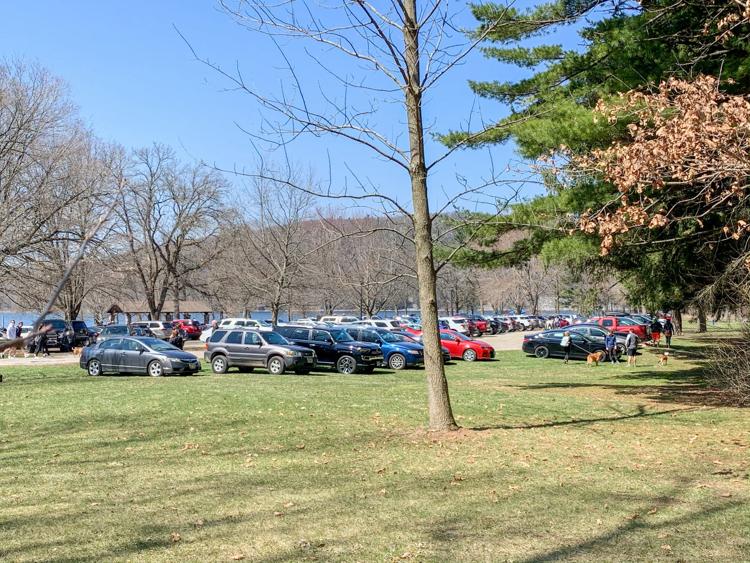
The photo below is from a "back door" entrance to Gov. Dodge park, and it has at least 3 times as many cars parked there as I've ever seen before.

Thursday, April 09, 2020

Epidemic analysis

In our practice with the small epidemic (there's going to be a big one someday, with the O(30+%) death rates), I'm not sure who is keeping track of what works and what doesn't, and trying to see how to open things back up.

We have "essential services" and "very low risk work." If you're not public-facing, a huge chunk of risk goes away. How can you reduce the rest of the risk? How do you know? Who is studying this?

Take tree-trimmers as an example. What precautions do they need to take? Separate vehicles, spray cleansers on shared tools like ladders, eat lunch apart, liners under the work gloves... Would those be good enough?

Sometime or other the lockdowns have to end, and they will have to end before the disease is completely gone--because it may never completely go away. The sanest way would seem to be staging it--but how do we (and who does) decide who goes first?

UPDATE: Looks like NEC Directory Gary Cohn is starting to think about it.

Wednesday, April 08, 2020

Subjective and Objective

Long ago I came to the conclusion that all women were beautiful if you looked at them in the individual way God made each to be looked at—not demanding "identi-kit beauty." True, there are some with such deep infelicity of feature or character that I've never been able to apply that rule to them. But as a general rule it has seemed to work.

Some 15 springs ago I was waiting for a bus in front of the student union, where three young women were improving the vista with their presence. After a while I noticed that my eyes lingered longer on one of the three, and wondered why. All seemed equally cheerful, and the other two had more classical figures. One of the other two was displaying a good deal of herself, which is a sure-fire attention-getter. Still, I thought the first more attractive.

After a few minutes I realized why. The first woman resembled my wife.

Monday, April 06, 2020

Care for the ancients

Looking at the Met's Aida tonight--or at least the first part of it--you can see that much
of the background is painted to look weathered, cracked, and worn. For a palace scene that
makes no sense, of course--everything would be made to look as good as possible.(*)

Egypt has been old for a long time. Did the rulers of Dynasty X take care to keep the temples of Dynasty X-N in good repair? If the gods weren't the currently fashionable ones, the temples might have been left to their own patrons' support. That might leave some decrepit-looking buildings around, which might not be the impression a pharaoh would want to give.

How about the funerary temples?

Some of the later builders scavenged stone, and there has to have been a huge black market in tomb-robbed gold, to which somebody was turning a blind eye. Perhaps, despite the elaborate efforts to maintain service for the dead, the ancestral service only lasted as long as the annuity. In addition, I suppose that the notables of N Dynasties back weren't really the ancestors of the current rulers.

Where paint survives on the temples, I assume we can figure out how often it was repainted. I'm pretty sure they could have used a little touch-up every few hundred years, and it would tell us something about their attitudes to the works of the ancients if the reliefs got the touch-up or not. Although something might be too sacred to monkey with, or too old-fashioned to keep in repair--the effect would be similar.

I'm tolerably sure that, even if a family lived in the same home for centuries and kept up the accruing memorials to the kas of all the ancestors, most of them would be honored en masse, because nobody could remember who they were. To be forgotten was a terrible fate for a ka, and observing this would make it a live worry for the living. "How can I make sure I will be remembered as me and not as 'honored ancestors'?"


(*) I wonder how many of the "hieroglyphs" Aida used in its decorations actually meant something? I can imagine some of the stage-crew getting a little creative. In their shoes, I'd try. It isn't as though anybody was trying extra hard for authenticity--the central figure in the "stone" trio of statues is a woman, of the same height as the men.

UVC

How do you clean an aircraft? The trays are notorious, the seats aren't exactly designed for quick scrub-downs (just imagine trying to vacuum them), and is there anyone here who hasn't flown with sick passengers (or been one of them!)?

Enter the GermFalcon, which generates UVC to kill bacteria and viruses. They use a 100amp battery (I think they get about 300 watts) to power UVC lamps to bake the surfaces.

Unfortunately the story doesn't mention how long it takes, and given that you only see one side of the tray table at a time (and it shadows other things), you'd need 2 passes to get the upper surfaces. I didn't see any lights down low for the floor--mustn't forget the floor and all the passengers who take their shoes off. And the shield for the operator isn't enough--he needs safety goggles as well, and had better wear long pants.

It looks interesting, though.

We bought a UVC sanitizing lamp, mostly for fluorescence demonstrations, but under the circumstances we may find uses closer to its original purpose. Ozone stinks, by the way.

Sunday, April 05, 2020

Ramming

Has everyone seen the story about the Venezuelan rammer?. "The 403-foot-long Resolute ... Intended for Antarctic cruises, it has a reinforced ice-capable hull." and "the steel-hulled patrol ship suffered severe damage from repeatedly ramming the cruise ship, began to take on water, and ultimately sank."

I'd have thought that the Naiguatá's captain might have noticed that things weren't going his way and desisted, but perhaps communications were poor.

I've heard a couple of explanations for the attempt--one at the link: "The ship was recently "arrested" by Argentina due to alleged non-payment of her fuel bill." Another implied a history of shakedowns.

Want to book a cruise?

Friday, April 03, 2020

Hypertension meds

"Instead of making COVID-19 symptoms worse, some antihypertensive drugs may actually reduce the severity of infections, and could therefore be used to treat the disease, both sets of doctors say."

One of those on the list is the very common lisinopril. It would be nice if that helped alleviate symptoms.

OTOH, one of those "underlying conditions" they warn about for COVID-19 death risk is hypertension. I wonder if they can split out those who were taking their meds and those who weren't: probably not. But if the drugs helped, I'd hope one could see a difference--hypertension being a lesser risk than other factors.

Wednesday, April 01, 2020

Fallbacks

An economic contraction can happen anytime, no matter what the Fed fancies its powers to be. And if it is deep enough and long enough, we have to consolidate: families take in fledged children, cousins, elderly aunts--and make do until opportunities open up.

Which suggests two questions...

Do we (on average) retain enough sense of extended family to be able to make that a real option?

Do we have the legal framework to define such mutual support? (Insurance, IRS tax status, etc). We've been busily trying to redefine marriage, but what about defining an ordinary extended family?

Tuesday, March 31, 2020

Evermor


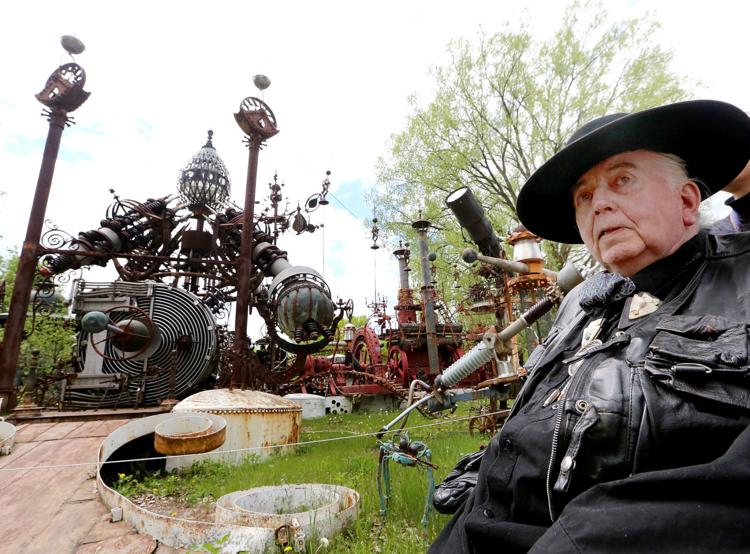
Doc Evermor died yesterday after a long illness.. Above, a robin took advantage of one of his metal birds.

He was a scrapyard artist. The sculpture park is weird and wild and fun. I think I liked his orchestra best. When we were there last, part of the fun was watching a grandson train the camera on everything around him. If you're by Madison, look it up.

Monday, March 30, 2020

Ahem.

The regular gust blew chill air out of the cave's mouth. In the evening it would blow in. It was old hat to the spelunkers.

The too-fast humans had no inkling of the slow tickle their years of exploring had made in the throat of the Father of Caves.

Sunday, March 29, 2020

Visions of the greater

In a very few of the SciFi stories I've read, the author contemplates what would happen to human science and technology after we met aliens with vastly superior technology. (Roughly equivalent technology doesn't change much: They have X and now we have X too, and aside from that we're peers.) Research science, as a field, disappears completely. Engineering turns into either reverse engineering or simply duplicating (if they let us) what the aliens build. We get discouragement. I think that was one of the points in Childhood's End, though I don't care to re-read it to check.

"What is there to do that has not already been done?" We're not big fans of doing the same things our forefathers did. Maybe that's not a virtue, but Is there anything of which one might say, “See this, it is new”? Already it has existed for ages which were before us. was a lament 2500 years ago.

In the face of true superiority, what choices do we have? If we can somehow unite with the superior without losing our own selves/souls, well and good. Otherwise, what's the use of doing anything?

God told Moses that "no man can see me and live." That's obviously true in the "firehose" sense--there is too much God for us to begin to handle. Perhaps there's something else analogous to those aliens as well. Aquinas set down his pen and said all he had written was so much straw. After the Beatific Vision, can we turn attention to the things of the world again?

Maybe. God did, and if we are united with Him maybe we can too. But it seems as though we were made to see in particular ways: "For the earth will be filled with the knowledge of the glory of the LORD," but with the glory incarnate through the physical things. We should have, not direct apprehension of God, but vision mediated and illustrated through His creation. (including ourselves, ideally--though not always so much in practice)

The resurrection of the body suggests that some of the old ways of seeing will remain; but at a minimum will be as they should have been.

Saturday, March 28, 2020

Trades

It struck me a few years ago: in the churches I've been a member of, we've had doctors, policemen, guards, nurses, dentists, real estate agents, teachers, school principals, secretaries, accountants, auto mechanics, carpenters, pilots, privates and colonels, painters, general laborers, lawyers, scientists, unemployed, hotel inspectors, even a state senator and a governor--but I don't remember ever meeting a reporter.

If you can keep your head

The headlines keep buffeting us with crises. How do I know when to take action, and what kind?

I want to advise someone who is not a specialist in the whatever the crisis-du-jour is. First--the generic steps to take to learn and evaluate; second--a specific example.

Big picture:
  1. The world has lots of things and people trying to kill you.
  2. Sooner or later something will kill you.
  3. In the meantime there will be plenty of real and false alarms.
  4. Nobody tells one from the other 100% of the time.

Now that that's out of the way: What about the current crisis?

  1. Turn off the TV. And the radio. Log out of Facebook and put your cell phone away. They all make money out of making you afraid.
  2. Get a pen and a pad of paper and sit down at the kitchen table. If you're nervous, recite a Psalm or sing a campfire song.
  3. Write down what the crisis is supposed to be about.
  4. Write down how it is supposed to effect you.
  5. Write down these questions. Don't start looking for the answers yet.
    1. Who says this? Reporters are as ignorant as you are. So are politicians. Find out the source they are quoting. If they don't give you a source, ignore the report and find one that does--if you can.
      1. Is the source they are quoting flogging a new book?
      2. Does the source have an expert's credentials? For example, is this a lawyer talking about medicine?
      3. Do other experts have something to say?
      4. Is the source credible? For example, a lawyer will always say his client is innocent, and totalitarian state officials will always cover up problems.
    2. What are the sources actually saying will happen, as opposed to what may happen? Remember that the media have a vested interest in playing up the worst case scenario. Write down the "may" case and the "worst" and, if they have it, the "best."
    3. Who benefits if the worst case comes to pass?
    4. Who benefits if we take the recommended action to stop the worse case? Sometimes the beneficiaries are politicians grabbing power; sometimes these are particular people or industries. That someone benefits does not make a claim false, but it is something to keep an eye on.
    5. What things might happen to you - short term - in the worst case? In the likely case?
      1. What are the chances that each of these might happen? For example, suppose you're worried about getting hit by a stray bullet. If you don't usually hear gunfire, the chances are very small. If you do: how often are people accidentally shot, and how many people live in the danger zones? Divide the first by the second--that's roughly your risk. It may be less if you live in higher stories of a building, or much higher if your neighbor is a gangster. Raw numbers can be scary; rates less so.
    6. What can you do to reduce your risk? You do not have anything to prove to anybody here--forget phrases like coward or racist or "bad for the planet." Just figure out what you might do.
      1. Any action, including no action, carries risks. What is the risk of your possible action? For example, if you are worried about getting mugged, you might think of investing in a bullet-proof vest. This has some risks--to an experienced eye you stand out, and you don't want attention, and it makes it harder to run when you need to run away.
      2. What is the opportunity cost of your possible action?
      3. If you are a Christian (I am), imagine trying to explain to Jesus why this action is a good plan. Write that down.
    7. Have things like this happened before? Make a list of times and places.
      1. How is the situation now different?
      2. Do the differences make any difference to your risk?
  6. Figure out where you need to look for these answers, turn your computer back on, and go look. Ask for help if need be. Remember that even the devil can tell the truth sometimes. Collect the answers.

  7. What does the risk look like now?


Take the Wuhan virus plague.

Ignore Trump. And Pelosi and Biden. What do the doctors say?

What may happen? If you find the numbers, you learn that something like 1% of people die. That's 10x worse than the average flu year, 10x better than the Spanish flu, and 50x better than Ebola. It is also about 10x worse than the average death rate from other causes. If the ER's get clogged, your chances of dying of something else are higher even if you never catch the disease. If you're old, the risk is high; if you're young your risk of dying is low--but your risk of passing it on to somebody else is high. So, say about 1% unless you're old, and a high risk of passing it on to somebody.

If you read widely, you find that the death rates vary all over the place. If you look even closer, you find that it is almost impossible to get true comparisons, because of reporting problems--if a country doesn't know how many are infected, it can't know what the rate is. So the 1% number that we got from the Diamond Princess is probably as good as you'll be able to know for a few months yet.

Who benefits in the worst case? Not even coffin makers; people will go cheap. Who benefits from extreme action? Politicians--as usual.

Can you reduce your risk? Yes--everybody has explained how. The question of whether to close businesses isn't a private question. Are you going to have a hard time explaining to the Almighty why you decided to skip going to a party and wash your hands? Probably not--those are decencies. You might have a harder time explaining why you decided not to take it seriously.

Have these things happened before? Yep. This one is worse than usual, but it could be a lot worse--and some day a really bad plague will come through. Similar--lots of people are going to die. Different--in this country, at least, we've got pretty decent medical care, which will help more people survive.

Friday, March 27, 2020

Tracking it down

I read a snappier version of this in You Call this Living and thought I should see where it came from.
On an official visit to Paris in 1963 at the death of Jean Cocteau, Jaroslow Iwaskiewicz, President of the Union of Writers and Dramatic Authors, and author of the novel _Mother Joan of the Angels_, was asked by Adrezej Moosman, directory of Slavic language broadcasts: "Are you a catholic?" Iwaskiewicz answered in a detached tone, "Yes, I am a believer but not a practicing Catholic." His companion retorted, "And doesn't that prevent you from having an important official job in a communist country?" The retort was a witty: "That's different, in that case I am practicing, but not a believer."
Found here

Shoes

I figured sidewalks are inhospitable places for viruses. But I hadn't thought of floors. All those aerosols settle where? The tiny droplets should dry out fast, but the bigger ones might be comfy homes for viruses for a while. A lot gets rubbed away when you walk out of the store, but...

OK, new rule--treat shoes like boots--change at the front door. Then wash your hands.

Thursday, March 26, 2020

Covid experience

Via ChicagoBoyz; some experiences of a Texas doctor. Note that he is seeing mostly the bad cases, but he's seeing a lot of them.

Interesting that steroids make things worse--I gather that's a common part of treatment for pneumonia, which this can be mistaken for. I suppose that immune-suppressed people are more likely to get it--but I wonder if they're resistant to the cytokine storm.

And I see why I was tested--I presented with a constellation of the symptoms.

Wednesday, March 25, 2020

Getting out

It's nice to get out of the house again. I've been recovering (self-quarantined for a few days until the test came back) and not up to driving about much.

The Post Office was open--the woman serving me noticed my glove and said "Oh yes, I need to do that," and pulled hers on.

I'm trying a little experiment. When I have to use touch-screens or buttons I wear a glove on the right hand and leave the left bare for jobs like fetching out debit cards or getting the car keys out--in other words the left hand touches my stuff and the right glove touches the public-facing stuff. And once the car door is open, the glove gets stripped off and dumped. It takes a little thought before acting.

Some stuff is a little ambiguous--e.g. the purchases. I figure a clean working area and cleanup of everything as it gets taken out is probably fine, and wash-up before putting the goods away.

For an amusing exercise, add a quart of oil to your car, and see how many places gather grubby marks. I'll bet you didn't remember touching that, did you?

Saturday, March 21, 2020

Exponential vs

Pearl curve


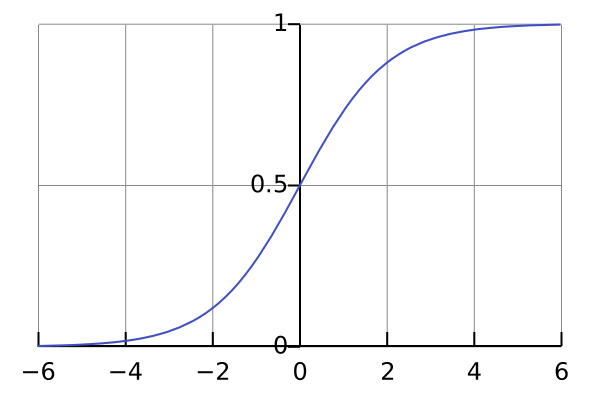
It starts out looking like exponential growth, and then flattens out as whatever-it-is saturates. WRT the Wuhan virus, we're at the start of the curve, where things look like exponential growth.

I'm just being picky, here. And, for those not aware, "exponential" doesn't always mean growing--it can mean shrinking too.

(To my relief but not surprise, I tested negative and don't have to self-isolate anymore. It turns out that has an impact on what other members of the household are allowed to do. But I've still got a bad cold.)


For some reason newspaper explanations remind me of this.

Two mathematicians are in a bar. The first one says to the second that the average person knows very little about basic mathematics. The second one disagrees, and claims that most people can cope with a reasonable amount of math.

The first mathematician goes off to the washroom, and in his absence the second calls over the waitress. He tells her that in a few minutes, after his friend has returned, he will call her over and ask her a question. All she has to do is answer "one third x cubed."

She repeats "one thir -- dex cue"?
He repeats "one third x cubed".
She asks, "one thir dex cuebd?"
"Yes, that's right," he says.
So she agrees, and goes off mumbling to herself, "one thir dex cuebd...".

The first guy returns and the second proposes a bet to prove his point, that most people do know something about basic math. He says he will ask the blonde waitress an integral, and the first laughingly agrees. The second man calls over the waitress and asks "what is the integral of x squared?".
The waitress says "one third x cubed" and while walking away, turns back and says over her shoulder "plus a constant!"

Friday, March 20, 2020

Elizabethan royal entertainment

“One day, a great feast was held, and, after dinner, the representation of Solomon his Temple and the coming of the Queen of Sheba was made, or (as I may better say) was meant to have been made, before their Majesties, by device of the Earl of Salisbury and others. But alas! as all earthly thinges do fail to poor mortals in enjoyment, so did prove our presentment hereof. The Lady who did play the Queen’s part, did carry most precious gifts to both their Majesties; but, forgetting the steppes arising to the canopy, overset her caskets into his Danish Majestie’s lap, and fell at his feet, tho I rather think it was in his face. Much was the hurry and confusion; cloths and napkins were at hand, to make all clean. His Majesty then got up and would dance with the Queen of Sheba; but he fell down and humbled himself before her, and was carried to an inner chamber, and laid on a bed of state; which was not a little denied with the presents of the Queen which had been bestowed on his garments; such as wine, cream, jelly, beverage, cakes, spices, and other good matters. The entertainment and show went forward, and most of the presenters went backward, or fell down; wine did so occupy their upper chambers. Now did appear, in rich dress, Hope, Faith, and Charity: Hope did assay to speak, but wine rendered her endeavours so feeble that she withdrew, and hoped the King would excuse her brevity: Faith was then all alone, for I am certain she was not joyned with good works, and left the court in a staggering condition: Charity came to the King’s feet; and seemed to cover the multitude of sins her sisters had committed; in some sorte she made obeysance and brought giftes, but said she would return home again as there was no gift which heaven had not already given his Majesty. She then returned to Hope and Faith, who were both sick and spewing in the lower hall. Next came Victory, in bright armour, and presented a rich sword to the King, who did not accept it, but put it by with his hand; and, by a strange medley of versification, did endeavour to make suit to the King. But Victory did not tryumph long; for, after much lamentable utterance, she was led away like a silly captive, and laid to sleep in the outer steps of the anti-chamber. Now did Peace make entry, and strive to get foremoste to the King; but I grieve to tell how great wrath she did discover unto those of her attendants; and, much contrary to her semblance, most rudely made war with her olive branch, and laid on the pates of those who did oppose her coming.”

I thought the cast party was supposed to come after the show, but would be happy to be corrected.

Feet of clay

The great Lord Acton once complained that Bishop Creighton treated morals far too lightly in his historical works. No doubt, fundamentally, Lord Acton was right. But it is a question of energy: to exhaust oneself in disapproval wastes so much, and—since all those strange figures are dead—does no good. No living person is likely to be improved by denunciations of phantoms, and as for the phantoms themselves, what purpose does condemnation serve? “Shrilling on the wind,” they go by; there is something a little comic in trying to rebuke them. Besides, it encourages us to think that we are better than they.

Charles Williams James I

But we find such a thrill in pointing out the real (or merely unfashionable) crimes of historical figures. Plus, they're safely dead, and can't refute you.

Thursday, March 19, 2020

Reconstructions of Helenist inventions

I wrote about Russo's book on "ancient" Greek science back in 2013. I don't follow him all the way, but there was plainly a lot accomplished, and then lost.

Pictures help. The Kostanas Museum of Ancient Greek Technologies shows some interesting reconstructions. This is a "mechanical theater".

Unconforming

"And this unwillingness to believe anything until it has been officially denied, my suspicion of every crowd and fashion, is not a virtue of my own making."

Wednesday, March 18, 2020

Chloroquine

In vitro is one thing, but clinical studies are another, though with relatively few patients yet.
results from more than 100 patients have demonstrated that chloroquine phosphate is superior to the control treatment in inhibiting the exacerbation of pneumonia, improving lung imaging findings, promoting a virus-negative conversion, and shortening the disease course according to the news briefing. ... regulatory authorities and organizers of clinical trials reached an agreement that chloroquine phosphate has potent activity against COVID-19

"Potency" seems like a strong word, but it is probably a term of art here. And I couldn't read the studies to see what they were like and how much "better than control" they were.

I knew chloroquine--used to take it--but I thought it wasn't any use against today's resistant malaria strains, and had no idea it had other uses as well, against other "intracellular infections" such as Q fever and Whipple's disease. And I'd not have thought that a drug effective against intracellular infections by bacteria would also help some viral infections, but the details matter...

Regarding viruses, for reasons probably partly identical involving alkalinisation by chloroquine of the phagolysosome, several studies have shown the effectiveness of this molecule, including against coronaviruses among which is the severe acute respiratory syndrome (SARS)-associated coronavirus

We'll see. It doesn't sound like a cure, but a treatment would be good too. Especially a cheap one like this.

But wait until this replicates before celebrating.

I used to have some pills left over after a bout of malaria over 40 years ago, which I kept around in case of a recurrence--malaria is infamous for those. I think I threw them out decades ago.

Tuesday, March 17, 2020

Status Updated

I've got a bad cold, and would be at home even without the telecommuting mandate. (I'm also the OOD this week.) However, my temperature is low--as usual: 98.6 is just a population average.

UPDATE: Oops. It seems that just as different medications can interact, so can different diseases. Bottom line: I spent quite a bit of time in ER and under observation, but the best the docs came up with is a two-fer combo deal. Though, out of an abundance of caution, I was also tested for COrVID-19(*) and must self-isolate for a few days until the results come back.

Strange to think that the most dangerous place I stayed was probably the isolation room at the hospital. Negative pressure sucks air into the room from the hall, and we know sick people go through there. Well, maybe the ambulance was risky too--traffic accidents are always possible.

(*)I'm sorry, but I always think of ravens when I see that term.

Sunday, March 15, 2020

Remote participation

Playing baseball without fan noise would be weird. They could do it, of course--they practice all the time--but the fans give the game more "energy" and put something more than just game stats at stake.

Suppose MLB created an app that let you watch the game if you liked (this already exists, of course), but with the option of signaling your approval/disapproval in real time.

This would have to be with "buttons"--no way could the network or the servers handle the bandwidth from live-streaming 10,000 fan voices. But when the boo/yay/hit!/miss! tallies arrived at the server, it could drive the appropriate volumes of fan noise into large speakers around the stadium.

The players would get fan feedback and encouragement in real time, the fans would get to feel like they're doing something--and hear the noise that results, and MLB could rake in a little extra money for the app as well.

The user interface is absolutely critical. It would have to be extremely easy to use, maybe let you hear your cry (maybe record your voice and play it back to you?) in the mix, and have enough "resistance" to make it feel like you are actually doing something more than punching a button. By resistance I mean that you have to do something harder than touching a screen: but it has to be something natural. Maybe pushing a button and yelling?

Friday, March 13, 2020

Immunity: Update*3

It seems likely to me that part of the jump in COVID-19 cases is more widespread testing.

I'm not sure how many variants of the tests there are--and I include procedural variants in that, because sometimes the procedures m
ake a difference. (CDC testing procedures)

  1. How many false positives are there in real-world usage?
  2. How many false negatives are there? How often ought we re-test to be confident that the person is indeed not infected?
  3. Can we reliable distinguish antibodies for this strain from others?
  4. Is there a reliable procedure for determining if someone is shedding the virus?

We expect the vast majority of the young who are infected to shake the illness easily. If, as with other corona viruses, those who recover have some immunity, then I think we want to try to assemble crews of the immune.

That means we want some accurate answers to those questions, as soon as we can get them.

UPDATE: " in contrast, the false-positive rate of positive results was 80.33%"

UPDATE2: " 697 who tested positive a month ago, seven people have died on the Diamond Princess cruise ship, 15 remain in critical condition, and 30 were once in critical condition but have improved". In other word, 1% die, and about 6.5% need intensive care. The deaths there were all over 70 with other conditions, but that's not the whole story.

UPDATE3: 23-Mar The first pass on an antibodies detection test

Show of hands?

Who else is starting to feel like Lady Macbeth?

Spam and humility

I may be the center of my world, but if I can manage to remember that I'm not on most people's radar at all, it gets much easier to remember that Bill Gates has little interest in my computer, Nigerian princes won't know me from Adam's off ox, and that strangers are unlikely to spontaneously take pity on my financial woes or my love life. "I'm flattered, but how did you get my name?"

Thursday, March 12, 2020

Ritardando

In congregational music we generally gradually slow down a bit when ending a song. (I don't hear ritenuto--immediately slowing down--very often) Is there a pattern that generally sounds best? (e.g. making the penultimate measure 25% longer and the last one 50%, or lengthening the notes in the last couple measures by 10% over the note before, or maybe the fractions vary with the original tempo)

A quick googling found the term "ridardando," but it looked as though it not defined and is left entirely to the taste of the performers. Which is fine, but I wonder in practice if they generally converge on some patterns that sound better.

Interpretation

The sign on the door matched the poster on the quad. He went in. Kingston looked around the brightly decorated room with its chairs and lectern and upbeat posters on the walls, and then at the handout the teacher offered him: Properly Ordered Desire. He hefted the coin in his hand and asked "Where's the wishing well?"

Wednesday, March 11, 2020

Today's covid watch

UW-Madison is moving to online classes. Spring break is being extended a week and students asked to please move out of the dorms when they leave. Profs are supposed to use the extra week to shift to online classes. (They understand that some students can't do that--e.g. Italian students--so some dorms will still be open.)

We started looking at this a while back, but I suspect that hand-holding a couple of thousand lecturers through the process is going to take more than a week. And we'll need a lot of facilities: lots of tech support to keep them running too.

I'm to travel tomorrow--but I'll be driving, not flying, so as long as I use care gassing up the car I shouldn't see much opportunity for infection, and as long as Louisville doesn't go all New Rochelle I should come back on time.

Conferences are cancelled left and right, and it looks like the collaboration meeting in Brussels isn't going to happen. Maybe it'll be virtual--I wasn't slated to attend, but I could try a virtual meeting. I just have to set the alarm to "impossibly early."

And, one of the team is self-isolating. It doesn't sound like covid to me, but he wants to be safe, and he can work just as easily from home--maybe more so.

The ravens aren't perched watching us yet. COVID-19 hasn't turned into corvid yet.

Sunday, March 08, 2020

Better than metric units

I never remember how many feet are in a mile, and avoid stones and slugs (and slings and arrows). Imperial units have their little issues, and when distances go to sea they leave me in knots.

But give the Imperial units their due. At least one set of measurements anticipated digital computers with their powers of two--the fluid measures. For a computer, they're better than metric. 2^3 fluid ounces to a cup, 2 cups to a pint 2 pints to a quart, 2^2 quarts to a gallon. If you move to dry measures, 2 gallons to a peck, 2^2 pecks to a bushel.

Daylight Savings Time

Every Spring, for about a week:

Saturday, March 07, 2020

Oversight

Measure R passed in LA. "The new policy grants an LASD civilian oversight commission independent authority to subpoena documents or witnesses pertinent to its investigations. Additionally, the referendum’s passage requires that body to draft a plan for reducing the county jail population with alternatives to incarceration."

That sounds relatively benign, unless you've heard about how oversight boards can work in big cities. What is planned for this one?

“We will use it to hold the Los Angeles Sheriff’s Department accountable, and we will use it to make sure L.A. County continues to move forward with a care-first/jail-never ethos.”
...

Cullors, who has often been candid about her desire to “dismantle” law enforcement agencies and abolish prisons,

It seems to be an article of faith that "the system" causes crime. Never mind evidence; never mind experience; never mind logic. None of those things matter. The fact that blacks are arrested more often than whites or asians is proof of injustice.

In Chicago there will be a Community Commission for Public Safety and Accountability: "Commission members will be selected based on their expertise in areas such as civil rights, social work, work with immigrant and undocumented communities, and law. Two of the seven commissioners will be between the ages of 18 to 24 and have experienced police misconduct." That last seems very very odd. I'm trying to think of a way this won't be abused.

Qui bono?

What drives this sort of "stop the police?" Self-justification, maybe. A kernel of truth; enough to make the whole thing seem palatable. Once upon a time in the South you couldn't convict a white man for attacking a black man--maybe there's a inchoate sense of collective revenge? Snow jobs? Netflix and Facebook founder's wives kicked \$2M into the campaign to get the LA referendum passed. Maybe they got the English version instead of the Arabic version of the story.

Yes, police misconduct is a real thing. But just as I don't want the police to monitor complaints against themselves, I don't want cop-haters and "social justice" activists doing it either. We've seen both movies--neither turns out well.

Hair of the dog

At a school concert the other day, I saw a number of posters evidently directed at an African-American student event. The one nearest me involved a black family, and bore a slogan inviting us all to build the family and destroy the patriarchy. I wonder who thought that up. If I read the statistics and studies correctly, black children need more fathers willing to take responsibility for their families, not fewer.

What does the slogan-eer think a family is? A fungible collection of interchangeable, role-less bodies?

Friday, March 06, 2020

Science Fiction Culture

"It is impossible to use electric light and wireless and to avail ourselves of modern medical and surgical discoveries, and at the same time to believe in the New Testament world of spirits and miracles. We may think we can manage it in our own lives, but to expect others to do so is to make the Christian faith unintelligible and unacceptable to the modern world." Bultmann, 1961

"Any sufficiently advanced technology is indistinguishable from magic." Arthur Clarke

Apparently for Bultmann, "sufficiently advanced" = "I don't understand it."

Anyone who understands the immense effort that goes into that switch bringing light will not mistake it for a miracle. If the knowledgeable one is working in the fields himself, he might even be insulted that you ignore his hard work.

Perhaps the mistake is unsurprising--miracles are done by Someone else, and the light from the ceiling or frozen food in the store is done by someones else--other people who are usually invisible to the lucky consumer.

Are we aware enough to be grateful?

It wouldn't hurt to remind ourselves, and our children, of how much work goes on behind the scenes, and how hard one must work to make things easy.


One side effect of living with so many "pocket miracles" is losing track of what is possible and what isn't.


Science Fiction Culture is a kind of magical thinking, shaped by our attitudes to the engineering marvels that we don't understand. In science fiction anything is possible. Travel faster than light? Upload your brain into a computer? All just a matter of time. I can point you to people who believe this!

The sci-fi/magic universe isn't just "pocket miracles" now, it is a future of more and more. "Whatever you imagine can be someday." There's already a touch of solipsism here--who needs to think about pesky realistic constraints?

If anything is possible, what's to keep us from achieving it now? "If we can put a man on the Moon, we can find a cure for cancer! All we need is the will to commit the resources." It turns out that dreams demand power and money, and if they're fruitless it's just because "You're not doing it right!"

When dreams meet reality, frustration ensues. I don't think it gets better when you can't admit you were wrong.

  • "We can eliminate poverty" Depending on how you define that, "sort of" and "not a snowball's chance."
  • "If the other countries just got to try the democratic/consumer society, they'd all get along." Somebody didn't pay attention in history class. Or current events.
  • "If everybody would become Christians, the world would be perfect and at peace." Jesus said a few things that disparage that premise.

What else is the notion that you can easily change sexes than sci-fi? (Tiresias had to have Hera work a miracle--not something just anybody can arrange.)


UPDATE: About the "invisible people:" when you think of "Top Gun" remember these pictures.

Thursday, March 05, 2020

"At risk"

From April 25, 2018 a pilot program that assists students with academic challenges and allows them to participate in a high school and college-credited state-certified Fire Academy program."

A few months later: September 9, 2018 they arrived and found 17-year-old Mekhi Moss threatening to punch a METRO bus driver. He was riding the bus. ... The teen faces multiple charges, including disorderly conduct, marijuana possession with intent to deliver and felon in possession of a firearm. Felon at age 17--presumably he was during the Fire Academy program too.

And today the report says that being charged with an armed robbery on 21-Jan.

I gather the Fire Academy program didn't help much. He wasn't in the picture with the mayor; I wonder if he had all the tattoos then.

The name turns up in "part time nannies" available in Sun Prairie. Was that a joke on him or by him?

Tuesday, March 03, 2020

Movie focus

I was absorbed in my reading on the bus. I felt it turn, and turn, and when I looked away from the kindle I realized I'd lost track of where we were. It wasn't significant--my exit wasn't for another 15 minutes--but it was a sharp reminder that I'm not always attentive. The sketch of a man eyeing an attractive woman walking by and running into a phone pole he didn't notice is funny because it's all too true.

What comes to mind is one of those scenes in the New Zealand movies where there's vast scenery and a troop of nine walking along the ridge. My eyes flick back and forth between the scenery and the actors, and when I concentrate on one the other fades.

Suppose you were making a "first person"/stream-of-consciousness movie, seeing what the protagonist sees and hearing what he hears. You could force the viewpoint with camera focus, and maybe with post-processing tricks to literally fade other things in view. I've seen something like this done when the hero has been drugged or slugged and is slowly gaining consciousness, but that's only for a scene. I wonder if you can do it longer. Finding a balance between single-minded focus and flicking the attention this way and that would be quite a trick.

In clumsy hands this would be unwatchable. Without a good story-line reason for doing it, it would be pretentious. With skill and story-telling reason--it might still be a poor choice.

Somebody is bound to have tried this--probably many somebodies. And I'd bet most of the results aren't any good: in art "90% of everything is junk". Has this approach to forcing the viewer's attention ever worked?

Monday, March 02, 2020

Snapshots and browsing security

Your browsing session carries along with it quite a bit of information--not just cookies. I'm told that even without cookies there's often enough info to almost uniquely identify your computer/browser combo.

There are supposed to be ways around that with Virtual Private Networks and anonymizers and what-not, assuming you trust them. I'll look into that some other time.

Another, perhaps more urgent, problem with browsing is that bad actors out there are happy to infect your computer with whatever they can load on. Anti-virus software can help, but last time I checked none of them were 100% effective.

I decided to experiment with virtual machines.

Maybe containers would be a more lightweight way to go. I'll look into that later. I figured virtual machines would be easier to offer step-by-step instructions for.

The platform is a 5-year-old Macbook I use but don't own: 16GB and an SSD. That SSD would probably be the biggest difference when comparing to some other platform.

I installed VirtualBox.

After starting VirtualBox and asking to create a new virtual machine, I installed Windows 10. And then installed the "extension pack" for VirtualBox into Windows 10. (I had to go back and add a "Virtual DVD drive" and then use the menu to point that at the extension pack's .iso file to get it to load) I asked that the clipboard be importable from the main OS to the client, but not vice versa. If you allow the VM to mount any part of the host's filesystem, a malicious worm may write there without your knowledge--so only mount scratch areas you don't care about.

In Windows 10, I installed firefox as the browser because it was familiar. I manually asked for the most recent Windows 10 updates. Then I started the browser.

Then I "took a snapshot;" both filesystem and memory at the same time.

That's a clever trick used with some filesystems (e.g. Plan9 and ZFS) and pretty much all virtual machine managers. At first there's no change, the snapshot is just like the original filesystem. But if I change a block of data, the old data in the snapshot does NOT change. What changes is the pointer: it points to the new data stored elsewhere. If you delete a file, the snapshot file is still there in the old area, but in the current system there's no pointer to it anymore.

You can tell the virtual machine manager to "revert" the virtual machine to the old snapshot, and it will chuck all the new stuff and return it to the old state.

So, suppose I need to look up repair manuals for a washing machine. Those sites are notoriously infected; as bad as recipe sites. I connect to a site that promises me a parts list, but instead it uploads a javascript that rewrites some important little files in my area.

At the end of the session, I have an infected machine, that may be phoning home as I sit back and reach for the peanut jar.

I log out and shut down the virtual machine. It isn't running, but is still infected.

I open the VirtualBox menu for the virtual machine and "revert to snapshot." It asks if I want to make a snapshot of the new version. No, I don't.

The system is reverted to the state of the original snapshot.

Now if I restart the virtual machine, it comes back to the state it was in at snapshot time--open browser and all.

Bottom line: With a Windows 10 VM and SSD for the host, it takes about 15 seconds to open and be ready.

I should play around with some other, lighter-weight, operating systems, to see if I can cut down that 15 seconds to something more snappy. I figure the less data it has to load from disk, the faster it will load.

Side effects: Any form fill-ins that weren't set up with the snapshot will be lost when you revert. Any updates to the OS that happen while you are browsing will be lost on reversion. That latter bit is important: every few weeks you will want to start a snapshot, install updates, create a new snapshot, and merge the old one away.

I tried watching YouTube videos: sound and movement were slightly and annoyingly out of sync.

UPDATE: Mint loads in about half the time.

Saturday, February 29, 2020

Haiku month

February has been "Write a haiku a day" month. Why not?

I did it: at least one per day. I picked a topic: archaeology, in honor of the Time Team videos my wife has been watching. (I wanted to be an archeologist when I was 7. And a paleontologist. And maybe a fireman. I've always maintained an interest.)

There are 6 pages worth; some trying for the spirit of the form and others "just following the form."

It was a fun exercise. But the result is an offense against the spirit of the haiku--because it is 6 pages worth.

I should have foreseen that.

UPDATE: Given the underwhelming popular demand:

The careless and slobs
Left great archaeology.
Tidy people don't.

Priestess of Mehyet
Makes a hardened dry grimace
In a library

Thursday, February 27, 2020

My Diary North and South wrapup

I used this as bus reading, so it took a little longer than usual. BTW, 4 pages in that are unreadably blurry. And the ocr scan is nightmarish. The book's pages were a little browned and spotted, and the ocr software frequently went nuts.

Read My Diary North and South for a more-or-less neutral take on the run-up to and beginnings of the Civil War.

Russell is not terribly fond of Americans in general, or American cities in general, or American attitudes in general, though he finds a number of pleasant people and places anyhow. For that matter, you or I probably wouldn't care for the streets in Washington DC at the time--nor those of London.

The newspapers of that day were even greater fabulists than those of today, and every bit as partisan. Wild boasting by officials and common citizens alike ("England will come crawling to our support; cotton is king!" "We can whip the Sesseshers and England and France as well if they get in our way!") tried Russell's patience.

The next-to-the-last straw was his honest report of the retreat from Bull Run. As the (English) bearer of bad news he was blamed for it as though he had caused it. And, though the generals didn't mind his traveling with the army, in the end as the war progressed, he was unable to get permission from the high-ups, and gave up and went home. He was there as a war correspondent, not for amusement.

In the South he observed that, at least publicly, everyone was vehemently for secession, and despised the North and especially New Englanders. The New York elite was, at least until Fort Sumter was shelled, in support of anything that that opposed the hated Republicans (some things don't change much, do they?). He didn't seem to have much conversation with lower classes in either region. He doesn't dwell on it much, but he saw egregious favoritism in army supply, and in which officers got promoted and why. He was not impressed with McClellan, or with the Union armies he saw.

Interestingly, in both North and South, women were more strongly partisan than the men.

He touched on the violence of Southern society, and prevalence of duels (at least one Northern officer died in a duel, so it wasn't limited to the South). I've heard "an armed society is a polite society," but I'm not quite sure about that. If you restrict "society" to a class, perhaps it is. Or perhaps if the society stays relatively sober, it might be.

He arrived after passions were already flaring. He watched as the anger grew after Sumter. I wonder if some of that, in the mouths of former Northern supporters of secession, was from a sense of betrayal.

I think it useful to read of a time when hatreds were even worse than now.

And, given those hatreds, I think we can be grateful for men who were magnanimous in victory, and magnanimous in defeat.

Tuesday, February 25, 2020

Preservation

When I was about 11 or so, I was given an illustrated (with color photos of the artifacts!) novel about Egypt, which followed the transformation of a young "grave robber" into a young archaelogist. Though it probably wasn't great literature, I liked it.

I'm not sure I'd re-read it if I found it again, but the fact that it was part of my life for a while and I haven't a clue where it is or what the title or author was, can feel like an itch.

"It was part of your life, why don't you still have it?"

On the sofa is a children's book, "Into the Mummy's Tomb," that reminded me of that itch, and of the irony of it. The pharoah's thought they were gods, and tried to take all the treasures of their lives with them.

But only God, for whom all time is now, can preserve all our treasures. We use them up or lose them, and can't even step into the same stream twice for a treasured experience. The second kiss doesn't have the same surprise as the first one: better or worse, it's different.

The bookshelves, despite some culling, still have some things that I enjoyed once. I mustn't try to be pharaoh. I read something about "the one who tries to save his life will lose it." Souvenirs can clog as well as encourage.

Cat music

Should vets play "cat music" when they want to handle cats?

Yours truly believes the devil is in the details (were the handlers listening too?), but if you want to see the research, the paper is here.

Snowdon and Teie recently concluded that cats listening to music in their homes prefer music that was specially made with cat vocalizations, with preferred tempos and with normal vocal frequencies as the primary considerations. Cats responded to music positively by orienting and approaching speakers playing cat music more often and quicker than to speakers playing classical music. The cat music played contained melodic lines based on affiliative vocalizations and rewarding sounds. These melodies are interpreted as more likely to be effective if the goal is to calm an agitated cat. The thought and musical design behind composing cat-specific music was based on the idea that the development of the emotional centers in the brain of the cat occur shortly after birth, during the nursing stage. Because purring and suckling sounds are common in this developmental stage, these sounds are layered into tempos and frequencies used in feline vocalization to create cat specific music.

And yes, the students were in the room for part of the "treatment"

After that, two veterinary students proficient in physical examination and venipuncture and trained in the study’s methodology, performed full physical examinations, including turgor test, mucous membrane examination, capillary refill time, oral examination, body condition assessment, abdominal palpation, pulse and heart rate, respiratory rate, cardiopulmonary auscultation and rectal temperature, all while the auditory stimuli continued.

And blood tests for stress didn't show any effect from different types of music.

And--they used 25 cats. Look at the overlap... (UPDATE: The image is now missing)


Want to have a listen? There's a snippet on this page. I checked YouTube, and a random sampling of "cat music" doesn't sound a lot like that, it's more human-soothing. Though I suppose if you are hyper, your cat(s) might pick up on that.

My take? "Cat music" sounds like it might be real, and it probably doesn't hurt at the vets, but getting hoisted and jabbed by strangers is always going to be stressful.

Monday, February 24, 2020

You Asked For It

Somebody called it the YouTube of the 50's. We watched it a time or two in "reruns" in Liberia. This was the first one that came up in a search--it was new to me, and a seriously mixed bag. It's good to remember that sometimes there are good reasons that some things aren't made anymore. Although-- quite a bit of YouTube (including professional performers' work) is in execrable taste too, so there's no evidence for moral improvement and uplift.

People wrote in to ask for a wrestling chimp, Ivory Joe Hunter's TV debut, a magician demonstrating card shark tricks, a William Tell shot, and a blackface song with one of the Jolsons.

I remember one episode which demonstrated the power of human temperature management through sweating. A man and a pan of brownie batter went into an oven (wooden seats for the man) for 15 minutes at (I don't remember) degrees. The brownies came out at least superficially cooked, and the man came out a bit dehydrated but OK.

Sunday, February 23, 2020

"mansplaining"

Althouse has a post up on the "subject." I don't know if this approach is strictly relevant, but in case you aren't familiar with the story...

Laura Fermi wrote:

Leo Szilard stayed several years with the phage group between two periods of intense political activity. Before revealing his interest in the phage, Szilard had visited Luria's laboratory at the University of Indiana. 'Doctor Szilard, I don't know how much to explain,' said Luria, embarrassed by the presence of the great nuclear physicist. 'I don't know what to assume ...' 'You may assume,' Szilard replied promptly, 'infinite ignorance and unlimited intelligence.'

Slogans

A slogan has to be pithy. Quite a few have a bit of Motte and bailey to go along, and once that hook is set, the rest of attitude should come along.

I posted a piece on deniability a while back, looking at "Black Lives Matter "as much as anyone else's""(*) and "We should have picked out own cotton "instead of bringing in slaves"" as examples. They seem undeniable statements (at least to a modern American), but the subtexts that come along with them, and the political attitudes that come with the subtexts, are other things entirely.

Another slogan came to mind recently: "God is still speaking." This means something within a Christian context--it isn't aimed at other religions. It seems straightforward enough--God is still calling, still disclosing to each individual what others may have already heard. It isn't simple to deny this.

The subtext is "God is revealing new things to us." That's a lot more controversial. Some with inadequate knowledge of history will argue that "Christianity used to approve of slavery; now it doesn't--see, God has revealed something new!" And it is true that the Western churches (not excluding Catholics--remember the filioque!) have indulged in some innovations.

But if you go along with that, the attitude that comes with it is (at least today): "The voice of fashion is the voice of God." I'm sorry if that seems unkind, but the way I've seen people "evolve" does not at all suggest careful thought or Divine revelation. On the contrary; oversimplifications and straw men abound, and herds rather than pilgrims.

Another (used to veto adding "and God" to a phrase about "Christ our Savior"!) is "Unity, not uniformity." That seems nice enough--so long as you're talking about non-essentials. The subtext is "Your concerns are inconsequential."

The unasked question is "In what sphere is this unity to be? If we're not just a social club, who are we worshiping?"

From the more conservative side, I can't think of many such slogans--some name-calling, but not slogans. I'm probably forgetting something.

Of course there are the aspirational slogans "Each one win one" or "Fifty-four forty or fight," where there's not a lot of hidden subtext ("Learn to evangelize!" or "We want that land!").

How about "No king but Jesus!" from the Revolutionary War? Some of that was from people who were serious about not wanting kings (1 Samuel 8). Maybe part of the support from that came from people whose religion might be forbidden if the king revoked their charter. But I'd bet a lot came from people who wanted to sound holier than they were.


(*) I haven't heard much from BLM in our area recently--possibly because the local organization wound up headed by intersectional types, who probably aren't quite as popular with the rank and file.

Saturday, February 22, 2020

For all your werewolf-defense needs

Silver bullets.

If you want to take up a career as a Lone Ranger you need these. And a loyal sidekick, though those aren't available through this vendor.

Sighting-in might be a little pricey, though if you just use them as calling cards you probably wouldn't have to fire any.

No, I'm not on their mailing list--this link was circulating

Friday, February 21, 2020

Hype

How particle physics could prevent financial fraud
Most transactions, or collisions, show no anomalies. But when they do, this may lead to new ground-breaking insights for both economists and physicists.

>Hence this new collaboration plans to combat fluctuations in markets caused by anomalies, by combining the unique commodity and financial market data and understanding from CORMEC and WUR with CERN’s ROOT data analysis expertise and techniques.

Forgive me for snickering.

The story isn't about any breakthrough--just the announcement of a research partnership. Maybe they'll come up with something useful, but I'd bet on more false positives than detections of nefarious activity. (How do you detect insider trading?)

ROOT is a kitchen-sink tool. It allows you to structure and manipulate your data, manage I/O, and provides huge number of tools for fitting, analysis, plotting, and various other goodies as well. About a decade ago they did a static analysis of the code and found all sorts of problems that I hope they've fixed. If you restricted yourself to the high level routines you were pretty much OK, but if you had something more complex (e.g. an event display, or low level I/O), it was an uphill climb to migrate to new versions of ROOT. Been there, done that.

For "finding anomalies," though, it is far from the only framework available--and the critical bit isn't the building blocks but the structure you build with it.

I used parts of ROOT in building a data acquisition system--I needed to fit for the center of a laser beam. I used different parts of it to create a tool for studying data provided in text format--a fancier version of TOPDRAWER. (All the cool kids are using jupyter these days, but there's a lot of overhead getting it started. I like lightweight and quick.) Some of the analyses were physics, some were sysadmin stuff (which systems are causing grief when), and I used it for looking at baseball statistics too.

More interesting would be a story about who was teaming up with the econ people, and which directions they were going to take--boosted decision tree, maybe?

Thursday, February 20, 2020

A British reporter in the South during the Civil War

From My Diary North and South
We visited an old negro, called "Boatswain," who lives with his old wife in a wooden hut close by the margin of the Mississippi. His business is to go to Donaldsonville for letters, or meat, or ice for the house--a tough row for the withered old man. He is an African born, and he just remembers being carried on board ship and taken to some big city before he came upon the plantation.

"Do you remember nothing of the country you came from, Boatswain?" "Yes, sir. Jist remember trees and sweet things my mother gave me, and much hot sand I put my feet in, and big leaves that we play with -- all us little children -- plenty to eat, and big birds and shells." "Would you like to go back, Boatswain?" "What for, sir? no one know old Boatswain there. My old missus Sally inside." "Are you quite happy, Boatswain?" "I'm getting very old, massa. Massa Burnside very good to Boatswain, but who care for such a dam old nigger? Golla Mighty gave me fourteen children, but he took them all away again from Sally and me. No budy care much for dam old nigger like me."

Tuesday, February 18, 2020

Helmets old and new

Shock wave effects on the brain are getting more attention these past few years, which may be why some Duke University researchers thought to compare WW-I helmets with a modern one.

The details (and more graphs and pictures) are here.

Executive summary: they tested the "shell burst above the head" (as would have happened a bit more frequently for trench tenants) using a shock wave generator (pressurized helium bursting a membrane) and measured pressures in various places in the dummy's "head." The best was an old French helmet with a metal ridge down the middle, showing slightly lower pressures than even the modern Advanced Combat Helmet.

Ah, but. The differences weren't huge (they didn't plot error bars, but the scatter of points is telling), the configuration was very specific (they didn't look at shocks from the side, as you'd get with IEDs), and the bottom line was that anything was far better than nothing. The plot below is the most dramatic result--other sensor positions seem less so.


UPDATE: The army says the study is faulty, mostly for the same reasons I did--but also something I hadn't realized: "Inside five meters is well inside the kill range of that artillery shell," DiLalla said. "It's not even in range where the protective equipment could actually do something."

Evildoers and art

Over at First Things, Peter Hitchens has an essay about "Evildoers and their art." He cites Polanski and an artist I'd never heard of: Gill. It's worth a read.

Things aren't perfectly cut and dried here. On the one extreme, would you go to, much less pay to see, an exhibition of Hitler's paintings? And if he were still alive and benefiting from the show--no way. On the other hand, we're all sinners--do you want to avoid all human art?

I'm told Renaissance painter's models were usually prostitutes with whom the painters were familiar. If you told me they were abused I'd not be greatly astonished. From another discipline, Francois Villon was plausibly charged with murder. Ancient misdemeanors don't bother us much, though. Maybe "but that was in another country, and besides, the wench is dead" governs.

More recent ne'er do wells--maybe not so much.

I was never a huge Marion Zimmer Bradley fan (I know, there's no accounting for taste), but someone who had been said that after the abuse revelations, certain details in Bradley's fiction now read completely differently, and she could no longer enjoy the work. I can think of one or two authors whose work reads more like self-justification now that I know more about them. (Maybe I should avoid learning about the authors?)

The more the artist's offense is part of his work, the easier you find it to avoid for cause. But in Hitchens' essay above, one of the things the daughter-molesting Gill made was typefonts--which are about as abstract an art form as they come. Contrast with Bradley, for example.

Another factor in approaching an artist's work is to what extent you want to immerse yourself in it. There are a number of fine paintings and sculptures in the art museum that my wife and I can appreciate together, but which she would strenuously object to in our living room. Once in a while is fine, but a diet of such things?

I had trouble getting exercised about Weinstein. He's clearly a creep, abusing his ability to make or ruin careers, and if he ends up paying his fortune out in reparations, I will not be shedding any tears. But who didn't know this kind of extortion was the rule in Hollywood?

Maybe one thing that keeps me from anger is distance. This involves nobody I know, and the odds are excellent that I haven't seen any of his movies. It's a similar kind of distance to that I have to Villon.

If I were induced to be angry about every injustice--if everything were present and there was no distance in my life--aside from being miserable I'd be spread too thin and useless. And easily manipulated.

And when it comes to vile artists (or vile scientists, or vile presidents) I'm going to have to make judgment calls on the fly, without benefit of a clear framework. That's apt to bias decisions in favor of what I happen to like and what doesn't gore my oxen. But notice that the "purists" are every bit as selective in who they accuse--I don't think professing an absolute rule is going to preserve me from potential bias.

Monday, February 17, 2020

Face masks

I am informed that ordinary face masks are of little use against the coronavirus. The pores are too large; the masks too leaky, and they do not stand off from the nose and mouth enough.

Nevertheless, I see some potential value in them.

They remind you not to touch your face.

Saturday, February 15, 2020

Brothers 4

A couple of days ago a song I remembered from long ago opened a radio ad for a concert by The Brothers Four (today, BTW). They can't still be around, can they?

The group has had various members, but Bob Flick still seems to be playing--after 61 years!

Wow.

Is it the same group?

If they sing the same songs in the same ways, with the same sound, I suppose they are the same--in a kind of utilitarian way. They have the legal imprimatur, which a tribute group that sounded the same wouldn't, but it is circular to rely on legal details to decide the question.

But... if you define the group in terms of what they do, the same people experimenting with new genres would be a different group. That seems silly.

If musicians are interchangeable, replacing one with another might mean the group remains the same. It isn't like a marriage. However, the musicians I've known don't think of themselves as interchangeable. And what do you get if the group disbands, and then reforms into two, both claiming the same name (as happens)?

I don't want to go all Heraclitus with this, but after so long it seemed a reasonable question.

I liked them then; probably still would. I'm listening to Manon at home.

FWIW: I liked the Kingston Trio too. "The Kingston Trio continues to tour as of 2020 with musicians who licensed the name and trademark in 2017."

Click bait

What it's like to be Democrat in Trump Country ... Apparently there aren't a lot of problems living in Fulton, except that your candidates didn't win. The article suggests that "many Fulton County residents traditionally registered as Democrats to gain and keep state jobs." One interviewee suspects he lost his job because of politics, but no evidence is proffered.

I know something about living in a strongly leftist area; I was curious if the mirror image was similar. Who knows? Not I, after reading the article.

Thursday, February 13, 2020

Crannog detail

I watched a Time Team episode in which they "excavate" a crannog.

That's a small artificial island, close to shore, with typically a securable "causeway." Larger ones might be for several families, but most were smaller. Wood and stones and packed earth could make a fairly solid place to live.

Life on a small island could be convenient if you and your neighbors traveled by boat a lot. Drinking water is right there. Food you can grow on land and store, or fish for. Wood--presumably the forests were more extensive then.

Storms would be a lot more troublesome than on land, though.

And sewage--oops. Unless there's a good current to move stuff away from your home, you have a problem. Wind-driven currents might help save your health, provided you remembered to dump waste downstream.

I wonder what the currents are like around the craggnogs? I'd guess the builders were smart enough to take note of that detail, but I'd also guess that if current patterns changed they'd not abandon all that effort until it got a reputation as an unlucky home. Or until the extra security of life on the lake didn't matter so much.

Wednesday, February 12, 2020

DAMA explanation?

You may have heard of the DAMA dark matter search experiment. In the Grand Sasso lab they put 100kg of extremely pure scintillator, and looked for annual variations in the rate of signals.

The basic idea is: assume the dark matter in the galaxy is more or less like a fog that the orbiting stars sweep through. We know the direction our Sun is going, and we know the Earth's orbit. At one point in the orbit we're heading in the same direction as the Sun's motion, and at the opposite point we're heading away. Dark matter particles scattering off nuclei when we're going faster should involve a bigger kick than those when we're going slower--and that bigger kick should appear as more light. (Of course, if the dark matter is orbiting the galactic center at about the same speed as the Sun, you won't see much energy from the collisions--but you might still see a little variation.)

So, if on the average they see more light (energy deposited) at the times of the year when the Earth is moving faster wrt the galactic center, that might be evidence for dark matter.

They claim to see that. They've been more than a little reluctant to show their raw data, though, and the backgrounds must be huge (cosmic rays, radioactivity in the rock, residual impurities, etc).

The plots look great though. The problem is that they suggest interaction rates so high that other experiments should be able to see it too--and they don't.

There's an interesting paper from INFN (Buttazzo et al) that suggests that the annual variation (this story has some nice explanatory plots) is an artifact of the way they analyze their data. The background rate is too high to see anything clearly, so they average the background year by year, subtract that from the data on a every-few-months binning, and accumulate those residuals for a bunch of different years.

That seems OK, but what happens if the background rate grows with time? (e.g. impurities on the surface of the crystals migrate into the bulk volume, or helium migrating into the phototubes causing more after-pulsing)

Answer: you get residuals that look like a sawtooth: negative at the start of the reference period and positive at the end. If you use the DAMA start and end points and fit with a sinusoid, you get a peak at about the same place DAMA does.

Since we've never seen their raw data, or their analysis chain in any detail, we've no idea whether their background rate does grow over time.

There should be a simple check that lets them keep their data secret--use different start and end reference months, or accumulate over 2 years instead of 1 (you'll get worse statistics that way, but the sawtooth would then have a period of 2 years instead of 1. If the sinusoid remained with a period of 1 year and the same peak, even if it looked muddier than it does now, they might have something. If it had a 2-year variation (in the second case) or the peak appeared in a different month (for the first cross-check), they have zip.

I look forward to hearing what DAMA has to say.

Tuesday, February 11, 2020

Military hardware

Years ago I had it carefully explained to me that the most important things about military hardware were not superior quality or efficiency, but reliability, ruggedness, and ease of repair in the field. You wouldn't repair the jet's engine, but yank it and stuff a new one in to get the thing back in the air quickly. The sine qua non--can you use it for its job? If not, you don't really have it. By that rule our navy is quite a bit smaller than we say it is.

Cheaper things than jets--jeeps, guns, radios--were supposed to be easy to get back in working order while in the field.

I was never in the military, much less in combat, but the priority makes sense to me--even when you have to pay a premium for the product as a result.

It seems that principle is no longer a priority: "Increasingly, Captain Ekman argues, the Department of Defense is signing procurement contracts for equipment from generators to trucks to MRAPs that not only cover the purchase of the vehicle but strict maintenance regimens as well. These contracts often place restrictions on the maintenance of the equipment, requiring manufacturer-affiliated contractors to perform maintenance and repair instead of enlisted Soldiers."

Apparently we have no "right to repair" important chunks of gear. I'm trying to imagine the "return-to-factory." Or will Oshkosh field its own armed repair teams? I remember some sci-fi positing that corporations would field their own armies. This wasn't the way they described it.

Probably rules about repairs and warranties get waived in combat zones. But in the meantime our mechanics have no experience on the equipment. They'd be learning on the fly.

If the Pentagon decides to change course and force a "right to repair" in the contracts, maybe some of the rest of us can get it too--a lot of farmers are unhappy with John Deere.

Conspiracies

I've heard the Iowa debacle blamed on the incompetence of the app writers, and of whoever failed to test the system, and of whoever chose this team (selected for party loyalty, perhaps?). I've heard it blamed on malfeasance of Party Members trying to cover up their favorites' poor showings.

New Hampshire is now voting, and will be effectively voting first in the nation--as they used to have the honor of doing. We wonders, aye, we wonders.

Saturday, February 08, 2020

AOFB

Who remembers Mad Mike? The former mercenary died Sunday at the age of 100, in a "care facility" in South Africa. He'd been released from prison by amnesty in 1985

I have to admit I knew little of him beyond the bizarre Seychelles fiasco, but the Congo story of the Wild Geese is worth reading. The full story puts him and his men's crimes in better perspective. Read it.

He hated communism. I wonder whether he expressed his opinions much about the new South Africa. He was in France researching books on (e.g.) the Cathars for about 20 years up to 2009, so he wasn't around for a lot of the transition. He was about 90 when he came back home--and maybe not as fiery as he used to be.

“The mystique is unexplainable — the mystique about soldiering with strong men,” he told The Post in 1978. “It’s something more than just soldiering for money. The moment of truth comes at 3 a.m. in a hole. Your buddy’s been killed or wounded, and no money can compensate . . . But there’s an indescribable exhilaration being part of a well-disciplined unit that holds its position.”

I'm not sure the Ancient Order of Froth Blowers was exactly "well-disciplined," though.

Attention to detail

Thousands of little engineering details sit just behind the facades of our gear. You don't notice them unless they're missing.

When you heat a cup of water or re-heat the coffee, you punch the button for 1 minute or 30 seconds. Did you notice that despite the rotation of the turntable while the microwave runs, the handle of the cup is pretty much in the same position as when you put it in?

There's a ten second rotation period on the turntables I've checked. A nice little detail--my thanks to whoever figured that one out.

Friday, February 07, 2020

Uncertainty

The news circulated today that the UW System's security group proposed (deadline for comments was also today) that there be an annual inventory of software assets and IT hardware assets, including such things as IP addresses and associated MAC addresses. Not that all of our network hardware has a MAC address: in particular the readout boards that are currently buried in ice at the South Pole. I can sort of see a relevance, though "university-owned" software is kind of ambiguous. For example, security wants to know if you're running a vulnerable version of apache (I think they all are, but for some versions the vulnerabilities are known.). It constitutes a possible weakness for everything on that subnet.

I'm not quite so sure about the hardware. Why do they care where it is? Property control might care, of course, but this was supposed to be related to cybersecurity. I suppose they've made common cause for a gigantic Database Of Everything the Universities lay claim to. (Fortunately I haven't heard them claim that "Our people are our greatest assets." So no inventory stickers for me. Yet.)

Property management no doubt would love to have everything documented down to the last chassis screw in the last drawer, and as long as it is our time they're spending they probably don't care about expense. Sure there are some sticky-fingered sorts: students who make a grab for something unattended, custodial who snarf a laptop (not realizing that it was being monitored and that its disappearance from the network could be pinpointed to a time the custodian was there!), and staff who regard equipment and office supplies as perks of the job. But we don't have anything like the loss levels of Walmart or stores in San Francisco. In our group I think we lose more to breakage than "misappropriation."

How much are you willing to spend to identify the residuum of losses? I strongly suspect there's an inverse relationship between cost and "loss uncertainty"--probably worse than linearly inverse, since there could be loss or wastage in the inventorying process too. On a national scale, nobody doubts that there's some welfare fraud, but the cost of trying to reduce it to 0 is probably orders of magnitude higher than the loss. (Send out investigators to verify every applicant?)

Hmm. (Cost of monitoring) * (Uncertainty in inventory) >= constant ?

It's probably not universal enough--the constant would depend on the industry. For UW it's probably small, for the military large (and really large in wartime), for aid to Ukraine or Puerto Rico pretty high too. For Walmart, in between.

Thursday, February 06, 2020

My diary North and South

By William Howard Russell. I haven't read much of it yet. I was pointed to it by Sgt Mom. He seems to have employed a wicked sense of humor as he reported on the USA during the Civil War.

"Had the pages been literally transcribed, without omitting a word, the fate of one whose task it was to sift the true from the false and to avoid error in statements of fact, in a country remarkable for the extraordinary fertility with which the unreal is produced, would have excited much commiseration;"

Some things haven't changed much.

...

"The swarming communities and happy homes of the New England States -- the most complete exhibition of the best results of the American system -- it was denied me to witness; but if I was deprived of the gratification of worshiping the frigid intellectualism of Boston, I saw the effects in the field, among the men I met, of the teachings and theories of the political, moral and religious professors, who are the chiefs of that universal Yankee nation, as they delight to call themselves, and there recognized the radical differences which must sever them forever from a true union with the Southern States."

I think some of us have a slightly different take on this description than he may have intended.

You can find it online.

Tuesday, February 04, 2020

Waste products

When bacteria decompose sugars they leave some toxins behind--ethyl alcohol being the most famous.

Bacteria are developing to devour plastics. What do they leave behind?

For the PET family, Ideonella sakaiensis is here. Some details are here. The answer seems to be that different colonies of bacteria can eat most stuff all the way down to CO2 and water, but some intermediate compounds are terephthalic acid and ethylene glycol. At least the former isn't very toxic, and since it is solid at room temperatures won't migrate far.

Maybe plastic mines aren't such a wild idea, though purification seems like it would be hard. I don't think I want to be downstream of the ethylene glycol though.

Monday, February 03, 2020

Centrifugal rocketry

This story about a "centrifuge" for launching rockets seems not to be an April Fools joke. The idea is to spin a rocket (and counterweight, of course) in a vacuum centrifuge with arms 100m long until they reach about 30 revs/second, and then let go the rocket and counterweight--opening the vacuum doors at the same time. The rocket starts off with O(3000m/sec) speed, which gives it a good start and means it doesn't need nearly as much fuel. That sounds nice. Sort of.

Of course the G-forces are about 10,000G. Your support arms are going to stretch. The rocket will presumably sit in a drop-away cradle to keep it from breaking to bits. I imagine the rocket nozzle would be squashed or smashed unless the cradle somehow supported it too.

When the newly released system hits air like a brick wall, what sorts of turbulence will it get, and how badly will it get knocked about? And the air will hit those spinning arms pretty hard once it gets inside the chamber.

Let's see. I want the rocket to go up. That means the counterweight has to be released down, so you need a tunnel--and a pretty deep one--to let the counterweight fly far enough away that when it hits the side of the tunnel and skitters in a different direction, the back-spray doesn't injure anything. I think that problem is solvable, albeit with the odd re-digging of the bending tunnel.

I don't want to think of what a liquid fuel rocket (think of all the tiny valves!) would look like after getting squashed by 10,000G sideways (not the direction rockets are usually required to be strong in), and I would want to be far away from a solid fuel rocket at release time. Or during spin-up, for that matter.

And I'm not sure how you'd release the thing--maybe explosive bolts? I don't think a magnetic system would hold, and if you have metal to metal you might get cold spot-welding and an unpredictable release.

One comment I saw suggested that this could be a weapon. I don't see how it would be useful. If you spin it up and release solid projectiles, they'll land pretty hard--but you have a relatively slow rate of fire and a known and fixed position you're firing from. And uncertainties in the initial direction thanks to eddies in the air outside will make tiny changes in the projectile's trajectory which would be magnified into big misses at long range. The "rods from God" start out with little interference, and would only hit large resistance as they near the target: exactly the opposite.

Saturday, February 01, 2020

Computer hacking

Hacking that saved the Apollo 14 mission.

Stuck bits are bad things. Stuck bits that are the "Abort" button are very bad things. Stuck bits that are the "Abort" button command that are intermittent are even worse. (Best guess is a solder blob was floating around inside the button contact.)

Read about how they fixed it, with a software hack.

BTW, the radar flaked out too, which also made landing problematic: "Using Mark 1 Eyeballs to accurately judge altitude and velocity during a lunar landing is not realistic given the sharply limited amount of fuel the LM carried."

Mississippi indian population

Near Cahokia, researchers looked through mud cores to find evidence of human feces in the area. They conclude that although the population around Cahokia Mounds never got back to its AD 1100 levels, there was a rebuilding of the population around 1600-1700. Since there weren't a lot Europeans in the area at the time, that was AmerIndian.

Eyeballing the plot suggests that the population in the area--not necessarily the Mounds proper (in fact probably not)--reached a density a bit over half that during the Mounds era. There might be some biases in my estimates here--the samples were taken from the lake, and it might be that the Mounds' sewage was mostly routed to the river. That would make the relative population estimate less. Or the mix of activities between 1400 and 1800 might have changed to more agricultural and lake-based, which might change the fecal impact on the lake without a population increase.

In any event, "This is significant because researchers have previously suggested that indigenous populations were in decline during this period from Old World diseases that spread across North America in advance of European colonists."