Wednesday, July 08, 2020

Different at the U

UW Chancellor Blank sent around an email about "Addressing Racial Inequities on Campus." Since I gather this is a public document I assume I can quote freely.

One bullet point is "Enrollment and Recruitment. We must continue efforts to increase the diversity of campus by expanding enrollment and employment among underrepresented groups."

The very next bullet point is "Campus History. Understanding our past is important to changing our future. ... A central part of this project involves confronting and discussing the history of racism and other forms of exclusion/marginalization on campus."

Imagine how much more enticing a campus will be to prospective black engineers when one of the main topics of discussion is how racist the campus has been.

And students will have to take an orientation explaining "culture, identity, and difference." I assume that eventually the faculty and staff will have to take it too. To appreciate the full absurdity of this, remember that UW-Madison is a reasearch university, and recruits students and faculty from all over the world. Wet-behind-the-ears students may not have experienced much "difference," but I guarantee the faculty and staff have.

I'm not tenure bound, so this isn't going to bother me, but do I need to explain what can happen to research groups? "This past spring each Divisional Committee added new language to tenure guidelines that recognizes the importance of community engaged scholarship and scholarly activities in support of diversity, equity, and inclusion as noteworthy endeavors to be considered as part of tenure and promotion." Virtue signalling is cheap, and quite a bit easier than research.

Granted, outreach is a good thing, and not that easy. The people I know will keep doing the same things (which reach diverse groups of students already, albeit the subset of students who are already curious about science), and modify the bookkeeping to keep track of ethnicity counts instead of just the total number of students.

I don't see 95% of the University students or staff. All I know about frats is what I read in the papers (and am thereby misinformed) and from conversations with a scientist who used to be in a frat. If you told me they were hotbeds of racism, I'd be surprised (and dubious), but couldn't contradict you.

What I have seen at the U is about as free of racism as you can get. If you can do the work, you're in: no matter whether your ancestry was from Western Europe, Eastern Europe, China, Japan, Mexico... We've had very few blacks (one Nigerian), but nobody seemed to be walking on eggshells. If there's anything structural that stops blacks from being physicists, it isn't in the physics department. It's in high school, or if my intermittent elementary school demos are any guide, quite a bit earlier.

I get it that being the only one "of your kind" can be very uncomfortable. You stand out; you're not in any of the families/groups/cliques; you can't read people--and some of those people may not like you because of what you are and you have no idea which. In my case, I also couldn't always understand the language: I never did acquire skill with Liberian English and learned about 3 words of the tribal languages.

What was liberating for me in those environments was clear expectations. In a defined environment, your family didn't matter, what mattered was whether you could kick the ball into the goal (not well, it turned out), or whatever the matter at hand was. Outside of school, in purely social environments, I was at sea. To be clear, that was and often still is the case in any purely social environment. introvert

Insofar as the university is about education, it is easy enough to make clear expections in clearly defined environments in which students can find a way to learn. Punctuality and lab courtesy and course expectations are pretty simple to define.

If the student is there for an apprenticeship, it gets more complicated, but I still think we can spell out expectations. "Research is a social activity. You are expected to have lunch with your fellow-students at least twice a month. If somebody in your group is uncomfortable discussing some subject, don't bring it up again." etc

If the student is there to make contacts (and maybe look for a spouse), thing get more complicated.

If the student is there for the modern Grand Tour, it almost seems redundant to try to teach diversity; you would hope the experiences would be enough by themselves. (If not, why bother with the U?)

I don't want to worry about "the student experience." That form of entertainment seems to be a big selling point for universities, though.

Monday, July 06, 2020

What's in a name

Dr Boli discovered a Macedonian work on linguistics that sheds some light on an old political dispute with Greece.

Sunday, July 05, 2020

Civil war

Our youngest daughter has had a tradition of watching the '93 movie Gettysburg on the anniversary of the battle, and this year she persuaded us to watch it too. It seemed like a fine movie, though perhaps relying a bit heavily on Longstreet.

The first question that comes to mind is: Will we have another civil war?

The answer, of course, is yes. We're not immune to history. Will one happen in my lifetime? I don't know.

All my news-reading life I've heard of people who want us to have another one. Remember Charles Manson, who wanted to jump-start a race war and piggy-back on it to start a new society? Apparently he has company again.

Saturday, July 04, 2020

In the voids

How do you see magnetic fields when they're too far away to stick a probe in, and too weak to polarize light? Like, for example, the magnetic fields in the voids between clusters of galaxies...

One thing you can look for is gamma rays from blazars.

It turns out that light can scatter from charged particles, but it can also scatter off other light particles. The effect isn't nearly so strong, but it's there. And if a gamma ray of sufficient energy collides with one of the background microwaves, it can "pair-produce". It might just simply scatter, of course, in which case it loses energy and the microwave photon gains it. But pair-production contributes quite a bit. Now, a positron from that pair-production will often interact with an electron to produce a pair of photons, and the electron scatter off other matter and result in a photon too.

The first thing to notice here is that these new photons have lower energy than the original gamma ray (conservation of energy). The second thing to notice is that they'll be going in more or less the same direction as the electron or positron.

Now in the absence of a magnetic field, those electrons and positrons would keep going in pretty much the same direction as the original high-energy gamma ray. But if there is such a field, it will bend the particles into new directions, and the gamma rays that result from their interactions won't point back to that blazar.

Quanta has a description and picture.

So, when you look at the spectrum of gamma rays from a blazar, some of the low energy gamma rays shouldn't be there. The model say there should be more than we see.

Arguing from an absence isn't very robust--there might be some other reason for the missing gamma rays. The models can be wrong.

But if you look near a blazar, maybe you can see an excess of low energy gamma rays there, bent off into a halo around the star. It looks like you can.

The intergalactic magnetic fields they infer are tiny: of the order 10^-17 to 10^-15 Gauss. That turns out to be big enough to solve another: the universe seems to have expanded faster than you'd expect (this has nothing to do with inflation, which I don't want to try to defend).

So, a little halo of light (well, gamma-ray light) may be telling us something about a region we'll never be able to visit.

"Coconut-picking machines"

"Supermarkets snub coconut goods picked by monkeys"

BBC reported that several British companies, panicked by PETA, have "vowed to stop selling" "any products sourced from monkey labour."

Male monkeys are able to pick up to 1,000 coconuts a day, Peta says. It's thought that a human can pick about 80.

It said it also discovered "monkey schools", where the animals were trained to pick fruit, as well as ride bikes or play basketball for the entertainment of tourists.

As usual, PETA describes the worst case as normative. That's when they don't outright lie: I read what they wrote of treatment of cows in Wisconsin--did they think we who live here don't have eyes?

I gather that the companies are perfectly happy to have humans do this harvesting instead--which is much more difficult and dangerous for a human than for a monkey. Priorities, you understand...

Wasn't there once an advertising slogan "Untouched by human hands?"

Thursday, July 02, 2020

Defunding police

What do people want with the slogan "Defund the Police?"

I'm told this really means taking money from enforcement and putting it into prophylatic social services.

That would be a more plausible claim if it were what marchers were saying, but "No more cops" suggests that they mean what they say, and that those "more sophisticated people" who want to be the spokesmen are merely saying what they think would be appropriate.

I am perfectly sure that some voices are not being heard. The previous Madison police chief kept a blog of the most significant police interactions of the previous day, and in response to pressures to monitor police/minority interactions, he included the ethicity and sex of the criminals and the victims. Most of the violent "suspects" were black. So were most of the victims, and entertainments like "beating up your ex" featured prominently. It wasn't white eavesdroppers who called the cops; it was the battered black woman. I don't remember hearing a lot from those like her.

The initial question is poorly framed. Different people want different things.

  1. Some believe that policing and punishment cause crime. There are some things so stupid only an intellectual can believe them. Some of the leadership are that kind of intellectual.
  2. Some don't care, they just want the power the slogan gives them. If they got control, just like their ilk elsewhere, they'd re-create a police force under their direct control, and use it to solidify their power. We've seen it happen many times before.
  3. Some don't think about it at all. "Smart people say it's OK, so let's go with it. No punishment, no crime; win/win!"
  4. Some undoubtedly are criminals themselves, or friends with them, or just want to cause mischief, and hope for a freer hand. Yes, it isn't that hard to find people who think uppity girlfriends deserve a beating.
  5. I hear some of them saying that they consider the police to be aliens.

There is precedent for having different ethnic groups police themselves. In the USA, the Indian nations could have, at some level, their own laws and enforcement. The Ottoman empire used the millet system to manage a multi-confessional land. Each group had its own responsible officials and internal rules and taxes, and in case of conflict the laws of the injured party's millet applied--unless it involved Muhammadans, in which case sharia applied.

The alien-averse might think some laws unfair (e.g. drug laws), but most of the time they'd create pretty much the same laws themselves: don't steal, don't beat people up, etc. Their objection is not to the enforcement but to the enforcers. "They aren't our laws, they're theirs:" even if the laws are the same.

This denies "We're all in this together." It's a call for separation; and separation along racial lines. Keep calling it millet even though it isn't confessional; we want to avoid Godwin's Law short circuits.

We've seen the "We're not the same" attitude before, most memorably in the early 1860's, but it's been part of the mix all along. So long as there was some kind of frontier we could manage that more or less peacefully. Mormonism was a bridge too far, but they managed to go it alone for a while. The more central control we have, the fewer opportunities for being separate there are--and one of our political parties is OK with growing central control and the other is enthusiastically in favor of it. I don't think "benign neglect" is going to work.

If we're going to accomodate the ones who want a millet (and who has demonstrated that they are even a plurality of the black population?), we'd have to be explicit about it.

And law enforcement gets to be really complicated.

911 gets a call: "My boyfriend strangled me!" "Are you black or white? I have to know which policeman to send."

Cleanly separated enforcement doesn't seem to be very possible unless there's some pre-determined clarity about who has jurisdiction where. That suggests that you'd need a clearly defined place where the millet applies, and that for the millet to be effective, those belonging to it should move to that place, and those not belonging to it move out.

I don't like this solution--even without the inevitable historical comparisons. And there'd be a butcher's bill eventually from the arguments over who got what.

But I wonder if some of those who've jumped to support the BLM demands have though it through too, and do.

UPDATE: Example added for #4

Barn swallow

While resting on the pier by the marina on the harborwalk at Port Washington, we watched the barn swallows perching on the wires. One of them seemed to have acquired a 2" fluffy gull feather behind its feet that it could not dislodge, despite about half an hour's effort.

The feather didn't seem to seriously impair flying.

A second barn swallow kept coming back to this one. At one point it looked like there was an attempt to mate, chased off by the first.

I wondered if the feather made the first bird look receptive. "Barn swallows prefer mates with long tail feathers. In general, it is the females that do the selecting in pairing and they prefer younger, more fertile males." So, unless that was two females, with the feather making the first bird look hyper-masculine, probably not.

But the second bird wasn't usually doing anything that might look agressive, so the feather wasn't making it look like a "chase it away" alien.

Has anybody seen this sort of thing before?

Wednesday, July 01, 2020

Lighter side

In Port Washington you may find a business called "Wholistic Dentistry."

I did not investigate closely: they were closed and I had places to be.

Your everyday non-wholistic dentist will urge you to make the lifesytle changes of eating less sugar and starch and flossing more often. Presumably "wholistic" adds new dimensions beyond these: perhaps a modified version of a Miskito smoke therapy that requires that the patient use cigars--that would probably be popular. Or perhaps they inject novacain into the left big toe instead of the jaw. Or they teach patients to transcend dental medication.

Or perhaps they really mean "hole-istic" dentistry.

I was accused of making Dad-jokes when I referred to Ouroboros butterflies.

Tuesday, June 30, 2020

Filling in the context

We're all seen the picture of the man with the AR and the woman holding the pistol, in front of a huge home.

The viewer can see fear, and weapons, and a big house (and the woman's finger on the trigger). The photograph was a little window, in one direction.

Is that enough information to know what's going on?

I know a few people for whom the mere presence of weapons meant the figures in the picture were bad people.

I wonder how much of the current animus towards policemen is the knee-jerk "only bad people have weapons."

The unseen people were described as demonstrators or protestors. I saw no photos of the group. You get to fill in whatever you want. If they're protesting in a good cause, they must be good people and you can fill in peaceful images of chanting or kneeling marchers. If you are more concerned with the riots that sometime accompany the demonstrations, you can fill in the rock-throwers and molotov-cocktail throwers. We had some of both kinds of marchers in Madison.

Once you've filled in your background, you re-interpret everybody in the scene. If you have populated the invisible side with peaceful black marchers for justice, the pair you see must be motivated by more than just fear--there must be some bigotry too.

If you've filled in your background with a wild-eyed mob, the pair must feel they're in mortal danger.

If you insert yourself into your imagined scene, you get to feel morally superior or smarter than the pair.

Inserting yourself into the real scene takes a little more work, and maybe more humility.


I wasn't there, I hadn't seen pictures of the marchers, and by now you can guess how reliable I find reporters. But I gather there were about 100+ people, who'd torn down an iron gate, and were marching past the couple to the mayor's home to threaten her. The couple yelled at the crowd to get out, and came back outside with guns.

Hmm. That's not a peaceful march. Maybe some members were, but their intention wasn't. On the other hand, there was not (yet) a direct threat to the couple.

(The mayor may have crossed a line, but that's outside the scope of this scene.)

What would a "reasonable man" have done? I have some ideas of what I would have done in their shoes, but there's been some dispute over whether I'm a reasonable man, since I differ politically from my betters. But of course I wasn't there.

Sunday, June 28, 2020

Potluck

The topic of potlucks vs "the lord of the manor's great hall" came up at dinner the other night.

So, of course you look it up, right?

The selection of sources seemed to agree that the name came from "luck of the pot:" whatever leftovers were kept simmering to keep from spoiling, that an unexpected guest would be offered. (The "keep from spoiling" is my interpolation: it seems pretty obvious.) It didn't come from the Indian "potlatch."

I'd never heard of Jacob's Join as a synonym for it, though. I haven't quite figured out how to get the Biblical Jacob as inspiration for a potluck. Maybe there was a local Jacob somewhen in Lancashire whose parties inspired it.

Wikipedia cites a Chicago writer to suggest that potlucks were a Depression-era innovation, but given that barn raising seems to have involved communal meals, I'm guessing reporters found imagination easier than legwork back then too.

Friday, June 26, 2020

A reminder

As the next generation has learned: If your kid wakes you up in the morning saying "I don't feel good," you have about 30 seconds to get them to the sink before the trouble starts.

Thursday, June 25, 2020

Jogging memory

When I was working on my PhD at UofI Urbana, our data lived at Fermilab, and that's where most of the processing had to be too. To communicate with the computers BI (Before Internet) we used several modems (mostly 300 baud, but one was 110 and the prized one was 1200!), and, to save on long distance charges, a special telephone line that made our terminal room appear to be an Aurora location. Thus phone calls through it to Batavia were all local. We didn't use it for phone service, just computer connections--except once when there was some kind of outage and a PI had to be on the line for hours.

It wasn't an ordinary line, and it wasn't protected by the usual features. In particular, the line did not register as "busy" when we were using it. UPDATE: It's called a "leased line"

Somewhere in Aurora or Batavia, a woman had written her doctor's number on her refridgerator. Sometimes she needed to call him. There was a typo in the number. Our terminals would suddenly all freeze as the sessions died, and the phone in the corner would ring.

She apologized, and promised to correct the number, but perhaps she was distracted talking to her doctor, and we'd get a call again a few weeks later.

I decided to make the call memorable. On the next call, I grabbed the reciever first. "North American Casket Insurance: You can rest in peace when your tomb's insured. How may I help you?"

She hung up, and we were never interrupted again.

Monday, June 22, 2020

Pundits, problems, prescriptions

When pundits make claims and prescriptions, it's useful to parse out the components of the problem.
  1. Is is a problem? If you worry that most Americans do not go to college, stop a minute and ask why everybody should. If you think everybody would benefit, you should get out more.
  2. Is it a new problem? Remember the epidemic of burning of black churches a few decades ago? When somebody bothered to look at the statistics, it turned out that this happened at the same rate it always had--and most of the fires were and are due to poor maintenance, not anger.
  3. Is the description of the problem accurate? Activists typically have tunnel vision, to put it kindly.
  4. Is the prescription relevant? "End capitalism" is a popular magic cure-all. The dark font in the human soul that pours out hatred and greed and lust is supposedly entirely due to private property.
  5. What side effects does the prescription entail? "Defund the police" and then what happens? I used to wonder if people got their ideas of problem solving from 25-minute TV shows and 20-second commercials, but I'm coming around to the conclusion that a lot of people are neither very bright nor very experienced. But they have certificates.

I'm going to be a bit cold-blooded here.

About 6 black people hung themselves outdoors in the past month

Yes, of course that's a problem. Any suicide is. Or any murder, if that's what it is. (In one of the cases someone allegedly has video evidence that it was murder.)

Is it a new problem? Is the rate higher than it used to be? That might indicate dangerously greater stress, if it is suicide, or an extremely ugly revival of old styles of murder if it isn't.

Let's see. I don't have statistics broken out exactly, but if the suicide rate among blacks is 40% that among whites (from the article), and there were about 48,000 suicides in the USA (2018), there would have been about 2500 black suicides. If the rate of hanging is about 1/4 the total, then in a month you'd expect about 52 deaths by hanging, concentrated in areas with larger black populations. (and in places with higher rates of addiction and mental illness--like homeless camps) I'd expect some fraction of those to take place indoors: maybe 3/4 if one UK survey is applicable. So, 13 outdoors--or more, if the homeless camps contribute a lot to the numbers.

A count of "6" isn't exactly a smoking gun. It tells me that either the estimate for the rate of hanging relative to other methods is off by quite a bit (quite possible--the article didn't break that down by ethnicity) or that most of the incidents haven't been reported on here. In neither case is there evidence for a "new" or resurgent problem. An old one, yes--though one we prefer not to think about.

Maybe there will be. I would not be surprised. Until then..

Sunday, June 21, 2020

Fossils and Indians

Native peoples were the first discoverers of the remains and tracks of dinosaurs on this continent and, in some instances, it was they who brought the bones, teeth, and tracks to the attention of people of European descent living here.
Edward Taylor, a minister and poet from Westfield, Massachusetts, recalled stories told to him by local Native people of these monsters but he didn’t believe the stories until 1705, when he was privileged to see the huge teeth, most likely of a mastodon, that had been found along with skeletal remains protruding from the banks of the Hudson River in Claverack, New York. Various Iroquoian and Algonquian groups believed these bones and teeth were from giant naked or hairless bears with huge heads. The Abenaki referred to them as “Gici Awas” (also here) and they were called “Nyah-Gwaheh”, among other names, by the Iroquoian peoples.

Friday, June 19, 2020

Progressives

"Politicians have to be progressive; that is, they have to live in the future, because they know that they have done nothing but evil in the past."
He also wrote: "Long ago, before the Balkan Wars or the Russo-Japanese War, I remember writing in this general sense: that there were two forces in the world threatening its peace, because of their history, their philosophy and their externality to the ethics of Christendom; and they were Prussia and Japan. I remember horrifying all my Liberal friends, when I wrote for the Daily News in the days of my youth, by saying this about Japan. I did not, however, modify my view then. I am certainly not likely to modify it now."

Immunity reminder

Most of my readers know it already, but in case you don't: Even for diseases for which you can acquire an immunity, a sufficiently large dose of the infectious agent can overwhelm the immunity. That's been known for over a century. And some immunities are only temporary.

Thursday, June 18, 2020

Iconoclast

If I, with no accomplishments to my credit, nevertheless have the moral authority to pass judgment on and condemn the greatest heroes of the past, what a superior person I must be!

You who used to honor those heroes, bow before me, the breaker of statues!

Wednesday, June 17, 2020

XENON

Just a heads-up about their press conference: folks here are watching it live and reading their paper and going "You don't have constraints on your tritium contamination and you're talking about axions??"

Of course they would want to talk about what they were looking for in the first place. See this video for a little background on their result.

FWIW, apparently the level of axion appearance or neutrino magnetic moment descrepancy that would be needed to explain the excess they find are ruled out by other experiments.

It's an honest paper--it tells the warts and all, and isn't claiming a discovery. "The excess can also be explained by β decays of tritium, which was initially not considered" But I doubt the media will get the story right.

Tuesday, June 16, 2020

Believe half of what you see, and none of what you hear

An excellent example is the BBC story on an Arizona protest and shooting: "The paper says a man was pushed to the ground and started shooting when protesters moved towards him, "some threatening him"." "Police later said in a statement that one man arrested in connection with the shooting, 31-year-old Stephen Ray Baca, had been detained on suspicion of aggravated battery with a deadly weapon."

Sounds like a hair-trigger kind of guy. But perhaps you want to see for yourself.

The video shows a man remonstrating with the demonstrators, who is attacked, who runs away, who is chased down and attacked again--and at that point he shoots.

Figure it out for yourself.

Job's wife

When Job got hit with disease on top of all his other losses, his wife said "Curse God and die!"

When I was O(8 years old) I wondered what kind of phrasing was involved in that curse--after all, he went on to complain at length, including coming very close to calling God unjust. What was the boundary between kvetching and a final sort of curse?

The other day I was reminded of Chesterton's "The man who kills himself, kills all men; as far as he is concerned he wipes out the world." Perhaps that's what she meant. Perhaps it was an idiom for suicide: trying to wipe out God and all His works--from Job's point of view.

That would be futile, of course--and I think Job knew it.

Saturday, June 13, 2020

Loan misunderstanding?

When I read of President Roye years ago his fate seemed goofy: He took out a loan on behalf of the country for \$1M, but the terms were that the country got \$900,000 and had to pay back \$1M. Riots ensued, on the assumption that he had eaten the \$100,000, and he died fleeing the country.

Or maybe it wasn't quite that way.

There was more to his story than that one incident. A newspaper article gives some of his background, and says it was a \$500,000 loan with only \$90,000 cash and the rest bonds (and 7%). The revolt started when he "tried to extend his 2-year term of president by edict." This site doesn't mention the sums but says that he may have drowned thanks to the money belt he wore, or may have been dragged naked through the streets of Monrovia to be beated to death (the latter was designated the official version when Tubman named the True Whig Party building after Roye. Or maybe he was shot after escaping from prison. (He was there for several months.)

He was a free black man of Ibo descent living in Ohio, who learned how precarious life was for even free black men. He inherited his father's wealth, and went to Liberia in 1846, where he became a very prosperous merchant. When he was elected president he had a plan to build railroads to link the hinterland with the coast for trade, and to build new schools. But... That takes money, and the terms of the 100,000 pound loan were harsh. And the restrictions on trade weren't calculated to spur the economy (in fact, the restrictions sparked wars with tribes whose traditional trade was squelched: including slave trade, btw).

In October 1871 the dispute over this issue and the dissatisfaction with his handling of the financial affairs of the country resulted in riots, street fights between supporters of the two rival political parties, the Republican Party and the True Whig Party, and the shelling of the President's residence. Reportedly, President Roye himself started the actual fighting by flinging hand grenades to the crowds in the streets of Monrovia.

In fact, the underlying cause of the fighting was the "colour-conflict", the struggle for political power between the mulattoes and the people of darker complexion.

Roye was pure Ibo, while the ruling elite were "mulatto." Many of the settlers were more dark-skinned--they were lower caste than the elite. Lower than they were the "Congos" who were those liberated from slave ships and dumped in the country. Lowest of all were the indigenous tribes. So Roye was rich and of the second tier caste. He'd just borrowed a huge amount with at best a very long term return (assuming the money was spent wisely and honestly) and a great deal of short-term pain. Declaring that an election had just been held to change the constitution to allow 4-year terms was the last straw.

My memory may have turned 100K pounds to 1M dollars, but I'm pretty sure most of the rest of this wasn't in the textbook I read.

This was in it, though: One of the things Liberia was dealing with was encroachments by the English and French. The Liberians still remember.

Monday, June 08, 2020

Reconciliation

The topic of racial justice and reconciliation comes up in church events: sermons, prayer meetings, etc. It also has come up in the physics department, and the invective-loaded Particles for Justice group is quite influential. I have griped about the latter.

I wonder if the former isn't sometimes a little backwards too.

I've claimed, and still believe, that the rule that "You don't get what you want unless you want something else more" has wide application. If the church puts "welcoming all races" as top priority, I think they miss out. If we get the "in Christ Jesus" part first, I think we'll have a better shot at the "neither Jew nor Greek."

Of course it's very easy to kid ourselves about how well we apply the gospel. Suppose the claim that "the biggest factor in whether someone attends a church is whether they were invited" is true. Then the question is not "Is the church environment friendly and inviting to visitors?" but "Am I friendly and inviting out there in the world?"

When reviewing Purpose Driven Church I noticed that the result was segregated by design. The church plan tried to reach particular groups--and if it succeeded, it wouldn't be diverse. The language of the service matters--I'd attend a Coptic service in English more often than an evangelical service in Tagalog. The music matters, the idiom matters. I don't know how you design a service that's supposed to be equally welcome to everyone--except perhaps by being equally obscure to everyone (latin).

It comes back to us in the world.

Saturday, June 06, 2020

Listening

AVI is planning a post on listening and asking us to think about the topic beforehand.

UPDATE: What kind of listening and Random Thoughts on Listening

OK.

I've an analytical bent, and I try to find solutions. This is famously not always what the situation requires.

Usually finding a solution demands finding out what's real, not merely what's perceived. I've noticed that exploring to find the real sources of the problems sparks explosions faster than almost anything else.(*)

So, "just listen." (which isn't the same as the "humble listening" and "humble questioning" discussed in a session Thursday about getting along with problematic colleagues)

But to listen, I have to ignore or reject a lot of nonsense. When protest leaders (e.g. Freedom Inc.) demand an end to the police it's hard to take them seriously, and hard to give them the benefit of the doubt wrt the looting.

I wind up suspecting that I'm not hearing all the voices; only the connected ones.

And some of what I hear is perception, and not objective statements about the justice system. I don't like lies.

Politics is perception, and perhaps pretending to share perceptions is the proper plan. Join some marches, say some words, give some activists sinecures, and let everything settle back down again. After all, it's a fallen world and there will always be problems and it isn't really so bad in America.

That's not exactly listening, of course, or being particularly honest. I understand there are situations where calming is more important than being accurate (e.g. with delirium), but that seems like a pretty insulting way to deal with a group. On the third hand, an organization isn't a person and doesn't deserve the same kind of respect.

I don't know about other people, but I prefer not to affirm something unless I've good reason to believe it. And "I hear how you see things" doesn't seem to satisfy--I'm expected to affirm that the justice system is structurally racist, and similar things.

I think my form of listening/evaluating is listening. I'm not sure everybody agrees about that.

FWIW, I am trying the exercise of taking Freedom Inc seriously and trying to figure out what sort of society they realistically could get--if they successfully avoided chaos and totalitarianism. If I succeed I'll make a post of it.


(*) I'm accused of having "white privilege." OK, great! How can that be more widely shared?

Friday, June 05, 2020

Edited video

A news story showed protest marchers marching and armed civilians standing by the side of the road. The video cuts back and forth showed peaceful marchers in a business district, but the men with the AR pattern rifles were standing in front of houses.

The reporter deprecated the implicit threat from the civilians, of course.

But..

A march is always an implicit threat itself: even at its most peaceful it is a reminder that "Hey, there are a lot of us and this issue matters to us!" Most protests don't turn violent--though one can discern some patterns in those that do. When it goes to the centers of government, everybody figures this is trying to get the powers-that-be to do something. When it marches down a business street, it threatens (and, in the recent marches, not infrequently actually damages) businesses. The wise generally get out of the way. (Which is not easy if you live upstairs from the business and somebody is experimenting with Molotov cocktails.)

But when you march by people's homes, you're not threatening their livelihood, but their families. That changes the dynamics.

I'm afraid I cannot trust the video to tell me what the marchers or the civilians were actually doing. Or the reporter to tell me what people were saying. I want raw footage to see for myself.

And given the track record of the protests, if one went by my home, I'd want some firepower at hand too. And some friends beside me. Maybe all would be perfectly peaceful--the march in Sun Prairie was quite calm. But do I want to take that risk, in light of recent experiences?

FWIW, several Chicago street gangs got their start as neighborhood protection groups. They didn't stay benign. Although word is that some of the looter/"protests" this week were beaten back from various Chicago neighborhoods by the local gangs.

Sunday, May 31, 2020

"Clerics"

I was introduced to D&D back in college. Some friends played regularly and invited us, and once circumstances converged to allow it.

There were a couple of things that didn't quite add up in the description. One was the notion that a section, once cleared of monsters, would stay cleared. That wasn't plausible at all--wait a while and it would fill up again, albeit with less dangerous critters (if they were more dangerous, they'd have pushed out the original occupants before you got there). That would include your victorious return journey--you'd have to fight your way back out too.

But it was the cleric that bothered me. True, these were based on pagan gods, which have consistency problems of their own. But as a rule a priest doesn't get to tell the gods what to do (although the Egyptian spell books might suggest otherwise); his god tells him what to do. And he might.

So, if a cleric can get a divine command at any time to leave and do something else, what would induce the party to invite him aboard? The team could get divine graces for a while, but they couldn't rely on him to stick around for the whole adventure.

My solution was the "geas-ite." If your cleric got a command to head somewhere, he had to light out right then, but he got divine protection along the shortest way out--and so would his companions so long as they didn't try side-trips. "In a jam and want to bail? Have the cleric check his mail." Would that be "d-mail" for "divine-mail" or "g-mail" for god-mail?"

I never got far enough to figure out which game-play mechanism would work with that concept--D&D play was far too time-consuming and I only lasted the one session. As a scheme for letting (most of) a team get a second try at a dungeon it seemed plausible, and it seemed more faithful to the nature of a cleric, but whether it would actually be playable I couldn't begin to guess. I haven't checked the rules in more than 40 years.

(The DM would, of course, repopulate the parts of the dungeon you'd already visited, thanks to the ecological principle I mentioned at the start.)

Friday, May 29, 2020

A little reminder

When you read about tests for the Wuhan virus, and grand conclusions about them, bear in mind what Beveridge said:
No one believes an hypothesis except its originator but everyone believes an experiment except the experimenter. Most people are ready to believe something based on experiment but the experimenter knows the many little things that could have gone wrong in the experiment. For this reason the discoverer of a new fact seldom feels quite so confident of it as others do. On the other hand other people are usually critical of an hypothesis, whereas the originator identifies himself with it and is liable to become devoted to it.

The technology for those tests comes from experiments, and if you collared the developers (not the marketers), you'd get some insight into the limits of knowledge, limits that reporters rarely recognize. Those of us who don't do or actively use research might be surprised.


I remember hearing an engineer's slogan to the effect that "Every bridge will fail eventually, but I pray mine doesn't fall down yet." It turns out that in the non-virtual world, even things as simple as identical I-beams aren't exactly the same.

(And, thanks to my usual rabbit-tracking, remember The Wonderful One-Host-Shay)? "Logic is logic."

Fees

I chuckled when I read about the Visions decision, but on reflection I wonder: are the rules so byzantine that you can overlook fees for a core feature of your business? (They'd not paid their adult entertainment license for half a year.)

The same committee also rejected an alcohol license for a hotel: "the hotel’s license is void because the company is not registered with the state, so there was no license to renew."

The hotel also owes more than \$200,000 to the city in room tax fees, is delinquent in property taxes and has not honored payment plans, Zilavy said.

Verveer said Howard Johnson is one of the hotels that is partnering with the city and Dane county to provide housing for the homeless during the COVID-19 crisis. He said that partnership shouldn’t be impacted if the council decides not to renew the hotel’s alcohol license.

If the bit about unpaid fees and taxes is true, I wonder what that conversation was like in which the hotel agreed to "partner with the city."

Saturday, May 23, 2020

Anything you want to be

It's an article of faith in our new religion that you have no necessary nature; you can be anything you want to be. Quite a few of the powerful join in the chorus, including groups you'd think would be more bottom-line focussed. And the HR departments sing along.

I remember hearing "you can be anything you want to be" long ago. Back then it was a statement of pride in the USA, and an invitation to hope. It really meant "You may be anything you want to be," of course: I could no more play professional basketball than I could swim the Atlantic.

The "can" is deceptive. We've heard the claim that "10,000 hours of practice" will make you excel, and some people seem to believe it.

One group that seems pre-disposed to believe it are the gifted. I became a scientist. I could have become a lawyer. I could have become a second-tier mathematician, I think. (I'm not sure I could have become a doctor--too much memorization.) I had a lot of options, and many things came easy. And I suspect I inherited some predispositions along with the gifts, so I ignored some options. Surely other people could do the same, right? Because I was taking the "gifted track" most of the people I hung out with were likewise gifted; I came from a gifted family--you can see the sampling bias. If you didn't excel, it was because you hadn't chosen to, or because you didn't have good schools, or something else in society got in your way.

I suspect industry and media leaders see the same sort of sampling bias, for the same reasons.

If you don't feel good blaming people, then the reasons for failure to excel must be accidental or structural--nurture, not nature; and not choice.

And there's another deception in the claim: "be." I wrote that I "became" a scientist. That's not quite right. I trained as one, developed the habits of thought needed for one, worked as one--but I did not change my nature: It's still me in here. With enough free time I could study law and "become" a lawyer--and still be me.

That careless "be" can turn very expansive. It needn't just refer to professions.

The interior "me" is invisible to everyone but me and God. Since the "me" can choose, the "me" is a kind of creator, with all the power that implies. If my desires become changes in the world, how powerful my desires must be! (Just don't look too closely at the pattern of limitations here; close your eyes and blame them on society.)

Suppose I understand the "me" not in terms of some given nature, or even in terms of capabilities, but in terms of desires. That has several advantages: Nobody is in a position to contradict me, which magnifies my power vis-a-vis everybody else. I can blame any lack of changes in the world commensurate with my desires on society. I can change if I find my current definition inconvenient. I am not responsible to anyone for my desires, and if I can pull it off, not for actions either. I can be anything I want to be. Maybe I can do anything I want to do, too.(*)

This treats choice incoherently, of course.

I suspected the "I identify as a dragon" character at google was pulling somebody's leg. But I could be wrong, some people take this very seriously.

I have no idea how to communicate with someone like that. I don't see any common language anymore. "It depends on what the meaning of 'is' is."


(*) We were well on our way to worshipping desire when we decided that the measure of a person's character was not in their control of their desires but in the strength of their desires.

Love

In the half-asleep time an odd question came to me. We all know the song "Oh how I love Jesus". Would we recognize Him if we met Him on the street? One short answer is in Matthew 25, of course. The longer answer delves into how abstract or personal that love is.

Friday, May 22, 2020

Turandot

We watched Met's Turandot this afternoon; the version Zeffirelli designed the set for. Being able to see what's going on makes a huge difference in understanding the music when you don't speak the language.

It opens pretty grimly--and not just because of the crowd's bloodlust and the execution offstage. The slave girl Liu says she has been caring for Calaf's father because Calaf had smiled at her. Shortly thereafter, Calaf falls in love at first sight with Turandot. Despite pleas from all around him, he rings the gong to take the deadly riddle challenge.

From a practical point of view (which everybody urges on him) this makes no sense. The risk is very high, and the reward would be to marry a princess who's been trying to get vengeance on all men because of something that happened to an ancestress of hers. That kind of wedded life hardly entices, and given what he is just learning about Liu's feelings for him, he looks cruel as well as crazy.

But he's a prince, and that makes the slave Liu a tragic but impossible lover, and Turandot a worthwhile conquest--princes have to take risks sometimes; perhaps for their kingdom's sake or to prove they're worthy of the job.

And he's also (at least according to Turandot) a hero, and mythic heroes are supposed to accomplish the impossible, like solving impossible riddles and melting the ice princess.

The little problem is that neither aspect is played up at the beginning. He comes across as an ordinary Cal, and USians are not heavily into royalty or mythic heroes much. You've got to cue us. Even our superhero stories seem to prefer clay feet these days. Also the transformation of Turandot needed a little more work--but Puccini died before finishing it. Apparently he was stalled on the transformation problem himself.

Liu is an excellently drawn character, though, and the music is gorgeous. And the set was something to see. Thanks to the Met for making these available!

Fool or Physician: The Memoirs of a Sceptical Doctor by Anthony Daniels

You may know him under his pen name of Theodore Dalrymple. He wasn't keen on becoming a doctor; he wanted to be a philosopher. He started out quite naive about medicine, society, and himself.

He tried for a warts and all narrative, and some of his mistakes leave you wincing. He was not satisfied with any place for long, and picked exotic places to travel, sometimes with no job lined up but confident that a doctor can always find work. Somehow (he doesn't go into his motives for moving much), he kept coming back to situations that were hard. At the end he is back at a psychiatric hospital.

The Amazon site has a good anecdote from the book; here's how it starts.

‘I only had ten cans yesterday, doc,’ he said. ‘And today I haven’t had any. I just don’t feel like it. Today’s the first day in ten years I haven’t had a drink.’

I looked at him. He was yellow; he had hepatitis.

I envy him his memory for names and people. I gather he doesn't like missionaries much. And I'm glad I didn't try to become a doctor.

Read it.

Thursday, May 21, 2020

"undisciplined"

The BBC has a story on Covid in Dagestan. Tests are short, equipment is scarce, and the disease hit hard.
He says seven colleagues in his town have now died, including nurses, orderlies and laboratory staff, according to a count kept by local medics themselves.

"All three doctors on my team got sick. We were replaced by dentists until we recovered," Dr Yevtemirov told the BBC

and

The minister told a blogger that 40 medics had died in the republic: more than the total, official number of Covid-19 fatalities.

The story of one village is encouraging.

The village of Gurbuki was better served than others to cope.

A brand new hospital was opened in December to great fanfare. But when in April suspected Covid-19 cases began filling up beds, a staggering 50% of medical personnel fell ill.

Locals didn't wait for government help to take action.

Volunteers, mainly young men, began helping out on the wards; others stepped in to set up checkpoints at the village entrance to try to control the infection's spread.

And when the hospital began running dangerously low on oxygen, it was volunteers who travelled the 120km (75-mile) round trip to the Dagestani capital, Makhachkala, to refill all the gas canisters they'd begged and borrowed off villagers.

The worst seems to be over, but Eid is coming up.

People have been crowding local markets, he says, despite imams sending WhatsApp warnings not to lay on food to share with neighbours.

"I think they'll gather together less, but it won't stop totally," the doctor worries, ahead of another shift on the Covid ward. "People are a little bit undisciplined.

"Locals didn't wait for government help to take action." I'll bet nobody had authorization for any of that. Perhaps "undisciplined" can be a good thing sometimes.

Wednesday, May 20, 2020

Not-so-deep-thoughts

NOTES TOWARDS THE COMPLETE WORKS OF SHAKESPEARE BY ELMO, GUM, HEATHER, HOLLY, MISTLETOE & ROWAN

Parallel universes

No. The story is all garbled, IceCube has nothing to do with it, and the ANITA people are probably tearing their hair out. One of our people was misquoted; unhappiness abounds.

What evidence IceCube does have apparently rules out the claim. (I don't have a link for that, unfortunately.)

Tuesday, May 19, 2020

Debugging and emigration

What was wrong with the SM-1800?

That was a Soviet clone of the PDP-11 (Yes, I remember the PDP-11: we used it and a smaller LSI-11 for data acquisition.). It was routing trains and cargo, and was crashing at night.

Read the story.

I'm a little puzzled--perhaps they cloned a version of the PDP-11 that didn't use parity memory.

Uninformed/misinformed

A recent post of AVI's--The Truths We Use to Lie With brought to mind the "Twain" quote: "If you don’t read the newspaper, you are uninformed. If you do read the newspaper, you are misinformed."

So, of course, I have to check that he actually wrote that. Luckily we've got the net: Quote Investigator already did the legwork. One of Twain's genuine lines matches AVI's post: "Often, the surest way to convey misinformation is to tell the strict truth. —Pudd’nhead Wilson’s New Calendar"

And, also from the linked article from Quote Investigator:

In 1955 Orville Hubbard who was the controversial mayor of Dearborn, Michigan was quoted in an article titled “How to Play Politics and Keep Out of Jail” published in “The Detroit Reporter”:
Hubbard also had an opinion on Detroit’s strike-bound newspapers.

“I haven’t missed them myself,” he said. “It’s better to be uninformed than misinformed. I even doubt some of the pictures I see in the papers.”

Saturday, May 16, 2020

Lutes

I was looking up Hungarian composers, and got distracted by Bakfark "While Bakfark almost certainly wrote an enormous amount of music, very little was printed: a commonly given reason was that it was simply too difficult for others to play." and "As was common practice at the time, all the possessions of plague victims were destroyed by fire, so most of his manuscript music was lost."

Plagues cause irretrievable losses.

I leave it to lutists to say how complicated the surviving works are.

Poetry with a purpose

In the comments to AVI's post on poetry at ChicagoBoyz, I read a reference to "rollicking stanzas about judgement day by Wigglesworth."

I had to look it up. It is exceedingly Calvinist: single-predestinarian. The book isn't only the one poem; there are several others as well. When you read them, remember that the '-ed' ending is sometimes a separate syllable and you'll find it scans much better.

The last poem in the collection is headed thus:

VANITY OF VANITIES.

A SONG of EMPTINESS, to fill up the Empty Pages following.

Friday, May 15, 2020

Virus question

I know that some bacteria present very different diseases if they enter through the lungs, intestines, or into the blood directly.

What about viruses? Can some of them result in different diseases, or do they just not infect at all if they don't come through the favored pathway?

Tuesday, May 12, 2020

"Backed by science"

I don't remember ever hearing a scientist use that phrase.

I think I've heard "the science shows", but far far more often I've heard "the data show."

When I hear "backed by science," I want count the spoons.

Sunday, May 10, 2020

Ah, yes, that's why

I watched a video of a whale breaching, and heard it was to help get rid of whale lice.

OK, whales don't have hands to groom the way monkeys do in the ubiquitous monkey-grooming videos, but they could still brush up against each other and help brush crud off, couldn't they?

It turns out the lice like to hang out around barnacles on the whales; the water moves slower there.

Maybe it could be a two-fer--whales could maybe rub off barnacles too. They do against beaches and boats.


I forgot. Barnacles are kind of pointy at that end. The whales would scratch each other--not quite what the doctor ordered. Brushing might be useful prophylactically, to keep barnacles from getting ahold in the first place, but not once they get started. And most whales don't seem to be very cuddly creatures--though some dolphins swim very close together.

If sharks were more social, they might get rid of remoras fairly easily that way--sand them off each other.

Cats and chickens and words

I figured cats were introduced to the Americas by Europeans, and so it was. A post here discusses names for cat in different Amerindian languages. Generally these are borrow words.

How quickly did the Amerindians start keeping cats once they showed up?

I didn't find anything old, but "Prior to Columbus we kept domestic dogs, but according to the stories told by my great grandmother we Comanches also kept tamed birds, opossums (she had one as a girl), and tarantulas. We acquired cats at the same time we acquired horses. I have seen old pictures of relatives of mine riding horseback with a cat on one shoulder. We kept all these animals despite being nomadic. I imagine sedentary tribes kept even more animals."

At a guess, such useful creatures were adopted very quickly.


Did Polynesians bring chickes to South America before Columbus? Hard to be sure--one study doesn't quite convince me. A linguistic study suggests chickens showed up very early--this one presumes the Europeans brought them, but it's consistent with earlier arrivals too. The study finds almost no borrow words--so the tribes acquired them before the arrival of a lot of Europeans. That would be either very quick dissemination of escapees, or the birds were there well before.

Saturday, May 09, 2020

Trireme question

When I see pictures of a trireme (and most other similar boats) I see a sharply up-peaked stern--and usually it curved back over the body of the boat.


In the images, there's nothing tied to it, so I assume during normal sailing nothing was.

I know they had a tensioning rope running down the middle to hold the planks tightly together from end to end, and I know the boats had to be dragged ashore for refitting very regularly--and they were light enough that it wasn't a big deal.

I'm puzzled why the Greeks and the Carthaginians (very different cultures) both used that same curved-back peak. (The Romans did too, but I gather they borrowed Greek technology here.). I figure there had to be some good reason for the curve-back. It's quite an extra complication to be simple decoration, though it did get decorated frequently.

A high peak might be easier to sling ropes around to drag it in/out of the sea, and maybe a little back-curving would be helpful for when the stern's peak bent under the force of the ropes. But that much?

Alternatively, maybe they hung ropes on it when refitting, when trying to release the tensioning rope, or for strapping other things in place when replacing planks.

My preliminary search didn't find out anything conclusive. I vaguely remember reading something about it decades ago, but my memory fails me here.

Does anybody know?


UPDATE: maybe a bit of an answer?

Friday, May 08, 2020

Remote learning

What would a university look like in a time of social distancing, but with high tech? Or better, since the current era of social distancing is not sustainable for very much longer, remote learning?

The first question is: What is the purpose of the university? From history, and from observation:

  1. Providing bodies of specialized knowledge, a set of skills, ways of thinking, and (although these are pretty well obsolete by now) breadth of understanding and a baseline body of cultural knowledge.
  2. Verification/credentialing--the student did learn this, and was very good/ok/mediocre
  3. The "University Experience"
  4. Job training (engineers, lawyers, teachers, etc)
  5. Teaching proper social attitudes
  6. Research (and apprenticeship for aspiring researchers)
  7. Helping students make social connections into society or future employment
  8. Providing an opportunity to find a mate (The University doesn't do matchmaking, but that's where a lot of selection happens.)

Ignore C, E, F, G, and H for this exercise. (You'd think that the internet would allow an inexpensive equivalent of the "Grand Tour," but it seems not to happen much.)
With few exceptions, research is hands-on. Even IceCube, despite being super-remote from the physical detector, works better when people can communicate with fewer barriers. One of the communication tools is the "Don't bother me, I'm in the zone" vibe which you can read from a quiet peek through the office door--but when you're in the zone you don't pay attention to distractions like changing your Slack(*) setting. I'm not sure how you can do poultry nutrition research without actually spooning out the feed.

Job training for engineers and teachers in particular is hands-on. (True, teachers have--or did when my wife got her degree--a lot of theory mush to get through, but class management needs to be practiced.) We used to have "reading for the law," and I think law might lend itself to remote learning.

Lab courses: I despise "simulation" experiments, and demonstrations are all very well but not a substitute for practicing slapping a scope on a circuit and trying to find the problem. If nothing else, it drives home the role of measurement error and how much you can control this with care.

Verification and credentialling I don't see as very difficult problems to solve. Oral exams are still possible, and test validation seems readily do-able. It's harder to exclude ringers, of course.


The second question is: What are teachers supposed to do?

For example, if you could get a video series of Shakespeare explaining his plays, a lot of lectures would never have to be given again. You'd maybe have Q&A breakouts after showing each video. The mass learning lectures can be "one and done"--and I don't see any good reason why such things couldn't be subsidized to be free for the general good. Let anyone who wants to learn, learn. The value-added is in the interactive part--answering questions.

I think that for the liberal arts this brings us close to the "Oxford Model" of education. A student is associated with a tutor. The tutor assigns readings (or viewings) and after a week or so the student presents and defends a paper written about the readings. Sometimes there might be several students at the same time, but only if they all interact with each other; there are not necessarily any classes as such. (I've heard Oxford has abandoned the model in favor of the American class-based model.)

STEM is harder. I think math classes, once you get out of the big lectures, could be fairly interactive--though maybe cameras should be pointed at the pad of paper instead of the student's face. Engineering I mentioned--design is all very well, but unless you're "bending tin" I doubt that you'll be very grounded. Do I have to talk about medicine?

The more I think of it, the more it seems as though something like Oxford is likely. After creating a lecture once, the teacher doesn't have to spend time doing that in the future--watching that is the student's reponsibility--and so has more time to spend interacting with small groups of students.

If a teacher can handle a maximum of 3 students during a single hour subsession, and has perhaps 5 hours per day of time he can usefully spend with students, that's 75 student-hours per week. For 3 meeting/week, that's only 25 students per class. That's pretty low, especially if you have a lot of infrastructure that needs to be paid for. Simply counting teacher salary, with 4 quarters, that's \$1000/course.

I guess that number has to be doubled, at least. And then, if you have 44,411 students each taking 3 courses per quarter, the university will need 6660 teachers; 2 1/2 times what we have.

If you change the numbers to 1 meeting per week, the numbers start to add up better. Whether this works well or not is something for study. Somebody has probably done that already--I know that group discussion sessions are popular tools (and they're cheaper).

Of course, if the student isn't very motivated, remote learning isn't going to educate them in very much. I'm not sure that's the university's responsibility.


(*) Web-based Slack changes the tab's icon when your name is mentioned in a conversation in one of the channels you connect to. I assume it wouldn't be hard to set, for each channel you want, a set of key words which would also flag an "alert." This would be the online equivalent of hearing somebody down the hall talking about something that might need your attention.

Tuesday, May 05, 2020

Fascism

Codevilla wrote a little reminder of the history of fascism, with comments on the ubiquity of its methods in modern governments.

Sunday, May 03, 2020

Penitence

We all know (or I trust we do) the story of Zaccheus: "Today salvation has come to this house."

At the Bible study this morning, the point came up: was Zaccheus repentant? Giving half away, and offering to restore 4-fold (Moses' law only demanded 2-fold) would seem like good faith repentence. On the other hand, "if I have defrauded anyone of anything" seems a little conditional, compared to "where I have defrauded." Maybe he couldn't admit to it publically--that might be dangerous. Or maybe even partial repentence is a good-enough start. (Or both)

Friday, May 01, 2020

Looking for meaning in a bit of art

The other night I watched the New York Metropolitan Opera's stream of The Tales of Hoffmann.

I'd heard it before, but being able to see what was going on made a huge difference.

Two of my daughters had discussed what the meaning of what some of the characters was (the opera is somewhat surreal). I had opined that Coppélius, Dr Miracle, and Dapertutto were all Hoffmann's dark side. After seeing the peice, I still think so, but I'm strongly reminded of the rock band who's members were asked what one especially obscure song meant. They admitted that they didn't know--it just sounded good so they went with it.

Your muse isn't always consistent. Sometimes I start in on something, and throw in what sounds good, and at the end there's a nice logic and flow; something I didn't plan. Sometimes not. This includes blog posts, in case you hadn't noticed.

You could claim the opera shows how dangerous a muse is. At the start Hoffmann's muse explains that she wants him devoted to her only, and hang the rest of his relationships. Antonia's muse is the ghost of her mother (from whom she inherited a beautiful voice and a bad ticker), and even Spalanzani serves his muse (in this case a muse of technology) to the point of committing fraud and bringing disaster on himself. The third act doesn't fit the theme well, but who promised us that Offenbach was going to be consistent?

It's another form of "fans proposing complicated theories that make different episodes consistent." (star-dates, anyone?)

Wednesday, April 29, 2020

His Master's Voice

AVI thought that dogs would pay more attention to recorded voices as the reproduction quality improved.


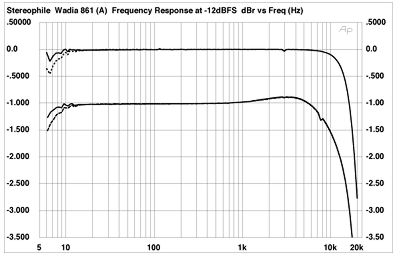
I wasn't so sure. Look at the above frequency response thresholds. Dogs can hear higher frequencies than we, but miss out on the lower. When a dog hears your voice, it hears supersonic details we don't, and misses the lower register. It doesn't hear what you hear.

Below find the response curve for a "Wadia 861, Filter A, CD." The response curve is nice and flat--until it falls off. It keeps up with the low register, which the dogs don't notice anyway, but it misses out on the high end, which we don't care enough about to instrument. (Why bother? Dogs don't buy electronics.)


The bulk of the energy spectrum for human speech is below 1000Hz, but there's still about a percent or so above human hearing range. Does 1% matter? I guess that dogs wouldn't have that kind of sensitivity unless it made a difference--maybe in finding mice. I wonder if anybody has tested dog response to human voices with signal response flat out to 30-40 kHz.

Monday, April 27, 2020

DPD

AVI links to a common sense essay by Kling. Except for the bit about ventillators, which I don't know enough about to have an opinion on, this matches my view of the situation.

I have said for years (even on this blog), that defense against non-human invaders is a responsibility that can rise to the same level as defense against human ones, and that we should plan accordingly. And fund the planning. Epidemics can get a lot worse than this one, and will.

One of the similarities between the DoD and the Department of Plague Defense is that in both cases you have to be adaptable. OK, so the enemy is coming through that impenetrable forest after all--your old plans are no good: adjust.

The generals we curse are the ones who doubled-down on stupid. When this virus first appeared, China was getting draconian. (The Chinese say that all is well now, and it wasn't from China in the first place, so I infer they're still in deep trouble.) Italy got hit hard. Knowing little more than that, radical measures seemed appropriate, but given the political effect of "it hasn't happened here yet," even things as obvious as shutting down travel with China roused objections.

We know more now. We don't have vaccines, and won't; we don't have cures, and won't for a while, if ever. We can see patterns, though. Some things look like they'll help, and some don't. Outdoor activities--probably OK. Singing--probably not OK. Close quarters--not OK. Aggressive air circulation/filtering--worth checking. Masks--if I were a business owner I'd demand that customers wear them. Putting the homeless in hotels--probably not as kind an idea as it seemed. Releasing prisoners--looks like that was a bad idea too. Listening to panic mongers--very bad idea.

Another similarity between the two defense arrangements is that you find profiteering and power grabs in both. "For the duration of the emergency" is a classic excuse. We've done mostly OK with keeping power grabs under control (yes, I've heard of exceptions), and sometimes we even prosecute war profiteers. When designing the Department of Plague Defense we can use some of the lessons learned from keeping the military under control to keep the new systems under control.

Who decides when a situation has risen to the level of an emergency? And who is accountable? Political partisans aside, most of us tend to forgive good-faith mistakes, but get impatient with CYA and refusal to decide--and refusal to notice that charges across no-man's-land aren't working very well. (*)

How do we define victory? "If it saves one life, it's worth it" is not a wise calculation. (I'm being kind.)

Another similarity is that both are guided by politics. The World Wars are pretty clear examples--there were plenty of sympathizers with the "other side" before, and some even after we committed to war. A large fraction of the "news" about the current epidemic is driven by political partisanship and not by dispassionate analysis of the data.

In time of peace and prosperity, the top officials for both will care more about internal politics and budgets than their mission, and congress-critters with pet programs will invite the agencies to "work smarter" and pare budgets. And both will indulge in fantasy boondoggles (the Zumwalt class destroyer, for example).

Yet another is that, when the real problem rises, both will probably be caught with their pants down. The CDC didn't cover itself with glory this time around, and military history can make you weep. On the other hand, without some infrastructure and thought beforehand, things would have been even more dire.

No plan survives first contact with the enemy. On the other hand, without a plan you will lose.

UPDATE: One more thing. One way we keep the military under control is by clear definition of the mission. Military are not police..

Defense against plagues is not public health.


(*) The Athenian approach didn't work very well and I'm not advising it, but I suspect that if there were more reporting of what Generals/Admirals say and do, and if they could face recalls, quite a few would be gone.

Sunday, April 26, 2020

RCA-Victor

This makes such a good story--too good--that you just have to cross-check. "Francis observed that when he played the records of his dead brother's voice, the dog would run over to the phonograph and listen intently. Francis painted the scene, calling it "His Master's Voice" and tried to sell the painting."

"The painting His Master's Voice in its original form was completed during 1899 and originally showed the dog (who had in fact died four years previously) listening to a cylinder phonograph."

Or in more detail:

It is difficult to say how the idea came to me beyond the fact that it suddenly occurred to me that to have my dog listening to the phonograph, with an intelligent and rather puzzled expression, and call it 'His Master's Voice' would make an excellent subject. We had a phonograph and I often noticed how puzzled he was to make out where the voice came from. It certainly was the happiest thought I ever had.

Or in another page: "The little dog was puzzled by where the voice came from, and Barraud found it very amusing." ... and ... "Barraud named the painting "Dog looking at and listening to a Phonograph," and eventually he decided to rename it to "His Master's Voice.""

FWIW: "Nipper (1884–1895) was born in Bristol, England, and was a mixed-breed Jack Russell Terrier. The playful dog’s tendency to bite the backs of visitors legs earned him the name."

Yes, the story was a bit too good to be perfectly accurate...

Friday, April 24, 2020

Protests

I looked at the picture in the newspaper's website, and given that the event was supposed to start at 1, figured that arriving by 4 should avoid most of it.

Sort of. The last block of East Washington had 2 lanes full of protest cars, decked out with banners, posters, big signs on top, and functioning horns. I had to detour a bit, but the delay wasn't important. People were leaving, with signs tucked under their arms, and waving flags--mostly US flags, but there were a few Gadsden flags too. No, I saw no Confederate flags.

I spotted a few counter-protestors too: "Who do you trust, scientists or rednecks?" but even they seemed to be in a good mood.

Most protestors seem to leave whatever their event was in good spirits. Not all--I heard of a few, but I wasn't around for those. Maybe it's a function of who they attract--a demonstration in favor of letting people go back to work probably won't be a beacon to out of town looters.

I'm not a huge fan of big crowds, but I gather protests usually tend to be pep rallies, and are good for morale boosts.

The view from the home office

In the recently-turned garden outside, a bluejay is having a territorial dispute with a robin over who gets to find nesting material in the garden. At one point the jay perched sideways on the fence attempting to pull chickenwire loose.

Tuesday, April 21, 2020

Pain and Mary

I ran across the reference: Did Mary have labor pains?

The official (but not fully authoritative) word from the Catholic Church is "no". That link cites Isaiah 66:22 "Before she was in labor she gave birth; before her pain came upon her she was delivered of a son. Who has heard such a thing? Who has seen such things?" OK, that could be a reference--or maybe not. It doesn't cite Revelation 12:2, which is cited in other contexts to refer to Mary as Queen of Heaven, and which refers to pain in childbirth. Further, arguments like "Many Fathers of the Church and theologians down through the centuries deemed it fitting that Mary alone would be exempt from such pains as a sign of her unique holiness. Thus, Mary’s freedom from the pains of labor is one of many reasons for belief in her Immaculate Conception." are a bit circular.

I don't know. I'm not obligated to believe in the Immaculate Conception, though I will cheerfully concede that her relationship to her son was not going to be ordinary. But stipulate the doctrine for the sake of the discussion. (FWIW, the Orthodox reject the doctrine, since they don't have the doctrine of Original Sin, which, as Chesterton noticed "is the only part of Christian theology which can really be proved." But they believe in a painless birth.)

What would Mary have answered if God had asked her "Would you rather have a painless childbirth, as a reminder of what Eden was supposed to be and as a promise of what will be, or would you rather share the pain your sisters do?" She wasn't going to be pain-free later (Luke 2:35). Her Son came and shared our pain.

Microwave-powering rockets

Calling this a microwave rocket (see the journal article) isn't ideal, but there's not an obviously better way of describing it. The idea is that you just bring along reaction mass, and let the energy supply be beamed to you. "Furthermore, if the atmosphere around the spacecraft is used as a propellant (in the ramjet or scramjet mode), the amount of fuel that needs to be carried by the rocket can theoretically be reduced almost to zero."

Um, not quite. You could get a huge boost getting out of the atmosphere, but after the first few miles it gets harder to pick up gas to use as reaction mass. Once you're up that high, you need to provide stuff yourself.

Ideally what you'd like your rocket to have on hand is atomic hydrogen, and some magic energy source to heat it up so you can eject it out the nozzle and propel yourself forward. In our not-so-ideal world you have to make do with oxygen and hydrogen, though I suppose fluorine and hydrogen would work too--though I'd prefer to be very far away from the launch. Nuclear rockets use a reactor to heat the fuel, but the shielding is heavy, control is hard, and the erosion you get running plasma through the reactor is scary.

If you can beam the energy from a ground station, receive it and efficiently transfer that to the reaction mass, you have your "magic energy source."

The popular article seems to have gotten a few things confused. The paper says they got 28-36% power generation efficiency (wall power to waveguide power), which isn't something terribly surprising. This is the ground-based stuff--you've got plenty of room to amp up your power generation.

The second part of the problem is power transmission--and they get about 51% of the power getting beamed out in the direction you want, and about 14% actually making it into the thruster.

Side note--they beamed power into the back of a tube with an aluminum nose, to see how much impulse they got--from 22 to 52 mNewtons/second.

With 34% efficiency into actual thrust, they claim a 5-6% power efficiency. That beats rocket fuel.

But that last step bothers me. If only 1/3 of the beamed power goes into thrust, what becomes of the other 2/3? Some is wasted and goes out the nozzle in non-kinetic energy, but not all. And when the rocket trajectory bends and you're not aiming up its backside...

Still, it's a nice measurement, and I'm guessing it would be way cheaper to put together a power beaming station (to send up small rockets) than the huge rockets we make now. But there are a number of little details to deal with in the meantime--like making sure the power transfer to the reaction mass is high performance (even if not efficient), and shielding the cargo and the rest of the rocket fuel, and redundancy in case of a power station failure.

Saturday, April 18, 2020

Faith, hope, and love

These seem to be closely allied to actions.

James has a famous passage on faith and works. If faith is like trust, it only shows up in actions--or refraining from action; it's an approach to

Hope is looking forward by remembering--which is a choice of what to remember, and how to let that inform your other choices.

Love, of course, is also expressed in actions.

Thursday, April 16, 2020

Arts and Sciences

It is National Poetry Month, and (so far) a couple of IceCube collaborators have tried their hands at the art. Illustrations are by the IceCube outreach team.

On Facebook

On Facebook

And a third, also on FB

And a fourth, also on FB

And a fifth
Maybe we're not Shakespeares, but we try to have fun.

UPDATE*3: Adding more as they arrive. They didn't post my second offering.

Wednesday, April 15, 2020

Illicit drug trade

I wonder what effect the social-distancing and shelter-in-place and what-not is having on the last link in the chain--consumer purchases.

I gather from SCC that social distancing is not a thing in the inner city. The street-corner deals there are presumably as brisk as ever, or, with the prisons being emptied, even busier.

And I presume that for addicts outside the inner city, getting supplied is a high enough priority that they are finding ways. Maybe the purely recreational users might be put off by elevated risks, but not the addicts.

But with less traffic, are deals more visible? Is the US Mail handling more of the deliveries?

Monday, April 13, 2020

I do not think that word means what you think it means

This from seconds ago by an NPR literary pundit recommending books to read while isolated.
"...it reminds me of the immortal (redacted), who died in 1991..."

Garden Gates and Power Tools

To put up a garden gate, you just need a screwdriver, a level, a pencil, and a drill. And some soap for the screws.

But. If you are building a garden gate, it must have a sill. Trust me on this--it may swing freely now, but just wait while the grass grows and the dirt shifts.

At some point you will be exasperated enough to take the gate off and reseat it above a real sill.

If you originally drilled through a pine knot, that screw will be glued in forever or until the post decays in a landfill, whichever comes first.

If the screw is well and truly glued in, it will turn out to be made of something the bit can't get a bite on. Other screws will just take a minute to drill out; this one looks to take hours. The bit size doesn't seem to matter.

However, an angle grinder will make quick work of the screw head, and any of the shaft sticking above the wood--and about 1/8" of the wood too. And it'll tear up the hinge plate, but since there's room for 5 screws there's enough redundancy that you can ignore that.

(I don't like that angle grinder. It has a switch on/off, not a spring-loaded "Ouch! and it stops" switch.)

Oh yes--since the posts are no longer perfectly parallel, you need to use a planer to narrow down the top of the gate a bit.

Passes

The LawDog, a blogger and policeman, is a firm proponent of always being prepared to provide bio-degrading elements at high speed. This isn't his go-to, and he much prefers quieter ways to get yourself out of trouble. Hence the Media Pass.
Reach into your glove box, grab your Media Pass, a notebook, and a writing instrument; stare purposefully at the crowd/mob/ demonstration/ riot, and move along the periphery of the crowd/ mob/ demonstration/ riot, pretending to take notes, and waving your Media Pass at anyone who takes notice of you.

As soon as you get to a point where you can duck, disengage, and Beat Feet Away From The Stupid, do so. If there's a barricade in front of your Newest Favourite Alley, waving your Media Pass at the cops manning said barricade will frequently get you past it.

Sunday, April 12, 2020

Resurrection

He is risen, and with Him, we too can rise.

I'm not a big fan of dying. It hurts, losing all your powers of body and mind is humiliating, and there are no more chances--"Pencils down. Time's up." Woulda/coulda/shoulda--but too late.

What of that does resurrection change? The pain would be past, and the soul and body restored. Are there any more chances? Probably not.

"Jesus came to raise the dead. He did not come to teach the teachable; He did not come to improve the improvable; He did not come to reform the reformable. None of those things works." — Robert Farrar Capon

I look at my life and talents and, I think properly, see the losses and waste. But perhaps what was done for God, however half-heartedly--perhaps some of my dead deeds can also be resurrected and purified, in union with Him and His resurrection.

Saturday, April 11, 2020

Helpless

"And on the Sabbath they rested according to the commandment."

Saturday was a day of rest, but also of helplessness. The prophet they had trusted was dead, the men were hiding, and the women couldn't even have the closure of completing the burial.

There are times you can act, and times you can do nothing. When Jesus hung on the cross, he couldn't swat away the flies.

Wait and endure and hope. There we have the advantage over the disciples: they had no hope. But helplessness we all share in. It needn't be always bad--babies are helpless too.

As a little contrast, the Pharisees seem to have indulged in a little business on the Sabbath (I wonder how they justified that?): they asked Pilate for a guard, and were told to set one up. They thought they weren't helpless.

Friday, April 10, 2020

Negation

I'm not sure I agree with Augustine that sin is essentially a deprivation. I think it's a negation. I could be wrong, but personal experiences lean me that way.

In heaven un-numbered creations can say "Look what God made of nothing!" or out of His glory, according to some scholars

I think we will be saying "Look what God remade of less than nothing!"

State Parks

I was wondering why Evers wanted to close the state parks. Apparently, with other venues closed, the parks had such a huge surge in use that they couldn't keep them clean. Plus there is the "social distancing" when passing on sometimes-narrow trails, although I think that's probably overblown in the breezy outdoors.

The photo below is from a "back door" entrance to Gov. Dodge park, and it has at least 3 times as many cars parked there as I've ever seen before.

Thursday, April 09, 2020

Epidemic analysis

In our practice with the small epidemic (there's going to be a big one someday, with the O(30+%) death rates), I'm not sure who is keeping track of what works and what doesn't, and trying to see how to open things back up.

We have "essential services" and "very low risk work." If you're not public-facing, a huge chunk of risk goes away. How can you reduce the rest of the risk? How do you know? Who is studying this?

Take tree-trimmers as an example. What precautions do they need to take? Separate vehicles, spray cleansers on shared tools like ladders, eat lunch apart, liners under the work gloves... Would those be good enough?

Sometime or other the lockdowns have to end, and they will have to end before the disease is completely gone--because it may never completely go away. The sanest way would seem to be staging it--but how do we (and who does) decide who goes first?

UPDATE: Looks like NEC Directory Gary Cohn is starting to think about it.

Wednesday, April 08, 2020

Subjective and Objective

Long ago I came to the conclusion that all women were beautiful if you looked at them in the individual way God made each to be looked at—not demanding "identi-kit beauty." True, there are some with such deep infelicity of feature or character that I've never been able to apply that rule to them. But as a general rule it has seemed to work.

Some 15 springs ago I was waiting for a bus in front of the student union, where three young women were improving the vista with their presence. After a while I noticed that my eyes lingered longer on one of the three, and wondered why. All seemed equally cheerful, and the other two had more classical figures. One of the other two was displaying a good deal of herself, which is a sure-fire attention-getter. Still, I thought the first more attractive.

After a few minutes I realized why. The first woman resembled my wife.

Monday, April 06, 2020

Care for the ancients

Looking at the Met's Aida tonight--or at least the first part of it--you can see that much
of the background is painted to look weathered, cracked, and worn. For a palace scene that
makes no sense, of course--everything would be made to look as good as possible.(*)

Egypt has been old for a long time. Did the rulers of Dynasty X take care to keep the temples of Dynasty X-N in good repair? If the gods weren't the currently fashionable ones, the temples might have been left to their own patrons' support. That might leave some decrepit-looking buildings around, which might not be the impression a pharaoh would want to give.

How about the funerary temples?

Some of the later builders scavenged stone, and there has to have been a huge black market in tomb-robbed gold, to which somebody was turning a blind eye. Perhaps, despite the elaborate efforts to maintain service for the dead, the ancestral service only lasted as long as the annuity. In addition, I suppose that the notables of N Dynasties back weren't really the ancestors of the current rulers.

Where paint survives on the temples, I assume we can figure out how often it was repainted. I'm pretty sure they could have used a little touch-up every few hundred years, and it would tell us something about their attitudes to the works of the ancients if the reliefs got the touch-up or not. Although something might be too sacred to monkey with, or too old-fashioned to keep in repair--the effect would be similar.

I'm tolerably sure that, even if a family lived in the same home for centuries and kept up the accruing memorials to the kas of all the ancestors, most of them would be honored en masse, because nobody could remember who they were. To be forgotten was a terrible fate for a ka, and observing this would make it a live worry for the living. "How can I make sure I will be remembered as me and not as 'honored ancestors'?"


(*) I wonder how many of the "hieroglyphs" Aida used in its decorations actually meant something? I can imagine some of the stage-crew getting a little creative. In their shoes, I'd try. It isn't as though anybody was trying extra hard for authenticity--the central figure in the "stone" trio of statues is a woman, of the same height as the men.

UVC

How do you clean an aircraft? The trays are notorious, the seats aren't exactly designed for quick scrub-downs (just imagine trying to vacuum them), and is there anyone here who hasn't flown with sick passengers (or been one of them!)?

Enter the GermFalcon, which generates UVC to kill bacteria and viruses. They use a 100amp battery (I think they get about 300 watts) to power UVC lamps to bake the surfaces.

Unfortunately the story doesn't mention how long it takes, and given that you only see one side of the tray table at a time (and it shadows other things), you'd need 2 passes to get the upper surfaces. I didn't see any lights down low for the floor--mustn't forget the floor and all the passengers who take their shoes off. And the shield for the operator isn't enough--he needs safety goggles as well, and had better wear long pants.

It looks interesting, though.

We bought a UVC sanitizing lamp, mostly for fluorescence demonstrations, but under the circumstances we may find uses closer to its original purpose. Ozone stinks, by the way.

Sunday, April 05, 2020

Ramming

Has everyone seen the story about the Venezuelan rammer?. "The 403-foot-long Resolute ... Intended for Antarctic cruises, it has a reinforced ice-capable hull." and "the steel-hulled patrol ship suffered severe damage from repeatedly ramming the cruise ship, began to take on water, and ultimately sank."

I'd have thought that the Naiguatá's captain might have noticed that things weren't going his way and desisted, but perhaps communications were poor.

I've heard a couple of explanations for the attempt--one at the link: "The ship was recently "arrested" by Argentina due to alleged non-payment of her fuel bill." Another implied a history of shakedowns.

Want to book a cruise?

Friday, April 03, 2020

Hypertension meds

"Instead of making COVID-19 symptoms worse, some antihypertensive drugs may actually reduce the severity of infections, and could therefore be used to treat the disease, both sets of doctors say."

One of those on the list is the very common lisinopril. It would be nice if that helped alleviate symptoms.

OTOH, one of those "underlying conditions" they warn about for COVID-19 death risk is hypertension. I wonder if they can split out those who were taking their meds and those who weren't: probably not. But if the drugs helped, I'd hope one could see a difference--hypertension being a lesser risk than other factors.

Wednesday, April 01, 2020

Fallbacks

An economic contraction can happen anytime, no matter what the Fed fancies its powers to be. And if it is deep enough and long enough, we have to consolidate: families take in fledged children, cousins, elderly aunts--and make do until opportunities open up.

Which suggests two questions...

Do we (on average) retain enough sense of extended family to be able to make that a real option?

Do we have the legal framework to define such mutual support? (Insurance, IRS tax status, etc). We've been busily trying to redefine marriage, but what about defining an ordinary extended family?