Monday, September 14, 2020

Different customs

I'm reading Captain Canot; 20 Years of an African Slaver. (He reformed.)

At one point he takes up residence in Vai (he says Vey) territory. He describes the Gree-gree bush, which is their equivalent to the Sande Society found elsewhere in the area. If his description is correct, there are substantial differences: the maternity ward, the initiation fee, and the "kept 'till marriage" are details I never heard of elsewhere. Where I was the girls came home first (painted white) and then were eligible to marry.

As the procession of novices who are about to enter the grove approaches the sanctuary, music and dancing are heard and seen on every side. As soon as the maidens are received, they are taken by the gree-gree women to a neighboring stream, where they are washed, and undergo an operation which is regarded as a sort of circumcision. Anointed from head to foot with palm oil, they are next reconducted to their home in the gree-gree bush.

Here, under strict watch, they are maintained by their relatives or those who are in treaty for them as wives, until they reach the age of puberty. At this epoch the important fact is announced by the gree-gree woman to the purchaser or future husband, who, it is expected, will soon prepare to take her from the retreat. Whenever his new house is ready for the bride's reception, it is proclaimed by the ringing of bells and vociferous cries during night. Next day search is made by females through the woods, to ascertain whether intruders are lurking about, but when the path is ascertained to be clear, the girl is forthwith borne to a rivulet, where she is washed, anointed, and clad in her best attire. From thence she is borne, amid singing, drumming, shouting, and firing, in the arms of her female attendants, till her unsoiled feet are deposited on the husband's floor.

I believe this institution exists throughout a large portion of Africa, and such is the desire to place females within the bush, that poor parents who cannot pay the initiatory fee, raise subscriptions among their friends to obtain the requisite slave whose gift entitles their child to admission.

Sometimes, it is said, that this human ticket is stolen to effect the desired purpose, and that no native power can recover the lost slave when once within the sacred precincts.

The gree-gree-bush is not only a resort of the virgin, but of the wife, in those seasons when approaching maternity indicates need of repose and care. In a few hours, the robust mother issues with her new-born child, and after a plunge into the nearest brook, returns to the domestic drudgery which I have already described.

Vote shenanigans

Trucking voters in Liberia: "Photojournalist Sando Moore was sitting at home Friday when he got word that loads of buses had begun trucking residents from Monrovia to Bomi County."
John Forkpah, 28, who is a native of Jorquelleh District in Bong County and had spent three years in Monrovia since his graduation from the William V. S. Tubman Gray High School in Gbarnga, was on board the NTA bus on Friday. He said Moye had invited them in Gbarnga to register to vote for him in December. “We are supporters of the Representative Moye and we decided to come Gbarnga to vote for him. He sponsored our trip to Gbarnga,” he said.

..

Peabody said they were promised US\$ 50,00 by the Deputy Speaker to come Gbarnga to register to vote for him. “Rep. Moye promised to give us to US\$ 50,00 if we come to register to vote for him in Gbarnga,” he said.

"Before we arrived in Gbarnga Senator Yallah had already booked a guest house for us to pass the night. He gave us US\$ 30.00 after we showed our voters card to him, he (Elizabeth Collins !) said."

Clearly being a senator is lucrative there too. \$30 x N voters seems like a largish investment for the area. You'll notice that some of the people are originally from Bong and some aren't.

Their vote harvesting seems to involve more transportation than ours does.

I'm regularly instructed that there is no vote fraud in the US, or not at a significant level--almost nobody is ever convicted. I gather there is no adultery in Wisconsin. It is a felony but I never hear of anybody being convicted.

Update: I forgot this quote. "We are marching to Zion, the beautiful, beautiful Zion, we are marching all the way to Zionnnn….the beautiful city of gold”, they sang while clustered at the back of a pick-up.". I don't know if the "gold" was because the reporter didn't hear it right or the singers had something else on their minds.

Non-verbal accents

BBC has an interesting story on culture-specific body language.
They found that the Americans they tested were also strangely good at spotting who was Japanese and who was Japanese-American, even though they were all ethnically the same. The subjects wore the same clothes, and were lit in the same way. When the two groups held neutral expressions, people could barely differentiate between them. But when they showed their feelings, especially sadness, something from Japan or America seemed to emerge.

I wonder what they'll find when they look at actors. Are actors better at mimicking these mannerisms? How well do they mimic different cultures after a little watching/listening?

Sunday, September 13, 2020

Wildfires

There's a rumor that Antifa has extended their burning program to the forests, and that many fires have started by the roads, and that witnesses have seen arsonists. It's vehemently denied, of course.

It wouldn't surprise me that such an organization would consider expanding their scope. We may find out in due course. I doubt the official denials--they came too quickly.

Sometimes I try to imagine myself as the criminal. If I were one of those who like to set forest fires, I think I'd want to join in. The other fires are a proof-of-principle that conditions are ripe, and there's plenty of confusion, perhaps making it more likely that I could get away with setting one or two of my own.

I've no specialized knowledge about this kind of crime, but I'd predict that where you have a few wildfires, firebugs will set more. Antifa wouldn't be needed to explain the outbreak.

OK, now I have to figure out where to get the information to prove or disprove my conjecture about firebugs...

Zampolit

The names are different.
The enlisted personnel endured lengthy and stupefying lectures on the Party, its goals, accomplishments, and plans for the future.

At our current collaboration meeting, attendance at the Social Justice Workshop is -- so far -- not mandatory.

Saturday, September 12, 2020

Ship pets

My wife was listening to one of Drachinifel's "dry dock" (Q&A) episodes, when the subject of ship's pets came up. Apparently in the early 70's the Royal Navy decided that (presumably for reasons of hygiene), no ship's pets were permitted. That did not prevent sailors from trying.

How about an elephant?

HMS COURAGEOUS 1974-1979 adopted an African Elephant that someone found tethered to a bollard next to the taxi rank on Helensburghs mainstreet. They called him *Mongo* and he lived in an old Chacon that they put in their Lay-apart store just up from 6-Berth.

I can imagine sailors yarning a hoax like this--they're famous for them. I can also easily imagine them trying to do it just to prove they could. And if anyplace would be challenging to fit an elephant it would be on a nuclear submarine.

Unfortunately for the story, I can't see any easy openings in the deck big enough to sling one below, and I can't imagine a captain agreeing to keep such an attention-getting passenger on top. Maybe on a cruiser... But then it wouldn't just be the elephant acquisition method that was untrue, but the ship's name as well. Pity. It would be such a wonderful way to tell the brass where to put their rules about pets.

By the way, the text in the link about the elephant was lifted from a thread on "Rum Ration" about Ships Pets and Mascots. Somewhat more plausible mascots, including "unsinkable Sam," are shown here.

One drop rule

Grad student apologized and resigned as TA "after falsely claiming to be a person of color."
“I have let guesses about my ancestry become answers I wanted but couldn’t prove,” Vitolo-Haddad wrote in an apology posted Sunday on the blogging platform Medium. “I have let people make assumptions when I should have corrected them.”

In a second apology posted Tuesday, Vitolo-Haddad wrote that when asked if they identify as Black on three separate occasions, they did not say no.

She says she really identifies as Southern Italian/Sicilian. But "I repeated things I heard growing up from my family that I now know to be lies. I am so sorry. I take full responsibility for spreading these lies and am deeply sorry."

Clearly being black in the USA is such a burden that people have been falling over themselves to be labeled black so that they can accrue the social or job opportunities that g o with that. (Jessica Krug...Rachel Dolezal...a whole town

The Teaching Assistant's Association has announce that it will "allow people to provide more feedback about candidates, both in public forums and through anonymous mechanisms." So if someone claims to be black or hispanic (or white), some anonymous poison-pen letter can derail their position (she was co-president). This sounds familiar--a rumor that X had a black ancestor, however remote, might ruin a white man's chances a century ago.

You might argue that turn-about's fair play, or that the idea was stupid then and it is stupid now.

But about those "benefits" from being considered black (or hispanic, or whatever): I notice that the three people who got caught are all women. Granted, the statistics are low, so add in the Guardian story about the town in Ohio, and notice that the only men cited currently "identify as white."

Maybe there are social benefits to being a young black woman that aren't available to a young black man. Or maybe women are more willing to reshape their identities. (Fair or not, women have had to adjust more than men--moving to her husband's tribe; winding up war captive; whatever.) Or perhaps those benefits are only present in certain environments (she is in "Journalism and Mass Communication"). Or maybe it's just poor statistics.

Friday, September 11, 2020

Who and which

At the table tonight the question came up: "If you could have any composer living or dead create an opera with a modern character or story, who would it be and which?" My wife came up with the best of the evening: Verdi and Douglas MacArthur. Shakespeare would have fun with him too.

Thursday, September 10, 2020

Ricks

The trees are all new, and there were not nearly so many then. Any surviving old ones were cut down during the time this was a UN refugee camp. The roads have been regraded, and sometimes moved or abandoned. The bright red asbestos roof in the center looks as bright as it did when new--up close it is darkened by years of wear and grime and agressive mold. (Unless somebody replaced it.) The area above the classroom/administration/library/church building on the right used to be the parade drill ground where the boys of "military age" had to drill each week. My mother was the school nurse, and would always get plenty of "sick" boys that morning. "Our" house, which was also the mission office, is at the middle left.

The little white splotch in the middle was a pile of large, and at the time sharp-edged, quartz boulders dumped there after some pre-us foundation work. Children find strange things to play on, and to try and recite chunks of Julius Caesar from. The boulders subsided and softened their edges.

The image looks like it is more recent than the last time I was there: I guess there've been even more changes since we traveled to Liberia to bury my father at the seminary. Scrolling aound, it looks like somebody finally broke up the old foundation slab I used to wonder about back in '64, and I can't see where the "new" water tower is anymore, but the dormitories still seem to be there, and the dining hall and the clinic. And the old basketball court, which looks like still nobody is taking care of it. Soccer.

A picture may be worth a thousand words, but sometimes they don't tell the story. Even the old ones don't.

Tuesday, September 08, 2020

Blaming it on the sun

Yes, I saw the article that claimed they found a correlation between strong solar winds and earthquakes.

I'm still mulling it over. I have to try to work through their statistical model myself. My immediate reaction is that something's wrong.

Executive summary: really strong solar storms seem to be associated with higher numbers of earthquakes about a day after the peak passes.

The notion that solar weather might effect the Earth's crust seems far-fetched, but it has been around for a while. It hasn't gathered much favor, because the analyses tended to show no correlation. Early ones did, which is why people thought of it. But it isn't entirely crazy: faults aren't obviously the same as nearby rock, and an electric current induced in the fault could result in forces perpendicular to the fault--closing it tighter or opening it up, depending on the direction. One possibility is "inverse pizoelectric" forces, especially if there's a lot of quartz involved: an electric field makes the quartz crystal flex. And we've seen earthquake lights, so something electrical can happen.

But why would this happen after the peak instead of during the rise? (Rising and falling times are when you get induced currents elsewhere--steady state solar wind wouldn't.) The total current being deflected around the earth in a solar storm is pretty gigantic, but it's mostly pretty far off. But on the "stick beat dog" principle, if changes in the current in the magnetosphere caused turmoil in the plasmasphere, that might induce some electric fields in the crust. I'm not sure about the time scale, but days seems maybe a bit long. But figuring out what the conductivity of fault rock is turns out to be quite a rabbit hole--the rock type, how much water is in the area, etc etc. I gather people haven't drilled down into too many deep earthquake faults to get samples.

I still don't get why the decreasing wind would correlate better than the increasing. In fact, I'd guess there'd be more of quick fast shock and a longer slow speed tail. (It wouldn't be the first time my intuition was wrong, though.)

I think they made a mistake somewhere.

But if it were a real effect, maybe you could look at faults that trend more or less in the direction of the expected delta-B: which for places like Alaska would be north-south vs those that break more or less east-west or up-down.

Indignation

Via Lead and Gold, Tom Wolfe:
From the outset the eminence of this new creature, the intellectual, who was to play such a tremendous role in the history of the twentieth century, was inseperable from his necessary indignation. It was his indignation that elevated him to a plateau of moral superiority. Once up there, he was in a position to look down on the rest of humanity. And it did not cost him any effort, intellectual or otherwise. As Marshall McLuhan would put it years later: 'Moral indignation is a technique used to endow the idiot with dignity.'

Campus Covid

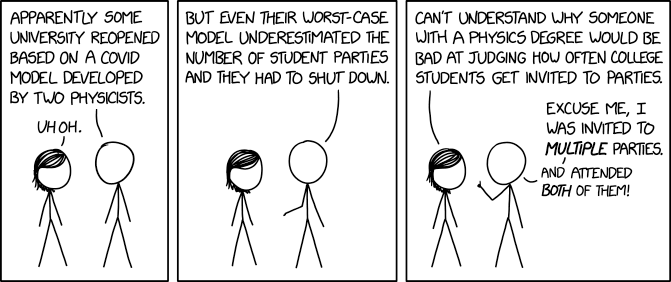
A number of universities re-opened to inperson courses and promptly re-closed. The cynical sorts opine that UW will try to stretch in person past the two-week full refund deadline, but I suspect the UW wouldn't be allowed to take advantage of that. It's a state school, and at odds with the legistlature from time to time.

Lab courses demand in-person presence. Science and engineering labs are, except for the intro courses, populated by students intending to take a rigorous course of study--presumably taking their studies seriously. Could this population be enriched in students who take social distancing rules seriously?

Did any of the universities try to break down the covid case spikes by major? I know HIPPA rules might make that complicated, but it would be interesting. Can you open the university for grad students and STEM majors safely?

Sunday, September 06, 2020

Public prescription

We went to try to tag monarchs at Festge Park. We ate our lunch in the picnic shelter. The other side of the shelter was occupied by a loquatious man explaining to a woman how people failed to respect him and talked in "passive-aggressive" and other bad ways, even when he tried to correct them. I don't know if "psycho-babble" is the right term to describe it: "socio-babble" might be better. When he let her have a word in edgewise, the woman suggested alternative interpretations. I figured she was his therapist, meeting outdoors instead of in an office. He was, of course, using his "outdoor voice."

Not my circus, not my monkeys--it would have been presumptuous to offer my advice. I guess he'd been getting in touch with his sensitive side, when what he needed to do was get in touch with his inner John Wayne and shut up and not care what people said.

Maybe that advice would exacerbate other problems--another good reason for me to be silent. But for someone so concerned about other people's rudeness and unwillingness to listen, he was magnificently un-selfconscious.

I wonder if the Babylonians might have had a useful way to help him:

They have no physicians (in Babylon), but when a man is ill, they lay him in the public square, and the passers-by come up to him, and if they have ever had his disease themselves or have known any one who has suffered from it, they give him advice, recommending him to do whatever they found good in their own case, or in the case known to them; and no one is allowed to pass the sick man in silence without asking him what his ailment is.

The internet serves part of that purpose now, but the one on one interactions might be useful for people with lesser issues. I know, some people have broken minds, or addictions they can't deal with. AVI has to deal with some of them. But some conditions need the aid more of a "life coach" than of a doctor. And yes, the Babylonians had plenty of doctors too.

People ahead of property

A thief appreciates property--he just wants it to be his. A vandal--not a petty vandal, but a destroyer--seems to hate the thing and what it represents. In his envy he doesn't want a garden for himself, but to destroy anybody else's garden. And time and effort and love.

The recent riots frequently associated with the protests are larded with both kinds: thieves famished for $300 sneakers and arsonists burning what they can.

In Liberia, except for the Kru who keep dogs as pets, dogs (Basenji) are tools: "Kiki (dog) will fill the pot." Either the dog will help you catch something to eat, or you will eat the dog. And yet I heard a proverb that whoever would kill a dog would kill a man. Possibly this was a Kru proverb, but I wasn't in a Kru area. And they weren't talking about the owner killing his useless dog, but someone else. The dog is "just" property--but the dog-killer is more than merely a property-destroyer. And, don't forget, mere "property" can be the difference between the owner eating and starving.

Sure, people are more important the property, but they are linked. The destroyer may just be destroying property right now, but his hatred threatens people, not just things.

German noodles

At our home, birthdays are spaetzle occasions.

Saturday, September 05, 2020

"2000 years back in time"

Like everybody else, I read about the U.C. Santa Barbara Religious Studies TA who tweeted that his priority, given a time machine, would be to kill Jesus.

The story is too good to be true, right? It sounded like a joke in bad taste that hit the media at the right time to go wild. So I tried to dig around a bit to find out exactly what he was trying to say. That's what a good blogger does, right? And it would be cool to have a scoop.

He deleted his Twit account, so I don't have any history to look at there. But he has some things out on the web already--his home page, for example. He cites a passage from François Laruelle to describe himself, which includes this gem: "If philosophy has only been and only ever will be an opinion and a poorly thought out passion, then the question is of passing from its state of war and of competition, a state of exploitation of thought and as such of man, to its civil state, which we want to call human and democratic." Maybe the context would help dress that word salad, but hoi polloi don't deserve any context.

His areas are "Philosophy of Religion, Political Theology, Psychoanalysis", or alternatively "continental philosophy of religion, political theology, psychoanalysis, and black studies" "His dissertation undertakes a philosophical investigation of pessimism and the ethical and political significance of bad moods in the context of the contemporary climate disaster. He also thinks and writes about police."

If you attempted to read that last link, you'll have noticed that his stock in trade is redefining words.

Other little gems: “I suggest that the emergence of this figure of the malicious God is one of the many conceptual felicities of Kotsko’s general theory of political theology”, and, from Professor Watchlist, this: “Our imperative is to join the struggle for subjectivity, to struggle to speak truthfully about ourselves, to discover that relation to the outside which allows us, in accordance with Nietzsche’s injunction, to become what we are—to become, in a word, anti-Christian.”

The reporters were right. He was perfectly serious. God help him.


"Political Theology" is exactly the phrase for this sort of thing. "God is that, than which nothing greater can be conceived." For some of us, that is the state, and political theory is its theology. E.g. "The greatest thing I run across regularly is humans (who have the transcendental capacity to decide), and the only thing greater than that is a whole lot of humans deciding things."

Friday, September 04, 2020

Old habits

When I was a little lad, my father taught me how to comb my hair, and after all these years I unthinkingly put the part in the same place--even though if I moved it a half an inch I'd get no silly comb-overs.

On the other hand, I didn't understand why Mom folded towels in thirds instead of halves, until my wife's father showed why that was useful--and I switched and have been doing that ever since. I guess I comb more often than I fold.

Dad also taught me that shirts should be tucked in neatly, and I still do that without thinking. All the "cool kids" let the shirt hang out over the trousers these uncertain days, and I'm trying to remember to do the same--so far not very successfully. Why give away security information?

I never did get the hang of Mom's hospital corners, though.

Presumed false

For the next two months I will be assuming that all disreputable stories about Trump or Biden are lies concocted by their opponents.

Wednesday, September 02, 2020

Wide-ranging discussion

A few quick notes from this morning's study:

Jonah: the teenage-drama prophet ("I wish I were dead!")

Wokeness: self-righteous calvinball

Blessings: they could be a sign of God's favor to the righteous, or could represent the last chance for the unrighteous.

Monday, August 31, 2020

A smidgeon of history

You've probably heard of the Sullivan Act in NY.

This was the heyday of the pre-Prohibition gangs, roving bands of violent toughs who terrorized ethnic neighborhoods and often fought pitched battles with police. In 1903, the Battle of Rivington Street pitted a Jewish gang, the Eastmans, against the Italian Five Pointers. When the cops showed up, the two underworld armies joined forces and blasted away, resulting in three deaths and scores of injuries. The public was clamoring for action against the gangs.

Problem was the gangs worked for Tammany. The Democratic machine used them as shtarkers (sluggers), enforcing discipline at the polls and intimidating the opposition. Gang leaders like Monk Eastman were even employed as informal “sheriffs,” keeping their turf under Tammany control.

...

Sullivan knew the gangs would flout the law, but appearances were more important than results. Young toughs took to sewing the pockets of their coats shut, so that cops couldn’t plant firearms on them, and many gangsters stashed their weapons inside their girlfriends’ “bird cages” — wire-mesh fashion contraptions around which women would wind their hair.

Ordinary citizens, on the other hand, were disarmed, which solved another problem: Gangsters had been bitterly complaining to Tammany that their victims sometimes shot back at them.

FWIW, some Chicago politicians have close ties with gangs. On the national level... We wonders, aye, we wonders.

Followup- Men's Sheds

A few years ago I noticed what I thought was a great idea to address men's mental health issues. Men's Sheds seem to still be going strong. Some morphed to allow women as well. There are even some (don't tell the SJW's) in the USA (even in Hawaii and Washington, though most are MidWest). Motto: "Men don't talk face to face, we talk shoulder to shoulder."

Sunday, August 30, 2020

Sampling bias

If Ecclesiastes was written by Solomon (or perhaps in his honor?) then it may be simple to understand the curious passage in which he says he's found 1 man in a thousand but not a single woman (in context he's looking for the upright and wise).

If, as 1 Kings 11 suggests, his wives were political acquisitions, you'd expect the bulk of them to be "ambassadors for their families/countries," and always keeping their eyes on what influence they can have. I don't think many kings pick their concubines for qualities like wisdom. Together these groups don't sound like a pool one could draw from to find uprightness and wisdom. In that culture, they'd represent most of the women he met.

In other words, it was his own fault his search failed.

Clever cells

When the body is damaged, the injured cells release "I'm in trouble" chemicals. Other cells (e.g. white blood cells) come to help out.

How can they figure out which way to go? After all, the chemicals are going to diffuse all over the place. True, a blood vessel is a simple one-dimensional region, but do you go left or right to get to the hammered thumb?

The model this group was testing is pretty simple and clever: the seeking cells destroy the trouble chemicals near them. After that the region with a higher density of those chemicals will diffuse into the newly cleaned regions by the seeker cell first. The seeker cell detects the alarm chemicals on (e.g.) its left side first--so that's the direction the seeker cell should move. That's a pretty clever way to estimate a density gradient, and it has the added benefit of getting rid of the old alarm chemicals so the body isn't in constant alert mode.

They have videos of ameobas and cancer cells threading mazes to find "chemoattractants".

It isn't infallible, of course--brownian motion might randomly bring attractants to the low density side first. You can see that in the videos. But most of the time it works, and it seems like a simple process to implement. It'd be more robust than a simple "try to measure concentration on both sides" scheme, since very high densities of chemoattractants would overwhelm a seeker cell's finite number of built-in receptors.

Thursday, August 27, 2020

Taken for granted

"I love you like salt"

How much of my world is invisible? Air is, usually--and I tend to forget about it until I either get pneumonia or try to swim.

Unless you live in hurricane country, food generally just arrives at the store. Maybe some things get scarce for a while, but even in poor areas something shows up.

If you tent camp regularly you don't take electricity for granted, but it's so ubiquitous that it's easy to overlook.

I've read the "privilege knapsack" stuff and don't consider it particularly useful, but yes, imagine living among people who are radically different from yourself, and who don't like your tribe. If they express the dislike violently (as in inner city Chicago or the old "Don't let the sun set on you here" towns): just imagine how you'd watch your back. Non-violent expressions of tribalism (e.g. in universities) induce you to watch your mouth.

Even the antifa and blm folks rely on the police--as one can hear in the Kenosha video. Yes, if you're black encountering the cops you're more likely to get roughed up (and less likely to get shot) than if you're white--but you don't have to worry about just disappearing. Everybody assumes they'll get a day in court, and that the rest of the world will be able to hear from them. That's not a small matter.

We have vast machinery to supply parts and drugs and food and information and legal help and clothing (ever notice how often a suit of clothes is mentioned as a great gift in old stories?) and loans and things that aren't easy to get without that machinery.

Some of those invisible things we should be grateful for. Ingratitude is ugly--though excuseable in babies. Some things, maybe we should change--but don't forget Chesterton's Fence. Other things--do "window treatment" fashions matter? (You should probably not trust my aesthetic judgment on such matters.)


How do we see the invisible? A few things come to mind; there are probably plenty of others.

You can have someone sit you down and explain in detail why you are a bad person and never knew it before. I assume that corset and riding crop are extra cost options.

The Grand Tour is nice, if you have the money. But having money makes a lot of things invisible, even in a foreign environment.

You can try to get to know someone from a wildly different environment. But then, are you treating the person as a means to an end--your enlightenment? You won't really meet them that way, and it may rankle them. If you aren't, there's some goal you both share that brings you together--which is good and also means they may not be as different from you as they could be.

Read. Read the foreign stuff first, and then maybe the careful explanations. How do those foreigners like to think of themselves? Poetry, folk stories, other literature--if you feel brave tackle some internal debate. Their arguments seem sound from their point of view--why? Assume they're not deliberately malicious--though some people are.

Read stuff from the past. Your grandfather's worries were generally quite serious ones--why are yours different? Hint: it isn't because you're smarter or more moral. You aren't.

Read stuff you disagree with. Assume for the sake of argument that the writer isn't deliberately malicious. Sometimes even the beyond-the-pale ones see something you don't, though their cure may be wicked.

As mentioned above, camping can, if you cut out the electronics and other luxuries, make some everyday things like waste disposal rise up out of invisibility. (The same is true of hunting, if you want to avoid spooking the deer.) Try mending with needle and thread. (I'm not very good at it.) Exercise your imagination when visiting one of those museum displays of ancient villages--and try not to be a smartass in your fantasy. You wouldn't know any more than they did.

Cut out all electronics for a week or two. What was harder/impossible? What was better and why?

You're not trying to become cosmopolitan =home-less, just see more--and maybe be more grateful for what you have.

FURTHER Another little thing: how much money do you need to buy groceries today? We don't have hyperinflation and prices are posted--you can estimate how much you need, and not have to spend time dickering and hoping there's not just one item left (driving up the seller's price).

The climax by itself isn't enough

I saw a Kenosha video in which the youth was being chased, knocked down, and attacked--and when he shot back. Absent other information, that's pretty cut and dried self-defense.

But. As I commented over breakfast this morning, what happened before that video is key. If the first shot was unprovoked, the kid was committing a crime, and other deaths occurring as a consequence of it are murder. If it was provoked, he's innocent of everything except being a minor carrying a rifle in public, and perhaps not even that.

What happened before the chase-down seems to depend on who you talked to. Unsurprisingly. So the climactic scene doesn't tell you as much as you might hope.

FWIW, Andy Ngo seems to have done the research the State Journal didn't: identify the perforated ones. I remember reading about Bernard Goetz and wondering how, if he was such a bigoted random shooter, he managed to hit so many with criminal records. The rally organizer said about the perforated ones: "They came out here every time with us. Sweet. Loving. They were the sweetest hearts, souls." Kindred souls, perhaps?

Allegedly protesters in Madison are trying to limit who gets to associate with them, but they haven't always been very effective at that.

UPDATE: A detailed analysis can be found here.. First time I've heard of the site, btw. It seems plausible, though no doubt if I was on the jury I'd hear other things as well. I couldn't make head or tail of the video I saw of the first shooting--it was too blurry, obscured, and had too many gunshots.

Wednesday, August 26, 2020

Kevlar

We've been seeing a lot of documentaries on WWII Pacific battles, and the Franklin's amazing damage control story came up. After hearing about arguments regarding what the best placement for armor was, I wondered if modern flight decks used Kevlar. Carriers do. The stuff seems to handle fire relatively well as well as protecting against penetrations.

The topic doesn't tend to come up in most families' table-talk, but if it does you're ready.

Sunday, August 23, 2020

Is there a name

for "first past the post wins" knowledge?

You've seen it: a "fact" conflicts enough with other facts that the person asks for clarification, but cannot accept that their first "fact" was wrong.

Forgotten names

"Yet, while the rock itself is blameless, the cultural associations with it are enough for some to call for its removal."

The State Journal was unable to find a reference to the objectionable name that was more recent than 95 years ago--and certainly I've never heard it before. "The term itself appears to have fallen out of common usage by the 1950s."

That sounds, to first order, as though somebody dug long and hard to find something they could object to, at a university that seems to try hard to be welcoming to black students.

As far as I know for the past N decades it has been simply known as Chamberlin Rock and celebrated as a very large glacial erratic.

I suppose if someone were to find proof that it had been used by the Sioux to sacrifice immigrating Ho Chunk, the local Ho Chunk might be pleased to see it go away. But they might not care anymore--the Sioux lost and were driven west.

The old term--it wasn't even an official name--was long gone. It lost. This kind of demand resurrects it. Even if the rock goes away, the hole will remind everyone of the old name.

Friday, August 21, 2020

Against evil forces

The radio played Beer For My Horses in the car this evening. If you're not familiar with it, it celebrates vigilantism--as a backstop when those entrusted fail, but vigilantism nonetheless.

"The police aren't there to protect people from criminals, but criminals (and presumably merely suspected criminals) from vigilantes."

I don't think so. There's a foolish line from the song's lyrics "When the gun smoke settles we'll sing a victory tune And we'll all meet back at the local saloon." Some vigilantes never came home.

The issue is unfortunately quite relevant in certain of our cities where it looks, from where I sit, as a power struggle in the Democratic/Progressive parties is playing out with street thugs, and police are ordered to stand down. Some of the brownshirts have have marched into residential areas. I've read this story before, and it doesn't turn out well.

I've not made a systematic study, but what I've read of history is full of situations where a tiny violent group cowed a larger one--even when the larger one was also armed at some level. Just being armed is only part of the story--being confident in your arms and being ready to go first is the rest. If antifa's brownshirts decided to march down our block, I don't know how many of my neighbors would be standing guard outside their homes. I suspect very few. (I know several who'd call the cops and trust that the cops would magically do the job.) The risks of standing out are high--you get to be the target of deniably lethal attacks (they're just throwing stones...), the enemy makes a note of your address, and there's a non-trivial chance that when the police do arrest somebody they'll go for the easy stationary target, the one with a home to lose. And if your face gets on the national news, you'll get lots of death threats, some of them serious, maybe lose your job--lots of downsides. And, maybe somebody else will do the defense for you, so hiding inside is probably fine.

A march through your home streets is literally a threat close to home. Defending it isn't like asking you to counter-protest somewhere else.

I know a few men who'd not think twice about standing in front of their homes, even alone--disciplined sorts, too, just not living in my neighborhood. I gather from the news that they exist elsewhere too. But I wonder how many there are who are ready to be first. Would I be? It's easy to kid yourself. I know it would take a lot to get me to join a countermarch somewhere else. Ditto for the guys I mentioned, so I'm in good company there.

Jack

I typo'd the name on youtube, and up came a song I probably should have heard back in the day, but which I don't remember at all.

People took it as a protest song against the South African rulers in '68. The composer said it was about a mine worker telling his boss he was going elsewhere. Maybe he meant both things. When she sings it, neither situation is what first comes to mind.

If you can describe even a small human experience just right, it echoes in many others.

Thursday, August 20, 2020

Nuclear energies

If you know much about nuclear decays, you know that they're so much more energetic than ordinary chemical reactions that you can neglect the latter. The energy released by the decay of a uranium 238 atom is the same as that released by the decay of U-238 chloride, to within measurement errors. The energy ratios are a million to 1, or a hundred thousand to 1. The chemical bonds don't matter enough to bother with.

Unless they do. "Thorium 229, which has an isomeric state Thorium 229m, which can be obtained as a decay product of Uranium 233. The transition energy of this state is 8.28 +- 0.17 eV" That's electronVolts, and that's easily within range of chemical energies. In fact even the crystal structure matters for predicting the exact energy release.

I'd never heard of such low nuclear energies before.

Wednesday, August 19, 2020

Universities

In between student debt changing the financial calculus and covid cutting into attendence, prospective students may need to look at universities with a different, and more frugal eye. That's going to hurt. I looked at online learning before, but I think I want to try again from a different direction. AVI recently wondered about what universities would do with the diversity staff in their current financial stress.

I suspect they'd help the bottom line and provide a much better campus climate for everyone if universities fired everybody with "diversity" or "equity" in their job title. I don't think you learn a lot from picking scabs, especially when you just assume the scabs are there without asking. And I judge that there's quite a bit of unity to be found in working together to learn.

I don't think the universities will, though. A bureaucracy is like plaque--it just keeps building up while things rot underneath.

Nor do I think they'll generally get a good handle on online-learning--figuring out how to add enough value to merit the student $$$. I think a lot of universities will break before they adapt.

They provide some things we want, so whatever replaces them (assuming we don't crash so far that nothing does) should provide those same things. Some of the things a university does are easily adapted for remote students. Some don't really need anything like a university at all.

Here's my list

Credential You

  1. Generic:
    1. IQ: You have above some threshold level of intelligence. This could be easily replaced with a test suite, but that's politically and sometimes legally impossible right now. (Remote=easy/impossible)
    2. Perseverance: You are able to persevere through a 4-year plan. A job history might be able to do that for you also, unless you were unlucky with job situations. (Remote=irrelevant)
    3. Getting along with others: You are able to put up with people (some of them quite strange) for 4 years without resorting to homicide. This too might be inferred from a job history. (Remote=irrelevant)
  2. Specific:
    1. Body of knowledge: You absorbed, however temporarily, a specified body of knowledge. In some cases you could substitute a suite of tests, but those aren't always easy to design--imagine trying to prove by a test that you are skilled in Turkish literature. You really need experts to examine you. (Remote=possible--pay an expert to examine you and personally certify you; cheaper than 4 years of college.)
    2. Able to do work in your field. This is related to the above criterion, but is more demanding. Think of the internship after med school, or an engineering student's portfolio. A job history can do this too--often better. But getting hired in an advanced field in the first place isn't easy. (Remote=possible, with work/study)
    3. Able to contribute orginal work in your field. You've passed the apprenticeship as a researcher. Or, if this school is like Juliard, you can play music people will pay to listen to. An autodidact can demonstrate this--in theory. In practice, it isn't easy to get into the journals without somebody vouching for you--like employing you at a known research institution. (Remote=difficult)

Teach You

People learn in different ways, of course.
  1. Talk at you. They use lectures, live or recorded. For these you don't need a university as much as you once did. (Remote=easy)
  2. Read. Some things are harder to come by outside the university, but at least in theory you could get these elsewhere. (Remote=easy)
  3. Show. Labs and some kinds of lectures (e.g. math) involve demonstrations. These could be recorded, of course. (Remote=easy)
  4. Do. Labs, language classes, some kinds of physical training demand that you do them yourself. Equipment and guidance aren't free--the university is the go-to place. (Remote=impossible)
  5. Discuss.
    • You question the teacher during a lecture or demo--"I don't understand X" There's no substitute for live; questions submitted and replied to the next day aren't a good substitute. (Remote=impossible for a group, possible for one on one)
    • The teacher questions you during a lecture. It is really easy to think you understand, and the best time to check and correct is right then. In person, a good teacher can sometimes spot the students who aren't quite getting it. Remotely it's not so easy. (Remote=difficult)
    • You question other students. In STEM there's generally a right answer, but in most of the other liberal arts--What is "justice," Socrates? There's something different about being physically with someone that multiplies the opportunities to talk. Phone or video-phone feel more distant. (Remote=difficult)
    • Other students question you. Can you defend what you think--without resorting to "my felt reality" solipsism? That can be a great education in itself. (Remote=difficult)
    • "The Grand Tour" of meeting other people and ideas and customs that are not always congenial. It can give a good lesson in what's common and what divides us. Most of us, by default, stick to the congenial. (Remote=possible, if you take advice)
    • Late night bull sessions. They're mostly nonsense, but who's keeping score? And it's practice thinking. (Remote=possible)

Connect You

  1. Make acquaintances that will be important professionally. The Ivies are renowned for this--making sure the proper people know each other may be their main function. (Are frats like the Odd Fellows?) (Remote=possible)
  2. Find a spouse. There are few other places that bring so many of your cohort together for long enough. A concert doesn't last long; classes do. (Remote=impossible; you're on your own)
  3. Find friends. You can probably do this most places--in fact other places might be better, in that they mingle ages more than a college does, and there's a poverty in only having friends of one age. (Remote=impossible; you're on your own)
  4. Bond you to the school so they can put the touch on you for alumni donations. I'm a cynical one sometimes. (Remote=impossible)

Labs can't be done online. Discussion, and one on on interaction with the teacher, don't seem to be done very well by most online schools, if early reports are any guide. But scheduling 1:1 teacher time should be possible, albeit expensive. I wonder how the language classes are doing.

A lot of the credentialing can be done elsewhere, or replaced with job history, or replaced by hiring specialists.

The social part would be hard to replace, since many of the older connecting institutions aren't popular anymore. (Bowling Alone?) Reviving the secular ones depends on fashion, not fiat.

James 3:1

When I'm wrong, you're at risk. When I'm right, I'm at risk. (pride)

Tuesday, August 18, 2020

Dreams of a scholar

Sometimes a writer hits just the right note for a character: "... the Balearic slingers would be listening to him as he told them how they used to use their slings, and the next thing he would know would be either his housekeeper tapping at the door ..."

After all, you wouldn't be dreaming of listening to the ancients explaining things to you, the great scholar?

My own dreams are shorter and stranger. I found myself reading an economic treatise--I looked at the page header and it said Romans 16 as I expected, but looking back at the text it was still on economics. Finis

Monday, August 17, 2020

Witch Fragility

See Witch Fragility (1692 edition) from The People's Cube.

Sex roles

I'm not an expert, except perhaps in the sense of having lived through it myself, but puberty is awkward and confusing enough even with society's help. When the guidance is "You decide your life" or worse, when people who profit from your confusion get the magaphone, it is surprising as many kids turn out as well as they do.

With roles, you start out a boy or a girl, with the understanding that eventually you'll be a man or woman. Thanks to the roles you have a formal idea of what that means, but not a visceral one--yet. When you hit puberty, you have categories for the new feelings, and ways to understand and express them. Generally along with the roles come social rules for interacting with the opposite sex, and a path toward marriage and social frameworks to help you be a parent and grandparent. A few people have troubles with the roles, because they're from the tails of the distributions, but for almost everybody the roles mostly just work. If you aren't cut out for marriage, there are often roles for that too--sometimes religious ones and sometimes other "secular" insofar as that concept is even defined in your society family support roles.

But without anything clear, all you know is that you aren't quite the person you thought you were. If it is all your choice, what do you choose? You're too young to know the trajectory of any of the choices.

I'm fairly smart, though not always wise. When I started out in marriage I didn't have a firm handle on what things were going to be the most important long term. I'm not sure I would have taken advice, but roles are more embedded in "what everybody knows." "What everybody knows" is harder to argue with. And you can probably think of people who would have had a less bumpy start with clearer roles too.

Depending on how flexible those sex roles are, some folks would be squeezed hard. If men's roles involved not just willingness to protect your family, but regular fighting against each other, I'd not do well. Perhaps in some really dangerous era it's essential to be ready to fight at the drop of a hat, or be willing to help spear a lion for the tribe, but that would be a little exaggerated for our place and time. (I didn't do wonderfully well in sports either.) Some flexibility is important. But roles need some rigidity too: the parents are supposed to take care of their children, and only serious disability excuses them. And men and women are objectively different, no matter what the fashionable madness claims, so their responsibilities (roles) will, on the average, differ--and a little collective experience (tradition) can tell you how. Of course in a pinch you do what you have to.

Remoteness

Email is a little formal, and even a video talk is more formal than a water-cooler meeting.

You miss a lot of cues remotely--even not-so-remotely. The other night my wife and I were writing in different rooms. Neither of us noticed that the other was slowing down, stretching more, changing breathing patterns a little--so neither noticed that the other was tired and ready for bed.

In the comments to a Chicago Boyz post Gavin wrote "There is probably an element of “eating the seedcorn” in today’s remote work — guys doing certain types of activities who have worked together effectively for a while may be able to continue to work effectively for some time. But as new projects come along and people leave the organization and new people try to find their feet on the job, the lack of face-to-face contact will probably degrade both performance and individual satisfaction."

And... probably new ideas won't congeal as quickly either, if you lose the body-language cues for how David ranks alternatives.

Saturday, August 15, 2020

You never know what rabbit tracking will start

While contemplating a tiny spider the other morning I wondered: are there any vegetarian arachnids?

Spiders and scorpions and ticks and even horseshoe crabs (new addition--or maybe a very old one). The latter sometimes eat algae, harvestmen eat anything handy, mites eat--it depends on the species, but anything handy, but ticks--no, scorpions--no. Spiders: Bagheera Kiplingi sometimes eats insects but more often eats "protein- and fat-rich nubs called Beltian bodies" on Mimoseae trees. I like the name, but it isn't appropriate for a largely green vegetarian.

After looking up the first link, I looked up Donald Swann. I had no idea anyone had tried to make an opera of Perelandra. Some time after Lewis’ death, however, the film rights to the Perelandra story had been sold and as a result, an embargo was placed on commercial dramatic adaptations. Following this, the Perelandra Opera vanished into obscurity for another 50 years, until the Oxford CS Lewis Society arranged a limited reproduction of it in 2009. There are no commercially available recordings of the performance, but it was recorded and high-quality archive CD-sets made available at selected research institutions."

Unfortunately, the UW-Madison doesn't seem to be one of them. Wheaton looks like the nearest And I wonder who owns the film rights--or if they reverted from disuse They reverted. (I can't imagine a successful film version. Too much of the story involves interior reactions to sights and sounds and tastes that the rest of us, in a bent world, would have different reactions to.)

Three short selections.

The purified elect?

With a hat-tip to David Warren, read Cadevilla's essay on millenarian Mobs: "Pastoureaux, Flagellants, Cathars, Free Spirits, Ranters" and more recent versions.

Friday, August 14, 2020

Gell-Mann Amnesia

If the speakers have the knack of sounding plausible, we tend to believe them. Even when we know we shouldn't.

An actor's bread and butter is "sounding plausible." IIRC most cultures don't respect actors very much--I wonder why we do. The risks seem obvious.

My experiences have been that most salesmen have been honest, but they don't always have stellar reputations. And yet people deal with even the crooks.

In recommending his son to a merchant as a valuable salesman, a father does not say he is a nice, moral, upright boy, and goes to Sunday School and is honest, but he says, “This boy is worth his weight in broad pieces of a hundred—for behold, he will cheat whomsoever hath dealings with him, and from the Euxine to the waters of Marmora there abideth not so gifted a liar!”

WRT Biden: I've heard people say that "He's not deteriorating; he has always talked this way." I haven't listened to him, so I can't say for sure, but I suspect his defenders listen for meaning, and if the meaning is the proper shiboleths they assume his wisdom is undiminished. This isn't crazy, but I notice they don't allow Trump any benefit of the doubt.

Tuesday, August 11, 2020

Athletics departments

I was talking with a PE teacher this morning about school closures (he says: closed in Dane County, not in the surrounding ones). He wondered about the sports teams: if one player tests positive (even if not sick), that player is out for 2 weeks, which can put a crimp in your lineup, and maybe take out others. He worried that departments would have a perverse incentive to not test players, or fudge the testing.

Monday, August 10, 2020

Chipping

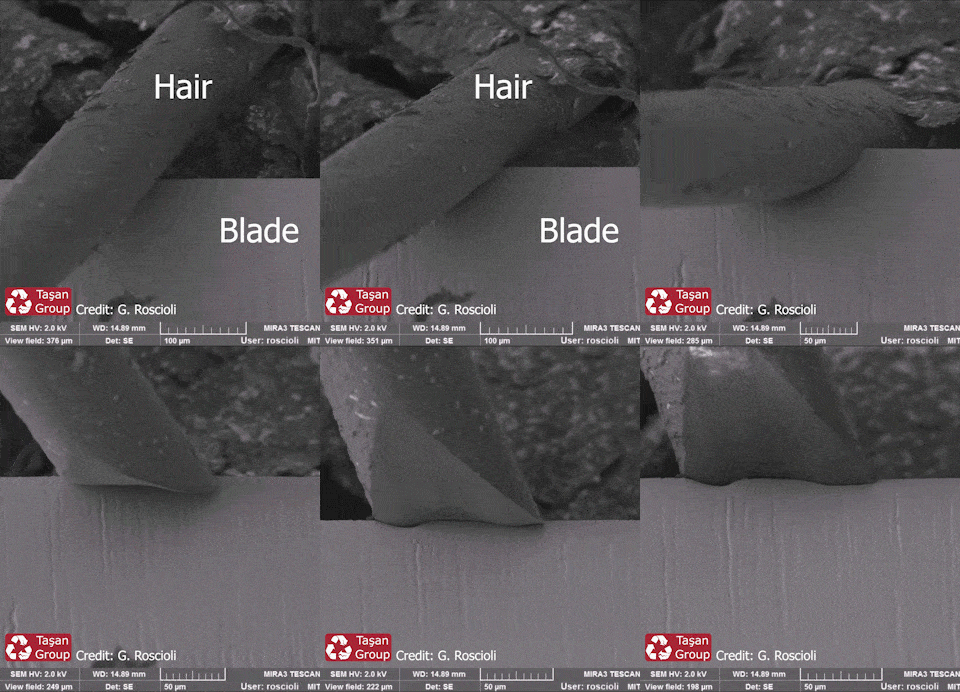
How razors wear out, as seen by electron microscopes. If you cut at an angle, the flexing of the hair can snap tiny cracks in the thin blade in regions where the blade metal isn't homogenous--and the cracks grow into tiny chips.

Friday, August 07, 2020

Location, location, location

The Master said, 'It is virtuous manners which constitute the excellence of a neighborhood. If a man in selecting a residence, do not fix on one where such prevail, how can he be wise?'

Is that "cultural appropriation?"

Learn something new every day...

I'd heard of "The Chicago Machine" for decades: everybody has. Apparently I only heard of part of it. "This is the Prickwrinkle Machine continuing the "campaign" that they lost to the Rahm/Daley Machine. Crimesha, Evans, Dart and Prickwrinkle are birthed from the Stroger Machine. Their first loyalty is to the County Machine, not the City Machine." ... "We understand why you're writing this column - you see that Groot is losing - badly - and the future belongs to the Prickwrinkle Machine. The remnants of the Anton Cermak Machine are dissolving in a flurry of federal indictments and an old aging white guard. You won't have a job worth speaking of unless you have some sort of "in" with Prickwrinkle's people"

Toni Preckwinkle aka Prickwinkle lost the mayoral election to Lightfoot aka Groot (because of a close resemblance).

On the subject of tribal conflicts, the mostly black Milwaukee Fire and Police Commission succeeded in demoting the latino police chief Morales in favor of a black replacement. "Morales' relationship with the commission began to deteriorate almost as soon as the panel appointed him chief in 2018." (FWIW, the commission head is under investigation for misusing his position.) In July that commission banned the police from using tear gas: a number of police departments promptly "recinded their support" to help Milwaukee with the Democratic Convention.

Wednesday, August 05, 2020

"Come on you SOBs; do you want to live forever?"

I wrote before that there were parallels between combatting foreign enemies and combatting plagues. I need to be more precise: there are anti-parallels too.

Before I go on, I need to remind us that using armies for internal crime control almost always turns out badly. You don't want to even think about it unless you have an insurrection (political or Mexican-cartel) already. It turns corrupt very easily.


Within a country, or tribe, or even a family sometimes, we rob and kill each other. You might be able to reduce that, but you'll never get rid of that problem. Punishment works better than no-punishment; the rest is details I don't want to get into right now.

But crime, so long as it doesn't grow into a state-within-a-state, is something we can keep under enough control that we, as a group, can live with it. Individual action can make a difference. Don't go there alone; don't hang around people using drugs; don't fool around with somebody else's squeeze; carry your own weapon; etc. That'll be no comfort to me when I get mugged, of course, but human nature isn't something I can change, and a lot of the "cures" make the problem worse.

Invaders are another matter. Their scale is already large enough that individual action is of no use, and the scope of the potential damage they do is not limited. Unless there's no possible way of fending them off, and sometimes even then, you band together to provide and support your warriors. In an ideal world, in which generals are more interested in winning wars than in politics, you trust the generals to be careful with the lives of the soldiers, but be willing to expend them in order to stop the enemies. You expect some of your soldiers to die. Traditionally, and wisely, the burden of that risk falls on the men. The risks of losing fall on the women and children too.

You have to measure your enemy. How big is the risk, and how much effort must you marshall to deal with it?

You have to expect setbacks and mistakes. If a general makes too many mistakes, he (one hopes) is removed. How many is "too many" is a judgment call, and I wish I could be more confident about how well that's usually done. But you're supposed to be able to point to the responsible people. After the Fitzgerald crashed into a freighter, Bryce Benson needed to move ashore permanently, but when the extent of the problem came out, the Secretary of the Navy should have gotten the axe too. And somebody needed to explain matters to politicians who want to "show the flag."

The demands of a war sometimes require infringements of rights. Someone needs to be responsible for that, and there needs to be a clear end to it as well. Otherwise it's hard to claw the rights back afterwards. Power is addictive, and especially the power to suppress dissent.


Diseases happen. Some of them are random, and some of them are self-inflicted stupidity, and some happen because somebody else was careless or stupid--or malicious. Usually we worry along somehow, trying not to be too stupid. Eventually something kills us. It is possible to spend infinite resources in health care--the demand will grow to match the supply, but in the end everybody dies. Some projects make health better overall (sewage treatment), and others have opportunity costs that make things worse.

Deadly epidemics are another matter. Their scope is large enough that individual action is of little use, and the damage they can do is not very limited. If you hope to live, you need to coordinate with your neighbors and essential workers to simultaneously provide food/water/waste disposal while minimizing the chance of contagion. Without supplies and waste disposal you will die of hunger or some other disease, but each contact brings a probability, however small, of contagion and the plague. Unless the plague discriminates somehow, the risk falls on everyone.

You have to measure your enemy. How big is the risk, and how much isolation and effort must you use to deal with it?

For example, the current plague is relatively mild as these things go. It isn't as contagious as measles, or as deadly as ebola, or as apt to hide out as anthrax. That's not cheering to the crippled or dying, but it's true. FWIW, I'm getting into the higher risk category, and expect that I'll get it one of these years.

As an exercise, imagine a plague, spread by touch or fomites, with 30% mortality rate. Quarantines would be enforced at gunpoint, and transportation would shut down--including vital supplies. Some people would starve or die of unrelated diseases. You'd have to balance deaths by plague against deaths by starvation or lack of critical drugs. (And by quarantine I mean both town border enforcement and locking the sick in their home until the inhabitants either die or survive the illness.) In an ideal world, there would be people clearly responsible for these decisions, and they would be careful with people's lives, but willing to let some die that more would live.

You expect some random failures, and some mistakes, but you also hope that those who make too many are removed and replaced with more competent people. There needs to be a clear chain of responsiblity. Different states may wind up with different policies, especially if the plagues hits them differently.

Combatting the plague may require infringement of rights, including the right to travel--even for vital things. Someone has to be clearly responsible for that, and there needs to be a clear end to it as well.

There would be plenty of opportunity for abuse, score-settling, and profiteering--just as in a war.


Some of the parallels are pretty clear: collective effort, people sent to likely death, redirection of resources, tight controls on ordinary life, and a need for chains of responsibility/command.

Both bring a strong temptation to mission creep: using the military to police, or to do public works service; expanding the Department of Plague Defense to address lesser diseases as well. ("If we can stop smallpox, why can't we cure tooth decay? Let's ban sugar.") Do I have to explain why both are very bad?

And, as I wrote before, both are very likely to be caught with their pants down when a real plague or war breaks out.

There are anti-parallels. In times between epidemics, the Department of Plague Defense will want to justify its existence. Politicians would tend to favor this: increasing "free" medicine plays well in the ballot box. In times between wars, the military gets more interested in internal empire-building and politics than actual readiness. Politicians tend to be eager to cut military budgets in favor of their personal priorities.

People understand volunteering for war well enough--the dangers are clear, the enemy is clear (well, usually), and what to do is clear. Plague defense is more abstract, and much creepier. You feel more exposed and helpless with an invisible enemy.


In my schema for this kind of program, the CDC's mandate is far too broad--they'd be more analogous to police than army. I'd not want to give them the kind of emergency authority the DPD would need--especially when they show an interest in broadening the definition of epidemic to include crime. I think they need some housecleaning, not greater scope.

Still topical

"the passion for equality made vain the hope of freedom". Lord Acton, in The History of Freedom and other essays, wrt the French Revolution.

Sunday, August 02, 2020

Lincoln projects

Althouse reviewed the Lincoln Project's attack ad on Trump's physique and sex. "We do it," Wilson continued, "because every second Trump is distracted by a Lincoln Project ad, ... — every moment he’s focused on us, he’s not campaigning against Joe Biden."

This seems to be in the same tradition as another Lincoln project, this one from 1864, sponsored by The World. They had political beefs with him, and also were peeved that he was interfering with a stock market manipulation scheme they were involved with.

Little has changed in politics.

Friday, July 31, 2020

Elam

I've run across references to them in the Bible, and in ancient history, but until now never took the time to figure out who they were.

It turns out that's not entirely easy.

Wikipedia has an entry, and there's a Youtube series.

Very little remains. King lists in the region are not always consistent. Cross-referencing what is known from Sumer and Babylon lets scholars reconstruct a history of the kings (or the Great Regents of the Sukkalmah dynasty) and some of the wars, but the names are empty and there's hardly a hint of anybody else. "Ebarat the King. Kuk Kalla, son of Kuk-Sharum, servant of Shilhaha." You'd swear somebody was just making up sounds: "Kuk-Nashur", "Tan-Uli", "Tempti-Halki", "Shirukduh."

It doesn't help that the Assyrians did their usual number on Elam and the fragmented "kingdom" never recovered. The language slowly died out and the Medes and the Greeks and the Parthians and the Arabs defined the culture thereafter.

"I, Napir-Asu, wife of Untash-Napirisha. He who would seize my statue, who would smash it, who would destroy its inscription, who would erase my name, may he be smitten by the curse of Napirisha, of Kiririsha, and of Inshushinka, that his name shall become extinct, that his offspring be barren, that the forces of Beltiya, the great goddess, shall sweep down on him. This is Napir-Asu's offering."

Her statue is headless. For what it's worth, the name of the smasher is extinct. "There is no remembrance of earlier things; and also of the later things which will occur, there will be for them no remembrance among those who will come later still." They were a powerful people 10 times longer than the USA has been a nation.

Wednesday, July 29, 2020

Interpreting numbers

Raw numbers of disease cases aren't always very informative, beyond some general "Holy cow, that's a lot of cases!" or "Is that a problem?" How many tests were done; how big is the population; and on and on. The details matter.

I wasn't expecting this detail: in reporting cases "they prioritize those positive cases, the negative cases are dragging behind a day or two or three." It makes sense, but it means that you have to use not the test numbers as given by the day of information release, but by the day the test was administered--which adds a little more complexity. And my observation of reporters suggests that they don't handle complexity well.

Monday, July 27, 2020

Why a dummy?

Commander Salamander and his commenters are musing about why Iran would spend the money on a fake aircraft carrier, and then tow it to the Strait of Hormuz. It isn't as though they're rolling in dough. The boat isn't as expensive as a real carrier, but it isn't chicken feed either.

Two interesting suggestions so far are "graft" (somebody connected has a boondoggle contract) and as an obstacle in the strait. And, of course, propaganda movies for home consumption as they blow the "American" carrier to bits.

It's a dummy carrier, but it isn't obvious what lies under the fake flat top. I'm not an expert on the strait, but maybe they're laying mines with the thing. It doesn't "look like" a mine layer, so you've got some surprise there. If they were planning an imminent attack, it could also be a "fire ship" or kamikazi. I don't think they've got the drones to use it to launch a fast drone-swarm attack. (I wonder how many drones you need to overwhelm anti-aircraft measures on our modern boats. I suppose you might do some damage with hundreds of small drones too--sort of like strafing.)

Sunday, July 26, 2020

What makes it "modern"

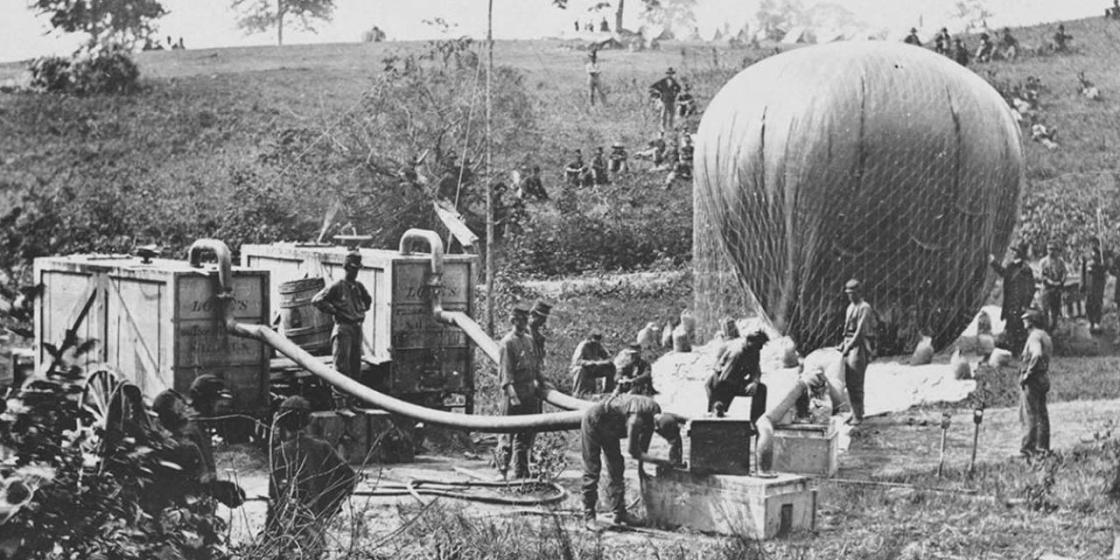
Youngest Daughter was talking about why the US Civil War was supposedly the first modern war. The first thing that came to my mind was air power.

Think balloons for reconnaisance.

The Union only used them from 1861 through 1863--I guess they were too awkward to supply and use.

The Confederates had one too, made of silk dresses, but it was captured by the USS Maratanza on July 4, 1862.

Friday, July 24, 2020

The Young Scientists

If you've hung laundry on a line, you know that pinning up a sheet leaves it perilously close to the dirt. If you drape it over a line, the air doesn't get at both sides of the sheet easily, because you have it folded. If you drape it over two lines, you get better air circulation, but it pulls the clothes-lines close together. So, at the cost of a little more effort, you pin it to two lines, letting it dry in a U-shape.

OK, now suppose you and your sister are playing in the yard. The above-mentioned sheet looks like an interesting place to sit.

It isn't.

Suppose it is windy enough that plausible deniability is possible. Your mother pins the sheet back up and you and your sister keep playing in the yard.

Clearly the pins don't hold a lot of weight.

How much weight will they hold?

There's a way to find out. The California lawn is new, and there's plenty of exposed dirt, and a shovel leaning against a wall.

Unfortunately, the experiment gets interrupted before more than about a half dozen shovels of dirt land in the sheet--not enough weight to pull it down. So you never learn the answer.

"The Ape Who Loves"

Sarah Hoyt's essay is worth reading today. She just lost a beloved cat, and looks beyond that to the bigger picture.

Sunday, July 19, 2020

Patron saint

He's not exactly a saint, but Matthew Hopkins seems a good choice for patron of the AntiRacism™ investigators.

Clout

I assume that it was unwise to discuss matters where the boss could hear, but when his nephew was hired the first question in everyone's mind was--was he hired for reasons other than competence? In Chicago, the son of an alderman's buddy faced the same unspoken question. It may have been unfair--the boss' nephew might have inherited the same native capacities that put the boss where he was. But one wondered--until the alderman's buddy's son actually showed he could do the work.

We have a new kind of "alderman's buddy" these days. And the unspoken question is sometimes unfair now too.

Landed too soon?

This morning I had the window open, and heard a loud honking. A flight of geese flew over at about 20' high--pretty low given that there's not much open space beyond the trees in that direction. About 10 seconds later, another wave flew over, between houses, this time at about 10' high.

10 seconds after them, a couple of geese ran down the road after them.

Friday, July 17, 2020

On St. George

Chesterton, of course:
If the real original St. George did find himself interviewed by a modern newspaper man, he would think that hardly anything in the newspaper was new. He would not think primarily that he had come into a strange world, far away from dragons and princesses and mediæval armour. He would think he had got back into the old bewildered and decaying world of the last phase of Paganism, loud with denials of religion and louder with the howlings of superstition. He would find everything in Juvenal – except Juvenal. He would find quite as many absurd lady gladiators – only not so many people calling them absurd. He would be quite at home, thinking himself back in the old Diocletian Empire – and he would prepare for death.

Sunday, July 12, 2020

World views and values

"I have no filter" = "I am authentic"

"I have no filter" = "I am incontinent"

Saturday, July 11, 2020

Reluctance to endure lectures

Althouse got there first: an upscale shopping mall shut down when a BLM protest showed up. It was nominally to be a "block party" to "educate patrons on the plight faced by Black people in America."

One of the protest leaders had the nom-de-guerre Frank Nitty (real name Sensabaugh. (He claims that a "White Supremacy group" had threatened his life. I suspect a "basement email warrier" was the culprit.)

His chosen name is suggestive, though possibly he's ignorant of the original.

This, however, is perhaps more troubling: he served as apologist for a riot that burned down a couple of houses on the rumor that two missing girls were being trafficked there. (They weren't.)

UPDATE: I'm told the nuns would rap your hand with a ruler if you didn't pay attention to the lecture. I wonder about BLM lecturers...

A thought about the "Nations"

Though Yankeedom and the Deep South may have despised each other, they lived in untroubled agreement that they knew who were the elect destined and empowered to tell all others what to do. They merely disgreed on who it was.

Friday, July 10, 2020

Colin Woodward: American Nations

"A History of the Eleven Rival Regional Cultures of North America"

Woodward continues what Albion's Seed and The Nine Nations of North America I haven't read the latter began, with a history of the nations. "Nations" means an ethnically/linguistically/religiously coherent group--which doesn't always coincide with a legal state.

He figures there are eleven nations: Yankeedom, the Deep South, New Netherland, Tidewater, Greater Appalachia, Midlands, New France, El Norte (the oldest), the Far West, the Left Coast, and the First Nation. The latter isn't all the Amerindians, only those of the far north.

This view of the history was very interesting. He brought in details of history I'd forgotten, and some I hadn't heard of, and wove them into a plausible pattern--so smooth that I started to get suspicious about cherry-picking.

So far I was eager to recommend it.

Then he got into the Culture Wars section, and eras I actually knew quite a bit about, having lived through them. Oy. He's a partisan himself. He doesn't understand religion--he seems to think it to be politics by other means. And his descriptions of nations he doesn't agree with, and things like the Tea Party--can you say "invidious?" But his take on the nations' modern history slots smoothly into his framework, which calls into question how accurately the older history really fits: how much of that did he caricature too?

I'll have to cross-check some of his claims. E.g. Appalachia didn't completely ally with Dixie until after the war. Given the name Yankees had earned in the early years of the country, I suspect he's right that Appalachia was torn between hating the Yankees and the Deep South masters.

He finds it easy to spot the ulterior motives of the movers-and-shakers in the Far West and the Deep South, but Yankeedom and the secular descendents of the Puritans are almost always on the side of the angels. Except perhaps for the time the federal budget surplus (37% !)was turned into Civil War veteran/widow/children pensions--only for Union soldiers, of course, so all the money flowed north.

If the Wikipedia article on "Nine Nations" is correct, all three books have a vast gap, one that Fischer promised to fill but never did. The black cultures in North America don't map neatly onto the "white" cultures. I'm not sure I'd rely on Woodward to fill that gap, though.

Wednesday, July 08, 2020

Different at the U

UW Chancellor Blank sent around an email about "Addressing Racial Inequities on Campus." Since I gather this is a public document I assume I can quote freely.

One bullet point is "Enrollment and Recruitment. We must continue efforts to increase the diversity of campus by expanding enrollment and employment among underrepresented groups."

The very next bullet point is "Campus History. Understanding our past is important to changing our future. ... A central part of this project involves confronting and discussing the history of racism and other forms of exclusion/marginalization on campus."

Imagine how much more enticing a campus will be to prospective black engineers when one of the main topics of discussion is how racist the campus has been.

And students will have to take an orientation explaining "culture, identity, and difference." I assume that eventually the faculty and staff will have to take it too. To appreciate the full absurdity of this, remember that UW-Madison is a reasearch university, and recruits students and faculty from all over the world. Wet-behind-the-ears students may not have experienced much "difference," but I guarantee the faculty and staff have.

I'm not tenure bound, so this isn't going to bother me, but do I need to explain what can happen to research groups? "This past spring each Divisional Committee added new language to tenure guidelines that recognizes the importance of community engaged scholarship and scholarly activities in support of diversity, equity, and inclusion as noteworthy endeavors to be considered as part of tenure and promotion." Virtue signalling is cheap, and quite a bit easier than research.

Granted, outreach is a good thing, and not that easy. The people I know will keep doing the same things (which reach diverse groups of students already, albeit the subset of students who are already curious about science), and modify the bookkeeping to keep track of ethnicity counts instead of just the total number of students.

I don't see 95% of the University students or staff. All I know about frats is what I read in the papers (and am thereby misinformed) and from conversations with a scientist who used to be in a frat. If you told me they were hotbeds of racism, I'd be surprised (and dubious), but couldn't contradict you.

What I have seen at the U is about as free of racism as you can get. If you can do the work, you're in: no matter whether your ancestry was from Western Europe, Eastern Europe, China, Japan, Mexico... We've had very few blacks (one Nigerian), but nobody seemed to be walking on eggshells. If there's anything structural that stops blacks from being physicists, it isn't in the physics department. It's in high school, or if my intermittent elementary school demos are any guide, quite a bit earlier.

I get it that being the only one "of your kind" can be very uncomfortable. You stand out; you're not in any of the families/groups/cliques; you can't read people--and some of those people may not like you because of what you are and you have no idea which. In my case, I also couldn't always understand the language: I never did acquire skill with Liberian English and learned about 3 words of the tribal languages.

What was liberating for me in those environments was clear expectations. In a defined environment, your family didn't matter, what mattered was whether you could kick the ball into the goal (not well, it turned out), or whatever the matter at hand was. Outside of school, in purely social environments, I was at sea. To be clear, that was and often still is the case in any purely social environment. introvert

Insofar as the university is about education, it is easy enough to make clear expections in clearly defined environments in which students can find a way to learn. Punctuality and lab courtesy and course expectations are pretty simple to define.

If the student is there for an apprenticeship, it gets more complicated, but I still think we can spell out expectations. "Research is a social activity. You are expected to have lunch with your fellow-students at least twice a month. If somebody in your group is uncomfortable discussing some subject, don't bring it up again." etc

If the student is there to make contacts (and maybe look for a spouse), thing get more complicated.

If the student is there for the modern Grand Tour, it almost seems redundant to try to teach diversity; you would hope the experiences would be enough by themselves. (If not, why bother with the U?)

I don't want to worry about "the student experience." That form of entertainment seems to be a big selling point for universities, though.

Monday, July 06, 2020

What's in a name

Dr Boli discovered a Macedonian work on linguistics that sheds some light on an old political dispute with Greece.

Sunday, July 05, 2020

Civil war

Our youngest daughter has had a tradition of watching the '93 movie Gettysburg on the anniversary of the battle, and this year she persuaded us to watch it too. It seemed like a fine movie, though perhaps relying a bit heavily on Longstreet.

The first question that comes to mind is: Will we have another civil war?

The answer, of course, is yes. We're not immune to history. Will one happen in my lifetime? I don't know.

All my news-reading life I've heard of people who want us to have another one. Remember Charles Manson, who wanted to jump-start a race war and piggy-back on it to start a new society? Apparently he has company again.

Saturday, July 04, 2020

In the voids

How do you see magnetic fields when they're too far away to stick a probe in, and too weak to polarize light? Like, for example, the magnetic fields in the voids between clusters of galaxies...

One thing you can look for is gamma rays from blazars.

It turns out that light can scatter from charged particles, but it can also scatter off other light particles. The effect isn't nearly so strong, but it's there. And if a gamma ray of sufficient energy collides with one of the background microwaves, it can "pair-produce". It might just simply scatter, of course, in which case it loses energy and the microwave photon gains it. But pair-production contributes quite a bit. Now, a positron from that pair-production will often interact with an electron to produce a pair of photons, and the electron scatter off other matter and result in a photon too.

The first thing to notice here is that these new photons have lower energy than the original gamma ray (conservation of energy). The second thing to notice is that they'll be going in more or less the same direction as the electron or positron.

Now in the absence of a magnetic field, those electrons and positrons would keep going in pretty much the same direction as the original high-energy gamma ray. But if there is such a field, it will bend the particles into new directions, and the gamma rays that result from their interactions won't point back to that blazar.

Quanta has a description and picture.

So, when you look at the spectrum of gamma rays from a blazar, some of the low energy gamma rays shouldn't be there. The model say there should be more than we see.

Arguing from an absence isn't very robust--there might be some other reason for the missing gamma rays. The models can be wrong.

But if you look near a blazar, maybe you can see an excess of low energy gamma rays there, bent off into a halo around the star. It looks like you can.

The intergalactic magnetic fields they infer are tiny: of the order 10^-17 to 10^-15 Gauss. That turns out to be big enough to solve another: the universe seems to have expanded faster than you'd expect (this has nothing to do with inflation, which I don't want to try to defend).

So, a little halo of light (well, gamma-ray light) may be telling us something about a region we'll never be able to visit.

"Coconut-picking machines"

"Supermarkets snub coconut goods picked by monkeys"

BBC reported that several British companies, panicked by PETA, have "vowed to stop selling" "any products sourced from monkey labour."

Male monkeys are able to pick up to 1,000 coconuts a day, Peta says. It's thought that a human can pick about 80.

It said it also discovered "monkey schools", where the animals were trained to pick fruit, as well as ride bikes or play basketball for the entertainment of tourists.

As usual, PETA describes the worst case as normative. That's when they don't outright lie: I read what they wrote of treatment of cows in Wisconsin--did they think we who live here don't have eyes?

I gather that the companies are perfectly happy to have humans do this harvesting instead--which is much more difficult and dangerous for a human than for a monkey. Priorities, you understand...

Wasn't there once an advertising slogan "Untouched by human hands?"

Thursday, July 02, 2020

Defunding police

What do people want with the slogan "Defund the Police?"

I'm told this really means taking money from enforcement and putting it into prophylatic social services.

That would be a more plausible claim if it were what marchers were saying, but "No more cops" suggests that they mean what they say, and that those "more sophisticated people" who want to be the spokesmen are merely saying what they think would be appropriate.

I am perfectly sure that some voices are not being heard. The previous Madison police chief kept a blog of the most significant police interactions of the previous day, and in response to pressures to monitor police/minority interactions, he included the ethicity and sex of the criminals and the victims. Most of the violent "suspects" were black. So were most of the victims, and entertainments like "beating up your ex" featured prominently. It wasn't white eavesdroppers who called the cops; it was the battered black woman. I don't remember hearing a lot from those like her.

The initial question is poorly framed. Different people want different things.

  1. Some believe that policing and punishment cause crime. There are some things so stupid only an intellectual can believe them. Some of the leadership are that kind of intellectual.
  2. Some don't care, they just want the power the slogan gives them. If they got control, just like their ilk elsewhere, they'd re-create a police force under their direct control, and use it to solidify their power. We've seen it happen many times before.
  3. Some don't think about it at all. "Smart people say it's OK, so let's go with it. No punishment, no crime; win/win!"
  4. Some undoubtedly are criminals themselves, or friends with them, or just want to cause mischief, and hope for a freer hand. Yes, it isn't that hard to find people who think uppity girlfriends deserve a beating.
  5. I hear some of them saying that they consider the police to be aliens.

There is precedent for having different ethnic groups police themselves. In the USA, the Indian nations could have, at some level, their own laws and enforcement. The Ottoman empire used the millet system to manage a multi-confessional land. Each group had its own responsible officials and internal rules and taxes, and in case of conflict the laws of the injured party's millet applied--unless it involved Muhammadans, in which case sharia applied.

The alien-averse might think some laws unfair (e.g. drug laws), but most of the time they'd create pretty much the same laws themselves: don't steal, don't beat people up, etc. Their objection is not to the enforcement but to the enforcers. "They aren't our laws, they're theirs:" even if the laws are the same.

This denies "We're all in this together." It's a call for separation; and separation along racial lines. Keep calling it millet even though it isn't confessional; we want to avoid Godwin's Law short circuits.

We've seen the "We're not the same" attitude before, most memorably in the early 1860's, but it's been part of the mix all along. So long as there was some kind of frontier we could manage that more or less peacefully. Mormonism was a bridge too far, but they managed to go it alone for a while. The more central control we have, the fewer opportunities for being separate there are--and one of our political parties is OK with growing central control and the other is enthusiastically in favor of it. I don't think "benign neglect" is going to work.

If we're going to accomodate the ones who want a millet (and who has demonstrated that they are even a plurality of the black population?), we'd have to be explicit about it.

And law enforcement gets to be really complicated.

911 gets a call: "My boyfriend strangled me!" "Are you black or white? I have to know which policeman to send."

Cleanly separated enforcement doesn't seem to be very possible unless there's some pre-determined clarity about who has jurisdiction where. That suggests that you'd need a clearly defined place where the millet applies, and that for the millet to be effective, those belonging to it should move to that place, and those not belonging to it move out.

I don't like this solution--even without the inevitable historical comparisons. And there'd be a butcher's bill eventually from the arguments over who got what.

But I wonder if some of those who've jumped to support the BLM demands have though it through too, and do.

UPDATE: Example added for #4

Barn swallow

While resting on the pier by the marina on the harborwalk at Port Washington, we watched the barn swallows perching on the wires. One of them seemed to have acquired a 2" fluffy gull feather behind its feet that it could not dislodge, despite about half an hour's effort.

The feather didn't seem to seriously impair flying.

A second barn swallow kept coming back to this one. At one point it looked like there was an attempt to mate, chased off by the first.

I wondered if the feather made the first bird look receptive. "Barn swallows prefer mates with long tail feathers. In general, it is the females that do the selecting in pairing and they prefer younger, more fertile males." So, unless that was two females, with the feather making the first bird look hyper-masculine, probably not.

But the second bird wasn't usually doing anything that might look agressive, so the feather wasn't making it look like a "chase it away" alien.

Has anybody seen this sort of thing before?

Wednesday, July 01, 2020

Lighter side

In Port Washington you may find a business called "Wholistic Dentistry."

I did not investigate closely: they were closed and I had places to be.

Your everyday non-wholistic dentist will urge you to make the lifesytle changes of eating less sugar and starch and flossing more often. Presumably "wholistic" adds new dimensions beyond these: perhaps a modified version of a Miskito smoke therapy that requires that the patient use cigars--that would probably be popular. Or perhaps they inject novacain into the left big toe instead of the jaw. Or they teach patients to transcend dental medication.

Or perhaps they really mean "hole-istic" dentistry.

I was accused of making Dad-jokes when I referred to Ouroboros butterflies.