Thursday, September 08, 2022

Elizabeth

I've preference for monarchs who stay out of the way, but that may be something imbibed with the rest of our culture. Probably if I'd grown up with kings, I'd have a feel for the king as an icon of the people, and maybe if the king were sovereign even a respect for a king's authority. It's not part of my mental furniture, though. I wonder what it would feel like.

Elizabeth did her duty as a "monarch who stays out of the way." I wonder to whom she confided what she really thought about the ministers and policies. Maybe Philip; maybe nobody. Rest in peace.

At the side of my desk sit some coins and bills left over from Canada. I wonder how long they'll keep making money with her face on it.

And, of course, I wonder about Charles. I'm told he's unpopular; does he have the gravitas to be an icon?

Tuesday, September 06, 2022

Harassment

Antarctica is a hard place to work. You're cooped up with the same people for months working and sharing close quarters. Different people sometimes answer to different agencies. And some are jerks. A few years back the first flight to the Pole at Austral Spring brought a US marshall to arrest a man. I don't know what means they'd taken to constrain the culprit before the marshall arrived.

It seems the Antarctica program has had problems with sexual harassment. Apparently the bulk of this is at McMurdo, which has twice the population of all the other stations combined, and apparently has much laxer staff vetting. The upper echelons think most of it is alcohol-related, but complainants disagree. Because this is voluntary survey and focus-group based, there aren't numbers of incidents, much less broken out by who and when.

Harassment training modules are designed for workplace issues, and don't fit so well the environment where workplace and living place is the same place with the same people. They need better designs. Coordinating complaints and responses between (e.g.) the Air Force and the NSF seems like a no-brainer, but hard. (important things are always simple; simple things are always hard) Figuring out who causes problems and why (alcohol can breed misunderstandings) might go some way towards cleaning things up.

I've never been there. If I'd gone: I'm an older man and orders of magnitude less likely to be pursued, I'm not into the dating or bar scene so I'd not be hanging out with young ones who were, and I'd not be taking liberties with non-existent subordinates. I don't think I'd have seen any harassment. It'd be like different worlds.

Teacher at home

Milpitas teachers are struggling to afford housing. The school district is asking parents to take them in
The average rent for a one-bedroom apartment in Milpitas is now nearly \$3,000 a month, a 15% spike since last September... That works out to roughly half the annual salary for early-career teachers in the district, who earned around $68,000 last year.

Some districts are looking to create teacher housing on school property--but that's expensive.

Imagine the relationship a family would have with a live-in teacher. What sort of boundaries get set? Of course one model doesn't fit every situation, and I can't imagine everything being successfully firewalled. So how much extra help does Junior get from the teacher? How much extra help does the teacher get from the family?

Some years ago I mused about the possible increase in the number live-in servants. I should revisit that. We'd need some changes in home design.

Monday, September 05, 2022

Some background on Roman slavery

I got side-tracked into looking up Roman slavery: apparently its extent is not well attested and consequently estimates are disputed. I hadn't realized that exposed babies might provide a slave pool--I'd heard of exposed girls being raised to be slave prostitutes, so it makes sense that boys might be raised and sold too. Some might have been bought from captors outside the Roman Empire--the surrounding nations fought each other too. "Adverse moral judgments focus on the supposed greed and general turpitude of slave dealers, who were accused of tricking out their wares to defraud buyers, and likened to pimps"--note that the concern is for the customers rather than the slaves.

His estimate of the free population in the cities and countryside is 6.5-7.5M and 49-52M respectively, while estimates for slave populations are 1.3-1.9M and 3.5-6.5M respectively: 20%±2 slaves in the city vs 10%±3 in the country. They weren't all captives--children born to a slave woman (provided she was a slave throughout the pregnancy) were also slaves.

But what's known? There's no data from Republican Rome so: "We are reduced to the mere assumption that slave prices in Republican Italy ought to have been relatively low during the massive expansion of the regional slave complex."

The relative prevalence of private sales versus transactions arranged by professional dealers is unknown. In slave markets, slaves were displayed on platforms and could be undressed for closer inspection; new arrivals were marked with chalked feet. Slaves wore placards (tituli) advertising their qualities around their necks (including their origin, state of health, and propensity to run away), or special caps (pillei) in those cases where the seller would not offer guarantees. Extant sales contracts, primarily from Egypt with rare additions from Italy and Dacia, testify to the scrupulous observance of formal legal requirements, and give us a rough idea of the age distribution of traded slaves, dominated by individuals in their teens and twenties.

You'll probably have read already about diffences between Roman slavery and ante-bellum US slavery (and Caribbean slavery, different yet again). This is interesting background detail--and explanation of what's not known.

Sunday, September 04, 2022

"Ideally"

I've read several times that having renewable energy sources charge up automobile batteries is the ideal future for automobiles. But if we're talking about "ideal", how about using renewable energy to synthesize octane or nonane? These have a high energy density; we understand the safety issues very well; we have mature technologies for delivery and for engines.

The only thing we don't have is the synthesis technology. But the phrase was "ideal", not "feasible anytime soon."

Even if it was feasible, right now it is so cheap to distill octanes from oil that I can't see anybody trying to synthesize n-octane for anything other than curiosity's sake. And of course there's the "what's the raw material?" question--we'll run low on coal one of these days too. CO2 or plant waste would be "ideal" raw materials.

Different "ideals" send you in different research directions. Batteries or synthesis?

Saturday, September 03, 2022

Interferences

The Niagara Gorge rapids show places where the water seems to sweep high over some obstacle, but the signage assures us that the bottom is scoured pretty flat. Reflections off the sides of the river could produce standing waves where the reflections interfere constructively. It reminded me of shock diamonds, except with incompressible fluid and an irregular channel which makes the reflections show up irregularly.

Friday, September 02, 2022

When there's one road

Scores of travelers leaving the country via the Roberts International Airport nearly missed their flight on Tuesday due to the heavy and uncontrolled traffic on the RIA Highway caused by the United Methodist University’s graduation.

The airline was gracious enough to have delayed by an hour to give passengers a chance to board since half of its travelers were stranded in the traffic. The hour delay in Monrovia, however, led to many passengers missing their connecting flights from Accra, Ghana to other destinations.

There's no other good way to get there. Maybe you could get a ferry ride at SNAFU, but probably not on short notice. And I was complaining about Pittsburgh traffic...

UPDATE: The last time I was in Liberia, there was one working stoplight in Monrovia, and stop signs were meaningless unless enforced by a policeman.

Thursday, September 01, 2022

Canoe Plants

Polynesians brought along plants on their explorations, so that wherever they might land, they could produce the foods and tools and medicines they would need to survive, and perhaps travel onward from there. The link lists 24 plants taken to Hawaii, many of them serving multiple purposes. One plant might just be used to make rope, and another produce food, medicine, materials for clothing and for building.

Of the 24, 11 were used for food, 1 for an intoxicant, 12 for building materials and tools, 8 for clothing and beauty, 15 for medicine, and 3 had religious use as well.

They varied from tall trees to small garden plants. Some went wild as invasives, and others required careful cultivation and, in Hawaii, are almost gone.

Math brains

"Are All Brains Good At Math"

Elizabeth Landau should have been clearer about what math is. Counting ability seems hardwired but needs a language that is the start for math. To be able to understand something in math when it is explained to you is another capacity. Being able to use the abstractions yourself is yet another, and being able to do research a fourth (and much rarer) thing.

The answer to her headline question is, as you instantly guessed, "No." She should have asked some parents about their children and math. Some take to the first three types quite easily, others get the first and sometimes the second but struggle to use the abstractions. Same environment, same genetics--random variation.

I believe we can do much better with the second type (understanding when it is explained) with better explanations. I'm trying some things myself. Youtube has some excellent teachers and animators (motion works so much better than little arrows on a page!)--much better than I. And as far as I can tell, Barbara Oakley is correct--you need a foundation of memorization. Perhaps one can find ways to make the requirements less frightening (timed tests could be scary), but there's no royal road.

Wednesday, August 31, 2022

Trying to rejoice

Paul said to rejoice always, even though the prayer meetings request relief from pain and illness. That's a trifle hard to remember when you throw your back out (painting the basement floor, FWIW). Pain isn't the way it was supposed to be. Unfortunately...

When was the last time you heard a sermon using Isaiah 57?

The righteous man perishes, and no man takes it to heart; And devout men are taken away, while no one understands. For the righteous man is taken away from evil, He enters into peace; They rest in their beds, Each one who walked in his upright way.

When you're rich, maybe things don't seem so evil.

Tuesday, August 30, 2022

Niagara boat tour thoughts

The world was made for God. We are rich enough to make ourselves comfortable and keep most things human scale and human-controlable, but the world isn't always either one. Things like Niagara drive that home. Farmers probably are forced to know that we don't control everything, and the rest of us should remember it. Maybe that's part of the daredevil urge--they try to extend human control, but do it by frankly facing the non-humanity and wildness of the world.

Bout and Liberia

Viktor Bout has a little history with Liberia--he helped a great deal to make it the mess it is now; supplying several sides. I have a little list of villains in that war (including Gadaffi), and no earthly court will suffice to bring justice.

I don't know Griner from Adam's off ox, but ... We just visited Canada. It's a friendly country, and there's rarely any problem with travel--but every now and then they do random checks. So, just in case, we made sure there was no contraband produce, medications were in original bottles, etc. I've never met a customs agent with a sense of humor, and our schedule was a bit tight; I didn't care to spend extra time explaining. If I were going to Russia (or China) I'd travel as light as possible, and triple-check everything--and then ask again if I needed each peice.

Granted, the two criminals both were importing contraband, but the trade is incommensurate.

Monday, August 29, 2022

Cynical

"Watch what people are cynical about, and one can often discover what they lack." George S Patton

There seems some wisdom in that. But suppose I try to apply it to myself--what am I most cynical about?

Politicians. The naive reply is that we have no lack whatever of them. But maybe one could probe differently--I have no political power, and no experience with the necessary tradeoffs and manipulations required to get anything done. I don't know--if I had such experience, would I be less cynical, or would that expand to include myself?

Advertisements. It's horribly hard to get noticed in the din of slogans and images. I was "watching" someone's playlist the other evening, and the pictures of bands used alongside their songs were always extreme in some way. Remember the fashion a few years back for attractive women to e.g. play the cello nude? I suspect it didn't help their careers long term as much as they hoped, but there weren't so many actually involved that one could do a good statistical analysis.

News and reporting. OK, fair enough. I lack enough good sources of trustworthy news. I know that when I investigate science reporting the story often has little resemblence to the facts.

Popularity. OK, fair.

Thursday, August 25, 2022

Poetry of astronomy

Chesterton complained that
But for some mysterious reason this habit of realizing poetically the facts of science has ceased abruptly with scientific progress, and all the confounding portents preached by Galileo and Newton have fallen on deaf ears. They painted a picture of the universe compared with which the Apocalypse with its falling stars was a mere idyll. They declared that we are all careering through space, clinging to a cannon-ball, and the poets ignore the matter as if it were a remark about the weather. They say that an invisible force holds us in our own armchairs while the earth hurtles like a boomerang; and men still go back to dusty records to prove the mercy of God. They tell us that Mr. Scott's monstrous vision of a mountain of sea-water rising in a solid dome, like the glass mountain in the fairy-tale, is actually a fact, and men still go back to the fairy-tale. To what towering heights of poetic imagery might we not have risen if only the poetizing of natural history had continued and man's fancy had played with the planets as naturally as it once played with the flowers!

C.S. Lewis took up the challenge in Perelandra in the Great Dance scene, and in Already the whole house would have seemed to him to be tilting and plunging like a ship in a Bay of Biscay gale. He would have been horribly compelled to feel this earth not as the base of the universe but as a ball spinning and rolling onwards, both at delirious speed, and not through emptiness but through some densely inhabited and intricately structured medium. He would have known sensuously, until his outraged senses forsook him, that the visitants in that room were in it not because they were at rest but because they glanced and wheeled through the packed reality of heaven (which men call empty space) to keep their beams upon this spot of the moving earth's hide.

Today I can post the Lewis links with a clear conscience...

Saturday, August 20, 2022

Freshness of children

A lot of people I know or read are fascinated and envious of the “innocence and freshness” of the very young.

I’m not so sure about the “innocence” part. It doesn’t take a very long acquaintance with the child to notice some not-so-innocent aspects.

But the “freshness” brings some other things to mind:

Their stories are adventure stories:

  • as though no one had ever walked before
  • as though no one had ever climbed the slide before
  • as though no one had ever explored this trail in the woods before
  • as though no one had ever known a dandelion before
  • and when a bit older, as though no one had ever been tongue tied trying to talk to someone fascinating, who you know would end your world if she laughed at you

Yet it isn’t entirely a matter of a new adventure story. The infant seems more completely present. It isn’t dandelions, it’s this instance of dandelion or of the woods, and nothing else matters right now.

An adult sees this dandelion but remembers thousands of others—picked, blown, left alone—as well as the people they were shared with and the days they lived in. The adult’s dandelion is less of a pure dandelion and more of a tapestry.

That’s not a terrible loss; if anything it’s an increase in beauty. But sharing time with children lets us have it both ways for a while.

Thursday, August 18, 2022

If I'd known then

When my father was declining and his memory was mostly gone, his nurses said he was always a gentleman.

I've changed a bit over the years, and value some things more than I did when I was in high school. Or in college.

If you were to restore my memories to only what I had back in '73, and put me on the plane to the States again, would I live differently? Are the changes in values memory-based, or changes in me? I can lose memories.

Wednesday, August 17, 2022

Thick paint

The floor paint is thick as mustard, and the paint roller tends to skid in the tray and on the concrete. I don't think a paint sprayer would do much good with stuff this viscous, and I don't care to use one indoors anyway. Maybe the best thing is to use a wide brush instead. It can't be much slower.

Yes, I washed the floor several times--soap water and rinse. And vacuumed with a HEPA machine. I'm emptying shelves and washing the contents, then the shelves, and then painting the wooden shelves. I figure I can get the plastic and metal clean, but concrete and wood have pores. I want it clean enough for grandkids.

Tuesday, August 16, 2022

Perhaps these are connected

From the local paper today:

"Dane County Sheriff Kalvin Barrett ... goes up against one of his detectives who is accusing him of letting "identity politics" fuel the office's staffing shortage." "Hamilton ... says that too great a focus on recruiting women and people of color at the expense of considering as many candidates as possible has made staffing problems worse. ... Barrett ... said initiatives to recruit women and others from diverse racial, professional and socioeconomic backgrounds are a key solution to fix the deputy shortage."

At the bottom of the same page one finds this article: "Former Dane County deputy fired for fabricating attack is charged with misdemeanor": "Sarah Bortz-Rodriguez ... told investigators she’d been suffering from work-related mental health and substance abuse problems for months before the night of Oct. 21, when she said she was attacked at Festge Park near Cross Plains by a masked man with a box cutter, and then fired one shot at him. Instead, a failed search for the man turned up inconsistencies in Bortz-Rodriguez’s story that suggested she had cut her own arms with a box cutter and made up the attack."

Sunday, August 14, 2022

Trust

"The love of money is a root of all kinds of evil. Some people, eager for money, have wandered from the faith and pierced themselves with many griefs."

If money is, at its root, a promise that other people will do things for you, a love of money is like a hunger for promises from people. Granted, it isn't good for man to be alone; we need to be in relationship with other people. But why is there often no limit to this hunger for promises from people? Because you discount them, and need more promises to account for the discount? Because you can always imagine problems greater than the promises will meet? And as your wealth grows, losing some becomes another and greater risk. Because it's the wrong treatment for your fears and doesn't work?

moral evolution

Skimming the comment section of a post a few days ago, I ran across a dispute about whether modern reactions to a problem would differ from those of the 15'th century. The riposte was "500 years of moral evolution." Hmm. I assume he meant "improvement across the board," though evolution can make things significantly worse from a general point of view--for example the blind snakes found in caves. It doesn't hurt them to be blind in the dark, but we'd say it's better to be able to see.

Some things are better--going by Christian standards. Torture and slavery are deprecated and illegal most places. But has there really been evolution to something better, or merely change to a different set of values? I know some people who care about immigrants, and are eager to open our borders as much as we can, whose belief is based strongly in their Christian faith and who care deeply about their families. On the other hand, I know some whose love and sense of duty for family is rather more attenuated than their ancestors'. They care for the stranger as much as for their families, which is in their case is mostly abstractly.

Why are we so certain our popular sexual mores are superior to our ancestors', and our neighbors'? I've never seen that proven, just asserted that autonomy is more important.

Funny and unfunny

Over at ChicagoBoyz David Foster posted questions about humor.

St. Lawrence, while being roasted alive on a gridiron, asked his torturers to turn him over because he was "done" on that side. "Don't take life so serious, son ... it ain't nohow permanent."

To cite Lewis: "No people find each other more absurd than lovers." The beloved isn't as perfectly loveable as God, and we can't love nearly as well as He. Even at our best we see the difference, but it needn't be a painful difference; more like a game. We can happily live out our roles, and find them happily funny. From " Who Understands Who Anyhow?" by Ogden Nash "I will take all my hard-earned money. And I will bet it on the nose of the tribe whose men and women continue to think each other are funny."

In contrast it seems as though a lot of humorlessness comes from treating transient things as ultimate. "My pain at this percieved offense is sacred; don’t you dare joke about me."

You can’t joke about President N or President N-1 because ... lese majeste. Or blasphemy: your god is what you hold most sacred, and it’s easy to find people whose real god is the Party. I've heard the joke about God and the golfers, but never at church. The infinitely important isn't finite or fallible--or funny.

Friday, August 12, 2022

Hard at work

When I works, I works hard. When I sits, I sits easy. And when I thinks, I goes to sleep. Why thinking hard makes you tired

Wednesday, August 10, 2022

A different stereotype

AVI has a post on Vermont stereotypes, as shown in pictures. The first picture is of a gaily decorated VW. It reminded me of something else I'd seen: Gus Klenke's garage (my wife has a picture I like better, but I'm not sure where it is). Gus had a poem written about him. It's the first in that article.

Every year somebody replants the flowers in the car. The locals probably know who, but didn't tell us.

Friday, August 05, 2022

Too soon old,

too late smart.

I'd started sanding the steps to make sure the new paint would adhere, and realized the wood dust was going to be dangerous. So I stopped. And then I remembered how old the house was.

There seem to be some supply chain issues with lead paint test kits--the local stores were out and the first place I ordered from waited until the (much belated) day the order was to arrive to tell me they were out of stock. The second order got to me in a couple of days, and I tried it right away.

So, I need a better mask, and tacky sheets, and maybe a HEPA vacuum. I'm contemplating ripping the stairs out completely (the stringers splayed a bit and most of the treads don't fit in the dados well--I put braces underneath), but I've a lot of cleanup to address first. And I've got to plan it so one cleanup doesn't stir up dust elsewhere. I had other projects planned... At least I was still using the coarse grit.

Thursday, August 04, 2022

Pronouns

Althouse has a post about someone I heard about first on the Bee who is adjusting her pronouns. I learned that Finnish lacks them, which about now sounds refreshing.

In some of Andre Norton's science fiction, she introduced the term "gentle-sap" as a generic honorific that applied to any sapient species or sex. One might drop the "gentle" and repurpose the remainder as a generic pronoun--pronounced with a long or short "a" depending on your mood.

If we insist on multiplying pronouns, why not use some that add some distinguishing information--marital status, youth or elder, grandparent ... ?

Wednesday, August 03, 2022

Names from the past

The Friendly Orange Glow is about the PLATO project. I used PLATO as a TA when at U of I, and earlier when I was at SIU I was interested, got an account, and then got distracted and lost it. I wonder if my life would have been much different if I had gotten involved...

The book brought a name out of the past: Bill Roper. He was in the science fiction club, and into computers, and one day was explaining to me the premise of a sci-fi story he was writing that involved a computer program that hid itself in the unused bytes in allocated blocks of storage. I don't think he ever wrote code to do that, but computer viruses took advantage of not-dissimilar hiding places. I give him credit for early warning. You need quantum mechanics for a chemistry degree (and physics, of course), and there was a prerequisite math course to quantum mechanics that wasn't offered often enough, and his advisor slipped up. We parted ways on graduation, but I gather he has had a good career in IT instead.

Monday, August 01, 2022

Irrelevant and apropos of nothing

I'm not sure if it's a quirk or a flaw, but when I read something like the story of the Magi I wonder what happened to them afterwards, or read something like the one fighting against the prince of Persia, I wonder how that played out. You can get into trouble taking speculation seriously, but if it's just a "What kind of story can I tell" it seems harmless. These trend quite short: squibs and short stories. And sometimes I get an image or a problem, but it just sits there with no action or resolution, and I don't even get a squib.

Take the Daniel bit, which seems to imply a recalcitrant angel (demon?) in charge of an empire. Maybe a guardian angel of the Persian court? That idea just seems to sit there for me. Maybe the POV of the guardian angel's assistant would work as he tries to make them do right (or do wrong, if its a devil), with one of the humans starting off in a direction he or she should not go. Conflict ensues with the other humans and with the other empires' courts and their guardian angels. Call that Setting X. It could work, but it doesn't have the nice mythic feel you'd hope to find with these sorts of creatures. On the third hand, neither did Screwtape and that works brilliantly.

If you wanted to go with horror, you could notice that there's not a 1:1 map demon to human in demonic possession. The unnamed demoniac had a lot of unwanted guests. It might go the other way as well, and have 1 demon possessing or at least oppressing/influencing a nation's worth of people. Looking at some of the wicked madnesses that surrounded World War II, you might tie that in and call it the War of the Three Demons. The problem with that setting is that you can't tell a plausible story from the demon POV, and the humans are either captive or not. You could focus on unmotivated changes in individuals (as in the start of Ballroom of the Skies), and make the story be that of a friend trying to liberate a captive soul. But then you eventually need an exorcist of some kind, and the solution becomes too easy or too hard. It's also hard to have the friend "keep up" with the possessee. Maybe a group... Call it Setting Y, and with some effort it might turn novella.

Or you could take the bull by the ... whatever you please, just don't involve me ... and try to tell a story of a war between angels. Some big names have tried that (France, Blish, and so on) and some lesser lights (Peretti) without obvious success or plausibility. I don't think the mathematics rule "Try to solve a bigger problem" is going to work with Setting Z.

What would you try?

Number the stars

and figure which way they're going.

Some years ago we were working with Sloan Digital Sky Survey on a software management design. I thought the project was quite cool, and if I hadn't been working on CDF I might have been interested in joining. "The Sloan Digital Sky Survey has created the most detailed three-dimensional maps of the Universe ever made, with deep multi-color images of one third of the sky, and spectra for more than three million astronomical objects." (read "galaxies and quasars", not stars) (When our sons were little, I tried to put glow in the dark stars on their ceiling to display the Southern Sky, but it never looked quite right and I gave up 1/4 of the way through.)

It looks like it might get a little complementary competition from WEAVE, a multi-object survey spectrograph that is supposed to take spectographs of as many as 1000 different stars in our galaxy in a single exposure. Of course that only gives the star's relative speed towards or away from us, and doesn't tell us anything about side-to-side motion, but that's important already (SDSS does that too). The transverse (side to side) motion we can measure with enough patience--a few hundred thousand years should be good enough to measure most of them. Stars in our galaxy are close enough that you don't worry about the expansion contribution to red shift (they can estimate gravitational contributions).

WEAVE is going after stars to try to get a handle on how things are moving in our Milky Way

Unfortunately the SDSS only gets part of the sky, thanks to the Milky Way getting in the way. They've over 4 million galaxies. WEAVE will have some blind spots thanks to dust clouds, and uncertain regions ditto, but they should be able to improve the current catalog a lot.

I wonder how a VR view of the local stars would look. You'd only see all the familiar constellations from one vantage point, of course--what would you see in the sky if you moved your POV elsewhere?

Would you put a bubblegram of the local stars on your desk? I wish I'd finished the ceiling, even though it didn't look right and faded decades ago...

Sunday, July 31, 2022

Statutes that were not good

because they had not complied with My ordinances, but had rejected My statutes and had profaned My Sabbaths, and their eyes were on the idols of their fathers. I also gave them statutes that were not good, and ordinances by which they could not live

That's one of those tough sections. The best I come up with is that God gives us all logic, and if you follow the logic of your sins to their conclusions, it leads to stupidities: new rules that don't just double-down on evil but extend it in new directions.

Individuals who double-down on sins do tend to shift into greater sin, but the "statutes" aspect seems to apply more clearly to cultures than to individuals, since "rules" develop from groups. The picture I get is of a land where some are faithful and sensible, but the majority cling to syncretism and and from it learn the practices and logic of pagan sacrifices and rituals--in the Ezekiel case including human sacrifice.

We easily see the effects in our society of elevating particular principles to the status of a unique value--the result is Chesterton's virtues gone mad, and when gone mad, gone evil.

With that in mind, it isn't hard to look back at the last century or so and begin to see how Romans 1 isn't as arbitrary as it seems--we've had the misfortune to see it in action.

It still isn't quite enough of a key to unlock all of Ezekiel 16:49-50,52 for me. I still don't quite follow what restoration Sodom and her daughters are supposed to have (Moab and Ammon?), but if the original characteristic sin was arrogance and indifference to the poor, maybe that could have developed into the vileness displayed in Genesis. Perhaps that was their penalty--to embrace what they should have known was wrong.

Dimble: "Good is always getting better and bad is always getting worse" The knowledge that his own assumptions led to Frost's position combined with what he saw in Frost's face and what he had experienced in this very cell, effected a complete conversion. All the philosophers and evangelists in the world might not have done the job so neatly.

Thursday, July 28, 2022

Travel

"Of one thing I am quite absolutely convinced, that the very idlest kind of holiday is the very best. By being idle you are mixing with the inmost life of the place where you are; by doing nothing you are doing everything. The local atmosphere finds you unresisting and fills you, while all the others have filled themselves with the stuff of guide-books and the cheerless east wind of culture. Above all, refuse—refuse with passion—to see any places of interest. If you violently decline to see the Castle of Edinburgh, you will have your reward, a delight reserved for very few: you will see Edinburgh."
There is a very plain and sensible reason why nobody need visit places of interest in foreign countries. It is simply that all over Europe, at any rate, places of interest are exactly the same. They all bear witness to the great Roman civilisation or the great mediaeval civilisation, which were mostly the same in all countries. The most wonderful things to be seen in Cologne are exactly the things that one need not go to Cologne to see.

The marvels are at all our doors. A clerk in Lambeth has no right not to know that there was a Christian art exuberant in the thirteenth century; for only across the river he can see the live stones of the Middle Ages surging together towards the stars. A yokel hoeing potatoes in Sussex has no right not to know that the bones of Europe are the Roman roads.(*)

Exactly the thing we have not in England is a French open-air café. Exactly the thing we have not in England is a German beer-garden. It is the common life of the people in a foreign place which is really a wonder and delight to the eyes. It is the ordinary things that astonish us in France or Germany. The extraordinary things we know quite well already. They have been thoroughly explained to us by the insupportable cicerones of Westminster Abbey and the Tower of London. The man who refuses to be moved out of his seat in a Parisian café to see the Musée de Cluny is paying the grandest tribute to the French people. It is the same, of course, with the foreigner in England. There is no need for a Frenchman to look earnestly at Westminster Abbey as a piece of English architecture. It is not a piece of English architecture. But a hansom cab is a piece of English architecture. It is a thing produced by the peculiar poetry of our English cities.

(*) Unless, of course, our history is denied him.

UPDATE: Can't resist:

The scientific working-man endeavouring to explain to the others the law of gravity, or some such triviality, asks the omnibus conductor what would happen if he, the speaker, dropped a penny into his, the conductor's beer. I quote from memory: "It 'ud drop to the bottom wouldn't it?" says the scientist "Yuss," I says, "that's one of the things that 'ud 'appen. Another thing 'ud be that I should punch your fat 'ed off at the root for takin' a lib with my liquor." That is the sacred and immortal voice of mankind replying to the insolence of the specialist. The sociologist tells us that all sorts of things under certain conditions must happen, that the obliteration of nationality must happen, that the command of everything by science and scientific men must happen; and all because some particular economic or material fact must happen. "Yuss," we says. "That's one of the things that'll 'appen. Another thing'll be that we shall punch their fat 'eds off at the root for takin' a lib with the moral traditions of humanity."

UPDATE^2: "fire is the essence of nearly all ritual. ... Faith exhibits itself in works, and above all in fireworks." (in thoughts about a child begging for "Money for the Guy")

"Commit a sin, one of the monstrous and suffocating sins that stifled the Court of James—commit a sin, and you may be damned for it, but humanity will not be damned for it. A few centuries after, it will only be remembered as an opportunity for wearing a large cardboard nose."

UPDATE^3: "Before we congratulate ourselves upon the absence of certain faults from our nation or society, we ought to ask ourselves why it is that these faults are absent. Are we without the fault because we have the opposite virtue? Or are we without the fault because we have the opposite fault? It is a good thing assuredly, to be innocent of any excess; but let us be sure that we are not innocent of excess merely by being guilty of defect. ... Perhaps some great virtues have to be generated, as in men like Nelson or Emmet, before we can have these vices at all, even as temptations."

Wednesday, July 27, 2022

Line

I wonder what Mohammed bin Salman is smoking. The Line seems claustrophobic and fragile.

Claustrophobic may be just me, but I'm probably not alone.

"Fragile" comes in several ways.

The ground shifts. What did your rail line just do?

If you make skyscrapers too tall you run into elevator capacity problems. You can avoid that in The Line by replicating everything every few miles, so you don't have to travel from one end to the other to get home. Except 1) people aren't quite like that; if this week's hot performer is appearing in the theater in Mile 82 you'll attract fans from all over and 2) it seems to lend itself to partitioning, with tribal zones appearing just as they do in Baltimore.

If a disaffected or striking group wanted to choke off transit, it would seem very hard to guard against--because they could strike almost anywhere, and there's no obvious way to flank blockages.

You can probably think of several others. I doubt this would be run as efficiently as the scheme Niven and Pournelle envisioned, though the conflicts outsiders seem like a reasonable prediction.

Another way to look at it is "What's in it for me?" "Why should I move there?"

  • if you're a single out of school--flexibility
  • married with small children--does it have schools, places to play?
  • a gardener--where can I plant?
  • someone with mobility problems--close to transport and to aides
  • married with older kids who need more challenges, like first jobs--oh wait this is Saudi Arabia

That's an American way of looking at it. A more natural question, under the circumstances, might be "Where do my wives and my children and my cousins and my grandparents and so on fit in?" Physical distance matters--for that matter, just being on a different floor from another group at work can cut down communications. Will people be satisfied with adjacent apartments, or does one need large suites?

UPDATE: See comments

Tuesday, July 26, 2022

SN1987A

This supernova made big news because it was the first (and so far only) one to be detected in signals other than light. Several neutrino detectors spotted it too--and they spotted it first. Current models of supernovae hold that the neutrino burst comes first, and drives the rest of the explosion--not that these energy ranges of neutrinos interact very strongly, but that there are so many of them and the star is so dense that the pressure makes the star explode.

Christian Spiering wrote a book about neutrino astronomy (currently only in German). In his description of SN1987A and his book in a newsletter he points out that the detection was a near-run thing. "In 1987, there were five detectors in the world that could be used for the detection of a short neutrino burst:"

  1. Kamiokande "was switched off for a routine calibration two minutes after the arrival of the neutrinos"
  2. IMB's magnetic tape was almost full and wouldn't have recorded it "unless a proud graduate student hadn’t wished to show his girlfriend the facility on Sunday evening. He drove down into the mine with her, noticed that the tape was nearly full, and exchanged it for a new one"
  3. Atryomovsk: it was Soviet Army day, which was effectively a holiday, and the detector was off
  4. Baksan: the director made sure it kept running despite the "holiday"
  5. Liquid Scintillation Detector: nothing went wrong, except maybe the detection itself, which is disputed to this day (they saw something earlier than the rest, with a smaller detector.

Uptime is important.

Monday, July 25, 2022

Twain

"Being a stranger, it would be immodest and unbecoming in me to suddenly and violently assume the associate editorship of the Buffalo Express without a single explanatory word of comfort or encouragement to the unoffending patrons of the paper, who are about to be exposed to constant attacks of my wisdom and learning. But this explanatory word shall be as brief as possible. I only wish to assure parties having a friendly interest in the prosperity of the journal, that I am not going to hurt the paper deliberately and intentionally at any time. I am not going to introduce any startling reforms, or in any way attempt to make trouble. I am simply going to do my plain, unpretending duty, when I cannot get out of it; I shall work diligently and honestly and faithfully at all times and upon all occasions, when privation and want shall compel me to do it; in writing, I shall always confine myself strictly to the truth, except when it is attended with inconvenience; I shall witheringly rebuke all forms of crime and misconduct, except when committed by the party inhabiting my own vest; I shall not make use of slang or vulgarity upon any occasion or under any circumstances, and shall never use profanity except in discussing house rent and taxes. Indeed, upon second thought, I will not even use it then, for it is unchristian, inelegant, and degrading--though to speak truly I do not see how house rent and taxes are going to be discussed worth a cent without it. I shall not often meddle with politics, because we have a political editor who is already excellent, and only needs to serve a term in the penitentiary in order to be perfect. I shall not write any poetry, unless I conceive a spite against the subscribers."

From a collection.

Sunday, July 24, 2022

At least we hadn't planned any trips for this week

Or next. Liquids and bed rest, and cancelling appointments. I've no idea which variant this one is, but we've all got it. Being sick makes me grumpy.

Tuesday, July 19, 2022

Thoughts about Sparta

Not mine. Devereaux posted a series of essays on Sparta a few years ago. He has written a lot about pre-modern armies, among other things. If you haven't seen them, give them a read--Sparta's reputation differs considerably from its reality. His target audience is not familiar with helots, btw.

Monday, July 18, 2022

Probably not revenge for NPFL massacres

Bill Horace, one of Charles Taylor's commanders, was shot in Canada in 2020. "four armed men broke through the basement window. It was Father's Day. A struggle ensued, and shots were fired, with several bullets hitting Horace, who dragged himself outside to seek help. The men ran away after taking C$20,000 in cash."

The article calls him a warlord. BBC cites at least one gruesome massacre he commanded while serving Taylor. He moved to Canada in 2002 and applied for refugee status, and when that failed he appealed his removal repeatedly; then applied for permanent residence status in 2009 which he didn't yet have 13 years later when he underwent his permanent status change. That says a little about Canadian bureaucracy, I guess. The goverment was urged to charge him with war crimes, but they went for an immigration case. Odd, but maybe it was cheaper than flying witnesses to Canada.

His Canada family (as opposed to his Swedish one) filed a lawsuit against the Toronto Police asking for damages. If that sounds stupid, well...

"They have charged Keiron Gregory, 23, with second-degree murder." He's the son of police chief Trevor Gregory.

Just after midnight on 21 June 2020, the prosecution say Trevor got a text from his son Keiron, saying that he had been defrauded out of a large sum of money and that he had the licence plate of the man who had done it.

Shortly after, Trevor texted his police connections "strange car creeping through my hood… could you run this for me", the charges say.

After a colleague provided him with the address, Trevor wrote the information down on a piece of paper and invited his son over to his home. He stepped out of the room while his son took a photo of the information, the prosecution allege. Trevor will be sentenced in August.

Interesting family. And Bill Horace kept quite a lot of cash on hand, didn't he? He'd a conviction for theft too. And somehow Immigration didn't take it seriously.

Sunday, July 17, 2022

Challenge

I don't think I've ever linked Tommaso Dorigo's blog. He wrote a book Anomaly!, about the CDF experiment, and posted "The Revenge of the Slimeballs" chapter online in 5 parts. I wish I could say I contributed to this result.

SLAC was running an electron collider--they were set to measure a "world's best" Z boson mass and width. An electron collider has far cleaner events than a proton/antiproton collider, and tight control of the center of mass energy. They were going to publish soon, but some of their members were less than polite about their competitors at the hadron collider (CDF and D0). True a hadron collider event is extremely messy and it is very hard to know what the center-of-mass energy is because the proton and antiproton are made of lots of parts that don't share energy exactly--so which ones hit each other?

But you shouldn't make people mad. They might take the challenge.

  1. Part 1
  2. Part 2
  3. Part 3
  4. Part 4
  5. Part 5

Spoiler--the CDF team managed to get the measurement, and get it better than the SLAC team, and even finagle a way to present it first.

Saturday, July 16, 2022

Meaninglessness

Do we have school shooters (for some reason) that are attracted to nihilism, or does a nihilist shift in social attitudes magnify the tail of the distribution of violent nuts that school shooters are drawn from?

I'm no expert on killers, but there does seem to have been a shift, within my lifetime, in what certainly looks like a nihilist direction. See “A nation is never conquered until the hearts of its women are on the ground.” I've heard a number of reasons for not having children, and many center around meaninglessness and disbelief in a future. (And also "can't afford" and "I have genetic issues")

If it were a nihilist culture shift, you'd expect to see differences with places that don't share the culture, and similarities with others that do--which would include a large fraction of Europe, although there are enough differences to make comparison fraught.

Shopvac

I have to do some sanding on the stairs, and would prefer not to fill the basement with dust.

I've two machines: a belt sander which would nominally work faster, but can't get to the edges well, and an orbital sander that works better than I thought--I can control pressure better.

The orbital sander throws most (well, maybe half) of its dust through a small dust bag. The belt sander lets you connect the shopvac hose to its filter port. We have a winner!

Except... I decided to vacuum out the orbital sander's dust bag, and kept getting stung. After a few moments a 2/3 inch spark told me why.

I think I'd better think it out again.

I have an intense dislike for paint strippers, based on unhappy experience, but I may have to revisit that option.

Friday, July 15, 2022

Hosanna in the Highest

What does Hosanna mean? In the Old Testament 'it is used only in verses such as "help" or "save, I pray"', but in the Gospels 'it is used as a shout of jubilation.' Wikipedia links a blurry scan as an example of the complicated effort at reconciliation of meanings. A Jewish site is easier to read. That it did shift meaning is clear enough from the rituals associated with Hoshana Rabbah (the seven hoshanot in honor of patriarch or prophet).

It isn't hard for words to shift meaning: hussy changed from housewife to "improper woman" in a little over a century. You'd think that liturgical words would be more stable, but "Thou" is widely believed to be a holy and respectful way to address God, and its original intimate familiar meaning got lost. If a phrase becomes less popular in everyday language, it would be easy to pick up new connotations, and have those eventually become the denotation.

If no one can see God and live, and if the angels Ezekiel saw had to hide their faces, perhaps the closer you get to God's glory the more you need His protection: joy and fear together; praise and please save. That's almost certainly not how the phrase's meaning developed, but it's interesting that it still connects.

It probably shows a character defect, but I don't like roller coasters.

Blue Letter Bible is a nice resource, but be careful teasing meanings out of word roots.

Wednesday, July 13, 2022

There might have been an easier way

From the Personal Memoirs of U. S. Grant, as spotted by my daughter:
Bragg was a remarkably intelligent and well-informed man, professionally and otherwise. He was also thoroughly upright. But he was possessed of an irascible temper, and was naturally disputatious. A man of the highest moral character and the most correct habits, yet in the old army he was in frequent trouble. As a subordinate he was always on the lookout to catch his commanding officer infringing his prerogatives; as a post commander he was equally vigilant to detect the slightest neglect, even of the most trivial order.

I have heard in the old army an anecdote very characteristic of Bragg. On one occasion, when stationed at a post of several companies commanded by a field officer, he was himself commanding one of the companies and at the same time acting as post quartermaster and commissary. He was first lieutenant at the time, but his captain was detached on other duty. As commander of the company he made a requisition upon the quartermaster—himself—for something he wanted. As quartermaster he declined to fill the requisition, and endorsed on the back of it his reasons for so doing. As company commander he responded to this, urging that his requisition called for nothing but what he was entitled to, and that it was the duty of the quartermaster to fill it. As quartermaster he still persisted that he was right. In this condition of affairs Bragg referred the whole matter to the commanding officer of the post. The latter, when he saw the nature of the matter referred, exclaimed: "My God, Mr. Bragg, you have quarrelled with every officer in the army, and now you are quarrelling with yourself!"

Bragg was "thoroughly upright," and holding down jobs reflecting a possible conflict of interest. It sounds to me as though he also had a sense of humor as he tried to avoid the appearance of evil.

Tuesday, July 12, 2022

African iron followup

Fischer's book African Founders referenced an article that supposedly claimed that some African iron production was superior to that in Europe at the time. That seemed a rather dramatic claim, so I checked Journal of African Archaeology, 2004, Vol. 2, No. 1 (2004), pp. 97-112: "What do we know about African iron working?"

Killick doesn't actually find anything that was better. The closest statement is:

In fact, as Schmidt notes, students of African metallurgy have documented an amazing variety of processes, many with no known counterparts on other continents - "a spectrum of variation of such diversity as to suggest that the term "bloomery" no longer does justice" to the range of evidence (p. 220). ... Schmidt goes on to argue that continuous innovation was the normal state in African iron smelting, with each iron worker improvising off a preexisting repertoire of techniques - much, I suppose, like a jazz musician improvising off a standard melody. I'm not sure that I agree with this latter point; iron working can succeed only within a very narrow window of temperature and gas composition, which tends to impose rather strict limits upon individual departures from a successful process.

I think Fischer misread the article. Killick takes the time to point out the flaws in claims that iron smelting was invented in Africa.

One of the books Killick reviewed was "Les Routes du Fer en Afrique," initially proposed by UNESCO with a plan for a number of activities which in the event turned out to result mostly in scholarly journal articles. Surprise, surprise. One of the activities startled me: "consider whether indigenous African techniques of iron production could be revived in remote rural areas as a cost-effective alternative to importing iron from outside the continent."

The answer is obviously no--small scale works aren't going to be efficient (see Mao's Great Leap Forward) and scrap metal is readily available to even remote iron workers.

Another face of hypocrisy

From First Things: The Hypocrisy of Masks
C. S. Lewis in a passage from his autobiography, Surprised by Joy. Discussing his experience as a soldier in the Great War, he writes of a fellow soldier who was not only (like Lewis) a scholar from Oxford, but also—alarmingly to Lewis—“a man of conscience,” committed to adhering to taken-for-granted moral principles.

Embarrassed by the contrast with his own life, Lewis did his best to conceal the fact that he himself had not taken moral obligations so seriously.... "then I must conclude that hypocrisy can do a man good. To be ashamed of what you were about to say, to pretend that something which you had meant seriously was only a joke—this is an ignoble part. But it is better than not to be ashamed at all. ... When a boor first enters the society of courteous people what can he do, for a while, except imitate the motions? How can he learn except by imitation?"

A mask can be a tool to make me look good, but it could be a bandage too--protecting my wound until it heals, and protecting you from my uncleanness.

Sunday, July 10, 2022

Leaven and letters

Jesus warned the 12 to "beware of the leaven of the Pharisees and Sadducees" (Matthew 16:6) or "Beware of the leaven of the Pharisees, and the leaven of Herod" (Mark 8:15). Embracing the power of "and", what did He mean?

I'm told the Pharisees were huge on getting everybody involved--the Law wasn't just for priests. Teaching was pretty central, and the key was rules. In some ways they were closer to Jesus that the other groups--you can get in more fights with your family than strangers, they're nearby more often. Hedges about the law meant even more rules, but with some care there could be ways around them. A modern example: carrying keys might be forbidden work on the Sabbath, but if your key ring was on a cord attached to your belt, you weren't carrying the keys but getting dressed, which didn't violate the Sabbath rules. That sort of hairsplitting doesn't seem to express a living faith.

The Saducees managed the temple: Pay pray and obey. Religious politics seem to have been a big deal, and so was the connection with the worldly powers that had taken on themselves to appoint chief priests. They were doing quite well from temple business, and were skeptical of the prophets.

When I think of Herod I think of entertainment. And "ignore my sins." He'd enjoyed listening to John, but not repenting. Power and prestige were central. Jesus wouldn't even talk to him, though earlier He'd sort-of sent a message.

Essenes don't appear, unless John the Baptist was one. They were more like separatists, with a focus on purity and unshakeable conviction that the temple was a blasphemous farce. Since Jesus doesn't mention them at all, I suppose they weren't an issue among His disciples. So skip them.

We're pretty sure the leaven of the Pharisees was the focus on rules and models. It looks like the leaven of Herod was looking at religion as an accessory, and rejecting any rules. And the Saducees: rituals from the religious establishment are all you need.

Probably any church big enough will manage to cover all those bases in a single assembly--sometimes even alternately in a single member.

I wonder what He'd say to churches today? Maybe the 7 messages still apply. Well, maybe only 5.

Symrna and Philadelphia: tribulation is coming, be faithful. Tribulation is coming from those who think they're rendering service to God--lots of churches around the world fit that description.

Pergamum and Thyatira: have been faithful but you tolerate Nicolaitans and/or Balaamites and Jezebel who seduce people to idolatry and sexual immorality. but affirms that unlawful unions are a good thing, and places the highest happiness in pleasure, as does the man who is falsely called a Nicolaitan, this person can neither be a lover of God, nor a lover of Christ, but is a corrupter of his own flesh, and therefore void of the Holy Spirit, and a stranger to Christ. That fits some famous churches. Herod?

Ephesus: left first love, but at least you hate the Nicolaitans. I can think of a few like this. Is this usually a Pharisee-type?

Sardis: dead. Oops. I didn't think this is the demographic death type (e.g. where nobody speaks German anymore, or where all the children leave to work in the cities) but maybe it can be--not adapting to/welcoming new ethnicities. Rules and ritual are all that's left? Maybe it applies to Herod too--any of them taken to the limit.

Laodicea: nauseatingly lukewarm. Herod, taking nothing in religion seriously.

There seem to be problems in churches that don't map onto these well. Two that jump out at me are political splits (a form of idolatry?) and ethnic splits (Irish Catholic vs Mexican Catholic), and another is the abandonment of orthodox understandings about life and sex--though that one probably falls under Balaamite/Nicolaitan. Paul complains about disputes about words, of course, and that's a popular problem too. Maybe that one is the leaven of the Academy...

Some problems I assume He'd have simple and strong words for: Does believing in a pre-trib or post-trib rapture change how you worship God or treat your neighbor? No? Then make peace. Others, such as whether to use two fingers or three when making the sign of the Cross technically change how you worship God, though from outside I don't feel the importance of it.

Kite question

The word is that kites were invented in China, but they were used in Polynesia in nearly the same time frame. You need something thin (paper or some kind of thin bark or leaves) and something rigid and light (twigs) and clear area (jungle doesn't work) and some occasional stiff winds. And string.

Why didn't the Egyptians figure it out? The question that started this rabbit hole journey Papyrus and reeds should work, and they had string. But papyrus is kind of thick. It might need a bit stronger wind to do anything interesting. And maybe it was too expensive to play with.

Similarly in the Americas": there was paper, but apparently it wasn't plentiful.

Fabric works, if it is thin enough (like silk, see China above). A lot of simple cloth wasn't. Egyptian linen might have been, although "it was coarse compared with modern linen."

Unless you were rich and curious, I guess it would have been hard to experiment with flying things.

Friday, July 08, 2022

Upidee

Upidee lyrics according to Bobby Horton (Homespun Songs of the CSA V2) are a humorous complaint about the bugler. "He saw, as in their bunks they lay, Tra la la! Tra la la! How soldiers spent the dawning day Tra la la la la "There's too much comfort there," said he, "And so I'll blow the 'Reveille'." (I wonder if Irvin Berlin knew the song.)

Most of us probably know Upidee better from this:

But perhaps this is weirder: the tune went into a hymnary to accompany a modified version of Longfellow's Excelsior!

I would have had a little talk with the music minister after the service....

Abe

When I think of assassinations I think of things like Heydrich (killed by British-supplied Czech troops) or the Day of the Jackal's professional killer. But I suspect that nudging fanatics along is less traceable and safer, if less reliable.

Thursday, July 07, 2022

Lurking gator

An alligator was found in a lake near Green Bay. It wasn't very big.

Somebody must have brought it here and either lost or abandoned it. Although alligators can survive a little while if the water is frozen over, it gets a bit too cold for them. Maybe one could bury itself deeply enough in the mud, but I doubt it.

The alligator's "brumation"--quasi-hibernation while still awake--is new to me. It doesn't sound like they can do much until they warm up, though

Now that I think of it, it reminds me of ticks, which in contrast are not rare here. They can sit still waiting for a host for months. But they spring into action immediately.

Tuesday, July 05, 2022

Discovering that your peers (and you) were wrong

3 Things I Got Wrong About Patriarchy.

"Patriarchy" is a curse word. Extremes are obviously bad. Are flexible patriarchies also supposed to be evil? I missed the memo.

Sunday, July 03, 2022

Friday, July 01, 2022

Art that wasn't supposed to be interactive

Exhibit at MMOCA defaced.

Sounds bad--there wasn't anybody keeping an eye on the area in the Madison Museum of Contemporary Art.

In March, a white staff member at the adjacent Overture Center for the Arts aggressively confronted Gee, who is Black, on her way back inside the building after retrieving art supplies from her car because she was entering a door not generally open to the public.

The experience led Gee to halt work on her mural, intended to "give light to Black girls who have been silenced and erased," and display it unfinished, she said.

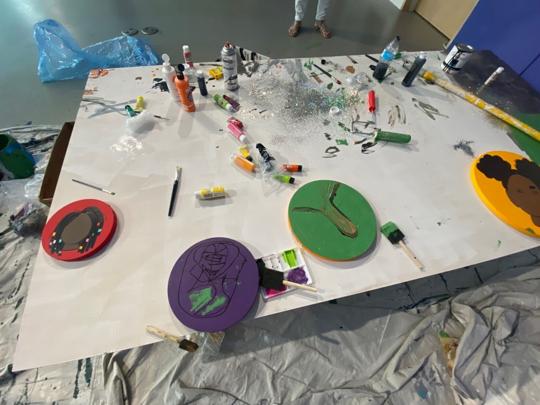
Gee's interrupted art installation looked like a workspace, with half-finished circular canvasses lying on a white table, a blank mural, paints, brushes and a video in which Gee recites an open letter she read aloud at the exhibit's opening.

A mother and 2 kids came in and did some painting of their own.

They tried to take their little canvasses home with them, but museum staff noticed them and stopped them. There was some unspecified "escalation" but nobody was arrested.

As of Thursday, however, there was no sign instructing visitors not to touch or interact with the piece.

The point of the museum "is to break down barriers for participation in art," said Karin Wolf, the city's arts program administrator. While she stressed she hoped the incident would not create new barriers, Wolf said the museum should only open the area if it has staff to "facilitate" visitors' interactions with the art.

"Artists of color are more likely to be mistaken for not being artists, and to have their work taken less seriously," Wolf said.

"I want to know: How does this change how Madison views MMoCA?" Gee said.

I don't know about Madison, but you can probably guess how I view an art museum that displays skill-free art.

Let's see if I know enough of the lingo: If a political statement identifies as art, why is its purely verbal description privileged over its non-verbal semiotics?

Thursday, June 30, 2022

African Founders

David Hackett Fischer has followed up Albion's Seed with African Founders: How Enslaved People Expanded American Ideals.

Summary: If you found Albion's Seed valuable (I did), you will probably find this likewise valuable. However, his picture here is much less clear, because it is much more complex. You will very likely find it interesting too, and on that score I say "read it."

He looks at more regions:

  • New England, Hudson Valley, Delaware Valley
  • Chesapeake Virginia and Maryland, Costal Carolina Georgia and Florida, and Lousiana, Mississippi and the Gulf Coast
  • Western Frontiers, Maritime Frontiers, Southern Frontiers

Within each region, slaves came from different parts of Africa, depending in part on internal African politics. For example, one Bamana ruler fighting other Bamana clans decided he didn't want to kill his captured fellow-tribemen, so he made slaves of them and sold them as far away as he could. The result was a surge in Bamana slaves. (Most slaves went to the Caribbean or South America; relatively few to the current USA.)

African cultures varied as much or more than European ones did. With written records so scarce, it would be very hard to compare the various cultures as they were circa 1600-1700; Fischer only touches on the obvious ones like the Kru (watermen and fishermen, in great demand as pilots). I think the origin of the Jonkonnu celebration (p445 in the hardcover edition) might be a melding of wassail and the way Poro society boys are supplied: dancing masked spirits with an entourage visit the villages and collect food and other goods for the boys in the Poro bush school.

Sidenote: When US servicemen built an airfield in Liberia during WWII, they apparently had a Santa one Christmas, and Liberians on the other side of the fence devised their own Santa on the local "begging devil" lines. Santa Claus boys come round with a shrouded and masked dancing figure. They play (mostly percussion) and sing and explain Santa's tale of woe and ask for funds to help him get back home.

Louisiana was one of the places where the law and practice differed dramatically. The laws required humane treatment--it was one of the most feared places for slaves. And yet it was also one of the centers of freeman culture, and the freemen and slaves maintained strong connections.

... two African women owned by the Ursilines. Both woment were assaulted by a drunken soldier named Dochenet, and severely wounded with a bayonet. Dochenet had earlier commited crimes against other slaves ... The Ursilines' Reverend Mothers Xavier and Magdalene refused to press charges against him, saying that "they would prefer to lose their negresses rather than do anything against charity toward their fellow men." Louisian's Superior Council was less forgiving, and more protective of the slaves. It ordered Dochenet to be hanged.

Slave drivers were responsible partly for making sure the slaves worked, but also for resolving disputes between slaves. In some places the slave owners were terrified of their slaves, and in a vicious cycle treated them badly enough to make them more dangerous. In others, many masters didn't care what slaves did at night so long as they showed up for work.

But you're probably asking: what were the "Expanded American Ideals?"

I wouldn't have picked that subtitle.

It would be more accurate to say something along the lines of "changed American cultures." In some times and places the slaves and freemen and "half-slaves" (like serfs owing fealty) quickly picked up on how the legal system could work for them, and in many places where they couldn't were still able to pry loose some customary rights. Aspects of different African cultures and technologies came with them and merged with Indian and European ones. In many of the cases he documents, the new culture was pretty much limited to the black slaves, but things like new boat designs spread more widely. Mutual aid groups formed. Individuals earned prominence and respect.

Fischer gives a good sense of how much experience varied across regions. Explaining how it varied with ethnicity is probably too hard to explore in adequate detail (too much information was lost)--but some cohorts of slaves were captured warriors and brought over their attitudes and training.

On the downsides, he is a bit repetitious: in a short section he'll say the society was diverse, give the section's example, and then say it again. He overuses "unimaginable." Somebody told him "black" was supposed to be capitalized these days, and "people of color" loses the distinctions they made between mulattoes and quadroons and octaroons--which was kind of important in Louisiana, although the one-drop rule makes it useful in other regions.

There's lots of history, some to cheer for and some to deplore. Slavery was never unanimously supported: Oglethorpe tried to forbid it in founding Georgia and the Quakers were split but eventually came out in consensus opposition. As slaves became freer or free there was usually an outbreak of intense racism that hadn't been nearly so conspicuous before.

I spent some time following up on some of the footnotes--I've a few more I want to look through still--which is why this is a bit late.

Read it

Tuesday, June 28, 2022

"Photogenic memory"

After time has had a chance to buff it up a little.

Saturday, June 25, 2022

To Space

For the hardier cargoes...

The article on SpinLaunch--spinup to orbit--referenced Project HARP, which I'd forgotten about. Gerald Bull's idea was to send solid stuff to orbit with a cannon loaded with a rocket. You need the rocket to change the direction of your satellite once you get high enough and maybe get some extra speed as well--otherwise your orbit will intersect the Earth again. It could have worked, though the design would have needed some changes to get different orbit directions. Made of two 16 inch battleship guns, one version sits in Arizona and another in Barbados. They're impressive bits of hardware, though the Barbados one is pretty rusty.

SuperHARP is still active. It uses hydrogen/oxygen for the propellent (with some helium in there too) in a 2-stage push. For the same energy, the hydrogen and helium get higher speeds, which helps getting the maximum speed out of your projectile. They claim greater than Mach 32 for the record so far. "Green Launch estimates the acceleration forces involved will peak at around 30,000 G, and it's got a simple enough test for whether a piece of electronics can withstand that sort of shunt: sticking the component to a golf ball with epoxy and whacking it with a three wood."

SpinLaunch sounds interesting too, though it has its own problems--the jolt the bearing will take when the rocket is released, for example.

I'd bet there's some advantage to launching from a nice tall mountain--less atmosphere to go through.

Reversible lanes

High traffic roads sometimes have reversible lanes. Some have barriers to temporarily separate the reversible lane's traffic from that going the other way, but some don't and count on drivers obeying the overhead lights.

I gather from my sister's videos that in Liberia they have innovated traffic lanes that are reversible on the fly. Is traffic too heavy? Move into oncoming traffic and claim the lane until something bigger than you are can't get out of your way. All lanes plus any pedestrian areas are available for such use.

It was sad to see what was left of the old house: it hadn't been maintained and a tree fell on it. Most other buildings were bulldozed and not replaced, including half of a duplex--the French NGO that rented the area apparently had more plans than money.

But just living there a few years doesn't give me a claim on anything. They're under no obligation to keep things the same, or even working. There are other priorities than being a museum.

Friday, June 24, 2022

Lying by omission

The abstract of the paper says "We find that SROs do effectively reduce some forms of violence in schools, but do not prevent school shootings or gun-related incidents. We also find that SROs intensify the use of suspensions, expulsions, police referrals, and arrests of students. These effects are consistently over two times larger for Black students than White students."

Liz King, the senior program director for education at the Leadership Conference on Civil and Human Rights said: "She thinks the guidance should reflect recent research showing police in schools don’t reduce gun violence but do increase suspensions, expulsion and arrests of students — especially for Black students."

Lying. I hoped that maybe I'd learn something, maybe even something counterintuitive. But no.

Wednesday, June 22, 2022

Puritans

E Glenn Hinson, retired Senior Professor of Church History and Spirituality at Baptist Seminary of Kentucky, has a series of lectures (I'm partway through it) on the history of prayer in the church. He noticed something curious about the Puritans.
In their central concerns I see the Puritans in the same stream as the ascetics and contemplatives of the Middle Ages. They shared both in the concern for discipline and in the concern for prayer which the latter had. True, the Puritans did not espouse celibacy or the cloistered life. However, they stressed sexual purity and, in regard to possessions, they called for frugality. They tried to get people who did not live in monasteries to live with the dedication of monks. Above all, they wanted contemplatives. Richard Baxter’s Saints’ Everlasting Rest is a Puritan treatise on meditation. It has much in common with the exercises taught in the contemplative tradition. Despite the avowedly anti-Catholic sentiment of the Puritans, it sounds much like Ignatius Loyola’s Spiritual Exercises in its use of imagination on scriptures.

I'd bet they'd have been shocked by the comparison.

Tuesday, June 21, 2022

Anniversary

Today's our anniversary.

Back in '74 a cohort of MK's were brought to Richmond for a get-together, survey, and trip to Colonial Williamsburg. One of the things the Board tried to do was make sure the missionaries didn't have to worry about their children, so they were checking up on how we were doing on our return to the States and giving us a little advice on integrating into US culture--all of which I quickly forgot.

The trip to Williamsburg was interesting and fun. I made the acquaintance of a very attractive young woman, and we toured together for the afternoon. No, I didn't see her again after that Saturday afternoon, and I don't remember her name, but "Come Saturday Morning" played in my head that day and for long afterwards.

I'd noticed for years that women could be fascinating, but it hadn't occurred to me until that afternoon that I could be fascinating in return.

It turns out fascination is just the start.

Monday, June 20, 2022

Modern Classical Music

Why is modern classical music so bad?

We've good composers--everybody knows John Williams, and there are plenty of others writing in classical styles, but they generally write for movies or play--and probably ads too. Not for concerts. I've not found much recent concert classical music to be memorable, even when it isn't unpleasant.

A review of The War on Music finds the book's thesis inadequate (postwar suppression of music the Nazi's liked and things they disliked), but its critique accurate:
About one thing, though, he is absolutely right. He writes with derision about the “trinity” of postwar music: the donor (usually the government), the critic (not infrequently an idiot) and the institution (the university that employs the composer, the orchestra that commissions his music). It’s a nice arrangement, Mr. Mauceri remarks, but it “leaves out something quite significant: the audience.”

Wright has a somewhat polemical attempt to understand why recent efforts in books and movies have often been dull. Painting and sculpture have been famously weird for decades, and "performance art" seems to delight in nonsense and chaos. An old joke says that "Modern art is what we got when painters quit painting women and decided they had a better idea."

Francis Schaeffer suspected that the modern world slowly came unmoored from Christianity, from tradition, and finally from reason, with the disconnect starting with the more rarified disciplines (philosophy) and working its way out through the rest of culture.

It's hard to see how to maintain a connection to tradition and roles when you're hooked on novelty. After a while novelty-hunger corrodes everything else: nothing else matters as much.

Hat tip to Maggie's Farm

Sunday, June 19, 2022

How to celebrate Father's Day

At 6 in the morning, one of the stair steps broke.

So, before we have to head off to music rehersal for the morning service, the father reseats the step and screws a temporary reinforcement in place.

The old carpet on the steps concealed a flaw that the home inspector missed 28 years ago: the free-standing stringer is splayed slightly at the bottom. Lower steps just barely fit in the slots, and are mostly held in place by the nails.

UPDATE: the carpet is held in place with over 55 staples per tread, each 1 1/2 inch long. In order to get the fresh support to be wood-to-wood, the carpet has to come off, and yanking those staples raises blisters.

Wednesday, June 15, 2022

Strange Adventures of Andrew Battell

The Strange Adventures of Andrew Battell of Leigh, in Angola and the Adjoining regions.

His adventures and Knivet's are included with editor's comments. Names are not necessarily the same as modern names--for example Sierra Leone is probably not the modern country.

Granted, captives aren't always perfectly accurate witnesses (Knivet claims to have been places he probably wasn't), but I grant witnesses on the scene a bit more credibility than commenters centuries later.

Battell's group are not paladins:

We found a village of negroes, which are sent from San Tome, for the Portugals of San Tome do use, when their slaves be sick or weak, to send them thither to get their strength again. For the islands are very fruitful, and though there be no fresh water, yet they maintain themselves with the wine of the palm-trees. Having refreshed ourselves with the fruit of this island, we burned the village.

Granted, this might have been revenge against the San Tome folk, but then it would seem to miss the mark a bit.

In search of trade, he found himself captive (although a useful one) to the Gagas, when his Portugese captors abandoned him. ("Adventures" is a better description than "Travels".)

The women are very fruitful, but they enjoy none of their children: for as soon as the woman is delivered of her child, it is presently buried quick [alive], so that there is not one child brought up in all this generation. But when they take any town they keep the boys and girls of thirteen or fourteen years of age as their own children. But the men and women they kill and eat. These little boys they train up in the wars, and hang a collar about their necks for a disgrace, which is never taken off till he proveth himself a man, and bring his enemy’s head to the General: and then it is taken off and he is a freeman, and is called Gonso or soldier. This maketh them all desperate, and forward to be free, and counted men: and so they do increase. In all this camp there were but twelve natural Gagas that were their captains, and fourteen or fifteen women. For it is more than fifty years since they came from Serra de Lion, which was their native country. But their camp is sixteen thousand strong, and sometimes more.

Later visitors suggest this may have only been the children born inside the war camp--but maybe customs changed.

He succeeds in escaping, but the Portugese wind up with him again.

Here they made me serve like a drudge, for both day and night I carried some stone and lime to make a fort.

It lyeth right under the Line, and standeth in a bottom in the middle of four hills, and about are many fogges [bogs] but not one river. It is the unfirmest country under the sun. Here the Portugals die like chickens. You shall see men in the morning very lusty, and within two hours dead. Others, that if they but wet their legs(*), presently they swell bigger than their middles; others break in the sides with a draught of water. O, if you did know the intolerable heat of the country, you would think yourself better a thousand times dead, than to live there a week. There you shall see poor soldiers lie in troops, gaping like camelians [camels?] for a puff of wind.

Here lived I three months, not as the Portugals did, taking of physick, and every week letting of blood and keeping close in their houses when they had any rain, observing hours, and times to go abroad morning and evening, and never to eat but at such and such times. I was glad when I had got anything at morning, noon, or night; I thank God I did work all day from morning till night; had it been rain or never so great heat, I had always my health as well as I have in England.

Perhaps the Portugals' approach to medicine left somewhat to be desired.


"Of all these friars the Italian Capuchins alone appear to have done good work; ... Many of the other friars seem to have been men whom their superiors in Europe were glad to part with; and the same may be said with reference to the secular clergy."


UPDATE (*): elephantiasis? but that's mosquito-borne. But there are snail-borne diseases, not all classified.

Gratitude

I wonder how many of the crowd before Pilate had a family member who Jesus had healed.

Saturday, June 11, 2022

Man does not live by bits alone

Joel Kotkin in Quilette accepts the notion that modern cities must be "cities of bits", though this has some serious problems that he also notes--no middle class to speak of, new parents leave, it has great class divides, and "work from home" pulls people away from the city entirely. To fix the problems: "The key is not forcing people into cities but making them more attractive to people as they enter adulthood and enter family formation years." ... "Successful future cities can only compete by providing a more dynamic, vital alternative to the periphery or small towns. In the “city of bits” era, success depends on tapping the skills and entrepreneurial penchants of its denizens."

But somebody has to "bend tin", process the food to make it edible, package and move things--where do those people live? Don't tell me robots will do it all, and offshoring just shifts the problem somewhere else and generates a new one--unemployment. Where do the factories go? Where is the space for the children?

Fixing the crime problems are a sine qua non for restoring a city, and fixing the corruption would be an excellent follow-up, but the systemic problems of space (where do you put something when everything is already full?) and inhuman scales need attention too.

Chesterton and monuments

I think he would have had choice words for our iconoclasts.
It is not enough for a popular monument to be artistic, like a black charcoal sketch; it must be striking; it must in the highest sense of the word be sensational; it must stand for humanity; it must speak for us to the stars; it must declare in the face of all the heavens that when the longest and blackest catalog has been made of all our crimes and follies there are some things of which we men are not ashamed.

Wednesday, June 08, 2022

nard

"How lovely on the mountains Are the feet of him who brings good news, Who announces peace And brings good news of happiness, Who announces salvation, And says to Zion, “Your God reigns!” "

If the smell of a little nard can last a couple of days, I suppose the smell from a pound's worth could have lasted 6 days, from Mary's anointing to Passover.

Of course Jesus wasn't announcing salvation, but accomplishing it--with His feet anointed. I wonder who noticed.

Saturday, June 04, 2022

Uvalde

JMSmith has an interesting take on Uvalde et al. Among other things: "Peer pressure is good for people who are worse than their peers!"

"They begin with the obvious truth that the root of the problem of school shootings cannot be guns, or mental health, or bullies, since school shootings are a distinctly American problem. Every country has enough guns, and nuts, and bullies." ... "Since Americans are unusually prone to run amuck, there must be something about America that drives people especially crazy."

No.

Something about our culture shapes the craziness into this form. The language of our imaginations is the language of our memes and movies and songs: "Let me make the songs of a nation, and I care not who makes its laws." I doubt that it's a single aspect that shapes it, and that makes it extremely hard to pin down--you could make an argument for almost anything. Superhero movies--the hero has to keep himself secret, but he's really a superpowerful being who could take revenge if he was pushed too far. Or our apotheosizing of children--if they're so much smarter than the adults, they're the ones really responsible for my situation. Etc.

It probably would help to Damnatio memoriae the culprits. And combat the notion that "the measure of their violence ... is ... the measure of the injustice done to them". Is there a good reason not to start?

These things wouldn't be universally popular: people like to know whodunnit, and the Internet is forever (sort of). Some enjoy special power through their disproportionate reaction to subjective slights and stand to lose that power if we start honoring measured response and self-control.

Hardest of all, these changes are things we have to do ourselves and in ourselves.

School shootings are, outside of gang battles, rather rare. It's hard to understand why we have them at all; hence the arguments. The "gang" fights, on the other hand are getting more common in the local schools. But that's a touchier subject, so the noise is about the rare and dramatic problem.

Friday, June 03, 2022

Bumblebees

A bumblebee is a fish.

"In October 2018, the public interest groups petitioned the Commission to list four species of bumble bee as endangered species" They did. "In September 2019, petitioners challenged the Commission’s decision": the Fish and Game Commission of California had no authority to do so.

They didn't claim that the bee wasn't endangered--just that the Commission had no statutory authority to include it.

"Prior to 1969, section 45 defined fish as “wild fish, mollusks, or crustaceans, including any part, spawn or ova thereof.” In 1969, the Legislature amended section 45 via Senate Bill No. 858 (1969 Reg. Sess.) (Senate Bill 858) to add invertebrates and amphibia to the definition of fish." Of course this was accompanied by the note that "[t]he expanded definition of fish will permit closer control and monitoring of the harvest of species such as starfish, sea urchins, sponges and worms, and the . . . "

Later regulation changes added some specific species: 3 butterflies and a snail. Their DNR pled that

"The [1970 Legislation] defined species as birds, mammals, fishes, reptiles, and amphibians. Although, technically, these terms name only vertebrate classes of animals, it was the Department’s understanding of legislative intent that the [1970 Legislation] was to extend to invertebrates as well. It was not believed necessary to include the term invertebrate in the original legislation because ‘fish’ is defined in the Fish and Game Code to include ‘invertebrates’

Page 19 mentions a "rule against surplusage", "which provides courts should “avoid, if possible, interpretations that render a part of a statute surplusage." I'd not heard of it before, but that's a good principle. If a statute spells out details, don't expand one of them to encompass others--the statute presumably has a reason for the breakdown. And if there is no good reason (contempt for congress seems mandatory sometimes), why am I to believe the judge is any smarter?

The ruling promptly ignores this on page 27, where the separate addition of the bristle snail to the list is taken to prove that the definition of "fish" is already expansive.

Never mind whether some organization needs to keep track of endangered species in California. That's a different question. As constituted, the Fish and Game Commission didn't have the authority to monitor "non-watery" things besides game. The Third Appellate Court seems to go at the issue backwards--they want a result and are willing to expand definitions beyond the law to get it. It seems like an innocuous goal, but HumptyDumpty means are dangerous. And in this case, also ridiculous.