People race them too.
Saturday, April 29, 2023
I'll pass
A penny-farthing (somewhat modernized) on back roads and back trails. I'd not be comfortable walking that last one.

Maritime oddity
Today's Maritime traffic has a very odd feature: from about Ecuador to French Polynesia is a purple column of what is mostly classified as "Pleasure Craft" (without a name). One suggestion I heard was "Maybe a race?"


UPDATE: Douglas2 found the answer, in the comments below. Thanks!
Friday, April 28, 2023
"Don't just do something, stand there!"
Please!
So you have a theoretical amelioration for putative global warming. Great. Are you sure there are no side effects? Warming is potentially good for some areas; did you ask them about your plan?
Thursday, April 27, 2023
The Provincial Letters
I'd read Pensees, but not The Provincial Letters. It seems some things don't change much. A sample:
"Do not flatter yourself with that," said the father; "there are still such things as mortal sins- there is sloth, for example.""Nay, then, father dear!" I exclaimed, "after that, farewell to all 'the joys of life!'"
"Stay," said the monk, "when you have heard Escobar's definition of that vice, you will perhaps change your tone: 'Sloth,' he observes, 'lies in grieving that spiritual things are spiritual, as if one should lament that the sacraments are the sources of grace; which would be a mortal sin.'"
"O my dear sir!" cried I, "I don't think that anybody ever took it into his head to be slothful in that way."
"And accordingly," he replied, "Escobar afterwards remarks: 'I must confess that it is very rarely that a person falls into the sin of sloth.' You see now how important it is to define things properly?"
History
AVI has some musings on history and what is possible and what isn't.
My wife was listening to a youtube series on Gettysburg places and museums, and the obvious question came to mind--When they reconstruct a site, what time do they reconstruct it to? Day 1? Day 2? When the house was a home, or when it was a sniper roost, or when it was a field hospital?
Or perhaps reconstruct it as it was when the new owners brought home their twins, or when the daughter of the house accepted the proposal, or when the materfamilias died--maybe thousands of significant events in only a century and a half.
Sunday, April 23, 2023
Church Fathers and the Babylon Bee
From Tertullian, via Pascal:
If the reader has met with passages which have excited his risibility, he must ascribe this to the subjects themselves. There are many things which deserve to be held up in this way to ridicule and mockery, lest, by a serious refutation, we should attach a weight to them which they do not deserve. Nothing is more due to vanity than laughter; and it is the Truth properly that has a right to laugh, because she is cheerful, and to make sport of her enemies, because she is sure of the victory. Care must be taken, indeed, that the raillery is not too low, and unworthy of the truth; but, keeping this in view, when ridicule may be employed with effect, it is a duty to avail ourselves of it.To treat them seriously would be to sanction them.
From the same letter: "according to St. Augustine, "charity may sometimes oblige us to ridicule the errors of men, that they may be induced to laugh at them in their turn, and renounce them"
But.. "the same charity may also, at other times, bind us to repel them with indignation"
Yes. I'm afraid so.
Friday, April 21, 2023
Constantinople
I had no idea so many old images of Constantinople existed. Or that a serpent column (a bronze column topped with snakes) made as a votive for Apollo would wind up moved to Constantinople and used as a Christian monument. (Good grief! Amazon wants 104.5 for that book!)
The author's research appears on another site as well, which includes a section on the additional fathers: writings of the Church Fathers that aren't in the usual collections. You can spend a lot of time exploring...
Thursday, April 20, 2023
An Oversight
When I was young I was "the cat who walks by himself, and all places are alike to me." Or at least that was my bent; in practice I did like sleeping in a bed, and liked other things I took for granted.
But somehow or other I overlooked one of the more obvious characteristics of cats: napping.
I am trying to correct the oversight.
Wednesday, April 19, 2023
Speculating beyond the author's intent
The last line of the Bergmans' song "What are you doing the rest of your life?" runs "All I ever will recall of my life is all of my life with you"(*)
It's not perfectly precise. I do in fact recall some of my life before I met my wife. It's hazy, but lots of things in my past are. But it does feel like the most significant part.
Perhaps our life with the Spirit of Christ will have a similar retrospective. Will the Spirit transform everything, or only what we let Him?
(*) Quite a contrast from the almost cowardly line "I don't want to change your life" from the song "I'd really love to see you tonight."
Friday, April 14, 2023
Ancient steel
AVI sent me a link about an iron chisel (900BC) from Rocha do Vigio (Portugal), which possibly was effectively tempered steel.
The paper has more details about the chisel (they were able to do studies on the haft, but because they are destructive, not on the tip) and their attempts to reproduce the stelae that seem to date from that era also: plus or minus a couple of centuries (some say 1300-800BC, others 1000-600BC). The rocks were of an extremely hard varieties of quartzite and quartz-sandstone. They tried stone chisels, which worked about as well as you'd expect. They tried replica iron chisels made using the processes they knew were in use--some hardened by heating and quenching, and one left unhardened. The unhardened one didn't do much of anything. The hardened ones did, though they had to be resharpened every 5 minutes, and re-hardened after a while too. And:
Specimens in four representative binary alloys with 10, 12, 14 and 16% tin have been cast by Bastian Asmus, ... The unambiguous result on the quartz-sandstone was that none of the bronzes could penetrate the surface
I'll get back to that in a moment. It does sound like the sculptors needed something better than one of the out-of-the-box iron chisels of the area.
The iron chisel they found was in spectacularly good shape--when they did a section of it the bulk of the artifact was uncorroded. They could determine the chemical makeup of different regions of the chisel. It looked rather as though an inhomogenous bloom was hammered into a blob that was made into a chisel. Some sections were high carbon, others not so much. Maybe they paid better attention to the tip, but if the haft makeup is any guide it seems as though they weren't being systematic with the iron makeup.
I suspect that a lot of technological progress now and in the past has come about when men were "just playing around." You can come up with a just-so story or three for discovering what can happen (if the iron happens to be the right makeup) when you quench red-hot iron. And if the overseer is curious about why some rods got tougher and others didn't, he might come up with some rough-and-ready tests for what "good" iron tips should look/taste like. Then everything depends on how secret he wants to be about it. "Gorri made really good iron, but his apprentice's stuff is mediocre."
Usually I put in a phrase like "what jumped out at me was", but several things did this time--mostly to my admiration. I liked that they tried to cut stone with stone; covering all the bases. But they said their bronze chisels "have been cast by". Bronze was hammer worked for maximum hardness, and the result is supposed to be about as hard as unhardened medium steel. One variety of bronze can be hardened to 95 HRb, which is comparable to some low end steels. I wonder if the test was quite fair--if the bronze was merely cast and not hardened.
And, btw, high carbon steel rusts faster than iron does. We're less likely to find steel artifacts, and might draw the wrong conclusions from the absence.
For the curious, Neil Burridge offered one of his bronze swords for destructive testing. It doesn't hold up to modern steel swords, but other experiments say it would have been a match for old iron swords.
Thursday, April 13, 2023
crypto
I've been dubious of cryptocurrency.
Aside from its volatility--which makes bitcoin pricing unpredictable ("Nope, the price is now .00457 bitcoin. Plus the tip.")--it wasn't obvious that the tools for manipulating things were either as bulletproof or as anonymous as advertised. The link doesn't quite describe how the feds rolled up bitcoin networks, or under what circumstances they can trace transfers now, though it says some private companies can do some of the work.
But I wonder what happens if some obscure number theorist (e.g. working for the NSA) discovers a new algorithm that, as an unexpected side effect, makes blockchains easier to maliciously manipulate.
If our government endorses a cryptocurrency, I'll be certain that they have backdoors to it. Why would they otherwise? Seriously. The value of the dollar is in the monopoly of its production by and the trustworthiness of the US government. Without ways of verifying that monopoly, it loses a good deal of its value.
Wednesday, April 12, 2023
Inside an LED bulb
Their light isn't as nice as that from incandescents, but they are good for science demos (diffraction grating slides are unbreakable, unlike prisms) and they last. Usually. This one was in the same fixture as an incandescent which has lasted for quite a few years.

It isn't easy getting everything in focus at once, but the ugly solder blobs ar attached to a bit of printed circuit board that almost looks like it is delaminating, although poking it with a knife didn't break it. There are spatterings of solder on the board nearby, and that white stuff on the edge of the solder is some kind of powder. Osram brand, made in China. I suspect the soldering job was manual.

Saturday, April 08, 2023
Cautions
To keep seedlings from growing leggy and spindly, it helps to provide them with a gentle breeze. We have acquired some small fans.
- This product is not a children's toy, for children under 10 years old, please use under the supervision of a guardian.
- Please do not knock this product, otherwise it will cause internal damage.
- Please do not occupy this product in a fire to avoid the risk of explosion.
- If the product becomes abnormally hot or deformed during using, please stop charging immediately.
- Please do not use this product in a twisted environment (such as a bathroom) to avoid short circuit damage.
- If abnormal phenomena are found (such as burnt smell or abnormal sound, etc), please cut off the power supply immediately, please do not disassemble or modify it without authorization.
- Please do not put the product into the fire to avoid the risk of explosion.
- During the operation of the fan, do not insert your fingers and sharp objects into the mesh cover to avoid personal injury or damage to the fan.
It has apparently similar instructions in other languages, and yes, the French version expects the bathroom to be "twisted" as well. I am trying to picture that.
Thursday, April 06, 2023
Thin
Our Bible study wrapped up a study of Jeremiah, and one of our men joked about Accentuate the Positive. We got a good chuckle out of that, though it is good to remember Who ultimately wins here.
Of course it isn't always in us to be positive about a situation, and it isn't always something to strive for anyway--Jesus wept.
And we have hope. Given Who promised, it can be joyful hope. So, at least in theory, we can, paradoxically, mourn in joyful hope.
It makes "Accentuate" sound kind of tinny by comparison.
Speaking of tinny, at Christmas we hear "A thrill of hope--the weary world rejoices, for yonder breaks a new and glorious morn", and, "I'm dreaming of a white Christmas just like the ones I used to know, where the treetops glisten and children listen to hear sleigh bells in the snow." The one acknowledges pain and hope, the other is a curated memory.
Monday, April 03, 2023
rebar
I've seen enough rusty rebar inside spalled concrete to have wondered if there's something better than iron rebar. Concrete is good under compression, but has poor tensile strength--metal is pretty good at the latter, and can help provide residual cohesion and strength even when there's been earthquake damage. interesting article on tradeoffs, read it Most concrete lets air and water in, and the rebar rusts, swells, and bad things happen. I'd figure that differential thermal expansion wouldn't be good either (leading to cracking), but the sources I've perused haven't mentioned that as a significant problem.
Of course the first thing I didn't think of was stainless steel, which holds up to corrosion a lot better, albeit at quite a bit more expense. For the rebar, that is.
I wondered about non-metallic rebar, but didn't have wide enough experience in materials science to guess at good alternatives. How about rebar made from basalt melted and spun into fibers mixed with resin? You can guess at some downsides (no sharp bends, more expensive, transverse strength is low compared to steel), and there's some degradation of tensile strength if it gets hot.
Something new every day...
Saturday, April 01, 2023
Learning
"Sometimes people ask me how I know all the random s-t I know (with varying degrees of politeness and belief in its veracity), and all I got is 'I have ADHD, an internet connection, really good research skills, and zero self-regulatory mechanisms' " @rahaeli on r/adhdmeme
Thursday, March 30, 2023
Differences and data displays
Grim's recent post included a "heatmap" data plot showing the differences between what conservatives and liberals value (as measured in the Nature article.
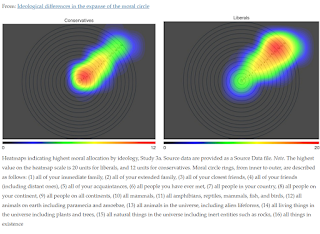
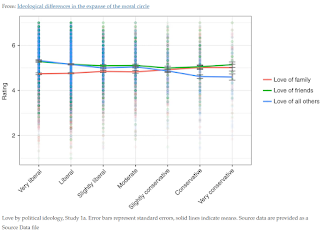
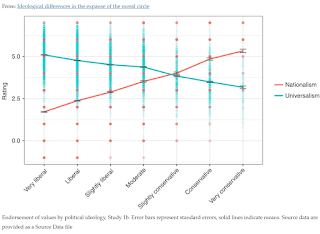

It's pretty dramatic--it suggests political groups are living in almost completely different psychological worlds.
However, there are other ways to display the data, as seen in Figures 1 and 2 from the same article:


The heat map doesn't emphasize the commonality between groups. Even when the differences are huge, there's still a background love of the local or the distant in both.
He got half of it
For the old humility made a man doubtful about his efforts, which might make him work harder. But the new humility makes a man doubtful about his aims, which will make him stop working altogether.At any street corner we may meet a man who utters the frantic and blasphemous statement that he may be wrong. Every day one comes across somebody who says that of course his view may not be the right one. Of course his view must be the right one, or it is not his view. We are on the road to producing a race of men too mentally modest to believe in the multiplication table. We are in danger of seeing philosophers who doubt the law of gravity as being a mere fancy of their own.
He underestimated what could be doubted, and overlooked the possibility of a reaction in which some are instead persuaded that their transient fashions are the immutable law of god, to be rigorously enforced on all doubters.
Wednesday, March 29, 2023
A few curiosities
Recent reading turned up a number of odd, and not always very nice, characters.
Harold Davidson, the "Prostitute's Padre", was killed by a lion. He did a great deal to help young women trapped in prostitution and otherwise isolated and poor, but was, let's say, eccentric, and not very good at "avoiding the appearance of evil." Retrospective analyses propose that he was actually well-meaning and not molesting anybody, but his superiors didn't think so at the time and he was defrocked.
To pay his resulting legal bills he went back into show business with gimmicks like "being roasted in a glass-fronted oven while a mechanised devil prodded him with a pitchfork". His "Daniel in a modern lion's den" went awry one evening.
..
J.F.C. "Boney" Fuller was a British theorist of armored warfare: his "ideas on mechanised warfare continued to be influential in the lead-up to the Second World War, ironically less with his countrymen than with the Nazis". He had strong Nazi sympathies, but apparently was able to persuade the authorities that he was nevertheless a patriotic Brit--he wasn't imprisoned. "Fuller spent his last years believing that the wrong side had won the Second World War... he announced his belief that Hitler was the saviour of the West against the Soviet Union and denounced Churchill and Roosevelt for being too stupid to see so".
I could almost see somebody thinking that early on in WWII, before the Nazi mass murder machine got into high gear. After the war, though... Bottom line was that the Nazis attacked the West, so it's kind of hard to see what other choices the West had.
He was also heavily into the occult (that seems to go along with Nazis for some reason), and wikipedia says that his most useful military theories "originally derived from a convergence of Fuller's mystical and military interests".
..
Maurice Hankey didn't think the Allies had the right to try German and Japanese leaders for war crimes. He believed this so strongly that he lobbied on behalf of the Wehrmacht generals, helping to create the myth that the army wasn't involved with (and by extension the German population was kept in the dark about) the crimes and exterminations.
Since the West faced an enemy almost as deadly as Hitler, higher-ups went along with it because we needed Germany to help resist the Soviets. Yes, it's a bit more complicated. But Hankey wasn't a Nazi sympathizer--more of a realpolitik type who seems to have really thought that soldiers shouldn't be blamed for political directions. Just following orders...
Sometimes history turns on, or is written by, some strange people.
Note about links
I've always had a taste for providing surprises--from the jack in the box toy to replacing the LP in the sleeve of my sister's favorite album with one my father and I liked, which he was reluctant to have stopped.
Sometimes I use web links the same way, though I sometimes try to leave clues that the link might not be entirely serious. Unfortunately undependable web sites sometimes mutate the links into "double-blind" surprises. Please accept my apologies in advance for any confusion.
Fluorescence
I'd been demonstrating fluorescence using a UV flashlight and a Walgreens eye drops bottle, when it occured to me that the same phenomenon has to occur at other frequencies too; ones we can't see. How about infra-red?
Yep. Visible light can be absorbed to spur IR emission (so can UV, of course), and if you filter out the visible light you can see the IR fluorescence. It turns out to be useful in identifying certain pigments like Egyptian Blue.
And, perhaps not surprisingly, one common chemical that absorbs visible (blue and red) and emits infrared is chlorophyll.
If you want to get into the infrared game, you can modify your camera.
Saturday, March 25, 2023
Questions before dinner
led to another rabbit hole: The Great American Novel seems like a concept designed to keep critics employed. Our effective motto seems to be e pluribus rixae(*), from the Albion's Seed era through today. External enemies unite us for a while, but not very long (I remember the 60's and 70's)--too many people see advantage in leveraging divisions, and quite a number of us find joy in being against things. It's fashionable to be against the fashion? Popular media don't seem quite the uniting force either--as soon as people found ways of getting non-monopoly news they did, and how many channels of music does siriusxm carry?
I have no clear idea what "American" means in this context."
Of course great art can be universal, but then how is it specifically American--aside from its provenance? Is Don Quixote The Great Spanish Novel?
(*) So says google translate.
Headlines mislead
"Police Use Tear Gas to Disperse Members of CDC Youth League in a Bid to Stop Them from Registering in District 10"
The third paragraph explains it:
While parading through the main streets on the Old Road, around the Total Gas Station, the police ordered that the group be dissolved to avoid a clash with supporters of Yekeh Kolubah, a lawmaker of the district.
Invidious reporting isn't just an American thing.
Jesus of Nazareth, Vol 1
After Benedict died I decided to read his trilogy on Jesus. So far I'm just through volume 1. I recommend it. I learned quite a bit. I had no idea that one Jewish tradition at the time held that though Elijah had escaped the murder that was the fate of so many other prophets, when Elijah returned he would have to endure martyrdom.
Bear in mind that Benedict XVI was a scholar, and he analyses a number of different interpretations. This may confuse the careless reader. (Amazon says "Reading age: 1 and up" Must be a very precocious 1)
Benedict was also the Pope--but there's little or nothing in the book that a Southern Baptist (of the types I once knew) would object to. For example, he doesn't bring up the Council of Trent's definitions when talking about the Eucharist--he keeps it Jesus-focussed. He assumes, of course, that Peter had a special ministry. The book ties together themes in Jesus life and ministry--up through the Transfiguration--in ways simultaneously logical and mystical.
Friday, March 24, 2023
The history of a project
Way back in grad school, when I was learning about Clebsch–Gordan coefficients and the finite tools used to study continuous groups, I wondered if there was a symmetry that went the other way: could one find continuous symmetries from mixing the elements of a finite group? And could one use the mixing field theory formalism we were studying to represent particle interactions as a finite group?
I gave it a try, and after an embarrassing false start, found that there could be. More detailed inspection showed that it wasn't a very plausible physics model, but there was something interesting (to me) going on. I managed to publish what I had, but I had enough on my plate to make essentially no progress for years. The question I wanted to answer was: given a finite group, can I predict what its continuous symmetries (of this obscure type) will be?
In one of my spurts of activity, I found that another grad student had a textbook I wanted for the study, and went to buy it. He insisted on selling two books as a bundle, so I wound up with Theory of Group Representations as well, which I hadn't wanted. Worse, the book I did want didn't help me much.
The project lay idle again for a while, until I decided to BFI tackle a simple family of groups in a systematic way--and I got a result. I wrote it up, but wanted to supply some tools for study to go with it before I tried to publish it.
Back burner again.
So I retired, and had some free time. I created the tools for finding the interesting quantities given a finite group, loaded them into GitHub, and did a deep dive literature search one more time--reading years worth of abstracts and skimming a promising paper now and then. I didn't find anything--was this really a new result? That would be cool.
But that day I noticed something for the first time--the symmetry I described was actually much more general than I had been claiming--it was an isomorphism of a group algebra onto itself. No way this was unknown--this is the sort of thing mathematicians are always looking at. And, in an ironic loop back to the begining of it all (Clebsh-Gordon coefficients arise from group representations), I realized I should have been looking at the group representations.
And so, "the stone the builders rejected", Naimark and Stern, Theory of Group Representations page 97, Chapter 2, Section 2.9, Theorem 1, Corollary 1. "The group algebra of a finite group is symmetrically isomorphic to the direct sum of complete matrix algebras."
If I had attacked the problem harder earlier, I'd have learned the answer to my question decades ago. So no, there's nothing new in my work. And no, $SU(3)\times SU(2)\times U(1)$ doesn't pop out.
Thursday, March 23, 2023
Non-state tribunals
First Things has an article on the conflict between "Jewish" and "democratic". It says a new proposal expands "the reach of the country's religious tribunals".
The devil is in the details, but from the linked site:
It is proposed to stipulate that rabbinical courts will have arbitration authority in a civil matter on which an agreement can be reached, if the involved parties have expressed their consent to this. As part of exercising its authority, the rabbinical court is entitled to hear [the cases] and rule according to Jewish law
At first glance this seems rather straightforward, but three issues come to mind--a lawyer might think of more.
- Can all parties consent? If a city ordinance says I can't rent or buy without pre-consenting, I haven't really consented; I'm compelled.
- Does this give a blank check to the tribunals: rule as you please and we'll send policemen to enforce it? What exactly will be a "civil matter"?
- Who determines when a tribunal has become corrupt and is perverting their own law?
Will they continue on to the rest of millet system, and provide for Christian and Muslim tribunals as well?
If their jurisdiction is restricted, and there's no compulsion, it seems a relatively harmless approach; little different from submitting to binding arbitration. I gather that is already the case at some level, so--the devil is in the details. It probably needs a lawyer trained in Israeli law to tell.
Heroes and Villains
God doesn't seem to always draw from the same group when He sends His reformers and prophets and saints. I suspect He doesn't want any group to start assuming that their power is from themselves and their wonderful paradigms and organization. If you church is a hand this year, it may be an ear next decade. A hero in one era, a villain in the next.
At one point monasteries were funded and controlled by the local nobility, and made into comfortable homes for retirement or superfluous heirs. Other revenues for abbey or church were often taxed away--no doubt originally on reasonable grounds (common defense in dangerous eras) but eventually taken as a customary entitlement.
The abbey at Cluny spearheaded reforms (esp independence of church institutions), but after a while they got rich themselves: so that Matthew Paris could write "The above-mentioned special clerk of the lord king, whose wealth attained to episcopal heights". Francis and his example helped reform some of the greed of the church of his era, but the Franciscans have been involved in some deeply uncharitable quarrels.
Last century some of the more--shall we say--conservative churches in the US had little interest in helping deal with the invidious discrimination suffered by blacks in the US (some did), and the most well known Christian civil rights proponents were more theologically liberal. Some of the churches had accomodated themselves to the spirit of the age(s)
This century saw almost the opposite (neither conservative nor liberal seem to have had great success in persuading the youth of the value of chastity), as the liberal churches have welcomed abortion and tried to normalize perversion, while the conservative churches continue to call these evil. (On the whole; exceptions are easily found.) The paradigm of "rights" helped stop unChristian prejudice, but the same paradigm now promotes unChristian sexual immorality and killing.
The above introduction will doubtless annoy some readers.
In the early church the pressure to burn incense to the genius of the emperor could be intense, and a number gave in. When they wanted to return to the church afterwards, Novatianists said no, the lapsed members were barred. The Church said yes, they could return. The Donatists went farther later, and created their own purer bishops--creating a kind of rival denomination. Eventually they compromised, but the split endured for over a century. At least it eventually ended.
Almost a hundred years ago there developed in Germany a "German Christian" movement, accomodating the racial (decidedly non-catholic) spirit of the age, and in reaction a "Confessing Church" which opposed Nazi control of the church. (The majority didn't take either side.) I was told that at some point there were meetings of repentence and reconciliation, but I haven't found anything that clearly supports the story--all I have seen is stories of direction from outside. That's disappointing. I'd love to read that the majority church repented of their go-along and reconciled, and even more that the "German Christian" groups repented.
I suppose that once there has been a division, even after the reasons are gone, mundane concerns (like new bureaucracies) militate against reuniting--even though we praise unity. Especially if each group has historical reasons to despise the other as unfaithful to the faith.
Even having a common enemy, such as the Soviet authority, didn't seem to encourage a lot of long-term reconciliation between different denominations--although perhaps it looked different on the ground, as opposed to in the hierarchies.
Wednesday, March 22, 2023
No confidence
"It was found that the democracy could not always be intimidated even by the threat of consulting them about the choice of a Government." A "no confidence" vote in Britain shakes things up a smidgeon(*). I wonder how we could construct one in the US: chuck everybody and make them all stand for re-election. Combine it with a binding
None Of The Above slot for extra fun. It'd be easier to try on the state level first.
(*) The unelected are, unfortunately, still safe.
Discoveries
At this time of year the neighborhood bulletin boards accumulate posts of "When the snow melted we found X. Does it belong to you?"
Probably hurricane-prone regions have their own versions of this.
Tuesday, March 21, 2023
POV
"He never insisted on seeing facts wrongly, though he did a busy best to persuade the facts to arrange themselves according to his personal preference." Charles Williams
Sunday, March 19, 2023
0 G
We wondered what could be different about dance in 0-G. You don't get more than about 90 seconds for a routine (I don't think the space station has room, or priority), and you'd have to practice in water, which has very different viscosity from air.
Of course whatever we wonder about, somebody else has already tried.
Eventually dancers will want to use fans for maneuvering, especially for non-solo routines. This looks fun (aside from the racket), but not a lot like dance.
Friday, March 17, 2023
Winter
It's 25F with a damp breeze, and every scraped windshield is framed with frozen slush. Their bumper-sticker reads "Life is better outdoors."
Thursday, March 16, 2023
Return of Don Quixote
"I say," she said rising in wrath, "that I never met a man who saw both sides of a question without wanting to clout him on both sides of the head."
I'd read The Return of Don Quixote so long ago that I'd forgotten all but the gist of one scene--and certainly didn't remember some of the now-coarse language of the intro and early chapters. It isn't Chesterton's finest. It feels a bit disjoint as it follows the different characters, and the Arbiter's judgment, though expressing Chesterton's judgment quite well, runs a little long for the humorous situation. And many of the topical themes may not seem as dramatic as they once did.
Give it a whirl.
"A taste for low company doesn't make people thieves," said Murrel, "it's generally a taste for high company that does that." And he proceeded to decorate a vivid violet pillar with very large orange stars, in accordance with the well-known style of the ornamentation of throne-rooms in the reign of Richard the First.
Barth
I heard decades ago that there had been a kind of reconciliation between the Confessing Church and -- either the silent rest of the church or the German Church (the ones that were all in for Mein Kampf on the altar). It sounded powerful, and a few days ago I started looking around for descriptions of this event/process.
Um. So far I haven't turned up much that matches that description, but I did find this about Karl Barth:
"in April 1940, at the age of 53, Barth enlisted as a soldier in the Swiss armed auxiliary; he refused office duty because he desired to serve his nation as any ordinary Swiss soldier, not as a protected, famous theologian, and he volunteered to stand watch along the Rhine in defense of Switzerland"
He lived in Germany during the Nazi years, and wrote against it from the start. After the war, trying to justify not reacting to Communism with equal strength, he wrote this about Nazism:
what made it interesting from the Christian point of view was that it was a spell which notoriously revealed its power to overwhelm our souls, to persuade us to believe in its lies and to join in its evil-doings. It could and would take us captive with ‘strong mail of craft and power.’ We were hypnotized by it as a rabbit by a giant snake. We were in danger of bringing, first incense, and then the complete sacrifice to it as to a false god.
Some of my readers will see parallels to modern Christian Nationalism (No doubt it is around somewhere, but I haven't seen it myself. Maybe I just hang out with a different crowd-- Rushdoony is not on our radar.) and others with those preachers revising morals and paradigms to match the elite culture.
I'm wondering about that reconciliation. Did it really happen?
Tuesday, March 14, 2023
Drivers
I don't think it is just a "presentism" bias; it seems as though I interacted with more reckless drivers this past year or so--and I'm driving less (except for the trip south we just came back from). I recall back in mid 2020 that the roads were about as empty in the daytime as they'd been before at midnight. Perhaps some people learned a casual entitlement about traffic control that was almost appropriate when nobody else was visible for blocks, and are having problems unlearning it that now that the roads are full again.
Or maybe some people are taking a kind of revenge on the world for the diffuse oppressiveness of the pandemic years...
Tuesday, March 07, 2023
Cold fusion
Some years ago I read an overview of cold fusion research. It gave the history and the various experiments current and completed. Some were variations on the "try to dissolve deuterium in palladium", while others used different metals--in one case powdered nickel. That wanted high temperature, with a small amount of heat released--which would result in a quite inefficient heat engine. (The survey was pre-Rossi and his infamous E-CAT.)
I wanted to see what more recent work said, and began poking around. After a while I noticed that I'd have to write a brand new survey myself to cover the material, and I think I'll leave that to experienced nuclear physicists.
There's not a lot of evidence for the $d + d \rightarrow He^{*}$ reaction. The Navy funded $d + Li$ research, but I didn't find any results published. (Why $Li$? Because it was present as a hydride to introduce the $d$ in some of the experiments.)
Some fancy schemes have been invoked--to try to see if the effective electron mass could be increased so you could get something akin to muon-catalyzed fusion. Atomic physicists have looked at how much hydrogen actually dissolves deep into the metal and how much is superficial, and into ways of loading more hydrogen in, and so on. I wondered if $d + Pd^{n} \rightarrow p + Pd^{n+1}$ would work, but that would probably produce $\gamma$'s also (2?) from excited $Pd$--not detected, and anyhow the potential barrier is higher than for $d + d$.
Doing the experiments right is hard, and some give tantalizing results. Some see neutrons--at energies that don't make a lot of sense, except that: well, it turns out that when you dissolve hydrogen in palladium, certain preparations are susceptible to cracking. Cracking can produce microscopic local high voltages, and those can accelerate $d^{+}$ to high enough energies to dissociate the deuterium on collision and release neutrons. Not many, but detectable. Who'd have guessed? FWIW, one survey article (on the positive side) claimed that the non-cracking preparations of palladium were the ones that provided anomalous energy.
I don't believe in cornucopias, but you can get room temperature fusion with $\mu^{-}$ particles, and I won't swear there aren't other ways. I'm not convinced any of these other things are the hoped-for fusions, but there are certainly some odd things going on. And, I'm afraid, there's some carelessness, and dishonesty (Rossi).
UPDATE: Remember that lightning can produce antimatter.
Early intervention
I'm pretty sure that Head Start doesn't do much of anything to improve academic performance.
But do such interventions have any other benefits? Suppose they encouraged students to stay in school, and not get involved in crime? From 2001:
" children who participated in the preschool intervention for 1 or 2 years had a higher rate of high school completion (49.7 % vs 38.5%; P = .01); more years of completed education (10.6 vs 10.2; P = .03); and lower rates of juvenile arrest (16.9% vs 25.1%; P = .003), violent arrests (9.0% vs 15.3%; P = .002), and school dropout (46.7% vs 55.0%; P = .047).
Not exactly a silver bullet, but if this reproduces (and since this is a longitudinal study that takes time), it would help. It's 20 years old, with hundreds of citations.
Another group used their data to study the effect of "Adverse Childhood Experiences" (they make things worse), and 37% of these high-risk youngsters had none from birth to 17. (Things like abuse were measured from police records, not self-reporting.) Somehow that number seems both horribly low, and surprisingly high.
I wonder what sorts of facilities would be required to do this sort of early intervention on a large enough scale. In a big enough district you could set aside whole buildings for the project, but in a small one you're duplicating a lot. If you got rid of a lot of administrators and consultants you'd get some of the way to affording it--and that's not happening. Maybe there are some non-public options.
Sanskrit
"The discovery makes it possible to translate any word written in Sanskrit."
That's a provocative headline. What does it really mean? "Rishi Rajpopat decoded a rule taught by Pāṇini, an Indian grammarian" of the 5th century BC.
Rajpopat decoded a 2,500-year-old algorithm that can accurately use Pāṇini’s “language machine” for the first time. Pāṇini’s system consists of 4,000 rules and is detailed in the Aṣṭādhyāyī. Considered his greatest work, Aṣṭādhyāyī is believed to have been written around 500 BCE. It is meant to work like a machine, where the base and suffix of a word are fed in and a step-by-step process should turn them into grammatically correct words and sentences.
"Pāṇini had a metarule to help the user decide which rule should be applied if a rule conflict occurred, but it has been misinterpreted by scholars for the last 2,500 years. ... Rajpopat argues that Pāṇini meant that between rules applicable to the left and right sides of a word respectively, Pāṇini wanted us to choose the rule applicable to the right side."
Rajpopat found the ancient scholar’s language machine produced grammatically correct words consistently and with almost no exceptions.
The headline was clickbait--people had been reading and writing Sanskrit already; this just had to do with being machine-like systematic about it.
But I'd bet that the ancient system was at least partly aspirational rather than descriptive, and that the ancient Sanskrit wasn't as systematic as the "language machine" describing it. (4000 rules?!)
Sunday, March 05, 2023
Acts warnings
In Acts 21 Paul is warned several times that going to Jerusalem will be terrible for him. But Paul believes that he is supposed to go, no matter what. Was the Spirit warning him not to go through the voices of the people, or were the people warning him not to go in light of what the Spirit had revealed? I think our preacher missed a bit: John 16:4: "I have spoken to you, so that when their hour comes, you may remember that I told you of them."
I gather from Ephesians that Paul could do with a little encouragement himself now and then, and knowing, when the disasters hit, that it was part of the plan and not a screw-up on his part, was probably encouraging.
Still true
"All political parties die at last of swallowing their own lies." John Arbuthnot (thanks to Anecdotal Evidence)
Saturday, March 04, 2023
Long yams
Dr. Boli mentioned that the Metropolitan Museum of Art was making some of its coffee-table books freely available. In the book on art of Oceania, page 65, it says: "The Abelam recognize and cultivate two distinct categories of yams, a small variety used as ordinary food and long yams--massive tubers that commonly attain lengths of six to nine feet and, in exceptional cases, can be up to twelve feet long. An Abelam man's social standing is determined not only by his abilities as an orator and, formerly, a warrior; it is also, quite literally, measured by his success in growing long yams."
UPDATE: For more details there's an Abelam culture web site.
Grimm's Law
Is there an analog to Grimm's Law in Chinese language families?
Ask and you shall receive: kind of. " The application of a Grimm's-like law comes later and differently in different languages, e.g. where the -p -t -k endings became -ʔ in Wu and -ø in Mandarin, or the /g/ initial was palatalised in certain situations so what in Korean is /ga/ is likely /tɕiɑ/ in Mandarin."
Don't ask me what those sounds are, but people seem to have noticed sound shifts in the languages in question. "But there's no single rule to explain all of them. They each developed in different ways."
It is fascinating what sorts of answers to random questions are easily available to us these days. Of course the answer has nothing to do with my life, and too much 'satiable curtiosity can get your nose pulled...
Thursday, March 02, 2023
Fun little oddity
I was doing a literature search and my eyes started glazing over. I took a break by skimming through a journal I'd never heard of before: Elemente der Mathematik "publishes survey articles and short notes about important developments in the field of mathematics; stimulating shorter communications that tackle more specialized questions; and papers that report on the latest advances in mathematics and applications in other disciplines. The journal does not focus on basic research." In other words, suited for both more applied and more random stuff. The discussion section is in German, unfortunately.

"The irrationality measure of $\pi$ as seen through the eyes of $\cos(n)$. A student asked: "What's the limit of $\cos(n)^n$?" Since it's always less than 1 in absolute value, as n becomes large, the result should go to zero. Except it doesn't. In fact, it "oscillates", because larger and larger fractions come closer and closer to approximating $\pi$. They go on to discuss qualitative irrationality, but that's more for specialists.
I suppose one conclusion to draw from this is: pay attention to student questions. Sometimes there's something weird hiding that nobody noticed before.
Drat. The article is too recent to qualify for the open access. I could read the paper in the library, but not from home. In order to cut down on the number of points, I didn't draw anything with abs() less than .01--pretend there's a line across the middle. Done with python, and I'm trusting that their $\cos$ function handles large numbers well.

You can't unsee it
Naomi Wolf says the old gods have returned. It has been accelerating lately, but I've seen signs of this for more than the three years she thinks--Moloch has been feeding since '73, for example. But there is a greater power than the old gods.
Mental diabetes
We have at our fingertips food enough, easy to prepare and digest enough, to push a number of us into diabetes. We have at our fingertips amusements enough that even ancient emperors might have been satiated: 24/7/365/umpteen channels/feeds. Two hundred years ago if you wanted music, you made it yourself or asked a neighbor to join, or once in a while went to the fair or a show.
There's an obvious analogy here, though endorphins don't work quite the same as insulin. If we try to process too many jokes at a sitting, the incremental funniness decreases--and so on, you can fill in examples as well as I.
So, before I tried to write up the idea, I checked to see if somebody else had already done it. Yes. Oh well. Bottom line: is the latest national news going to make a difference? Or the clickbait video? No? Abstain for a while and do something you might actually look back on with satisfaction. And when you do sit back for an amusement, you'll probably enjoy it more.
Wednesday, March 01, 2023
Who is she referring to?
Reading Luke 1: I think we can assume that when Zacharias went home, he wrote down what had happened to tell Elizabeth why he couldn't speak and what the angel had said. When Elizabeth mets Mary later, she blessed Mary and Jesus in v42, and then in v45 says "blessed is she who believed that there would be a fulfillment of what had been spoken to her by the Lord." Is she talking about Mary again, or using a circumlocution to talk about herself and what Zacharias had told her he had been told?
Changing my routine
I'll wipe down the equipment at the athletic club twice now: before and after. I watched a man lick his fingers before grabbing the bar on a machine.
Tuesday, February 28, 2023
Names of God
Arthur Clarke wrote "The Nine Billion Names of God" seventy years ago--its thesis is that the universe exists to pronounce all of God's names. Once done, it's done.
Cute premise, but a little simplistic. Presumably the "names of God" partake somewhat of His nature and are eternal--perhaps never known before, but known now. The proclamation of the Name would seem to partake of that as well.
Be that as it may, each of us sees God in a slightly different way, colored by our lives. That's not to say that every view of God is valid--a lot of views seem to be more like glimpses of the devil.
But I've noticed that each of us in Bible study seems to have something different to contribute--some aspect of faith or practice that the others didn't notice. We see as if in a cruddy bronze mirror, but one day face to face--and even there I suspect that what we each see will not be quite the same--giving us something to share. And with our name call on His name.
Monday, February 27, 2023
Another trireme effort
Chasing rabbits again: from an essay on "Could Napoleon have won?"(*) I ran across the tidbit that Napoleon III had indulged an interest in archaeology and had a trireme built. His son had a toy one.

Finding non-paywalled information was a bit hard. The Christian Science Monitor said it was used for target practice. There's a brief description of the project in French, and a much longer analysis (also in French) at academia.edu. (For more information about the 1980's Greek efforts with the Kyrenia II, this is succinct. I tried a rough translation of a few lines in the academia.edu paper. I fear my French is somewhat like that of H.G. Wells: "the strange dialect which I have inadvertently made for myself out of French, a disemvowelled speech of epicene substantives and verbs of incalculable moods and temperaments"
Jal and Dupuy de Lome each seem to have thought they were directing the project. Jal was a historian, and was accused of treating ancient authors' descriptions with a less critical eye than he applied to more recent authors. de Lome seems to have wanted to make something better than the ancients had.On 9-March-1861 it was launched for two days of tests on the river.
After the two days of tests, neither Jal, nor Dupuy de Lome, nor the emperor seem to have wanted to continue the program. Perhaps this was due to simple disinterest, a sign of hidden difficulties, or having seen an unacknowledged check. No document tells us. In June 1861 it was towed to Cherbourg and "disarmed"; in August 1863 it was beached, and 26-April-1878 it was decided to demolish the trireme. (Jal had been dead for 5 years, Napoleon III was not only not emperor anymore he was also dead. de Lome was now a senator.)
I found no details about how it was "demolished" but wikimedia seems to think it was dismantled instead of blown up. I wonder if people took souvenirs.
I've written about that ancient technology before here and here. It doesn't inspire enough curiosity for me to make it a hobby, but I notice it when it appears.
(*)Spoiler: yes, if Napoleon and the generals had adapted their technology and tactics to match their enemy's instead of sticking with the same old stuff.
Sunday, February 26, 2023
Wisdom
We know wisdom ≠ knowledge. We have some ideas (and an Everest of worthless fashions) about how to teach knowledge, but nothing reliable for teaching wisdom. "You can lead an ass to water..."
Socrates said he was the wisest because he alone knew he was ignorant--and his dialogues with his pupils generally started by proving that they didn't know what they were talking about. Of course his pupils wanted to learn from him and be wise--they were a select set.
"The fear of the Lord is the beginning of wisdom." "Search for wisdom as for hidden treasures" "Do not be wise in your own eyes" "such a man as tourists think simple because he is honest and neighbours think ‘deep’ for the same reason."
I can't think of any kind of curriculum that will reliably impress these on a youth. They have to grow from inside. We can try, however hypocritically, to encourge the virtues--"Do as I say, not as I do." "Hypocrisy is a homage that vice pays to virtue."
We can, perhaps, if, maybe, per impossibile--try to refrain from teaching folly. We have industries largely devoted to encouraging foolishness. (Buy it now! just because) The classical virtues are out of fashion, and the lesser ones magnified into weirdness.
What sort of bottom-up things can we do? ("Fish rot from the head down.")
It starts with me, of course. How can I live more wisely?
Friday, February 24, 2023
Remembering college
Some of what I learned in college I remember, because I used it. And I remember a few other bits and peices, but mostly, 42 years after I earned my last degree, I remember frameworks of knowledge, not the details themselves. Some of those frameworks are obsolete (genetics has undergone a revolution) and others were incomplete to begin with. I noticed the effect before I'd graduated; wrote a poem about it to mark graduation.(*) I gather from others that this is normal, colleges are for forgetting. Unless you found your spouse there. (I didn't: she and I were in the same icecream store in a Chicago blizzard. That I remember.)
One of the things I do remember was the habit of trying multiple hypotheses on an observation: What confounding factors are there? Once you get in the habit it is kind of fun, though it can make you a bit of a nuisance sometimes. And it probably gets in the way of making prompt decisions. And it opens you to squirrel attacks when you're trying to work through a problem from beginning to end. At least I think that's what those squirrels are planning. Oh look, another one!
I think some of the "creativity exercises" do pretty much the same thing. You don't need four years for them, though.
(*) No. Be grateful.
Twain on plagiarism
Helen Keller had been accused of plagiarism, and Twain wrote to encourage her. He adds: "a grown person’s memory tablet is a palimpsest, with hardly a bare space upon which to engrave a phrase" which is certainly a good description of my memory sometimes. I remember the grocery list, but then I notice the road work and think about the detour and I can't remember if we needed carrots.
Given Twain's endorsement, I will keep on writing, though others said the things better before--and will after.
Tuesday, February 21, 2023
CERN and war
CERN has Russian and Ukrainian physicists; how do they acknowledge the war?
But in March 2022, the number of new research papers by the LHC experiments fell to zero. The reason: a lack of agreement on how to list Russian and Belarusian scientists and institutes, if at all. The temporary compromise, in place up to now, is not to publish.
A Russian physicist says: “We have Ukrainian collaborators for whom this question is naturally extremely painful. [But] most of my Ukrainian colleagues do not extend responsibility for the invasion to their colleagues from Russian institutes. I would say that some of my EU colleagues are much more radical.”
In my not-so-humble opinion, the impact of such boycotts on the war will prove utterly trivial.
The closing line of the Guardian's article says "as Fedoroff notes: 'During the so-called cold war, interactions among Russian and American physicists and between the physicists and their respective governments were credited for keeping the war cold.'"
I don't believe that either.
Insofar as the research we are doing is good for everybody, I see no reason not to declare it off limits to politics, and leave off trying to influence politics or society. We're not a church to be a source of moral authority, but scientists trying to collaborate. The science and engineering are hard enough, and that's what the people funding us want. In the end nobody cares what we say about invasions or diversity, and they'll discount whatever we say about budget priorities since we're interested parties.
Not everything in the world is political, and trying to force it to be is perverse.
Individuals can say what they please, but CERN, lay off the virtue signalling. If individuals can't get along, they can go home.
Monday, February 20, 2023
Older monks
It hadn't registered with me that before there were Christian monks, there were Jewish contemplatives living in the Egyptian "desert".
Philo wrote about them: it isn't a long work, and there's quite a bit of description of how other people live for contrast. Ascetic, but not flagellant. Not solitary--for safety's sake. Men and women had walls to separate them, but weren't far apart. "And the interval between morning and evening is by them devoted wholly to meditation on and to practice of virtue, for they take up the sacred scriptures and philosophise concerning them, investigating the allegories of their national philosophy, since they look upon their literal expressions as symbols of some secret meaning of nature, intended to be conveyed in those figurative expressions."
But they also composed songs and hymns of praise to God, and their sabbath feasts included these.
And after the feast they celebrate the sacred festival during the whole night; and this nocturnal festival is celebrated in the following manner: they all stand up together, and in the middle of the entertainment two choruses are formed at first, the one of men and the other of women, and for each chorus there is a leader and chief selected, who is the most honourable and most excellent of the band. (84) Then they sing hymns which have been composed in honour of God in many metres and tunes, at one time all singing together, and at another moving their hands and dancing in corresponding harmony, and uttering in an inspired manner songs of thanksgiving, and at another time regular odes, and performing all necessary strophes and antistrophes. (85) Then, when each chorus of the men and each chorus of the women has feasted separately by itself, like persons in the bacchanalian revels, drinking the pure wine of the love of God, they join together, and the two become one chorus, an imitation of that one which, in old time, was established by the Red Sea, ... When the Israelites saw and experienced this great miracle, which was an event beyond all description, beyond all imagination, and beyond all hope, both men and women together, under the influence of divine inspiration, becoming all one chorus, sang hymns of thanksgiving to God the Saviour, Moses the prophet leading the men, and Miriam the prophetess leading the women.
The monks had given up their wealth and families to become poor/unattached, but it seems as though it was a life for the educated.
Philo used allegorical interpretation a lot and may have magnified his report of its use among the "therapeutae" (the idea was to heal the soul). His description of drunken dinner parties seems a little exagerated: some do require an ambulance and the police, but most don't, and I doubt the ancients were that much worse. I could be wrong
Saturday, February 18, 2023
Hawthorne effect
Never mind the fashionable accusations: this article from McGill is interesting.
From 1927 to 1932 the Hawthorne Works tried varying conditions in its factories to see what would improve morale and increase productivity. They found that any sort of changes made for brief increases in productivity, presumably (so said our textbook) because workers felt that somebody was taking an interest in them.
So goes the story. Or one variant thereof. It turns out that "A 1989 study of 86 studies that tried to isolate this Hawthorne effect found no evidence for it." That I hadn't heard before.
The raw data were found on fiche not long ago, and re-analyzed. There were several different studies, most quite sloppy. One tidbit: lighting changes were done on Sunday when nobody was at work. Was the Monday productivity increase similar on other Mondays? Not noted.
One study involved women taken off the main factory floor for study in a smaller and more easily modified room.
They were less supervised than the women in the main room and they were consulted with regards to how their conditions would be changed. Some of them were interviewed fifty years later: they had been working so hard because they did not want to be returned to their former department, where their supervisor was said to be very harsh. Also, when asked what they had liked about being in the test room, one of them immediately said, “We made more money in the Test Room.”
Thursday, February 16, 2023
words
AVI is correct; one does need to break up the monotony of text a bit. He selected something from his past. This episode predates my listening quite a bit but...
Wednesday, February 15, 2023
Lamotrigine off label
"Scientists switch off autism using lamotrigine" ... well, "Lamotrigine normalized not only the network hyperactivity ... but also several behavioural hyperactivity phenotypes observed in mice."
If researchers mutate MYT1L in mice, they show behaviors like those of humans with autism. Maybe the mechanism is the same in humans, though "the genetic heterogeneity of ASD is enormous, and multiple transcriptional regulators have recently been associated with this group of disorders." as the paper says. The paper is about some mechanisms that might play a role and the effects of lamotrigine on them. If this has similar effects on humans, and if there aren't any unhappy side effects (lots of luck there), and if this represents the important part of the autism impact on humans, and if this works for more than one variety of autism, we've got some interesting progress. But not a "switch".
I suppose it is hopelessly naive to expect headline writers to try to get the facts right.
It is not something I'd try to monkey with, even if lamotrigine were readily available.
Tuesday, February 14, 2023
Trial balloon
I've been picking up tidbits here and there. Here's my guess. I think the Chinese noticed a hole in our surveillance. It wasn’t useful for offense unless they wanted to start a bio-war, but it was dandy for loitering surveillance. So they did balloons–and our radar, tuned for fast stuff, missed the slow. Somebody eventually spotted one, with the results we know.
In the back rooms some analyst took a hint and started scanning old satellite images, and found that the Chinese had been doing this for a while. Now there are some extremely egg-faced people trying to hide behind the scenes (“You never told us to look for balloons, just nukes!”).
The responsible parties have adjusted their monitoring to spot balloons now, and are seeing lots of things they had been missing before: amateur stuff, research systems where a grad student never got around to filing the flight paperwork, and the odd spy probe here and there.
And to prove that they’re taking the bogeys seriously, they’re shooting them down as fast as they see them. The "never mind" over Lake Michigan suggests that the retuned systems are picking up a significant number of false positives too.
I wondered if the turbulence from a jet, or from its engine, would stress a balloon's fabric inside its lines enough to make major tears, but it occurred to me later that getting that close would put the jet in range of explosives on the balloon; so maybe not such a great idea. But bullets deflate balloons slowly and Sidewinders are expensive--can you think of some better anti-balloon devices? The Flying Ginsu is a bit small, and maybe not great at high altitudes, but something that split up into a whole bunch of short-range flying ginsus might do the job. Or a drone with a retro-rocket in the nose to make a nice blast of hot gas with little burning particles in it to burn through a wider area of the fabric. Proximity detection is a bit of a problem either way.
UPDATE: Chain shot or bolas bursting from the rocket when it got close enough to the balloon would do the job. They needn't be big or strong--given that they have to fall down sometime smaller would be better.
UPDATE*2: The destruction aspect of the problem is easier than a couple other technical aspects: how to home in on and reliably figure the correct stand-off distance on an object that almost isn't there--balloon skin. There's a logistical problem too--we don't generally equip fighters with anti-balloon rockets, so loitering fighters are probably not ready for it.
If you deploy a bola too soon the air resistance on the wire/chain will pull the weights close, losing the wide-cut possibility of the weapon. (From Quora: "Bolo rounds, consisting of multiple balls connected by wire, are sometimes found from boutique ammo makers. They are most effective for separating fools from their money.")
Sunday, February 12, 2023

#/media/File:Trireme_of_Napoleon_III_under_construction,_stern_view_02-013560.jpg)
We take a lot of things for granted
Do you buy medicines over the net?
Do you know where they come from, or have the facilities to know what they really are? In Liberia: "When drugs come in illegally they usually find their way to “bucket boys” sellers who peddle medicine from bins in the streets."
I have no way to know what's inside the concrete of a building. In Wisconsin we don't get strong earthquakes: Turkey is another matter "For years, experts warned that many new buildings in Turkey were unsafe due to endemic corruption and government policies." "The BBC examined three new buildings, turned to rubble, to find out what they reveal about building safety." Except, if you read the article, it says nothing about the actual construction--and the reporters were in a position to look at the rubble to count rebar. The tenants who died there weren't. "But the BBC has not been able to verify the construction standards used in this block."
We've an expectation (diminishing, unfortunately) that criminals will be sought and mostly caught and punished. Aside from the connected, that's still mostly the case, though there are plenty of high and low profile counterexamples where criminals go free and the guiltless are punished. But try living in other parts of the world.
And we expect electricity to always be there, or be back soon, and gas to be there, and the stores to have consistent stocks, and the bus to run on time--enough that we get annoyed when it isn't.
We expect most strangers of our tribe to be polite, even friendly.
And we expect that the malicious and pointless destructions of war will never hit our town, our block, our house.
I know plenty of people who think our situation is our natural state, with no sense that gratitude is owed to God or man.
MAID Service
You should read AVI's post. It has a grim graph that shows an ugly rise in doctor/nurse run suicides in Canada.
Yes, I judge that rise to be terrible, in many different ways--and AVI goes over a lot of that, including the "life not worthy of life" (I'm not as polite as he is) aspects.
An unexamined assumption is that you have the right to kill yourself. There's proof of that where, exactly?
The Daily Mail weighed in with an article that includes the news that "Last year, Dr Jennifer Gaudiani, who treats eating disorders, stoked controversy by prescribing lethal doses to three patients with anorexia nervosa". Granted, I understand that the disorder was hard to treat, but disposing of the difficult patients isn't what I'd call a cure either, no matter what it does to your numbers.
And along those lines, one of the arguments I've heard for "gender affirmation" treatment is that the dysphoric feel suicidal. When the hormones and surgeries don't give the relief intended, and the patients still feel suicidal, will doctors suggest "MAID service" to "bury their mistakes?"
Saturday, February 11, 2023
Accurate
"If there is one thing worse than the modern weakening of major morals it is the modern strengthening of minor morals," ― Poul Anderson
Thursday, February 09, 2023
Chukulati
Chocolate has always been a staple--at least aspirationally. Even things that only distantly resemble it, such as tootsie rolls, those little football eggs that defile Easter baskets, and the 90% cocao tests of fortitude--insofar as they partake of the divine nature of chocolate, they are good.
Long ago, in a Los Angeles far far away, the fanciest chocolate I could find was Hersheys. Not that I could afford it on my allowance, but I could dream and see who was willing to share. (It wasn't until we went to Liberia that I learned of the dear wonders of Toblerone.)
But in the young years, Easter and Christmas were the chocolate times. My sister was terrified of her (foil covered) chocolate Santa. More for the rest of us.
Sometimes chocolate appeared in the ice cream--generally Neapolitan. Vanilla I could understand, but why put that red stuff in there? Make it pure. Make it chocolate.
Lazy Dog
Commander Salamander's post on carrier vs rods from God sent me down rabbit holes again (although not quite as wild an excursion as Lileks' "From Here to There" today--which you should read too).
You know the "penny from a skyscraper" claim--the Lazy Dog project tried it out. Put little fins on a 50cal bullet and drop a whole bunch of them on your enemy's position. Speeds could reach 700 feet per second, which would do a lot of damage--in theory. Apparently there was a surplus of 50cal slugs and a why-not attitude--and they were tested and then tried in combat. reddit's r/WarCollege section (No, I'd never heard of it before either.) has a thread about them. The French tried them against antiaircraft artillery: the Viet Minh didn't offer any reports on how well it worked, but afterwards they "dispersed their antiaircraft batteries." We tried them against an enemy crossing, killed about a hundred, but the enemy got across anyhow. With a fast drop from 75 feet the slugs dispersed to about 8 hits per square yard, which isn't terrible--but that seems kind of a low altitude.
Commander Gary Palmer, who also flew at China Lake (and, like Powell, in Vietnam) said: "We had an idiot concept called Lazy Dog that had 45-caliber slugs with little fins on them. . . . The place we were working [Vietnam] was a jungle. There’s lots of tree branches and stuff. I like things that go ‘boom’ instead of just drop and rain down.".
Ray Powell said "When it hit terminal velocity, it would start tumbling and most of it didn’t even break that plastic [target] panel. It hit flat on it."
Maybe other shapes than those based around bullets would be better--maybe something to spin them a bit so they don't tumble so much? If you want to play with the aerodynamics yourself, DoD released the results.
Improper valuation
Over at Chicago Boyz a post and thread on slavery and the Civil War got me noodling around to see if I had ever figured out how much of the drop in wealth in the South was due to destruction and opportunity cost of war, and how much to the disappearance of the "wealth" value of the slaves. Apparently I didn't, and there's quite a bit of research and back and forth on the subject.
Studies of things like census records suggest that the South had per capita wealth almost twice the North, with claims of less income inequality. Income inequality is lower in rural areas, and the South was more rural than the North, but I'd love to see histograms rather than averages. And to what degree the bigger boys were also more indebted. Apparently Olmstead's observations are not supposed to tell the whole story--though he was there and the new researchers weren't.
Anyhow, a population of 5.5M free (3.5M slave) with a per capita wealth for the free of about 1040, gives about 5.7 billion dollars, and estimates of the value of slaves run from about 3 to 3.5 billion. So that's about a 50-60% drop in net "wealth". A wicked bubble.
An unexpected oddity--I added a LaTeX app to the blogsite so I could write equations more easily, and that turns the dollar sign into math-mode start/stop. Just a heads-up if you were planning to do the same.
Speaking of studies
A new study! There's a diet for brain boosting (or at least not depriving the brain)! Summary--they think we don't get enough choline, and the brain needs it. Though curiously enough the serum choline levels are generally pretty stable...
So, I should get more in my diet, right? What could possibly go wrong?
My brain works well enough to let me know that one attack of gout was plenty, thank you kindly.
Tuesday, February 07, 2023
If it sounds like something your grandmother would agree with
The psychology study is more likely to be reproducible--be right. "Most intriguingly, they found that papers which received more media attention were less likely to replicate. News outlets tend to favor counterintuitive and eye-catching findings." In other words, probably wrong.
The best field for successful replication was personality studies, at about 50:50, while social psychology or behavioral studies were about twice as likely to be wrong (irreproducible) as right.
I don't recall who coined the "grandmother test" (it sounds like something AVI would say), but it goes like this: If she'd say "I could have told you that!" the study is probably right, and if not, be very skeptical.
Monday, February 06, 2023
Artificial um.. intelligence...
NPR has an amusing report on what happened when ChatGPT was asked to explain or design rockets. "ChatGPT – the recently released chatbot from the company OpenAI – failed to accurately reproduce even the most basic equations of rocketry. It wasn't the only AI program to flunk the assignment. Others that generate images could turn out designs for rocket engines that looked impressive, but would fail catastrophically if anyone actually attempted to build them."
The bottom line is that the AI engines are trained to look at correlations between words/ phrases/ shapes/ vectors. (A vector is a set of numbers. It could include a count of bushels of potatoes, Chase holdings of rubles, the number of shark attacks this year, phase of the moon and number of estimated voters in Sierra Leone. It isn't just a direction in 3-space.) The ChapGPT is designed to use words to express those correlations in turn. Others produce images for output.
I think we've been trying to duck philosophical questions about the nature of understanding or learning, and the nature of man. Instead we've used a purely mechanical model, to try to fit in with a purely mechanistic universe. It seems easier than trying to figure out what learning is (e.g. Socrates' Meno)--it just doesn't seem to work very well. Some things are fairly easy to deal with--similar-sounding things aren't, as XKCD notes.

Perhaps it would help if we tried to categorize problems as "tractable using only correlations and statistics" and "not trivially tractable."
You could counter that a dozen years ago we would have classified chess games as an example of the latter, but that using randomly generated games scored by chess's rule for victory, a computer was able to learn to play skillful chess.
Look at the rocket assignment. It was given to an AI which was not trained on physics texts but on more general writing. If you picked a different training set you'd be able to get accurate results. The chess program was trained using a selected set of rules--for chess, and did not include the rules and scoring for Go. To get accurate results from either project, you need humans to select the criteria for the training. Without a standard for accuracy, the rocket chat was taking what people on the net had written (IIRC; could be wrong about the training), which was a mix of sloppiness and precision.
Tests showed that the ChatGPT system as initially offered had some dramatic biases on political topics--whether this was inadvertent (sloppy training set) or deliberate I don't know, though years in academia leave me with some suspicions.
With humans involved you can get invidious biases as well as accurate ones. Without humans involved in the selection you can get rubbish.
If such a chatgpt is going to be accurate and useful on some subject, the training set needs to be appropriate, and the data set either needs to be accurate (on the whole) for that subject, or with clear enough clustering that the system can crank out "there are disagreements, and here they are." It seems you can also create surprisingly good boiler-plate text to go with the text. If you design it to not return certain classes of answers you'll have side effects.
Fresh insight? I haven't seen any. Possibly there are connections that it could find: A relates to B, but also sometimes to C; or A relates to B which relates to C. But I'd have to evaluate the claims myself to be sure. And how does my evaluation differ from that of the correlator?
That's the question, isn't it?
Under what conditions can we use an uninspected data set?
- If I want to collect information so I can evaluate it ourselves, I could ask the program to give me the associated extra information so I can evaluate the data set too. For example, trying to predict election results based on Facebook "likes" is futile unless you know how people not on Facebook differ from those who are--and how the people who bother with "likes" differ from those who don't (guilty).
- If my question does not matter, because it is for amusement, or because I forgot a detail and don't care about the rest of the answer.
- When there are multiple answers all equally valid. (What's the best fruit?)
- When there is a single universally known answer (Where does the Sun appear to rise?).
- When the correlations demand no new (to me) insight. I'm not sure how to quantify this one, because some insights are already out there, along with statements of some form of my problem. The AI will scoop them up or not depending on how its internal numbers shake out--not whether the insights are coherent. I suspect this isn't quantifiable at all--it needs real understanding, and not mere correlations, to have insight.
- I understand my own question. Questions that sound very similar can have wildly different answers. Does the AI have the training to distinguish similar questions, despite their strong correlations? And know when it doesn't matter?
- I'll be satisfied with an average of what a bunch of people might say.
Going back to my test: write a poem in the style of The Barrel-Organ by Alfred Noyes. The original used long and strongly rhythmic lines--the AI didn't notice. The original flips scenes and meters between the city and the park--the AI picked a single different meter. The original speaks of the individual pains of passers-by--the AI was generic. It did pick up on one of the themes (people react to the music) and added a detail (the player packs up to go home). You could modify the AI to look for these kinds of details and register them--but would it then be suitable for writing a summary of cotton imports in Surinam? (Yes, with epicycles: Keyword "summary" → "discard report format details")
I can see uses for such a system in shaping searches, and apparently the big tech boys see it too ("New Bing", and Google's "Bard"). I assume their tools would be at the disposal of the Chinese government, and any others that care to try to shape local opinion.
High-context language
"Cultivation fiction"/xianxia is a popular genre that I haven't dipped into. Writer Benjamin Cheah is fed up with sloppy pastiches of it. He tries to connect Sapir-Whorf, high-context languages, and Daoism/Buddhism, along the lines that a high-context language tends to demand a more integrated/embedded understanding, with more indirect communication--and that this makes internal-oriented religions easier, and forms the framework for real "cultivation" and "cultivation fiction."
Strictly speaking, Buddhism was devised in Sanskrit and not Chinese, and from the fact that the oldest grammar is of Sanskrit I suspect it is a "low-context" (more explicit) language.
And poetic and mystical forms are, as far as I can tell, found in all languages, so I'd say that "high-context" forms can be used to describe the numinous in any language.
Still, it's an interesting take on languages.
Thursday, February 02, 2023
I didn't know he'd written more
(The lyric transcriber misspelled Andrew Wiles name, unfortunately.)
Columbia
Our military is supposed to (in between bouts of self-flagellation) make plans for defending against and defeating enemies known and potential. I'm told we entered a world war with a North Atlantic naval plan in the safe to fight Britain, but not Germany. Somebody fell down on the job.
One of my favorite scenes (at the time) from movie Marooned was the supervisor explaining that the checklist was going to take too long to make the deadline, and the manager taking the checklist book from him and throwing it away and announcing that "We're going to find out if the redundant systems work." Or words to that effect; I decline to try to find and re-watch it to get it exact
Since then I've been part of starting complicated systems myself, and seen from afar how regularly NASA hits glitches in its countdowns--not infrequently serious enough to demand delays. No, you can't skip the checklists; and sometimes A, B, and C have to be done sequentially.
Ars Technica has a very interesting article (updated from 2014) on whether Columbia's crew could have been saved by sending up Atlantis.
Maybe. If there were no major glitches (fuel valve issues are what I remember as most common). If the last CO2-poisoned astronauts could have donned the complex spacesuit successfully. If Atlantis didn't have foam damage too. (NASA had had 6 foam incidents before.) If NASA already had a plan in the safe.
For the rest of the shuttle flights (except the last), they did.
One of my responsibilities for some years was the backup of our servers. We spent a fair bit of money on it, and it took a little time, but I can count on the fingers of one hand the number of times we needed the system--and just as many incidents where people wrote to areas they were warned weren't backed up. I also had a role in disaster planning--and of course the disaster we had wasn't one of those we'd planned for (we couldn't afford the necessary redundancy anyway). Disaster planning feels a bit like make-work, especially when nothing bad happens. It's an easy expense to put off for another fiscal year, and "something went weird with the kubernetes servers this morning" too.
I suppose you can fail in the other direction too--creating new bureaucracies to be ready for an ever-expanding list of potential problems. And they'll each itch to justify their existence by spotting their target problem under every rug. Oh well.
Subscribe to:
Posts (Atom)